Removing a thick patch of old grass with a shovel is one of those jobs that humbles even the most determined homeowner. After about twenty square feet, your back tells you there’s a better way — and there is. A sod cutter does in two hours what manual digging stretches across an entire weekend, and once you’ve used one, you understand why landscapers reach for it before almost any other tool when prepping a yard for change.
This guide walks through what a sod cutter actually is, how it works under the surface, the different types you’ll come across, and the situations where it genuinely earns its keep.
The Short Answer
A sod cutter is a landscaping tool that slices horizontally beneath grass to remove turf in clean, uniform strips. Homeowners and landscapers use it for lawn renovation, garden beds, and hardscape prep because it’s faster, cleaner, and far less labor-intensive than digging by hand.
Mission Statement
At Dwellify Home, we help homeowners make practical, stylish, and well-informed decisions about their home, garden, and outdoor spaces. Our goal is to share clear, experience-based guidance that turns everyday property projects into confident, well-executed results.
What Is a Sod Cutter?
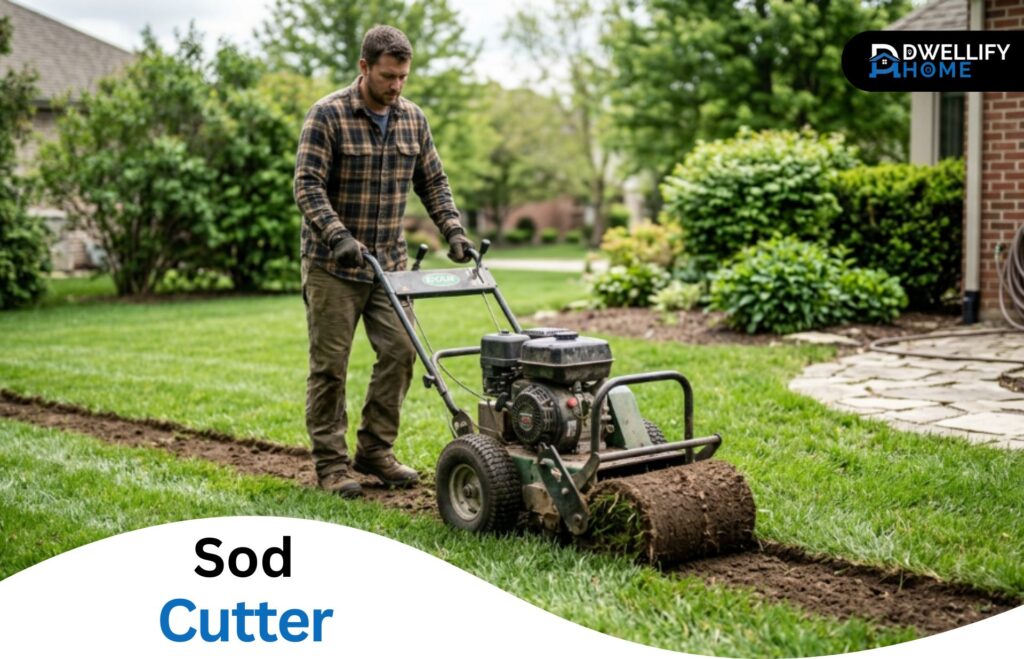
A sod cutter is a landscaping tool that slices horizontally beneath grass to lift it away in clean, uniform strips along with a thin layer of soil and roots. It’s commonly used by homeowners, landscapers, and contractors during lawn renovations, garden bed installations, and hardscape projects.
What sets it apart from other tools is the precision of the cut. A shovel tears. A tiller chops. A sod cutter glides under the turf at a controlled depth and removes everything cleanly, leaving the ground level and ready for whatever comes next.
Quick Comparison: Which Sod Cutter Type Fits Your Project?
| Type | Best For | Project Size | Typical Cost |
| Square-Edge Spade | Small patches, edging | Under 100 sq ft | $40–$80 to buy |
| Manual Kick-Plow | Gas-free, medium areas | Up to 1,000 sq ft | $25–$40/day rental |
| Motorized Walk-Behind | Most residential jobs | 1,000–10,000 sq ft | $90–$150/day rental |
| Tractor / Skid-Steer Attachment | Acreage and pro work | 10,000+ sq ft | Pro / commercial use |
Key Benefits of Using a Sod Cutter
- Removes turf in clean, uniform strips without tearing the soil
- Cuts hours of manual labor down to a fraction of the time
- Preserves healthy sod for transplanting elsewhere in the yard
- Leaves a level base ready for new sod, garden beds, or pavers
- Causes minimal disruption to the topsoil structure underneath
How Does a Sod Cutter Work?
The Cutting Mechanism Explained
The heart of the machine is a flat, horizontal blade that sits just below ground level. On powered units, that blade oscillates rapidly — many models run around 1,200 strokes per minute — slicing the soil sideways while the wheels pull the machine forward. On manual versions, the blade is pushed forward by the operator’s body weight or a hard kick to the crossbar.
The result is the same regardless of type: a clean horizontal cut that severs grass roots from the soil below, allowing you to roll or lift the strip away in one piece.
Cutting Depth and Width: What They Actually Mean
Cutting depth is how far below the surface the blade travels, usually adjustable between 1 and 3 inches. Cutting width is how wide each strip will be — typically 12, 18, or 24 inches.
For most residential jobs, 1.5 to 2 inches deep works well. Go shallower and you’ll leave roots behind. Go deeper and the strips become heavy, awkward to roll, and you end up removing valuable topsoil you didn’t need to lose.
How a Sod Cutter Differs From a Tiller, Edger, or Shovel
A tiller chews the ground up and mixes everything together — grass, roots, and soil all become one churned mess. An edger creates clean lines along borders but doesn’t remove turf. A shovel works for tiny patches but turns into back-breaking work fast.
A sod cutter sits in a category of its own: it removes turf intact, keeps the soil structure beneath largely undisturbed, and gives you usable sod strips you can transplant elsewhere if you want.
The Main Types of Sod Cutters
Square-Edge (Manual Spade) Sod Cutter
This is essentially a sharpened, flat-bladed spade with a foot pad. You push it down vertically, then angle it under the grass to slice the roots. It’s the cheapest option and works for small areas — think the patch around a mailbox or a strip beside a driveway. Beyond 100 square feet, it becomes more punishment than progress.
Manual Kick-Plow Sod Cutter
A kick-plow has two long handles, a crossbar at knee height, a roller, and a flat horizontal blade. You kick the crossbar with your boot, the blade advances forward and slices the sod, and you keep going row by row. It’s gas-free and quiet, but expect sore quads and a slow pace. Useful for areas up to roughly 1,000 square feet when you don’t want to deal with engines.
Motorized Walk-Behind Sod Cutter (Gear Drive vs. Hydrostatic)
This is the workhorse most homeowners and landscapers actually use. The engine drives both the wheels and the blade, so you steer rather than push. Gear-drive models are simpler and cheaper to rent — fine for straight runs on flat ground. Hydrostatic-drive models give you smoother speed control and easier transitions between forward and reverse, which matters on tight corners, curved beds, or uneven terrain.
If you’re cutting more than 1,500 square feet or working around obstacles, the hydrostatic version is worth the extra rental fee.
Tractor-Mounted Sod Cutter and Skid-Steer Attachments
For acreage-scale projects, sod cutter attachments mount onto a tractor’s three-point hitch or onto a skid steer’s quick-attach plate. They cut wider strips, handle harder ground, and use the host machine’s hydraulics for power. These aren’t really homeowner tools — they’re for landscaping crews, sod farms, and property managers handling large jobs.
When You Actually Need a Sod Cutter
Lawn Renovation and Replacing Old Turf
If your lawn is mostly weeds, dead patches, or the wrong grass species for your climate, starting over often beats endless reseeding. A sod cutter strips the failing turf cleanly so you can re-grade, amend the soil, and lay fresh sod or seed without fighting old growth coming back through.
Creating New Garden Beds and Flower Borders
Carving a new bed out of an existing lawn is one of the most satisfying uses of a sod cutter. Mark the shape, run the cutter along the perimeter and through the middle, lift the strips, and you’ve got a clean, level bed ready for soil amendments and planting.
Installing Walkways, Patios, and Hardscapes
Pavers, flagstone, and concrete pads need a flat, root-free base. Tearing out grass with shovels leaves an uneven surface that throws off the leveling work later. A sod cutter gives you a uniform starting point that saves hours of grading down the line.
Laying Sprinkler and Irrigation Lines
Running irrigation through an existing lawn used to mean trenching ugly scars across the yard. A sod cutter lets you lift narrow strips along the pipe path, dig your trench, lay the lines, then drop the same sod strips back into place. Done right, the lawn looks untouched within a couple of weeks.
Transplanting Healthy Sod to Other Areas
Healthy grass on one side of the yard can fix bare spots on the other. A sod cutter set to about 2 to 2.5 inches gives you strips with enough soil and root mass to survive the move, as long as you replant within a day.
Key Features to Look at Before Choosing a Sod Cutter
Cutting Width and Blade Size
Wider blades (18 to 24 inches) cover ground faster but are harder to maneuver in tight spots. A 12-inch blade is slower across a big lawn but handles curved beds and narrow side yards much better.
Adjustable Cutting Depth
Any sod cutter worth using has an adjustable depth control. A fixed-depth machine is a red flag — soil conditions vary across a single yard, and you’ll need to fine-tune as you go.
Drive System and Engine Power
Front-wheel drive with knobby treads handles thick sod and damp soil far better than smooth wheels. Hydrostatic drives give finer speed control, while gear drives are mechanically simpler. Engine sizes between 5.5 and 6.5 horsepower handle most residential work without bogging down.
Vibration Control and Ergonomics
Older sod cutters shake hard enough to numb your hands within an hour. Newer models include vibration-dampened handles, and the difference is significant on a long project. If you’re renting and have the choice, pick the unit with isolated handles.
Weight, Maneuverability, and Build Quality
A heavy machine cuts better in hard or dry soil because the weight helps the blade bite in. But heavier units are also harder to load into a truck and trickier to turn at row ends. Look for cast-iron blade housings and a solid frame — flexing chassis are a recipe for inconsistent cuts.
Renting vs. Buying a Sod Cutter
When Renting Makes More Sense
For one-time projects or work you’ll only do every few years, renting wins on every count. A daily rental usually costs less than $150, and you get a serviced machine without having to store, maintain, or transport it long-term.
When Buying Is Worth the Investment
Buying makes sense if you’re a landscape contractor, manage multiple properties, or run a sod-laying business. The math typically works after roughly 30 to 40 days of cumulative use across the machine’s lifespan.
Where to Find Rentals
Major chains like Home Depot and Lowe’s stock walk-behind sod cutters at most of their tool rental counters. Independent rental yards (United Rentals, Sunbelt Rentals, and local equipment shops) often have a wider selection, including hydrostatic-drive models and larger commercial units. Reserve ahead during spring and fall — they go quickly during peak landscaping season.
Typical Rental and Purchase Costs to Expect
Daily rentals for motorized units generally range from $90 to $150, with weekly rates offering meaningful discounts. Manual kick-plow cutters rent for around $25 to $40 a day. Buying outright runs from $40 to $80 for a square-edge spade, around $350 for a manual kick-plow, and several thousand dollars for commercial-grade walk-behind units.
How to Use a Sod Cutter the Right Way
Preparing the Lawn Before You Start
Call 811 at least two to three business days before you cut — they’ll mark buried utility lines for free, and hitting one is a disaster you don’t want. Mow the grass short, remove rocks and debris, water the lawn lightly the day before so the soil is moist but not soggy, and mark your cutting area with chalk spray or marking paint.
Setting the Correct Cutting Depth
Start at 1.5 inches for basic removal. Bump it to 2 to 2.5 inches if you’re transplanting the sod and need more soil and root mass. Cut a short test strip first — if roots are tearing rather than slicing, you’re too shallow. If the strip is too heavy to roll comfortably, you’re too deep.
Operating a Motorized Sod Cutter Step by Step
Position the machine at the edge of your marked area with the blade raised. Start the engine following the manufacturer’s choke and ignition sequence and let it idle for thirty to sixty seconds. Lower the blade onto the turf, engage the wheel drive, and walk steadily forward in a straight line. Keep a consistent pace — rushing creates uneven cuts, dragging wastes fuel and time. At the end of each row, raise the blade, turn around, and overlap your next pass by 2 to 3 inches so you don’t leave thin strips of grass between rows.
Operating a Manual or Square-Edge Sod Cutter
For a square-edge spade, push the blade straight down 1.5 to 3 inches deep around the perimeter, then angle it to about 45 degrees and push horizontally to slice under the grass. For a kick-plow, position it at the edge, kick the crossbar firmly with your boot, and continue the rhythm down the row. Both methods are physically demanding — take breaks every 15 to 20 minutes.
Working on Slopes and Uneven Ground
Always cut downhill, not across the slope or uphill. Wear boots with strong tread. Drop your blade depth slightly on slopes — the machine pitches forward as you descend, and a deeper setting can dig in too aggressively. On anything steeper than about 15 to 20 degrees, hire a pro. Sod cutters can flip on steep ground, and the injury risk isn’t worth it.
Common Mistakes to Avoid While Using a Sod Cutter
The most common mistakes I see on real jobs:
- Cutting when the soil is bone-dry — the blade skips, the wheels spin, and the cut quality falls apart.
- Cutting in mud — the strips fall apart, the wheels skid, and you’ll spend more time cleaning the machine than using it.
- Setting the depth too aggressive on the first pass — start shallow and adjust.
- Skipping row overlap and ending up with thin grass ribbons between strips.
- Forgetting to mark sprinkler heads and irrigation lines, then shearing one off mid-cut.
- Working alone on a large project — having a second person hauling strips while you cut roughly doubles your speed.
Safety Tips Every User Should Follow
Wear safety glasses, sturdy work boots (steel-toed if you have them), heavy gloves, and ear protection on motorized units. Keep children, pets, and bystanders at least 30 feet away while the engine runs. Never adjust the blade with the engine running. On hard or rocky ground, slow down — hitting a buried rock at full pace can damage the blade and jolt the handles hard enough to injure your wrists.
What to Do With the Sod After You Cut It
Transplanting It to Bare or Damaged Spots
Healthy sod can be moved to fill in thin or worn areas of the yard. Lay it grass-side up on prepared soil, water deeply, and keep it moist for the first two weeks while the roots reattach.
Composting It or Using It to Fill Low Areas
If the grass is full of weeds or you don’t need it, stack the strips grass-side down in a corner of the yard. Within a few months, you’ll have rich topsoil. Strips also work well for filling shallow low spots — drop them in upside down, cover with a thin layer of soil, and reseed.
How Long Freshly Cut Sod Stays Usable
Cut sod starts degrading within 24 to 48 hours, faster in warm weather. Keep it shaded, mist it lightly if you can’t replant the same day, and never let it sit stacked for more than two days — once it heats up internally, it’s done.
Sod Cutter vs. Other Lawn Removal Methods
Sod Cutter vs. Rototiller
A tiller mixes grass, roots, and soil together — useful if you’re amending the ground for a vegetable garden, but terrible if you want a clean surface. Roots and seeds left in the mix sprout back, and you’ll fight them for a year. A sod cutter removes the problem entirely.
Sod Cutter vs. Manual Digging or Shovel
Shovels work for areas under 50 square feet. Beyond that, the time and physical cost climb fast. A motorized sod cutter clears a thousand square feet in an hour or two — the same area takes a full day with a shovel and leaves you wrecked.
Sod Cutter vs. Smothering or Chemical Removal
Smothering with cardboard and mulch takes 2 to 3 months to kill grass. Chemical removal with herbicide takes 2 to 4 weeks and leaves residue. Both are cheaper but slow, and neither works if you need the area ready next weekend. A sod cutter is the only same-day option.
When to Skip the Sod Cutter and Hire a Professional
Hire a pro when the project exceeds 5,000 square feet, when slopes are steep, when buried utilities run shallow and complicate the work, or when you simply don’t have the time to do it right. Professional sod removal generally costs $0.50 to $2.00 per square foot including disposal, and once you factor in your rental fees, fuel, hauling, and a weekend of labor, hiring out often costs less than it looks on paper.
Frequently Asked Questions
How deep does a sod cutter cut?
Most sod cutters adjust between 1 and 3 inches deep, with some commercial models reaching 4 inches. For typical residential work, 1.5 to 2 inches handles grass and root removal cleanly. Use 2 to 2.5 inches when transplanting sod, since the extra soil helps the roots survive relocation.
Can you use a sod cutter on wet ground?
Lightly moist soil is ideal, but soaked or muddy ground causes the wheels to skid, the strips to fall apart, and the blade to clog. Wait at least 24 hours after heavy rain. Slightly damp soil cuts cleanest — push a screwdriver into the ground, and if it slides in with light pressure, conditions are right.
Is there a small sod cutter for narrow or tight spaces?
Yes. The Maxim Sod Kicker and similar 12-inch manual kickers handle narrow side yards, beds along fences, and curved borders where larger walk-behind units can’t fit. Square-edge spades work for spots even tighter than that.
What is a sod cutter attachment, and which machines support it?
A sod cutter attachment is a blade-and-frame unit that mounts to a host machine — typically a skid steer, compact tractor’s three-point hitch, or a stand-on landscape vehicle. It uses the host machine’s drive and hydraulics, letting professionals cut wider, deeper, and faster than a walk-behind unit.
Does Lowe’s offer sod cutter rentals like Home Depot?
Lowe’s tool rental is available at many but not all locations, and sod cutter availability varies by store. Home Depot’s rental network is more consistent for sod cutters, particularly the CLASSEN SC-18HD model. Call ahead to confirm availability at either retailer before driving out.
Where can I watch a sod cutter video before renting one?
Most rental retailers post operating walkthroughs on their YouTube channels, and manufacturers like Bobcat, Billy Goat, and Classen publish detailed how-to videos for their specific models. Watching the exact model you’ve reserved is more useful than generic tutorials.
Can a sod cutter cut through tree roots or thick weeds?
A sod cutter handles surface roots and thick weed mats but isn’t built for tree roots thicker than about a half-inch. Hitting a substantial root can damage the blade or kick the handles hard. For root-heavy areas, dig those sections by hand first, then run the cutter through what’s left.
Conclusion
A sod cutter is one of those tools that looks intimidating until you’ve used one, then quickly becomes the obvious choice anytime turf needs to come up. Whether you’re prepping for new sod, carving out a garden bed, or laying a paver path, knowing what type of sod cutter fits your project — and how to run it well — saves time, saves your back, and gives you a finish you can build on. Match the machine to the job, prep the ground properly, and the work goes faster than you’d expect.
Disclaimer
The information in this article is provided for general informational purposes only. Individual results, project conditions, and product availability may vary based on your specific situation, location, and equipment. Always follow the manufacturer’s instructions and local guidelines before operating any landscaping equipment.