A good espalier trellis does more than hold branches against a wall. It creates the framework that guides a tree into a controlled shape for years to come.
That is why the support should be planned before wires are installed or branches are tied. The plant, available space, training form, wall or garden boundary, and future maintenance all affect the final setup.
This guide explains how to choose and build an espalier trellis that suits your garden, from selecting the support style to tensioning wires and training the first young shoots.
Short Definition
An espalier trellis is a wire, cable, or frame support used to train trees and woody plants into flat, planned forms, helping gardeners manage space, shape growth, and support long-term branch training.
Mission Statement
DwellifyHome helps homeowners, renters, and home lovers make practical, stylish, comfortable, and informed decisions for better living spaces.
SERP Enhancement Elements
| Espalier Trellis Type | Best For | Main Consideration |
| Wall-mounted | Narrow yards, garden walls, compact spaces | Secure attachment and working clearance |
| Freestanding | Open gardens, boundaries, living fences | Stable posts and controlled wire tension |
| DIY setup | Custom sizes and training forms | Careful measuring and hardware selection |
| Trellis kit | Simpler material planning | Check size and layout against the plant |
What Is an Espalier Trellis, and What Does It Do?
An espalier trellis is a support structure used to train a tree or woody plant in a flat, planned pattern. Posts, wires, cables, or wall-mounted supports provide fixed training lines while branches are pruned and tied into shape.
The important distinction is simple: espalier is the plant-training method. The trellis is the support system.
The Purpose of Espalier
Espalier allows a tree to grow across a limited plane instead of spreading naturally in every direction.
Gardeners often use the technique to:
- Grow fruit trees in narrow spaces
- Create an organized feature along a wall
- Form a living garden screen
- Use a sunny boundary more efficiently
- Keep branches accessible for pruning and training
- Create decorative horizontal, fan, or woven patterns
The trade-off is maintenance. An espaliered plant needs regular observation, pruning, and tying to keep its intended form.
Espalier vs. a Regular Trellis
A standard garden trellis often supports climbing plants that attach, twine, or spread across the structure.
Espalier is more deliberate. Individual branches are selected and guided along predetermined lines. The gardener controls the plant’s framework through pruning and branch training.
For that reason, an espalier support should be planned around the final pattern rather than treated as a general climbing frame.
Choose Between a Wall-Mounted and Freestanding Espalier Trellis
The first major decision is where the support will stand.
A narrow sunny wall beside a home requires a different solution from an open vegetable garden or property boundary. Both wall-mounted and freestanding systems can work well, but their structural needs are different.
| Trellis Type | Works Well For | Main Consideration |
| Wall-mounted | Narrow yards, garden walls, compact spaces | Secure attachment and wall clearance |
| Freestanding | Open gardens, boundaries, living fences | Stable posts and resistance to wire tension |
Wall-Mounted Espalier Trellises
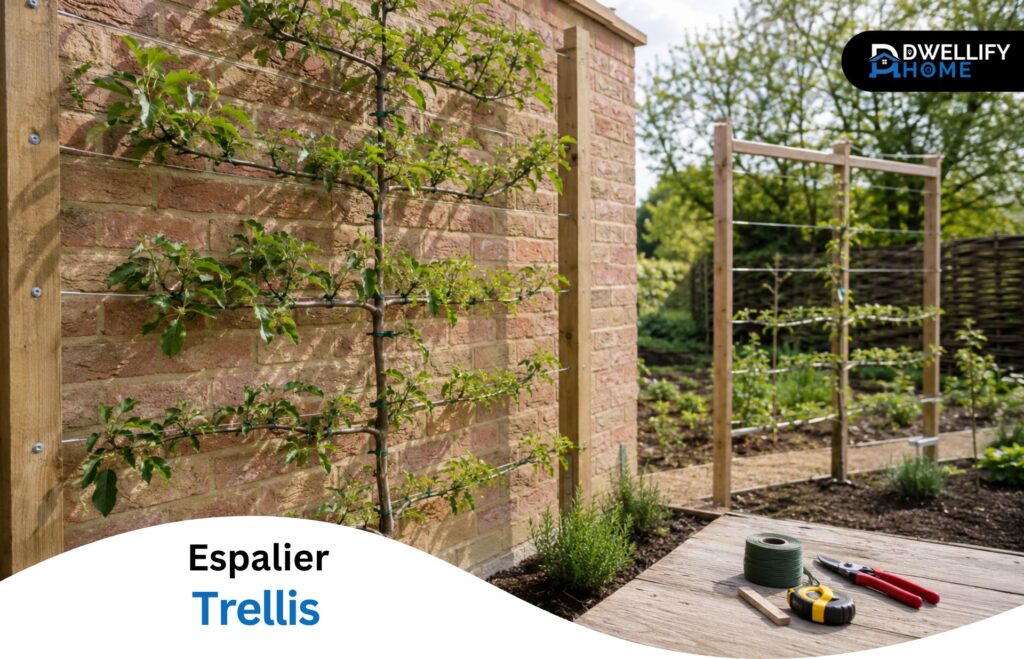
A wall-mounted espalier trellis uses anchors and spacers to support horizontal wires or cable in front of a wall.
This setup saves ground space and can create a clean architectural look. It is often practical for apple or pear trees planted along a suitable sunny wall.
Don’t attach wires directly against the wall without considering clearance. You need enough working space to tie shoots, prune branches, inspect the plant, and allow air movement around the framework.
The attachment method must also suit the wall material. Brick, masonry, siding, and other exterior surfaces do not all accept the same fasteners.
Where wall construction, hidden utilities, or attachment points are uncertain, get appropriate professional advice before drilling.
Freestanding Espalier Frames and Fences
A freestanding espalier frame normally uses posts with horizontal support wires running between them.
It works well along garden boundaries or anywhere a suitable wall is unavailable. Several trees may also be trained in a row to form an espalier fence or living screen.
The end supports matter more than beginners often expect. Tensioned wires pull against the posts, and the growing plants add changing weight and wind exposure over time.
An attractive existing fence is not automatically a strong espalier frame. Check its stability before attaching tensioned support wires.
Plan the Trellis Around Your Plant and Espalier Form
One of the easiest mistakes is buying an espalier trellis kit or installing several wires before deciding what will grow on them.
Reverse that process.
Choose the plant and the intended training form first. Then design the support.
Which Plants Work Well for Espalier?
Apple and pear trees are closely associated with espalier because their branches can be trained into organized frameworks when suitable plants and pruning methods are used.
Other fruit trees and ornamental woody plants may be trained in flat forms, but the best pattern and pruning approach depend on the plant’s natural growth and flowering or fruiting habits.
For fruit trees, cultivar and rootstock selection can affect mature size and manageability. Before buying a tree, check reputable nursery or extension guidance for the specific variety you plan to train.
A young plant with flexible shoots is generally easier to shape than an established tree with thick, rigid branches.
Understanding Tiers, Cordon, Fan, and Belgian Fence Forms
The chosen espalier style determines the trellis layout.
A tiered espalier usually has horizontal arms trained from a central leader. A three-tier espalier has three main horizontal branch levels.
A horizontal cordon follows controlled lateral lines, while fan training allows branches to spread outward at angles.
A Belgian fence uses multiple plants trained into crossing diagonal lines to create a woven effect.
These forms should not share one universal wire plan. A three-tier horizontal tree needs a different support arrangement from a fan-trained plant.
How to Choose the Right Espalier Trellis for Your Garden
The right support is the one that fits the plant, site, and long-term training plan.
Before choosing materials, look at the garden as a working space rather than focusing only on appearance.
Match the Support to Your Space and Site
Check:
- Available height and width
- Mature dimensions of the chosen plant
- Sun exposure
- Wall or fence condition
- Space for pruning and tying
- Soil and planting position
- Wind exposure
- Access for future maintenance
Imagine the tree after its horizontal arms have extended, not just as the small plant you are bringing home.
A trellis built to fit a young tree may quickly feel cramped when branches reach the ends of short wires.
DIY Trellis, Espalier Kit, or Custom Frame?
A DIY espalier trellis gives you control over width, height, wire levels, and materials. It is useful when working around an unusual wall or planning a specific espalier pattern.
The disadvantage is that you must choose compatible posts, anchors, wire, and tensioning hardware yourself.
An espalier trellis kit may simplify material selection. Check the dimensions and intended setup carefully, because a preplanned system may not match every tree or garden location.
A custom frame makes sense where the garden design or support conditions require a more tailored solution.
There isn’t one universally best option. Choose based on fit, support strength, adjustability, and how comfortable you are with installation.
Materials and Hardware You Need for a Strong Espalier Trellis
An espalier support system is usually simple, but each component has a specific job.
Common materials may include:
- Support posts or wall anchors
- Galvanized wire or suitable cable
- Turnbuckles or other wire tensioners
- Eye fittings or attachment hardware
- Wall spacers for wall-mounted systems
- Soft plant ties
- Basic measuring and leveling tools
Choosing Posts, Wire, and Cable
Freestanding frames rely on posts to resist the pull created by the support wires. End posts deserve particular attention because they carry tension from the full wire run.
For the training lines, gardeners commonly use durable wire or cable suitable for outdoor exposure.
Galvanized wire is a practical option in many garden setups. Stainless steel cable can give a cleaner appearance in some designs.
The visual difference is only part of the decision. The support should also work with your fittings and allow controlled tension adjustment.
Anchors, Tensioners, Spacers, and Plant Ties
Anchors connect the support system to a wall or structural point. Choose hardware that is appropriate for the actual mounting surface rather than relying on a universal recommendation.
Tensioners allow support wires to be tightened and adjusted. The goal is a firm, stable training line, not extreme tension.
Wall spacers hold the wires away from the surface and create room for plant growth and maintenance.
Soft plant ties connect young shoots to the support. They should hold branches without cutting into the bark.
Espalier Trellis Spacing and Support Layout
There is no single wire-spacing measurement that suits every espalier.
Wire tiers should match the intended training form, plant development, available height, and pruning plan.
How Far Apart Should Espalier Wires Be?
Espalier wires are commonly arranged in horizontal levels, but the distance between them should follow the form you are creating.
Start by mapping the desired branch tiers on paper. Consider where the central leader will grow and where lateral branches need to be selected.
Check guidance for your chosen plant and training system before fixing permanent wire positions.
This is more reliable than copying a generic espalier trellis plan that may have been designed for a different tree or form.
How Far Should the Trellis Sit From a Wall?
A wall-mounted trellis should leave useful clearance between the plant framework and the wall.
The space needs to accommodate shoots, branch ties, pruning access, and inspection. It can also help avoid pressing the entire framework tightly against the wall surface.
The appropriate clearance depends on the wall system and trellis hardware. Follow the requirements of suitable mounting components and consider how you will reach behind the trained branches later.
How to Build an Espalier Trellis Step by Step
The basic construction process is straightforward once the plant and training pattern have been chosen.
Step 1: Measure and Mark the Trellis Layout
Measure the full area available for the mature framework.
Mark:
- The center position of the plant
- Overall trellis width
- Planned support levels
- Post or anchor locations
- Necessary wall clearance
Use a level or reliable layout method to keep horizontal support lines aligned.
Step back and look at the markings before installing hardware. A misplaced tier is easier to correct on a plan than after anchors are installed.
Step 2: Install Posts or Wall Anchors
For a freestanding espalier frame, install support posts suitable for the planned structure and local site conditions.
The posts need to remain stable as wires are tensioned and the plants mature.
For a wall-mounted system, use attachment hardware suitable for the actual wall construction.
Don’t guess when drilling into an exterior surface you don’t understand. Improper attachment can damage finishes or create an unreliable support.
Step 3: Add and Tension the Support Wires
Run the support wires through or between the appropriate fittings.
Use tensioning hardware where required to create straight, stable training lines.
Tighten the system gradually. Excessive tension does not automatically create a stronger trellis and can place unnecessary force on posts or attachment points.
Check the full frame as you adjust each wire.
Step 4: Check Spacing, Stability, and Plant Clearance
Before planting or tying branches, inspect the completed support.
Ask:
- Are the wires positioned for the intended espalier form?
- Are posts or anchors stable?
- Is there enough room to work around the plant?
- Can ties be adjusted later?
- Does the support fit the plant’s future width?
Fix layout problems now. They become harder to manage once branches have been trained into place.
Planting and Training a Tree on the Trellis
The support system creates the framework, but pruning and training create the espalier.
Position the Tree to Match the Trellis
Place the tree so the central growth aligns with the planned framework.
Follow appropriate planting guidance for the specific tree, paying attention to planting depth and the position of the graft union where applicable.
The trellis should support the training process. It shouldn’t force the entire tree into an awkward planting position.
Train Young Branches Without Damaging Them
Select suitable young shoots as they develop and guide them toward the intended support lines.
Flexible shoots are easier to position gradually than older, rigid branches. Avoid forcing a branch sharply into place simply because it doesn’t line up with a wire.
Use soft ties and leave room for growth.
Check each tie regularly. A harmless-looking loop can become restrictive as the branch diameter increases.
Common Espalier Trellis Mistakes That Cause Problems Later
Most trellis problems begin during planning rather than construction.
Building the Support Too Lightly
Thin posts, unstable fences, weak anchors, or poorly supported end points may look fine while the plant is small.
The support conditions change as branches grow and, with fruiting plants, as seasonal loads change.
Build for the intended mature framework rather than the first year of growth.
Forgetting About Airflow, Growth, and Future Fruit Load
Placing the framework too close to a wall can make tying and pruning awkward.
Poorly planned trellis width can also leave horizontal branches with nowhere to extend.
Think about working access, branch expansion, and the changing plant structure before finalizing the frame.
Treating Espalier as a One-Time Project
Installing wires is only the beginning.
Branch selection, pruning, tying, tension checks, and small adjustments continue as the plant develops.
Espalier works best when the gardener responds to new growth regularly instead of trying to correct an overgrown framework all at once.
How to Maintain the Trellis as the Espalier Matures
The plant and the support should be inspected together.
A healthy-looking tree can still have a tie beginning to constrict a branch or a support wire gradually losing tension.
Check Ties, Wires, and Anchors Regularly
During routine garden inspections, look for:
- Tight branch ties
- Loose or damaged wires
- Changing wire tension
- Movement in support posts
- Loose wall fittings
- Branches rubbing against hardware
- Corrosion or wear on exposed components
Adjust problems while they are small.
Never allow the trellis hardware to disappear behind dense growth for years without inspection.
Expect the Espalier Framework to Develop Over Several Years
A mature-looking espalier isn’t created in one growing season.
The framework develops as suitable shoots are selected, guided, pruned, and allowed to form the intended structure.
Trying to rush the shape by bending older branches aggressively can damage the plant.
A slower, planned approach normally gives you more control over branch position and long-term maintenance.
Frequently Asked Questions About Espalier Trellises
What is the best support for espalier trees?
The best support is a stable wire or cable framework planned around the tree’s mature size and chosen training form. Wall-mounted wires work well in tight spaces, while strong freestanding posts and wires suit open gardens. The support should allow adjustable tension, secure branch ties, and ongoing access for pruning.
What is the purpose of espalier?
Espalier trains a tree or woody plant to grow in a controlled, mostly flat pattern. It can make productive use of narrow garden spaces, create decorative forms, and keep branches organized for regular pruning and training. The technique requires ongoing maintenance to preserve the planned framework.
What is a 3-tier espalier?
A three-tier espalier has three main levels of trained branches, commonly extending horizontally from a central leader. Each tier forms part of the plant’s organized framework. The supporting wires should be planned around the intended branch levels and the growth characteristics of the specific tree.
What is the difference between espalier and pollarding?
Espalier trains selected branches into a planned flat pattern using pruning and support. Pollarding is a pruning method in which upper branches are repeatedly cut back to encourage a controlled head of new growth. They use different pruning goals and produce very different plant forms.
Can you attach an espalier trellis to a fence?
You can use a suitable fence as part of an espalier support only when the structure is stable enough for the planned setup. Tensioned wires can place force on fence posts and panels. Inspect the fence carefully and avoid assuming a decorative or aging fence can serve as a structural support.
What type of wire should you use for an espalier trellis?
Durable outdoor wire or cable that works with the chosen anchors and tensioning hardware is generally suitable. Galvanized wire and stainless steel cable are common options. Select the full support system as a group so the wire, fittings, and tensioners are compatible.
How long does it take to train an espalier?
Espalier training usually develops over multiple growing seasons because the framework depends on new branch growth, pruning, and gradual positioning. The exact timeline varies with the plant, growing conditions, and chosen form. Regular small adjustments are more practical than trying to create the final shape immediately.
Can espalier trees grow in containers?
Some suitable trees can be trained as espaliers in containers, but container size, rootstock, water needs, stability, and long-term root space require careful planning. The support must also be secure. Check plant-specific guidance before choosing a container-grown espalier system.
Build the Support for the Garden You Have
The best espalier trellis begins with the garden, plant, and training form you actually plan to use.
Choose the tree first, decide how you want to train it, and then build the wire layout around that framework. Give the support enough strength and working room for future growth, but don’t forget the small details: adjustable tension, soft ties, pruning access, and regular inspection.
A well-planned support won’t train the tree for you. It will make years of careful training much easier to manage.
Disclaimer
DwellifyHome content is for general informational purposes only. Homes, needs, preferences, budgets, and situations vary. Seek qualified professional advice for safety, installation, repair, legal, structural, electrical, plumbing, HVAC, or major property decisions when appropriate.