Every summer the same scene plays out at my market stand. Someone picks up a Reed, turns it over a couple of times, and asks why this big green softball costs more than the familiar Hass sitting right next to it. It’s a fair question, and the answer is worth more than a quick “it’s just bigger.”
A reed avocado is a large, round, summer-ripening variety with thick green skin that stays green even when it’s fully ripe. The flesh is dense, creamy, and mildly nutty, and a single fruit often weighs close to a pound. Growers prize it for filling the late-summer stretch when most other avocados have thinned out.
Below I’ll walk through how to spot one, what it tastes like, when it shows up, how it stacks up against Hass, and the part most people get wrong — knowing when it’s actually ready to eat.
Snippet-Ready Definition
A reed avocado is a large, round, summer-ripening variety with thick green skin that stays green when ripe. Its rich, creamy, nutty flesh suits guacamole and fresh eating, and it fills the late-summer gap when Hass is scarce.
Our Mission:
Dwellify Home helps homeowners, renters, and food lovers make confident, practical choices for their kitchens, gardens, and everyday lives — from knowing which avocado to pick at the market to growing one in the backyard.
Ways to use a reed avocado:
- Eaten fresh from the skin with salt and lemon — the firm shell works as a natural bowl
- Guacamole, where one large fruit makes a generous batch
- Cubed in salads, grain bowls, and poke bowls, since the flesh holds its shape
- Mashed on toast or in sandwiches
- Blended into smoothies or spooned over grilled fish and chicken
What Is a Reed Avocado?
A reed avocado is a Guatemalan-type avocado (Persea americana) grown as its own named variety, not a mutation or offshoot of Hass. It’s one of the largest avocados you’ll find at market — round, heavy, and green-skinned — and it ripens through summer, which alone sets it apart from the Hass-heavy rest of the year.
It first turned up as a chance seedling in Carlsbad, California, back in the late 1940s (more on that story later). What matters at the counter is that Reed is consistent: the fruit runs large and round year after year, the flesh is reliably smooth, and you’re not guessing about quality the way you sometimes do with lesser-known fruit.
What Does a Reed Avocado Look Like?
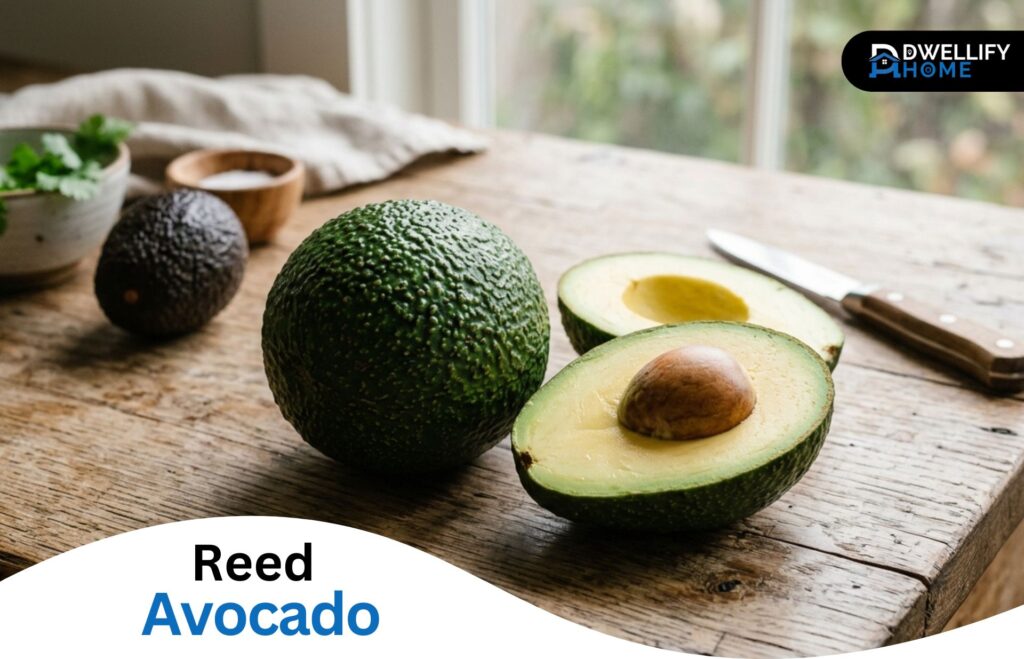
Picture a softball or a small grapefruit. A reed avocado is round to slightly oval, with thick, leathery, lightly pebbled forest-green skin and pale golden-yellow flesh inside. Most weigh between 8 ounces and a pound, though a well-grown one can push past a pound and a half. The seed is medium to large but sits in plenty of flesh.
The detail that trips people up is the skin color. It stays green when ripe — it does not darken the way Hass does. The skin also feels firm and shell-like in the hand, almost armored (a few growers argue it’s actually thinner than it looks, but you’d never guess that holding one). That sturdy skin is exactly why a Reed survives a market table all day without bruising.
What Does a Reed Avocado Taste Like?
Rich, buttery, and smooth, with a gentle nutty note and a dense texture that holds together well. The reed avocado has a high oil content, which gives the flesh a luxurious, almost whipped quality once it’s perfectly ripe, and many people find it slightly sweeter and cleaner-tasting than Hass.
Plenty of longtime growers will tell you it’s their favorite-eating avocado of all, and I won’t argue — but taste is personal, so treat that as a strong recommendation rather than gospel. What I can say flatly is that a ripe Reed rarely disappoints. The flavor is mellow rather than grassy, which makes it an easy sell even to people who think they don’t love avocado.
When Are Reed Avocados in Season?
Reed avocados are a summer fruit. In California they generally run from around June through October, with the best eating usually landing between July and September. Florida-grown Reeds flip the calendar and tend to show up in winter, roughly December through March, but the California summer crop is the one most shoppers encounter.
That timing is the whole point. Reed comes into its own as the peak California Hass season winds down, so it fills the warm-weather gap when good avocados are otherwise harder to find. Exact weeks shift year to year with the weather, so think of it as a window, not a fixed date.
Reed Avocado vs. Hass: What’s the Difference?
The short version: a reed avocado is bigger, rounder, and stays green when ripe, while Hass is smaller, pear-shaped, and turns nearly black. Reed is a summer fruit with a milder, buttery flavor; Hass carries the rest of the year with its classic nutty taste. Both are Type A flowering varieties. Here’s the side-by-side:
| Reed | Hass | |
| Skin when ripe | Stays green | Turns dark, nearly black |
| Shape | Round to slightly oval | Oval / pear-shaped |
| Typical weight | 8 oz – 1 lb (sometimes more) | 5–12 oz |
| Skin texture | Thick, leathery, lightly pebbled | Thinner, pebbled |
| Flavor | Mild, nutty, buttery | Rich, nutty, classic |
| California season | June–October | Roughly spring through fall |
| Ripeness cue | Gentle give only (no color change) | Darkens, plus slight give |
| Flower type | Type A | Type A |
One thing I’ve noticed over the years: a cut Reed seems to brown a little slower than Hass, which makes leftovers more forgiving. Treat that as a hands-on observation rather than a lab result, but it’s a nice bonus either way.
How to Tell When a Reed Avocado Is Ripe
Go by feel, not by color. A ripe reed avocado yields to gentle, even pressure in your palm — never a hard poke with one fingertip, which just bruises it. Because the skin stays green the whole time, color tells you nothing here, and that’s the single biggest mistake I see shoppers make with this variety.
A couple of reliable checks beyond the squeeze test:
- Pop the stem button. Flick off the little nub where the stem attached. If it comes away cleanly and the flesh underneath is green, it’s ready. If it won’t budge, give it more time.
- Mind the overripe trap. If you can already feel softness through that thick skin, it’s usually too far gone inside. A Reed often goes from firm to perfect overnight, so check it daily.
Once a Reed feels ripe, move it to the fridge if you’re not eating it right away. That slows things down and buys you a few extra days.
Where to Buy Reed Avocados and What They Cost
The easiest place to find reed avocados is a Southern California farmers’ market during summer and early fall — that’s the heart of the growing region, and you’ll often buy them straight from the people who grew them. Some Whole Foods and specialty grocers stock them seasonally, and a handful of California farms ship them direct to your door.
On price, expect to pay more than you would for a bag of Hass. A single large Reed commonly runs a few dollars, and direct-from-farm boxes tend to land somewhere around eight dollars a fruit once shipping is in the mix. Those numbers move with the season and the source, so treat them as a ballpark. You’re paying a small premium for size, scarcity, and a short season — not a markup for nothing.
How to Eat and Cook With Reed Avocados
Simple wins. The reed avocado is at its best halved, sprinkled with flaky salt and a squeeze of lemon, and eaten straight from the skin with a spoon — and because the skin is so sturdy, it doubles as a built-in bowl. The dense, firm-yet-creamy flesh also holds its shape when cubed, so it’s excellent in salads, grain bowls, and poke bowls where softer avocados fall apart.
For guacamole, one Reed goes a long way; half a fruit is often enough for a small batch. It mashes smooth for toast and sandwiches, blends into smoothies, and makes a clean topping for grilled fish or chicken. If you like making things ahead, the slightly slower browning I mentioned earlier works in your favor for next-day lunches.
Reed Avocado Nutrition and Calories
Honest answer first: there’s no official nutrition breakdown specific to the reed avocado, so the figures below are standard values for avocado in general. Per 100 grams, avocado runs about 160 calories, roughly 15 grams of fat (mostly the heart-healthy monounsaturated kind), around 9 grams of carbohydrate with close to 7 grams of fiber, about 2 grams of protein, and a solid dose of potassium (near 485 mg), plus vitamins B6, K, E, and folate.
Because a Reed is large, a whole one holds more flesh than a single Hass — very roughly 270 to 600 calories depending on its size. Take that as an estimate, not a measured number. The takeaway is straightforward: it’s a calorie-dense fruit built on good fats and fiber, satisfying in modest portions.
Growing a Reed Avocado Tree at Home
Yes, you can grow one, and the reed avocado tree is one of the friendlier choices for a backyard. It’s a Type A flowering variety but sets fruit reliably on its own, so you don’t strictly need a second tree — though some nurseries still recommend pairing it with a Type B for a heavier crop, and opinions genuinely differ on that point.
Reed suits USDA zones 9 through 11 and handles a brief dip to around 28–30°F, but not a hard freeze. The tree grows in a fairly upright, space-saving shape; kept pruned it stays around 15 feet, while left alone it can reach much taller. A grafted tree usually fruits within a few years, and Reed fruit can hang on the branch for over a year, holding well once mature. Many California growers plant Reed alongside a Hass and a Fuerte to keep fresh avocados coming nearly year-round.
The Story Behind the Reed Avocado
The variety traces back to James Reed, a grower in Carlsbad, California, who spotted a promising seedling on his property; the seed germinated around 1948, and the tree was patented in 1960 — one of the earlier patented avocado varieties. Its parentage is thought to be a seedling of the Nabal variety, though that’s an educated guess rather than settled fact.
Here’s the part most people never hear. Despite its eating quality, Reed never took over the market the way Hass did, and over the decades plenty of commercial growers grafted their Reed trees back over to Hass simply because Hass sold better and shipped year-round. That’s why a fruit this good still feels like a summer secret — it stayed a specialty crop rather than a supermarket staple.
Is the Reed Avocado Worth Trying?
For most people, yes. The reed avocado is a large, green-skinned summer variety with rich, buttery, nutty flesh that’s hard to fault — good eaten from the skin with salt and lemon, dependable in guacamole and grain bowls, and a welcome change of pace when you’ve had Hass on repeat all year. If you spot one at a summer market, pick it up, learn the feel of a ripe one, and enjoy it at its peak.
Reed Avocado FAQs
Do reed avocados turn black when ripe?
No. Reed avocados keep their green skin even when fully ripe, unlike Hass, which darkens to nearly black. Color is not a useful ripeness signal here. Judge a Reed by gentle pressure instead — when it yields softly and evenly to your palm, it’s ready to eat.
Are reed avocados bigger than Hass?
Yes, usually by a clear margin. A typical reed avocado weighs between 8 ounces and a pound, sometimes more, while a Hass usually falls between 5 and 12 ounces. Reeds are also rounder, closer to a softball, where Hass is smaller and pear-shaped. That extra size means more flesh per fruit.
When are reed avocados in season?
Reed avocados are a summer crop. In California they generally run from about June through October, peaking around July to September, which fills the gap as peak Hass season fades. Florida-grown Reeds appear in winter instead. Exact timing shifts year to year with the weather.
How do you know when a reed avocado is ripe?
Use feel, not color. A ripe Reed gives gently and evenly when you cradle it in your hand. The stem button should pop off cleanly to reveal green flesh. Since the skin stays green throughout, never judge by appearance, and check daily — a Reed can ripen fully overnight.
Where can I buy reed avocados?
Your best bet is a Southern California farmers’ market in summer or early fall, often straight from the grower. Some Whole Foods and specialty grocers carry them seasonally, and several California farms ship them direct. They’re far easier to find in California than elsewhere in the country.
Are reed avocados good for guacamole?
Very good. The reed avocado’s dense, creamy flesh mashes smooth and rich, and its large size means one fruit makes a generous batch — half is often enough for a small bowl. Its milder, buttery flavor makes an approachable guacamole, and the flesh’s slower browning helps leftovers hold up.
Do reed avocados turn black when ripe?
No. Reed avocados keep their green skin even when fully ripe, unlike Hass, which darkens to nearly black. Color won’t tell you anything here, so judge ripeness by gentle pressure instead — when the fruit yields softly and evenly to your palm, it’s ready to eat.
Are reed avocados bigger than Hass?
Yes, usually by a clear margin. A typical reed avocado weighs from 8 ounces to a pound, sometimes more, while a Hass runs 5 to 12 ounces. Reeds are also rounder, closer to a softball, where Hass is smaller and pear-shaped, so you get more flesh per fruit.
When are reed avocados in season?
Reed avocados are a summer crop. In California they generally run from about June through October, peaking around July to September, which fills the gap as peak Hass season fades. Florida-grown Reeds appear in winter instead. Exact timing shifts year to year with the weather.
How do you know when a reed avocado is ripe?
Use feel, not color. A ripe reed avocado gives gently and evenly when you cradle it in your hand, and the stem button pops off cleanly to show green flesh underneath. Since the skin stays green throughout, never judge by appearance — and check daily, as a Reed can ripen overnight.
Disclaimer: This article is for general informational purposes only. Growing conditions, seasonal availability, prices, and personal taste all vary, so your own experience with reed avocados may differ from what’s described here.