Nearly every apple tree you can buy is a grafted tree, even when the label doesn’t mention it. A grafted apple tree is two plants joined into one: a fruiting variety on top, called the scion, growing on a separate root system below, called the rootstock. That pairing is what lets a tree produce a known apple at a predictable size.
Once that single idea clicks, the confusing parts start to line up: rootstock codes, dwarf versus standard, those four-apples-on-one-tree offers. Here’s how grafted apple trees actually work, and how to choose one that fits your yard and your table.
Snippet-Ready Definition
A grafted apple tree joins a fruiting variety (the scion) to a separate root system (the rootstock). Growers use it because apple seeds don’t grow true to type, so grafting reliably reproduces a known apple at a controlled, predictable size.
Mission Statement
At Dwellify Home, we help homeowners and property enthusiasts make confident, practical decisions about their space, from choosing the right grafted apple tree to the everyday choices that make a house and garden work better. Our aim is clear, honest guidance you can actually act on.
What is a grafted apple tree, in plain terms?
A grafted apple tree is made by taking a cutting from the apple variety you want and joining it onto the roots of a different tree, so the two grow together as one. The top decides what fruit you get. The bottom decides how big the tree gets and how tough it is.
This isn’t a modern trick. People have grafted fruit trees for thousands of years, and it’s still the standard way every commercial apple is produced.
The two parts every grafted tree has: rootstock and scion
Think of a grafted tree as having two jobs split between two plants. The rootstock is the roots and the base of the trunk. It controls the tree’s eventual size, its anchorage, and much of its hardiness and disease tolerance.
The scion is everything above the graft, the variety you actually chose. It carries the fruit, the flavor, and the bloom time. When you buy a Honeycrisp on M.26, Honeycrisp is the scion and M.26 is the rootstock.
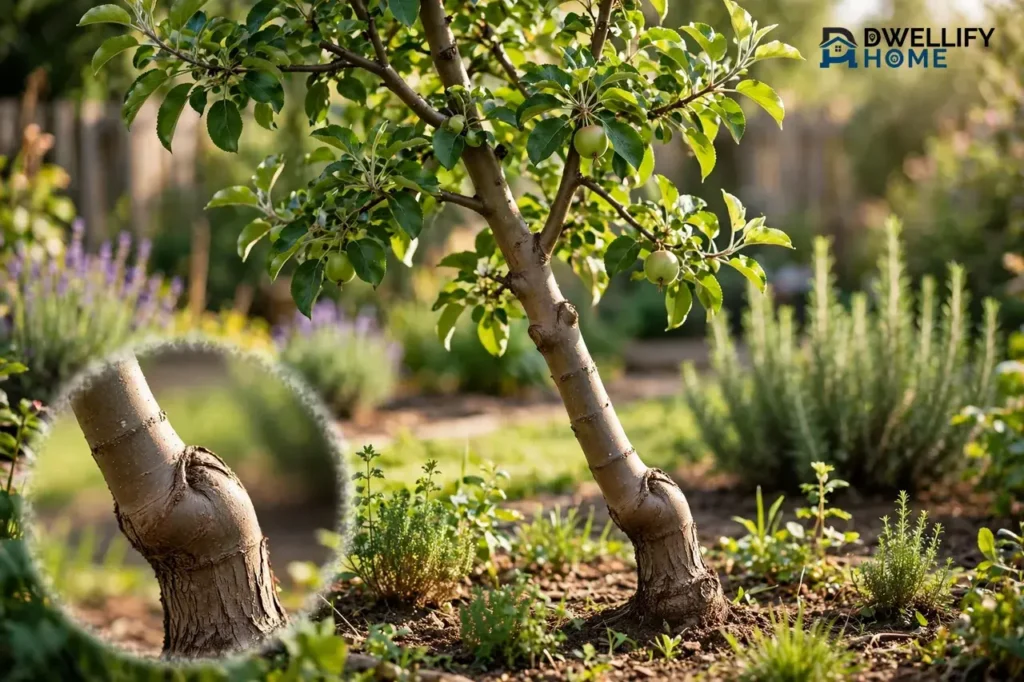
You can usually spot where the two meet. Look near the base of the trunk for a slight bend, a change in bark texture, or a small swelling a few inches above the soil. That mark is the graft union, and it matters later when you plant.
Why apple seeds don’t grow true to the parent fruit
Plant a seed from a Honeycrisp and you won’t get a Honeycrisp. Apples are heavily cross-pollinated and carry a wildly mixed set of genes, so each seed is a brand-new, unpredictable variety. Most seedling apples turn out small, sour, or simply unremarkable.
This is the whole reason grafting exists. Every famous apple, from Honeycrisp to Gala to the old heritage names, is one original tree that’s been copied by grafting ever since. Growing from seed is how you breed new varieties, not how you keep an old one.
How grafting works like a copy-paste for fruit varieties
Grafting is cloning. The scion is a living piece of the parent tree, so the fruit it bears is genetically identical to the apple you tasted and liked. Nothing about the rootstock changes the flavor of the fruit on top.
That’s why a grafted tree is dependable in a way a seedling never is. You’re not gambling on what shows up in five years. You already know.
Rootstock comparison
| Rootstock type | Mature height | Starts fruiting | Best for |
| Dwarf (M.9, Bud 9) | 6–10 ft | 2–3 years | Small yards, containers |
| Semi-dwarf (M.26, MM.106) | 12–18 ft | 3–4 years | Most home gardens |
| Standard (MM.111, Antonovka) | 20–30+ ft | 5–8 years | Large lots, long-lived trees |
Key benefits of a grafted apple tree
- True-to-type fruit: the tree produces the exact apple variety you chose, every season.
- Controlled size: the rootstock keeps the tree dwarf, semi-dwarf, or standard to fit your space.
- Tougher roots: grafting pairs a chosen variety with a hardy, disease-resistant root system.
- Faster harvests: fruit in roughly two to four years, instead of a decade from seed.
Why nearly every apple tree at the nursery is grafted
Grafting solves several problems at once, which is why growers rarely sell anything else. It locks in the exact variety, controls how large the tree grows, borrows toughness from a hardy root system, and gets you fruit years sooner than a seedling would.
Consistent, true-to-type fruit you can recognize
A grafted tree gives you the apple you signed up for, every season, with the same size, color, flavor, and ripening time. For anyone planning what to grow and when to pick, that predictability is the entire point.
Controlled mature size: dwarf, semi-dwarf, or standard
The rootstock sets the tree’s final height. The same Gala scion can become an eight-foot tree you pick from the ground or a thirty-foot tree you’ll need a ladder and a lot of patience for. That choice is yours, and it’s made through the rootstock.
Disease resistance and cold hardiness from the roots up
Many delicious apple varieties have weak or tender roots. Grafting lets a grower pair that tasty top with a root system bred to shrug off cold winters, wet ground, or soil diseases. The fruit stays the same; the foundation gets stronger.
Faster harvests: fruit in roughly 2 to 4 years
A seedling apple can take eight or ten years to fruit. A grafted tree on a size-controlling rootstock often bears in two to four years, sometimes in its first or second season on the most dwarfing roots. Smaller, grafted trees settle down to fruiting faster.
How grafting works (the concept, not the cuts)
You don’t need to graft your own trees to grow them well, but understanding how it’s done helps you judge a tree and care for it. At its core, grafting is about getting two living layers to touch and heal into one. It takes practice to do cleanly, and even skilled hands lose a few.
Cambium meets cambium: why contact is everything
Just under the bark of any branch is a thin green layer called the cambium. That layer is where growth happens. A graft only takes if the cambium of the scion lines up against the cambium of the rootstock, so the two can knit together and share sap.
Get that contact right and the union heals. Miss it and the scion dies, no matter how good the wood looked.
When grafting happens: dormant bench grafting vs. summer budding
Most variety grafting is done in late winter or early spring, while everything is dormant. Growers join a dormant scion to a rootstock indoors at a bench, which is why you’ll hear it called bench grafting.
The other common timing is summer, using a single bud instead of a whole cutting. That’s budding, and it’s done while the bark slips easily on actively growing wood.
The methods you’ll hear named: whip-and-tongue, bud, and top grafting
Whip-and-tongue is the classic bench graft, joining a pencil-thick scion and rootstock with matching diagonal cuts that lock together. Bud grafting joins just one bud to a growing rootstock. Top grafting, also called top-working, changes the variety on an established tree by grafting onto its existing branches.
You’ll see these names on care guides and nursery notes. Knowing the difference is mostly about understanding what someone did to make the tree in front of you.
How long a graft union takes to fuse
A graft that takes will callus over and push new growth within its first season. The connection keeps strengthening over the next couple of years as the wood thickens and the join fills in. A well-healed union becomes one of the strongest parts of the trunk. A poorly matched one stays a weak point for the life of the tree.
Choosing the right rootstock for your yard
This is the decision that matters most, and it’s the one beginners skip. The rootstock sets your tree’s size, when it fruits, how long it lives, and how much support it needs. Pick the rootstock for your space and soil first, then choose the variety you want on top.
Here’s how the common size classes compare.
| Rootstock class | Common examples | Mature height | Starts fruiting | Best for |
| Dwarf | M.9, Bud 9, G.41 | 6–10 ft | 2–3 years | Small yards, containers, espalier |
| Semi-dwarf | M.26, M.7, MM.106, G.890 | 12–18 ft | 3–4 years | Most home gardens |
| Standard / vigorous | MM.111, Antonovka (seedling) | 20–30+ ft | 5–8 years | Large lots, shade, long-lived trees |
Dwarf rootstocks (e.g., M.9, Bud 9, G.41): small yards and containers
Dwarf rootstocks give you the smallest trees and the earliest fruit, which makes them the easiest to net, spray, prune, and harvest without a ladder. The trade-off is that their roots are shallow and somewhat brittle, so these trees need a permanent stake or trellis for life.
They’re the right call for tight spaces, containers, or anyone who wants to grow several varieties in a small footprint.
Semi-dwarf rootstocks (e.g., M.26, M.7, MM.106, G.890): the homeowner default
Semi-dwarf is where most home growers land, and for good reason. You get a tree that’s productive and substantial but still manageable, usually without permanent staking once it’s established.
If you have an average backyard and just want a solid, dependable apple tree, this class is the safe middle ground.
Standard and seedling rootstocks (e.g., Antonovka, MM.111): heritage and homesteads
Standard and seedling roots produce big, long-lived, deeply anchored trees that handle neglect, drought, and poor ground better than dwarfs. The catch is size and patience: they grow tall and can take five to eight years to fruit.
These are trees for people with room, for shade and wildlife as much as fruit, and for anyone who wants a tree the grandkids will still be picking from.
Matching rootstock to climate, soil, and disease pressure
Beyond size, rootstocks differ in what they tolerate. Some shrug off cold, some handle wet and heavy clay, some prefer dry, well-drained ground. Where I’d steer people: cold-climate growers should lean on hardy roots like Antonovka or Bud 9, wet sites do better on Geneva-series roots bred for disease resistance, and dry spots suit a vigorous, drought-tolerant root like MM.111.
A quick rootstock-by-zone reference for home growers
Your zone mostly tells you about winter cold, so it drives hardiness more than anything else. In very cold regions, prioritize cold-hardy roots and accept a slightly larger tree if that’s what survives. In milder zones, your real deciders are space and soil, not the zone number.
When in doubt, call the nursery and tell them your zone, your soil, and how much room you have. A good grower will point you to the right root in one sentence.
Single-variety vs. multi-grafted apple trees
You’ll choose between two basic formats: a tree carrying one variety, or a multi grafted apple tree with several varieties on one trunk. Both have a place. The right pick depends on your space, your patience for pruning, and whether you have other apple trees nearby for pollination.
Single-variety trees: when one apple is the right answer
A single-variety tree is simple, predictable, and easy to manage. It’s the better choice if you already have another apple or crabapple nearby to pollinate it, or if you just want a clean, uncomplicated tree that does one thing well.
Most serious growing, whether for storage, baking, or a reliable crop, happens on single-variety trees.
Multi-grafted “family” or combo trees: 3 to 5 varieties on one trunk
A family tree, sometimes sold as a combination apple tree, has three to five varieties grafted onto a single trunk. The appeal is obvious: several different apples, often with staggered ripening, all in the space of one tree.
They’re genuinely useful in small yards. Just go in knowing they ask more of you than a single-variety tree does, which I’ll come back to.
The “Tree of 40 Fruit”: what’s real, what’s art, what’s possible at home
You may have seen the famous Tree of 40 Fruit. That project, by artist Sam Van Aken, is real, but it’s stone fruit, things like plums, peaches, and cherries, not apples, and it’s a years-long art piece rather than a backyard plant.
For a home apple tree, the realistic ceiling is around five or six varieties. Past that, keeping every limb alive and balanced gets harder than it’s worth.
Pollination on a multi-graft: what sellers don’t always explain
Multi-grafted trees are often sold as self-pollinating, and that’s only half true. The varieties pollinate each other only if their bloom times actually overlap, and if a vigorous limb dies off, you can quietly lose your pollination partner.
One more catch worth knowing: some apples, called triploids, make sterile pollen and can’t pollinate anything. If a triploid is one of the grafts, it leans on the others without giving back. A quick look at an apple pollination chart before you buy saves disappointment later.
4-in-1 apple trees: are they worth it?
A 4-in-1 apple tree can be worth it in a small yard if you don’t mind pruning. You get four varieties and built-in pollination in one footprint. The honest catch is that the four limbs rarely grow at the same pace, and without steady pruning the strongest one takes over and crowds the rest out.
What you actually get (and what “varieties may include” really means)
Read the fine print on these listings. Many say the tree may include certain varieties rather than guaranteeing them, because the grower grafts whatever took well that season. You’re buying a combination, not a specific four apples you handpicked.
If having exact varieties matters to you, ask before buying, or graft them yourself onto one trunk.
The pros: small footprint, extended harvest, built-in pollination
The upside is real. One planting hole gives you several apples, the ripening often spreads across weeks instead of all at once, and the varieties can pollinate each other so you don’t need a second tree. For a patio or a narrow bed, that’s a lot of value in a small space.
The cons: branch dominance, mismatched vigor, and pruning skill required
This is where most disappointment comes from. The varieties on a 4-in-1 almost never grow with equal vigor. Left alone, the strongest limb races ahead, shades out the weaker ones, and within a few years you have what’s basically a one-variety tree with a couple of stragglers.
Keeping it balanced means pruning the bully limbs harder than feels natural, every year, to give the slower varieties room. It’s manageable, but it’s hands-on.
Who a 4-in-1 is genuinely a good fit for
A 4-in-1 suits someone short on space who enjoys pruning and wants variety over volume. It’s a poor fit for anyone wanting a low-effort tree or a big, single harvest for storage or cider. Match the tree to how much you actually like fussing with it.
Buying a grafted apple tree: what to look for
A healthy young grafted tree matters more than its size at purchase. You’re looking for a clean, well-healed graft union, firm roots, and a label that tells you the variety, the rootstock, and the zone. Plenty of grafted fruit trees for sale look fine on the surface and have problems at the union.
Bare-root vs. potted, and when to plant each
Bare-root trees are sold dormant in late winter and early spring, cost less, and establish well if planted promptly. Potted trees can go in across a longer season and are more forgiving if you can’t plant right away, but they cost more and can be root-bound.
For most people buying in spring, a healthy bare-root tree is the better value.
Inspecting the graft union before you buy
Find the union near the base and look it over. You want it cleanly healed and solid, with no oozing, deep cracks, or gaps where the two parts join. A small, smooth swelling is normal. Give the trunk a gentle wiggle just above the union; it shouldn’t flex or hinge at the join.
Reading the tag: variety, rootstock, zone, and ripening window
A good tag names the variety and the rootstock, and lists the hardiness zone and roughly when the fruit ripens. If the rootstock isn’t listed anywhere, ask. You can’t judge a tree’s eventual size or its support needs without knowing what it’s growing on.
Where to buy: local nurseries, mail-order specialists, and big-box trade-offs
Local nurseries usually stock varieties suited to your area and can tell you the rootstock. Specialist mail-order growers offer by far the widest selection, including heritage apples and specific rootstocks, shipped bare-root in season. Big-box stores are convenient and cheap but often vague on rootstock and not always matched to your climate.
Planting and early care for a grafted tree
Get the first year right and a grafted tree mostly takes care of itself after that. The single most important rule is to keep the graft union above the soil. After that, it’s sensible staking, steady water, mulch, and protecting the trunk.
Where the graft union should sit relative to the soil line
Plant so the graft union sits a few inches above the soil, never buried. If you bury it, the scion can root on its own and bypass the rootstock entirely, and you’ll lose all the size control you paid for. This is the most common planting mistake I see.
Staking dwarf and semi-dwarf trees properly
Dwarf trees need a sturdy, permanent stake or trellis from day one, because their roots won’t anchor a fruit-laden tree on their own. Many semi-dwarfs benefit from a stake for the first few years while they establish. Tie loosely, leaving room for the trunk to sway and thicken.
Watering, mulching, and first-year pruning
Water deeply and regularly through the first growing season, since new roots can’t chase moisture yet. Lay a ring of mulch around the base, kept back a few inches from the trunk, to hold moisture and keep weeds down. Keep first-year pruning light: remove only what’s broken, dead, or crossing.
Protecting the graft from rodents, sunscald, and string trimmers
Young bark is vulnerable. A spiral trunk guard or wire mesh keeps mice and rabbits from chewing the bark over winter, which can kill a tree outright. The same guard helps with sunscald and, just as important, keeps a string trimmer from girdling the trunk. I’ve seen more young trees killed by a weed whacker than by any pest.
Common problems with grafted apple trees
Most grafted fruit trees problems trace back to the rootstock and the union: suckers from the roots, a graft union that fails, one variety overtaking a multi-graft, and pests that target the lower trunk. None are hard to manage once you know what you’re looking at.
Suckers from the rootstock: how to spot and remove them
Anything growing from below the graft union, or straight out of the ground from the roots, is the rootstock trying to take over. That growth carries the rootstock’s genes, not your variety, so it’ll never give you the apple you want.
Rub or cut these off as soon as they appear, right back to where they start. Growth above the union is your scion and stays.
Graft union failure: symptoms, causes, and what to do
A failing union shows up as poor growth, leaves that color up and drop early, or an obvious gap or weakness at the join. Sometimes a tree snaps clean off at the union in wind, years after planting. Causes range from a poor original graft to a mismatch between scion and rootstock.
If a union fails early, the tree usually can’t be saved and is worth replacing. Proper staking takes the strain off a weak union and prevents a lot of breakage.
One variety taking over a multi-graft (and how to rebalance)
On a family tree, the most vigorous variety will try to dominate. Catch it early. Prune the strong limbs harder and more often than the weak ones, cutting them back to redirect energy to the slower varieties.
It feels backwards to cut your best-growing branch the most, but that’s exactly what keeps a multi-graft balanced.
Burr knots, borers, and other rootstock-specific quirks
Some rootstocks, especially certain dwarfs, throw out burr knots, which are clusters of stubby, half-formed roots on the exposed lower trunk. They’re mostly cosmetic, but they’re soft entry points for borers, which tunnel into the trunk.
Keep the lower trunk shaded and guarded, watch for sawdust-like frass near the base, and deal with borers promptly if you see them.
Realistic grafting success rates: what “took” actually means
If you ever try grafting yourself, set honest expectations. A graft that took has healed and pushed new growth; one that failed simply dries up. Even experienced grafters don’t bat a thousand, and beginners should expect to lose a fair share of their first attempts.
That’s normal, not a sign you did it wrong. Graft a few extra and keep the ones that grow.
How long do grafted apple trees live and produce?
Lifespan depends almost entirely on the rootstock. Dwarf trees live roughly 15 to 25 years, semi-dwarfs around 25 to 40, and standard or seedling trees 50 to 100 years or more. Smaller trees fruit sooner but burn out earlier; big trees make you wait and then last for generations.
Lifespan by rootstock class: dwarf to standard
The pattern is consistent: the more dwarfing the rootstock, the shorter the productive life. That’s a fair trade for early fruit and easy picking, but it’s worth knowing a dwarf tree is more of a 20-year plan than a lifetime one. If you want a tree to outlive you, choose standard roots.
When productivity peaks and when to expect decline
Most apple trees reach full, reliable production a few years after they start bearing and hold a strong run for many years. Output eventually tapers as the tree ages, growth slows, and wood gets tired. Good pruning, feeding, and pest control stretch the productive years considerably.
Renewing an aging tree through top-working
You’re not stuck when a tree ages or you tire of the variety. Top-working, which means grafting new scions onto the established framework, lets you put fresh, often better varieties onto mature, well-rooted wood. Done in late winter, a top-worked tree can fruit again surprisingly fast because the root system is already strong.
Frequently asked questions about grafted apple trees
How long until a grafted apple tree bears fruit?
Most grafted apple trees bear fruit in two to four years, depending mainly on the rootstock. Dwarf trees fruit soonest, sometimes in their first or second season, while standard-rootstock trees can take five to eight years. Variety and care matter too, but the rootstock is the biggest factor.
Can I grow an apple tree from a Honeycrisp seed?
You can sprout the seed, but it won’t grow into a Honeycrisp. Apples don’t come true from seed, so the tree will be a new, unpredictable variety, usually with smaller, less tasty fruit. To get real Honeycrisp apples, you need a grafted Honeycrisp tree.
Do grafted apple trees need a pollination partner?
Most apple trees need a different, compatible variety blooming nearby to set a good crop. A few are partly self-fertile, and multi-grafted trees can pollinate themselves if their varieties bloom together. A nearby crabapple also works well as a near-universal pollinator.
Can I graft a new variety onto an apple tree I already own?
Yes. Grafting or top-working a new variety onto an existing apple tree is common and effective, as long as you’re grafting apple onto apple. It’s how growers add varieties or convert a tree to a better apple, using the established roots to get fruit again quickly.
Are grafted apple trees genetically modified?
No. Grafting is simply joining two plants so they grow together, a technique used for thousands of years. It doesn’t alter any genes. The fruit is an exact natural clone of the parent variety, which is the opposite of genetic engineering.
What’s the best rootstock for a beginner?
For most beginners, a semi-dwarf rootstock is the easiest start. It gives a manageable tree that fruits within a few years, usually without the permanent staking a full dwarf demands and without the long wait and large size of a standard tree. Match it to your space and soil.
Are grafted apple trees better?
For producing a specific, reliable apple, yes. Grafted trees grow true to the parent variety, reach a predictable size set by the rootstock, and fruit far sooner than seedlings. Seed-grown apples are unpredictable and usually disappointing. “Better” depends on your goal, but for known fruit, grafted wins.
How long does a grafted apple tree take to grow?
Most grafted apple trees begin bearing fruit in two to four years. The rootstock is the main factor: dwarf trees can fruit in their first or second season, semi-dwarfs in three to four years, and large standard-rootstock trees may take five to eight years to start producing.
Can you buy a grafted apple tree?
Yes, and nearly every apple tree sold is already grafted. You’ll find them at local nurseries, big-box garden centers, and specialist mail-order growers. Buy bare-root in late winter or potted through a longer season, and check the tag for the variety, the rootstock, and your hardiness zone.
Which is better, grafted or seedling?
For eating apples, grafted is better. A grafted tree clones a known variety, so you get the exact apple you chose at a controlled size, with fruit in a few years. A seedling grows into a random, unpredictable tree that’s often small and sour, and may take a decade to fruit.
The bottom line on grafted apple trees
Grafted apple trees are the standard for good reasons. They give you the exact apple you want, at a size you can manage, on roots tough enough for your conditions, years sooner than a seedling would. Nearly every worthwhile apple tree is grafted, and now you know why.
The decision comes down to two clear choices. Pick the rootstock that fits your yard and soil first, then pick the variety, or the handful of varieties, that fit your table. Get those two right, set the union above the soil, and you’ll have a tree that earns its keep for years.
Disclaimer: This article is for general informational purposes only. Growing conditions, climate, soil, and individual results vary, so treat it as a starting point and check with a local nursery or extension service for advice suited to your situation.