Few fruit trees reward a home gardener quite as reliably as the Superior plum. It blooms generously in spring, holds up through brutal northern winters, and drops heavy crops of deep red, sweet-fleshed plums every August without a lot of fuss. Over the years, I’ve helped plant and care for hundreds of these trees across cold-climate gardens, and the questions people ask are almost always the same — what does it need, what can go wrong, and how do you get the most out of it?
This guide covers all of that in practical terms. Not theory, not copy-pasted basics, but the kind of detail that actually makes a difference when you’re standing in your garden trying to make the right call.
Snippet-Ready Definition
The superior plum tree is a cold-hardy, Japanese-American hybrid developed by the University of Minnesota. It produces heavy crops of sweet, red-skinned plums in late August and thrives in USDA Zones 4–8 — ideal for northern home gardens.
Mission Statement
At Dwellify Home, we help homeowners make practical, well-informed decisions about their living spaces — from interiors and gardens to outdoor design and property improvement. Every guide we publish is written to give you clear, honest information so you can move forward with confidence, not confusion.
What Is the Superior Plum Tree?
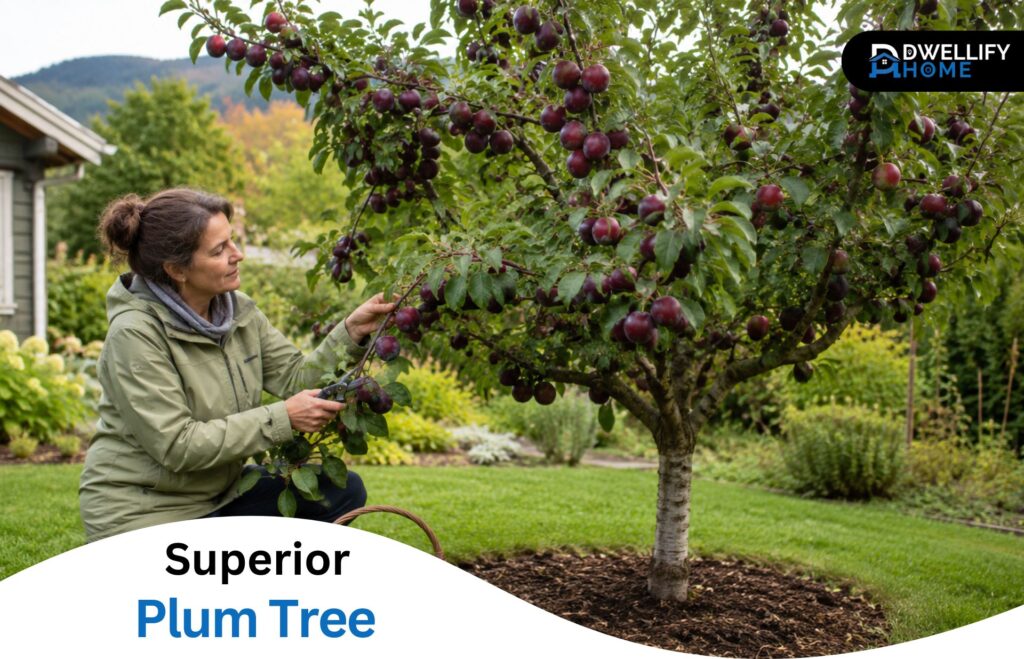
The Superior plum tree is a cold-hardy, Japanese-American hybrid developed by the University of Minnesota in 1933. Botanically known as Prunus ‘Superior,’ it produces heavy crops of large, dark red-skinned, clingstone plums with intensely sweet golden flesh. It is widely regarded as one of the best fruiting plum varieties for northern and cold-climate home gardens.
The Japanese parent — Prunus salicina — contributes fruit size, sweetness, and productivity. The American parent — Prunus americana — brings cold hardiness and structural toughness. The result is a tree that handles Zone 4 winters without flinching while producing fruit that rivals anything you’d find at a farmers’ market.
The name wasn’t just marketing. Breeders at Minnesota tested dozens of selections before settling on this one. It earned “Superior” the hard way.
Key Benefits at a Glance
- Survives temperatures as low as -30°F — reliable in harsh northern winters
- Produces large, intensely sweet, golden-fleshed plums every August
- Works as both a productive fruit tree and a three-season ornamental
- Adaptable to varied soil types including urban and slightly poor conditions
- Long-lived — well-cared-for trees produce for 40 years or more
Quick Comparison: Superior vs Similar Plum Varieties
| Feature | Superior | Toka | Alderman | Pipestone |
| Hardiness Zone | 4–8 | 3–8 | 3–6 | 4–7 |
| Self-Fertile | No | Partly | No | No |
| Fruit Size | Large | Medium | Large | Very large |
| Flavor Intensity | Very sweet | Rich, aromatic | Sweet | Mild |
| Best For | Yield + flavor | Pollinator + fresh eating | Small cold gardens | Size priority |
| Harvest Time | Mid–late August | Mid August | Early August | Late August |
Superior Plum Tree Quick-Reference Facts
| Feature | Detail |
| Scientific Name | Prunus ‘Superior’ |
| USDA Hardiness Zones | 4–8 |
| Cold Tolerance | Down to -30°F |
| Mature Height and Spread | 12–15 ft (standard) |
| Semi-Dwarf Size | 8–10 ft |
| Fruit Type | Clingstone |
| Skin Color | Dark red / crimson |
| Flesh Color | Golden yellow |
| Flavor | Intensely sweet, dense, juicy |
| Harvest Window | Mid to late August |
| Self-Fertile? | No — requires a pollinator |
| Best Pollinator | Toka (Bubblegum) plum |
| Lifespan | 40+ years under good care |
| Best Uses | Fresh eating, jams, jellies, baking |
What Does the Superior Plum Taste Like?
Superior plums deliver an intensely sweet, full-bodied flavor with dense, juicy golden flesh. The dark red skin adds a mild tartness that keeps the sweetness balanced rather than cloying. Eaten at peak ripeness directly off the tree, the Superior plum is considered one of the most flavorful hybrid plums available to home growers.
The flesh is dense — not watery like some Japanese varieties — with a richness that holds up well in baking and preserves. The skin has just enough bite to balance things out, which is part of why this variety works so well for jams. You get depth of flavor, not just sweetness.
Because it’s a clingstone, the flesh stays attached to the pit, which matters when you’re eating fresh. For cooking and preserving, it’s a minor inconvenience at most. The trade-off in flavor is absolutely worth it.
Pick one slightly before you think it’s ready and the flesh will be firm but already quite sweet. Wait until full ripeness and the flavor deepens considerably. Let them go past that window and they’ll still taste good — just softer and less complex.
Hardiness Zones and Climate Suitability
The Superior plum tree grows reliably in USDA Hardiness Zones 4 through 8. It tolerates temperatures as low as -30°F, making it one of the few plum varieties capable of thriving in northern gardens where most stone fruits struggle to survive winter.
Standard Japanese plums often die back or fail to bloom after a hard Zone 4 or 5 winter. The Superior’s American genetics act like a thermal buffer — the tree hardens off properly, survives the cold, and comes back strong in spring.
In Zone 8, heat tolerance becomes the limiting factor. The tree needs sufficient chill hours during winter dormancy to set fruit properly. In the warmer end of Zone 8, you may see reduced yields or irregular bloom. Zones 5 through 7 are genuinely the sweet spot for this variety.
The Superior also needs around 700 chill hours — temperatures consistently below 45°F during dormancy. In most of its rated zones, that’s not a concern. It’s worth knowing if you’re on the warmer edge of the range.
Choosing the Right Planting Location
Sunlight comes first. The Superior needs a minimum of six to eight hours of direct sun daily, and that’s not a soft number — reduced sun means reduced fruit. A site that gets morning shade and afternoon sun will work better than the reverse, but full sun throughout the day is always the goal.
Air drainage matters almost as much. Cold air settles in low spots, and a late frost hitting an open bloom can wipe out an entire year’s crop in one night. A gentle slope, a raised bed area, or the upper side of a yard allows cold air to move away from the tree rather than pool around it.
Give the tree enough room — plan for 12 to 15 feet of spread at maturity. Crowding a fruit tree against a fence or building restricts airflow, invites disease, and makes pruning unnecessarily difficult. One other thing worth mentioning: the Superior handles urban air pollution well, which makes it a viable option for garden spaces in city environments where other fruit trees sometimes struggle.
Soil Requirements — Getting the Foundation Right
Well-draining loamy or sandy soil is ideal. The pH target sits between 5.5 and 6.5. An inexpensive soil test kit from any garden center will tell you where you stand, and lime or sulfur can adjust the pH if needed before planting.
Drainage is the single most important soil factor. Stone fruit roots don’t tolerate standing water. A spot that stays soggy after rain will slowly kill the tree, often over two or three seasons before you realize drainage was the problem. If your soil is heavy with clay, raised planting, berms, or amending with coarse sand can help considerably.
The Superior is reasonably adaptable — it’s grown successfully in a range of soils across northern climates. But “adaptable” doesn’t mean it doesn’t have preferences. Give it what it wants upfront and you’ll rarely have to troubleshoot later.
How to Plant a Superior Plum Tree
Plant the Superior plum tree in early spring after the last frost, or in autumn at least six weeks before the ground freezes. Prepare a wide, shallow hole, keep the graft union above the soil line, and water deeply at planting. Spacing a pollinator tree within 15 to 20 feet is essential.
Step 1 — Prepare the Site Test soil pH, clear grass and weeds in a 3-foot radius, and amend if needed at least a few weeks before planting.
Step 2 — Dig the Hole Make it twice as wide as the root ball but only as deep as the root ball itself. Planting too deep is one of the most common mistakes I see — it suffocates the roots and stresses the tree for years.
Step 3 — Position the Tree The graft union — the slight bend or scar low on the trunk — must sit about 2 inches above the finished soil line. This is non-negotiable.
Step 4 — Backfill and Firm Use the native soil you removed. No need to heavily amend the planting hole — it can actually discourage roots from spreading outward. Firm gently to remove air pockets.
Step 5 — Water Deeply Soak thoroughly at planting. This settles the soil and makes first contact between roots and earth much more effective.
Step 6 — Mulch Correctly Apply 2 to 3 inches of mulch in a wide ring around the base. Keep it several inches away from the trunk — mulch against bark causes rot and invites pests.
Step 7 — Position Your Pollinator Plant a compatible variety within 15 to 20 feet. This isn’t optional — without a pollinator, there will be no fruit.
Pollination — The One Thing You Cannot Skip
The Superior plum tree is not self-fertile and will not produce fruit without a compatible pollinator planted nearby. A second plum variety that blooms at the same time in spring must be present. Without it, the tree will flower every year but set no crop — no matter how healthy it is.
This is the single most common reason people come to me frustrated that their plum tree “never produces anything.” The tree looks healthy, blooms beautifully, and then nothing. Nine times out of ten, there’s no pollinator within range.
What Is the Best Pollinator for the Superior Plum Tree?
The Toka plum — also called the Bubblegum plum — is the most widely recommended match. Its bloom window aligns well with the Superior’s mid-spring flowering, it’s equally cold-hardy across Zones 3 to 8, and it’s a strong pollen producer. Planting these two together is as close to a guaranteed pairing as you’ll get.
Other compatible options include the Alderman plum (reliable in Zones 3 to 6), the Pipestone plum tree (Zones 4 to 7, slightly larger fruit), and Methley (better suited to milder climates in Zones 5 to 9). Bees and other insects do most of the work, assisted by wind. Both trees need to be within 100 feet of each other for reliable pollination.
Superior Plum Pollination Chart
| Pollinator Variety | Bloom Timing Match | Hardiness Zone | Notes |
| Toka (Bubblegum) | Mid-spring — excellent | Zones 3–8 | Best overall match |
| Alderman | Mid-spring — good | Zones 3–6 | Ideal for colder northern gardens |
| Pipestone | Mid-spring — good | Zones 4–7 | Larger fruited companion |
| Methley | Early-mid spring — fair | Zones 5–9 | Works in milder climates only |
Watering — First Year vs Established Tree
In year one, water twice a week — slowly and deeply. The goal is to push roots downward, not just wet the surface. Deep roots build drought tolerance. Shallow, frequent watering creates shallow roots, and those trees struggle during dry summers.
From year two onward, once a week during dry periods is typically enough for an established tree. Signs of underwatering include wilting new growth, yellowing leaves, and small fruit that drops early. Overwatering shows up as yellowed older leaves and soft, waterlogged soil near the base.
A 3-inch layer of mulch around the root zone conserves moisture, regulates soil temperature, and reduces how often you need to water in summer. It’s one of the easiest things you can do for any fruit tree.
Fertilizing the Superior Plum Tree
Hold off on fertilizing in year one. A newly planted tree doesn’t need it, and excess nitrogen at that stage pushes soft, leafy growth that’s more vulnerable to frost and disease.
Starting in year two, apply a balanced fruit tree fertilizer — something with an even NPK ratio — in early spring before new growth begins. Nitrogen is important for tree health, but too much of it redirects energy toward leaves rather than fruit. If your tree is putting out long, lush shoots and light crops, dial back the nitrogen.
A soil test every two to three years gives you the most accurate picture of what your soil actually needs. Blanket fertilizing schedules are a reasonable starting point, but testing removes the guesswork.
Pruning — How to Do It Right and When
Young Superior plum trees should be pruned in late winter to early spring before buds break. Established trees benefit most from mid-summer pruning. Remove approximately 20% of the previous year’s growth per session using sterilized tools, cutting at a 45-degree angle.
Pruning a Young Tree (Years 1–3)
Give the tree its first full season without pruning — let it focus entirely on root establishment. In year two, begin shaping toward an open-center form, which allows light and air to reach the interior. Remove any branches growing at a narrow angle to the trunk. These are the first to snap under a heavy fruit load, and removing them early saves you from dealing with the damage later.
Pruning an Established Tree
Established trees do better with mid-summer pruning than late-season cuts. Pruning in autumn or during wet spring conditions opens wounds that stay damp and invite silver leaf disease — a fungal infection that enters through fresh cuts and causes a characteristic silvery discoloration of the foliage, followed by branch die-back.
Always sterilize your pruning tools with rubbing alcohol between cuts. It takes about ten seconds and can prevent a season-long disease problem. Never remove more than 20% of the tree’s growth in a single season — aggressive over-pruning stresses the tree and often triggers excessive watersprout growth in response.
Fruit Thinning — Why Heavy Bearers Need This Extra Step
Because the Superior plum is an exceptionally heavy producer, thinning developing fruit in early summer is strongly recommended. Reduce fruit clusters to one plum every six inches along each branch. This prevents branch breakage, allows remaining fruit to reach full size, and supports the tree’s long-term structure and productivity.
Thin when the fruit is roughly marble-sized — early enough that the remaining plums still have time to develop well. Use your fingers or small scissors; don’t tug or twist. If you skip thinning, the branches often bend dramatically under the weight, and in bad years they snap. The remaining fruit tends to be smaller and less flavorful too.
One more issue worth knowing: Superior is more susceptible than most varieties to rain cracking near harvest. When heavy rain hits during the final ripening stage, the skin can split as the fruit absorbs water rapidly. Thinning improves air circulation around developing fruit, which helps reduce this risk. So does harvesting promptly when the plums are ready rather than leaving them on the tree too long.
Common Pests and How to Manage Them
Plum Curculio
This small, snout-nosed beetle is the most serious pest for stone fruit in North American home gardens. It attacks just after petal drop in spring, cutting crescent-shaped scars into young fruit and laying eggs inside. The affected fruit drops prematurely or develops corky, scarred flesh.
The most practical organic solution is kaolin clay, sold as Surround WP. Applied as a spray right after petal drop and reapplied after rain, it creates a physical barrier on the fruit surface that discourages the beetle. Check developing fruit weekly through late spring.
Aphids
Aphids appear on tender new growth in spring and early summer. Curled, distorted young leaves and a sticky residue on stems are the key signs. A strong jet of water from a hose knocks them off effectively. Insecticidal soap handles heavier infestations without harming beneficial insects significantly.
Japanese Beetles
Japanese beetles skeletonize leaves in midsummer, leaving behind a lacy, dried appearance. Hand-picking in early morning — when they’re sluggish — and dropping them into soapy water is still one of the most effective approaches at home garden scale.
Common Diseases and How to Prevent Them
Black Knot Fungus
Black knot shows up as hard, black, tar-like swellings on branches. It spreads in humid conditions and can move quickly through a tree if left untreated. Prune out infected wood at least 4 inches below the visible gall, and dispose of it away from the garden — don’t compost it. Disinfect your tools between every cut.
Brown Rot
Brown rot appears most often during warm, humid weather close to harvest. It starts at the blossoms, then spreads to developing fruit, which shrivels into mummified forms and spreads spores to neighboring fruit. Thin fruit for airflow, remove any mummified plums left on branches after harvest, and avoid overhead watering.
Silver Leaf Disease
Silver leaf causes a silvery, metallic sheen on leaves, followed by dieback of affected branches. As mentioned in the pruning section, it enters through wounds made during wet or cold conditions. The best prevention is simple: prune only in late winter before buds break, or in mid-summer during dry conditions — never in autumn.
How the Superior Compares to Similar Plum Varieties
Superior vs Toka Plum
The Toka and Superior are best thought of as companions rather than alternatives. Toka is slightly more compact, produces its own distinctive fruit with a rich, almost candy-like aroma, and is considered partly self-fertile. Superior is larger-fruiting and a heavier producer overall. Grow them together and both will outperform what either could achieve alone.
Superior vs Alderman Plum
The Alderman plum tree is similarly cold-hardy and produces large, deep-colored fruit with good sweetness. It ripens slightly earlier in the season than Superior, which some gardeners find useful for extending the harvest window. Alderman’s more compact size makes it a better fit for the smallest gardens. For those with more space who want maximum yield, Superior has the edge.
Superior vs Pipestone Plum
Pipestone produces individual fruit that tends to be noticeably larger than Superior’s, which makes it appealing if size is your priority. The flavor, however, is milder and less intense. Pipestone also ripens a bit later. For raw flavor and volume of fruit, Superior is the stronger choice. For those who want the biggest possible individual plums, Pipestone is worth considering.
Ornamental Value — More Than Just a Fruit Tree
Before a single leaf appears in spring, the Superior covers itself in fragrant white blossoms. It’s a genuine seasonal display, not just a side note — the kind of bloom that makes neighbors stop and ask what tree that is.
Through summer, the dense green canopy provides shade and a degree of privacy, particularly useful in smaller yards. In autumn, the foliage shifts to warm red tones before dropping, giving the tree three seasons of landscape presence rather than just one.
For anyone designing an edible landscape or a backyard orchard, the Superior works well as a structural element — large enough to anchor a space, productive enough to justify the footprint. The spring blossoms support early pollinators, and fallen fruit in late summer attracts birds. It earns its place on multiple levels.
Harvesting and Using Your Superior Plums
How to Know When Superior Plums Are Ready to Pick
Superior plums are ready to harvest when the skin has turned deep crimson and the fruit yields gently to light finger pressure. Taste-testing one plum is the most reliable method — the flesh should be sweet and fully colored through, with no green or starchy notes.
The harvest window typically falls mid to late August in most growing zones, occasionally pushing into early September in cooler climates. Don’t rely only on color — some plums color up before they’re fully ripe inside. The gentle squeeze and a taste test together give you the most reliable read.
To pick, grasp the plum and twist it gently upward. A ripe plum releases cleanly. If it takes real effort to pull it free, give it a few more days.
What to Do With Superior Plums After Harvest
Fresh eating is where this variety truly shines — nothing compares to a fully ripe plum eaten the same day it’s picked. For preserving, Superior’s high natural sugar content makes it one of the best choices available for jams and jellies. The flavor concentrates beautifully and doesn’t require a lot of added sugar to reach a good set.
For baking, it holds its structure well in pies, tarts, and crumbles. To freeze, halve the plums, remove the pit, lay them flat on a tray until frozen solid, then transfer to bags. Stored properly in the refrigerator, fresh Superior plums keep for up to two weeks.
How Long Before a Superior Plum Tree Produces Fruit?
A Superior plum tree typically begins bearing fruit 2 to 4 years after planting. Some semi-dwarf varieties may produce a small crop in their first or second year. Full productive yields are usually reached by years 4 to 6, and the tree continues bearing reliably for 40 years or more with good care.
Rootstock plays a significant role in how quickly the tree bears. Trees on semi-dwarf rootstock generally fruit earlier. Having a pollinator in place from the start also matters — trees that have to wait for a pollinator lose seasons of productive fruiting.
By year three, most well-planted trees in good conditions will have produced at least a light crop. By year five or six, you’ll be dealing with the much better problem of having more plums than you know what to do with.
Frequently Asked Questions
Is the Superior plum tree self-pollinating?
No. The Superior plum tree cannot set fruit without a compatible pollinator tree blooming at the same time nearby. A second variety — ideally Toka — must be planted within 100 feet.
What is the best pollinator for the Superior plum tree?
The Toka plum, also called the Bubblegum plum, is the most widely recommended pollinator. It blooms at the same time in mid-spring and thrives in the same cold hardiness zones.
How big does a Superior plum tree get?
Standard Superior plum trees reach 12 to 15 feet in both height and spread. Semi-dwarf forms stay closer to 8 to 10 feet and are better suited to smaller gardens.
When are Superior plums ready to harvest?
Superior plums ripen mid to late August in most growing zones, occasionally extending into early September in cooler climates. The fruit is ready when it turns deep crimson and yields slightly to gentle pressure.
How cold hardy is the Superior plum tree?
It is rated for USDA Hardiness Zones 4 through 8 and can withstand temperatures as low as -30°F — making it one of the hardiest hybrid plum varieties available.
Why is my Superior plum tree flowering but not producing fruit?
The most common cause is the absence of a compatible pollinator tree. Without a second plum variety blooming at the same time, flowers will open and fall without setting any fruit.
Can I grow a Superior plum tree in a container?
Semi-dwarf varieties can be container-grown with diligent watering, annual pruning, and regular fertilizing. Choose a large container of at least 25 to 30 gallons and ensure the pollinator tree is also nearby.
How big does a superior plum tree get?
A standard superior plum tree reaches 12 to 15 feet in both height and spread at full maturity. Semi-dwarf varieties stay closer to 8 to 10 feet, making them a practical choice for smaller gardens or tighter spaces.
Does a superior plum need a pollinator?
Yes — the superior plum is not self-fertile. It requires a second plum variety that blooms at the same time in mid-spring to produce fruit. The Toka plum is the most compatible and widely recommended pollinator, planted within 100 feet.
What should not be planted near plum trees?
Avoid planting plums near other stone fruits affected by black knot fungus, as the disease spreads between them easily. Also avoid planting in areas with black walnut trees — walnut roots release juglone, a compound that is toxic to many stone fruit trees including plums.
Are plums good in October?
Superior plums typically ripen in mid to late August, so by October the season is well past. Plums harvested at peak ripeness and refrigerated can last up to two weeks. For enjoying plums in October, frozen or preserved fruit from the August harvest is the practical option.
Conclusion
The superior plum tree isn’t a complicated tree to grow, but it does reward the growers who take the time to get the basics right — the right site, a compatible pollinator planted close by, honest pruning, and a little patience in the first few years. Do those things, and this cold-hardy Japanese-American hybrid will produce reliably for decades. It’s one of the few fruit trees you can plant in a Zone 4 or 5 garden with genuine confidence, knowing it will handle whatever the winter brings and come back producing well the following season.
Disclaimer
The content published on Dwellify Home is intended for general informational purposes only. Growing conditions, soil types, climate variations, and individual results may differ. Always consult a local nursery or horticultural professional for advice specific to your region and situation.