Most people only realize their windows are the real obstacle after they’ve already carried a boxy window unit home and found it won’t sit in the frame. Crank-out windows swing outward like little doors, and a standard air conditioner has nothing to grip. A casement window AC solves that, and this guide walks through the types that actually fit, how to get the sizing and fit right, and what to buy for your situation.
There’s no single right answer here. The best choice depends on your window, your room, whether you own or rent, and how much you want to spend up front versus over the summer. I’ll lay all of that out so you can make the call with confidence.
Snippet-Ready Definition
A casement window AC is a tall, narrow air conditioner built for windows that crank open or slide sideways. Homeowners choose it because standard horizontal window units won’t seat or seal in a casement opening.
Our Mission:
At Dwellify Home, we help homeowners and renters make practical, confident decisions about their living spaces. This guide reflects that goal — clear, honest advice on choosing and fitting the right casement window AC, so you can cool a tricky room without the guesswork.
What Is a Casement Window AC?
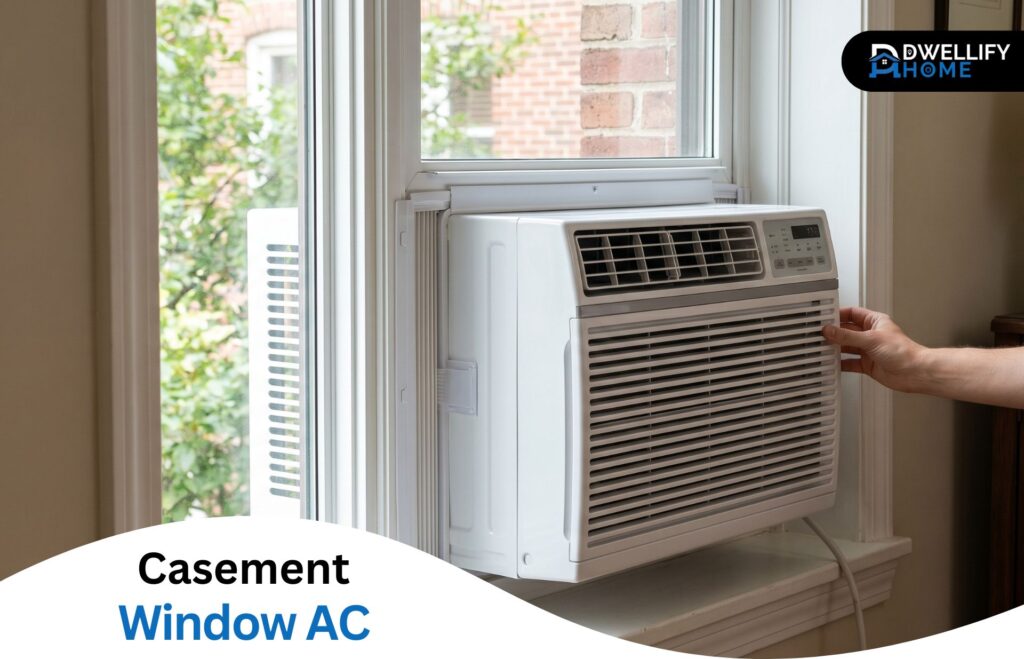
A casement window AC is an air conditioner built tall and narrow so it fits windows that open outward or slide sideways, rather than the wide, short units made for double-hung windows. Because casement windows have no horizontal sash to rest a unit on, these models stand vertically and ship with a kit to mount and seal the opening.
That vertical shape is the whole point. A normal window unit is wider than it is tall because it drops into the bottom of a double-hung window and the upper sash slides down to lock it in. A casement opening is the opposite, narrow and tall, so the air conditioner has to match that footprint or it simply won’t seat properly.
Most vertical units land somewhere between 8,000 and 12,000 BTU, which covers the rooms people usually need them for: bedrooms, offices, basements, and smaller living spaces.
Key uses and benefits
- Fits crank-out casement and side-sliding windows where standard units can’t
- Cools single rooms such as bedrooms, offices, basements, and small living spaces
- Ships with a kit to mount and seal the tall opening
- Commonly available from roughly 8,000 to 12,000 BTU for typical room sizes
- Removable at season’s end, which suits renters
Why Won’t a Standard Window AC Fit a Casement Window?
A standard window unit won’t fit because a casement window has no lower sash or ledge to support the unit’s weight, and no upper sash to slide down and lock it in place. Casement windows crank outward and leave a tall, narrow opening, so a wide horizontal AC has nothing to sit on and no way to seal, which also makes it prone to tipping.
I’ve had plenty of calls that start with someone saying their AC is broken when the unit is perfectly fine. The window just never held it correctly. That’s the honest reframe: most of the time this is a window problem, not an air conditioner problem. Forcing a horizontal unit into a vertical opening leaves big gaps, lets hot air pour back in, and puts the whole thing at risk of working loose.
Casement vs. Slider Windows — A Quick Distinction
You’ll often see these units labeled slider/casement, and that trips people up. A casement window swings outward on a side hinge using a crank handle. A slider window moves side to side along a track. They operate differently, but for cooling purposes they share the trait that matters: neither is a double-hung window, and both leave a tall opening that needs a vertical-fit unit.
So a slider casement window AC and a casement-specific model are usually the same category of product. What you’re checking is the opening’s shape and dimensions, not the brand’s label.
Casement Window AC Options: The Types That Actually Fit
You have more than one path, and the right one depends on your window, your budget, and whether you can make permanent changes. Here are the realistic options laid side by side.
| Option | How it fits | Upfront cost | Efficiency | Install effort | Renter-friendly | Best for |
| Vertical (casement/slider) unit | Sits in the tall opening | Higher than standard window units | Good | Moderate, heavier lift | Usually | A solid fit in one room |
| Portable AC + venting kit | Floor-standing, hose vents out | Moderate | Lower for the cooling you get | Easiest | Very | Renters, tricky windows, flexibility |
| Through-the-wall unit | Through a wall sleeve, not the window | Higher, plus install | Good | High, needs an opening cut | No | Avoiding the window entirely |
| Ductless mini-split | Wall-mounted, line set outside | Highest | Highest | Professional | No | Long-term, multiple rooms, quiet comfort |
Vertical (Casement/Slider) Window Units
These are the purpose-built option, the actual vertical casement window air conditioner that’s taller than it is wide. They seat in the narrow opening and come with side panels or fillers to close the rest. Real examples you’ll run into include the Frigidaire FFRS line, Keystone’s slider models, Koldfront’s casement units, and PerfectAire’s slider line. I mention those as examples of what the category looks like, not as a ranking. The best casement window air conditioner for you is the one that matches your opening and your room size.
The trade-off is availability and price. There are far fewer of these on the market than standard units, so your choices are narrower and they cost more. They’re also on the heavy side, which matters at install time.
Portable AC + a Casement Venting Kit
A portable casement window ac setup is a freestanding unit that sits on the floor and vents hot air out through a hose. Since the hose needs an exit and the rest of the opening needs to be blocked, you pair it with a vent panel or insert sized for a tall window. This is the most flexible route and the friendliest for renters.
The honest caveat: portables don’t cool as efficiently as a window unit of the same rating, and the exhaust hose radiates some heat back into the room. They’re convenient and easy to move, but you trade some performance for that convenience.
Through-the-Wall and PTAC Units
When the window is genuinely unworkable, going through the wall instead is an option. A through-the-wall unit slides into a sleeve cut into an exterior wall, which frees the window entirely and seals tightly. PTAC units, the kind you’ve seen under hotel windows, work on the same principle.
This is a bigger commitment. You’re cutting an opening, so it’s for homeowners rather than renters, and it usually means hiring help. But it sidesteps the whole casement fit problem.
Ductless Mini-Split
A mini-split mounts on the wall and connects to a small outdoor compressor through a line running outside, so the window stays free. They’re the quietest and most efficient option, and one outdoor unit can feed several rooms.
The catch is cost and installation. This is a professional job and the priciest choice up front. For a single room you cool occasionally, it’s usually overkill. For long-term comfort across a home with difficult windows, it’s often the smartest money.
How to Choose the Right Casement Window AC
Six things decide whether you’re happy in August or annoyed. Walk through them in order before you buy anything.
Measure Your Window First
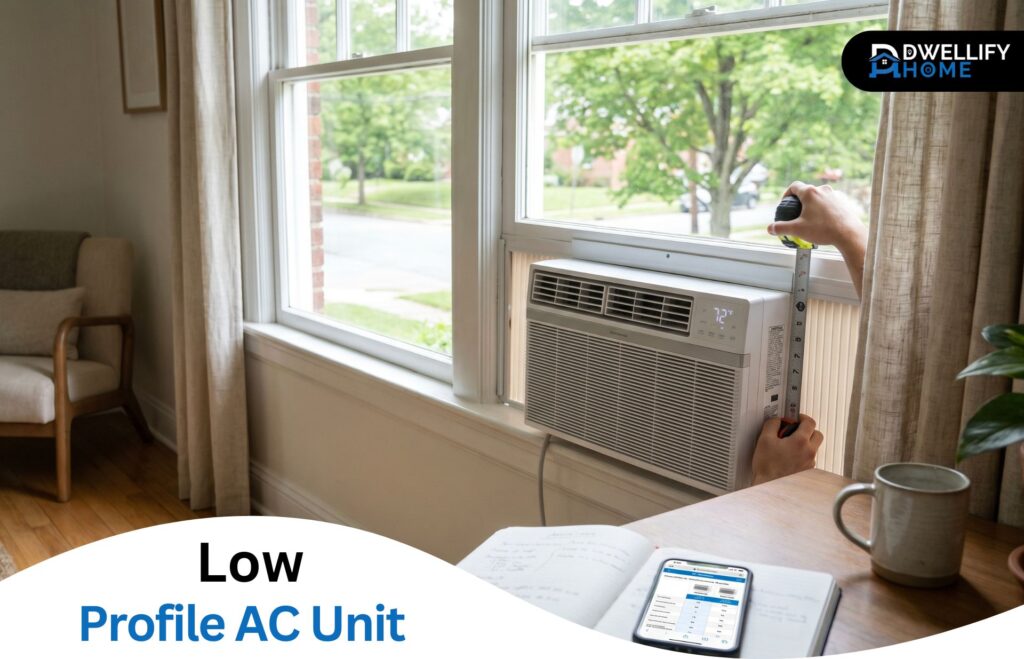
Measure before you shop, every time. Crank the window fully open and measure the actual opening, the clear height and width the unit has to fit into, not the glass. Most vertical units need an opening around 20 inches tall at a minimum, and they list a height range they’ll seal.
Write down the height, the width, and whether anything sits in the way, like a crank arm or a fixed center post. I’ve watched people return units twice because they measured the pane instead of the opening. Two minutes with a tape measure saves that whole headache.
Get the BTU Right for Your Room
BTU is the unit of cooling power, and matching it to your room is the single biggest factor in comfort. The rough rule is about 20 BTU per square foot.
| Room size | Roughly what you need |
| Up to 150 sq ft | ~5,000 BTU |
| 150–250 sq ft | ~6,000 BTU |
| 250–350 sq ft | ~8,000 BTU |
| 350–450 sq ft | ~10,000 BTU |
| 450–550 sq ft | ~12,000 BTU |
| 550–700 sq ft | ~14,000 BTU |
A 12,000 BTU casement window air conditioner sits near the top of what’s commonly available in this vertical shape, and it’s a sensible pick for a larger bedroom or a small open living area. Bumping up to the next size to be safe tends to backfire. An oversized unit cools fast, shuts off, and never runs long enough to pull humidity out, so the room feels cold and clammy. Adjust upward only for very sunny rooms, high ceilings, or a kitchen.
Energy Efficiency — EER, CEER, ENERGY STAR, and Inverter Models
Efficiency ratings tell you how much cooling you get per watt. EER and CEER are the numbers to compare, where higher is better, and an ENERGY STAR label means the unit meets a recognized efficiency standard. Those numbers translate directly into your electric bill over a long summer.
If you can find one, a casement window ac inverter model is worth a look. Instead of slamming the compressor fully on and off, an inverter ramps it up and down, which holds the temperature steadier, runs quieter, and uses less power. They cost more up front and pay some of that back in running costs.
Noise, Drainage, and Comfort Features
Where the unit lives changes what matters. For a bedroom, look at the decibel rating. A quiet, low-dB casement ac is the difference between sleeping through it and lying awake, and inverter units tend to run softer.
In a humid climate, check how the unit handles condensate and whether it has a drain plug for continuous drainage. The features actually worth paying for are a remote, a 24-hour timer, and a sleep mode, since they’re genuinely useful day to day. Most other extras are nice but not decisive.
Weight, Safety, and Support Brackets
This is the part people underestimate. Vertical units run heavy. Many land around 70 pounds, though some slider models weigh closer to half that. That weight is hanging in a window opening, so a support bracket isn’t optional on the heavier ones.
A bracket bolts to the exterior and carries the load so your sill and the unit’s mount aren’t doing it alone. On a second floor or higher, this is a safety issue, not a nicety. Get a helper and don’t improvise. If lifting a heavy unit into a window sounds like trouble, that alone is a good reason to consider a lighter slider model or a portable.
Renter and Landlord Considerations
Renters can absolutely cool a casement window, but check your lease first and favor setups that come out cleanly. A vertical unit with fillers, or a portable with a removable vent panel, both pull out at the end of the season with no permanent marks.
Avoid anything that requires drilling into the frame if your lease forbids it. A quick message to your landlord before you install saves arguments later, and most are fine with a clean, reversible setup.
How to Install a Casement Window AC (Step by Step)
Installing a casement window AC is a manageable DIY job for the lighter units and a two-person job for the heavy ones. The order below is what keeps it safe and sealed. If your unit is heavy or you’re working above the first floor, a second set of hands makes the whole thing easier and safer.
Step 1 — Measure and Prep the Window
Confirm your opening measurements against the unit’s specs one more time. Crank the window fully open, remove the screen, and clear anything in the path. If the crank arm or hinge blocks the opening, you may need to detach it and set it aside to reinstall when the season ends. Wipe the frame down so your seals stick.
Step 2 — Mount the Support Bracket
For anything heavy, install the support bracket first. Follow the bracket’s instructions. It typically fastens to the exterior wall or sill and is leveled to carry the unit’s weight. You may need to reach the outside, so set up safe footing before you start. Skipping this step is the most common way these installs go wrong.
Step 3 — Position and Secure the Unit
Lift the unit into the opening and rest it on the bracket, keeping it flush against the frame. Give it a slight tilt toward the outside so condensate drains away from the room rather than pooling inside. Fasten it according to the casement window ac installation kit that came in the box, then check that it’s solid before you let go.
Step 4 — Fit the Filler Panels and Weatherstrip
Most units include side panels or fillers to close the space the unit doesn’t occupy. Slide those into place and secure them. Run weatherstripping along the seams where the unit meets the frame to block drafts. This step is about closing the obvious gaps mechanically. Which material works best for the leftover opening is the next question.
The Best Way to Seal the Gap: Filler Panels vs. Acrylic Insert vs. Foam
Sealing is where most casement installs succeed or fail, because that tall opening leaves more gap to close than a standard window does. You’ve got three common approaches, and they trade off airtightness, looks, daylight, and cost.
The factory filler panels that ship with the unit are the easiest and cheapest. They clip in and do a basic job. The downside is they’re often a loose fit on an odd-sized window and they block the light through that part of the opening.
A cut-to-fit acrylic or plexiglass insert is the cleanest result. You measure the opening, get a clear panel cut to size with a hole for the unit or hose, and it seals tightly while still letting light through. It costs more and takes a little setup, but it looks like part of the window rather than a patch. A simple casement window ac adapter for the hose drops into a panel like this neatly.
Foam and accordion-style seal kits sit in the middle. They’re cheap and adjustable and good at blocking air, but the least attractive from inside and out. They’re a solid choice when function matters more than looks, like a basement or a rental you don’t want to spend much on. Whichever you choose, the goal is the same: no daylight gaps, because every gap is warm air sneaking back in and a higher bill.
Common Casement Window AC Problems (and How to Fix Them)
Most issues after install come down to a handful of causes. Here’s how to read the symptom and fix it.
The Unit Isn’t Cooling the Room
Start with the simple stuff. A dirty filter is the most common culprit. Pull it, clean it, and you’ll often get your cooling back. If the filter’s clean, check the seal around the unit, since leaks let conditioned air escape and warm air in. If it’s clean and sealed and still struggling, the unit is likely undersized for the room, the sun load, or the ceiling height.
Warm Air Is Leaking Around the Unit
This is almost always a sealing gap. Run your hand around the edges on a hot day and you’ll feel where it’s coming in. Re-seat the filler panels, add or replace weatherstripping, and close any daylight you can see. On odd-shaped openings, a cut-to-fit insert solves what loose panels can’t.
Water Is Leaking or Pooling
Indoor dripping usually means the unit is tilted the wrong way. It should lean very slightly toward the outside so condensate drains away from the room. Check that the unit is level side to side and pitched correctly, and clear any blocked drain path. In humid weather a unit produces a lot of water, so a proper drain matters more than people expect.
The Unit Feels Unstable or Tips Outward
Stop using it until you fix this, because it’s a safety problem. An unstable unit means the support is inadequate for the weight. Add or properly secure a support bracket so the load is carried from outside, and confirm everything is fastened per the instructions. A heavy unit in a window is not something to leave to chance.
Casement Window AC vs. Portable AC: Which Should You Choose?
Choose a vertical casement unit if you want stronger, more efficient cooling for one room and you can handle the heavier install. Choose a portable if you rent, your window is awkward, or you want something you can move and remove easily. The portable wins on flexibility; the window unit wins on cooling power and running cost.
| Casement (vertical) unit | Portable AC + kit | |
| Cooling for the rating | Stronger | Weaker, hose loses some |
| Running cost | Lower | Higher |
| Install effort | Heavier, in the window | Easy, rolls in |
| Floor space | None | Takes up floor space |
| Renter-friendly | Usually | Very |
One detail worth knowing in the casement window ac vs portable ac decision: portables are often advertised with two BTU numbers. The older ASHRAE figure looks bigger; the newer SACC number reflects real-world cooling and is lower. Compare on the SACC number so you’re not caught out when a portable cools less than its headline rating suggests.
How Much Does a Casement Window AC Cost — to Buy and to Run?
Expect to pay more for a casement unit than a standard window unit of the same BTU, mostly because far fewer models are made and demand is narrower. Running cost depends on the unit’s wattage, your local electricity rate, and how many hours a day it runs, so it varies widely from one home to the next.
Up front, vertical casement units generally sit at the higher end of the window-AC price range, and inverter models cost more again. The way to keep running costs down is to size the unit correctly, pick a higher efficiency rating, and seal the opening well. An oversized or leaky setup quietly costs you all summer.
If you want a real number for your situation, check the unit’s listed wattage, multiply by the hours you’ll run it to get kilowatt-hours, and apply your electricity rate from your bill. That gives you a far more honest estimate than any blanket figure.
Maintenance and Off-Season Care
A little upkeep keeps these units cooling well and lasting longer. During the season, clean or rinse the filter every few weeks. It’s the single most effective thing you can do for performance. Wipe down the front and check that the seals are still tight.
Once a year, look at the coils and clear any dust or debris so airflow stays strong. When summer ends, the safest move is to remove the unit, especially a heavy one in an upper window, rather than leaving it hanging through winter. Store it upright in a dry spot so any residual moisture and the compressor oil stay where they belong, and keep the kit and panels together so next summer’s install is quick.
Frequently Asked Questions
Can I put a regular window AC in a casement window?
Generally no. A regular window unit is wider than it is tall and needs a double-hung window’s sash to support and seal it. A casement window opens outward and leaves a tall, narrow opening with nothing to rest the unit on, so a standard AC won’t seat safely or seal properly. Use a vertical unit or a portable instead.
What size casement window AC do I need?
Size by room area, using roughly 20 BTU per square foot. A 250-square-foot room needs about 8,000 BTU, around 450 square feet calls for 10,000 BTU, and a 12,000 BTU casement window air conditioner suits roughly 550 square feet. Bump up only for very sunny rooms, high ceilings, or kitchens, since an oversized unit leaves the room cold and clammy.
Are casement window AC units more expensive?
Usually, yes. Because far fewer casement and slider models are manufactured than standard window units, you’ll typically pay more for the same BTU, and inverter versions cost more again. The upside is that a correctly sized, efficient, well-sealed unit keeps your running costs reasonable, which offsets some of that higher purchase price over time.
Can I use a portable AC with a casement window?
Yes, and it’s a popular choice for renters. A portable casement window ac setup stands on the floor and vents through a hose, so you pair it with a vent panel or insert sized for a tall window to block the rest of the opening. It’s flexible and easy to remove, though it cools a bit less efficiently than a window unit.
Do casement window ACs come with an installation kit?
Most do. A casement window ac kit typically includes side filler panels and the hardware to mount and seal the unit in the opening. Heavier units may need a separate support bracket, which isn’t always included, so check the box contents before buying. For odd-sized openings, many people add a cut-to-fit panel for a tighter seal.
What’s the smallest casement window AC available?
The smallest options are generally around 8,000 BTU in the vertical casement form factor, suited to rooms up to roughly 350 square feet. For a genuinely small space, a small casement window ac in that range, or a compact portable paired with a vent kit, will cool comfortably without overpowering the room or wasting energy.
Can you put an air conditioner in a casement window?
Yes, but not a standard one. Regular window units are wide and need a double-hung sash to support and seal them. For a casement window, use a tall vertical casement/slider unit, or a portable AC paired with a vent kit sized for the tall opening.
What type of air conditioner works with crank windows?
Crank (casement) windows work with vertical casement/slider window units, which are tall and narrow to fit the opening. A portable AC with a tall-window vent kit also works and is renter-friendly. For a permanent option, a through-the-wall unit or ductless mini-split bypasses the window entirely.
What size casement window AC do I need?
Size by room area at roughly 20 BTU per square foot. A 250-square-foot room needs about 8,000 BTU, around 450 square feet calls for 10,000 BTU, and a 12,000 BTU casement window AC suits roughly 550 square feet. Avoid oversizing, which leaves the room cold and clammy.
Are casement window AC units more expensive?
Usually, yes. Far fewer casement and slider models are made than standard window units, so you’ll typically pay more for the same BTU, and inverter versions cost more again. A correctly sized, efficient, well-sealed unit keeps running costs reasonable, which offsets some of that higher purchase price over time.
Can I use a portable AC with a casement window?
Yes, and it’s popular with renters. A portable AC stands on the floor and vents through a hose, so you pair it with a vent panel or insert sized for a tall window to block the rest of the opening. It’s flexible and removable, though slightly less efficient than a window unit.
Conclusion: Choosing the Right Casement Window AC for Your Home
The whole decision comes down to matching the solution to your situation. A vertical casement window AC gives you the strongest, most efficient cooling for a single room if you can manage the heavier install. A portable with a vent kit is the flexible, renter-friendly route when the window or your lease makes a permanent unit impractical.
Whatever you choose, the two rules that matter most are getting the fit and the size right, and sealing that tall opening tightly. Measure the opening before you buy, match the BTU to your room, and close every gap. Do those three things and the rest takes care of itself: a cool, comfortable room all summer, in a window everyone said couldn’t take an air conditioner.
Disclaimer: This article is for general informational purposes only. Individual windows, rooms, climates, and product specifications vary, so confirm your own measurements and the manufacturer’s instructions before buying or installing.