Walk into a home during the rainy season and the complaint is almost always the same. The room doesn’t feel hot, exactly, but the air sits heavy on your skin and the fan just pushes that stickiness around. That sticky, clammy feeling is what dry mode aircond was built for. Over the next few sections I’ll explain what it actually does, when it’s worth switching on, and whether it really trims your electricity bill the way people hope it does. No hype, just what holds up in real homes in a hot, humid climate.
Snippet-Ready Definition
Dry mode aircond is a built-in dehumidifying setting that runs the fan slowly and cycles the compressor to pull moisture from the air. People use it to make sticky, humid rooms feel fresher and lighter without strongly lowering the temperature.
Mission Statement
Dwellify Home helps homeowners, renters, and property enthusiasts make practical, informed decisions about their living spaces. On topics like dry mode aircond, that means clear, honest guidance you can act on, so you get the most comfort and value from the home systems you already own.
What is dry mode on an aircond?
Dry mode is a built-in dehumidifying setting on your air conditioner. It runs the fan slowly and lets the compressor work in short bursts, so the unit pulls moisture out of the air without aggressively chilling the room. The goal is to lower humidity, not temperature. It makes a damp room feel fresher and lighter.
The simplest way to understand the dry mode aircond meaning is this: cool mode chases a temperature, dry mode chases the moisture. You’ll still feel a little cooling, but that’s a side effect, not the main job.
The dry mode symbol and how to turn it on
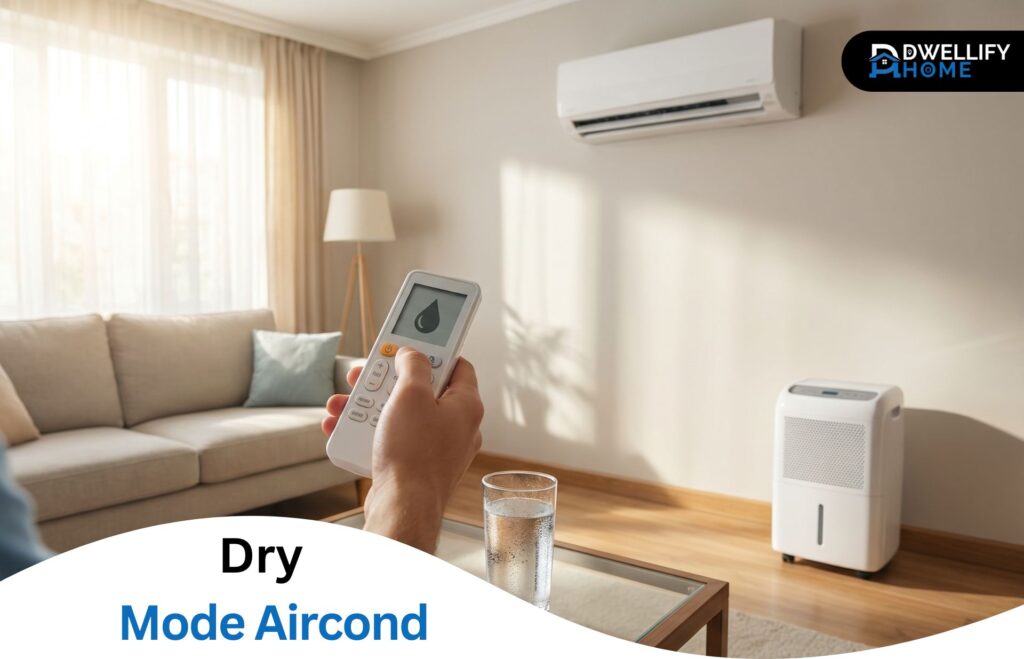
On nearly every remote, dry mode is marked with a small water-droplet icon. Press the Mode button until you land on that droplet, and you’re in dry mode. Some brands also spell it out as “Dry” or “Dehumidify” next to the symbol.
Turning it on is straightforward:
- Press Mode on the remote until you see the water droplet.
- Set a sensible temperature (more on the right number shortly).
- Close the windows and doors so you’re not pulling in fresh humid air the whole time.
The droplet is close to universal, but labels vary slightly by brand. Here’s a quick reference for what you’ll see on common units:
| Brand | What dry mode looks like |
| Daikin | Water-droplet icon, often labelled “Dry” |
| Mitsubishi | Droplet symbol; some models tie it to “Econo Cool” settings |
| LG | Droplet icon, sometimes shown as “Dehumidify” |
| Samsung | Droplet symbol on the Mode cycle |
| Panasonic | Droplet icon, labelled “Dry” |
| Midea | Water-droplet symbol |
| Gree | Droplet icon |
| Hitachi | Droplet symbol |
| Acson | Droplet icon |
| TCL | Water-droplet symbol |
If your remote is faded or you’ve lost it, the mode order on most units cycles cool, dry, fan, auto, and heat, so the droplet usually sits second in the list.
Where dry mode sits among your other aircond modes
It helps to know what each setting on your remote is really for. Cool mode lowers temperature at full power. Fan mode just circulates air with no cooling or drying. Auto mode lets the unit pick between cooling and drying on its own. Sleep mode gently raises the temperature over the night to save energy while you rest.
Dry mode is the quiet specialist that targets humidity. Some Mitsubishi units also have Econo Cool, which adjusts airflow to feel cooler while saving power, but that’s still a cooling mode at heart, not a drying one. I’ll cover the dry versus cool difference in more depth below.
Key uses at a glance
- Clears sticky, heavy humidity on warm but not hot days
- Keeps rooms comfortable after rain or during monsoon season
- Helps discourage mould, mildew, and musty smells
- Runs quietly and uses a little less power than cool mode
- Works well overnight when paired with a timer
Dry mode vs cool mode
| Aspect | Cool mode | Dry mode |
| Main goal | Lower the temperature | Remove humidity |
| Compressor | Full power, continuous | Cycles or runs at low frequency |
| Fan speed | Medium to high | Low and steady |
| Best for | Hot days | Warm, sticky, humid days |
| Energy use | Higher | Generally lower |
How dry mode actually works inside your aircond
Dry mode pulls moisture from the air by running the indoor fan at a low, steady speed while the compressor cycles on and off. The slow airflow lets room air linger longer against the cold evaporator coil. Water vapour condenses on that coil, drips into the drain, and flows outside. Drier air returns to the room.
The key thing to understand is that this is reduced-capacity cooling, not “no cooling.” The coil still gets cold, you’re just running the system gently so dehumidifying does most of the work and the temperature barely moves.
Why the fan stays slow and the compressor cycles
The slow fan is the whole trick. Move air across a cold coil quickly and it barely has time to give up its moisture. Slow it down, and each pocket of air sits against the coil long enough for the water to condense out. That’s why dry mode feels weak on airflow, it’s doing that on purpose.
The compressor cycles off in short intervals too. If it ran flat out, the room would get cold fast and the unit would stop removing moisture. The brief pauses keep the coil cold enough to dehumidify without overcooling you.
Inverter vs non-inverter dry mode
This is where units genuinely differ. An inverter aircond can throttle its compressor frequency down, so in dry mode it runs slow and smooth at partial load. That’s efficient and steady.
A non-inverter unit only knows on and off. In dry mode it simply switches the compressor on for a bit, off for a bit, on again. It still removes moisture, but the operation is less smooth and the energy savings are smaller. So if someone tells you dry mode barely changed their bill, the first question I ask is whether they’re on an inverter or an older fixed-speed unit.
Why use dry mode? The real benefits beyond cooling
The main payoff is comfort. When humidity drops, your sweat evaporates properly again, so a room at the same temperature suddenly feels cooler and lighter. Beyond that, lower humidity does real work around the home:
- Discourages mould and mildew, which tend to take hold once indoor humidity creeps past roughly 60 percent.
- Cuts that musty, damp smell in rooms that don’t get much airflow.
- Eases the heavy, stuffy feeling that makes sleep difficult on humid nights.
- Runs quietly, since the fan and compressor aren’t working hard.
- Puts less strain on the compressor than full cooling, which is gentle on the unit over time.
The comfort and energy angles each deserve a closer look, so I’ll come back to those below rather than repeat myself here.
When should you use dry mode?
Use dry mode when the air feels sticky and heavy but the room isn’t actually hot. That usually means a temperature somewhere around 25 to 30 degrees with high humidity. It’s ideal right after rain, on grey monsoon afternoons, and in the early morning or late evening when the heat has eased but the dampness hasn’t.
In a tropical climate this comes up constantly. The day after a downpour is the classic case, the temperature is mild but the whole house feels like a wet towel. That’s dry mode weather.
When NOT to use dry mode
Dry mode is the wrong tool on a genuinely hot afternoon. If it’s 33 degrees and climbing, dry mode won’t pull the heat down fast enough, and you’ll just sit there frustrated. Switch to cool mode for that.
It also isn’t the answer for a constantly damp room, a laundry area, or a storeroom that stays wet year-round. Those need a dedicated dehumidifier. And in cool conditions at or below about 20 degrees, many units, including some Daikin models, simply won’t let dry mode run, which I’ll explain near the end.
What is the best temperature for dry mode?
The best temperature for dry mode is around 24 to 26 degrees Celsius. Setting it close to the room’s natural temperature tells the unit to prioritise pulling out moisture rather than chasing a big temperature drop. Go too low and you push the system toward cooling instead of drying, which defeats the purpose and uses more power.
In practice I tell people to start at 25 and only nudge it down a degree if they still feel warm after twenty minutes.
Why some airconds lock or limit the temperature in dry mode
This trips a lot of people up, and it’s not a fault. Some units deliberately limit how much you can change the temperature in dry mode because the setting isn’t meant to be about temperature. Certain Daikin models capture the room’s temperature the moment you switch to dry mode and hold to that. Some MRCOOL units ignore the setpoint entirely. Mitsubishi often narrows the adjustable range.
So if you can’t freely change the number in dry mode, the unit is working exactly as designed. It’s keeping you out of its way so it can do the dehumidifying.
Dry mode vs cool mode — what is the real difference?
The difference between cool and dry mode comes down to what each one is chasing. Cool mode targets temperature and runs the compressor and fan at full power to bring the room down quickly. Dry mode targets humidity, runs at reduced capacity with a slow fan, and removes moisture as the main job while barely touching the temperature.
| Aspect | Cool mode | Dry mode |
| Main goal | Lower the temperature | Remove humidity |
| Compressor | Runs continuously at full power | Cycles on and off, or runs at low frequency |
| Fan speed | Medium to high | Low and steady |
| Best for | Hot days | Warm, sticky, humid days |
| Energy use | Higher | Generally lower |
| Noise | Louder | Quieter |
Which feels more comfortable in tropical humidity?
Comfort isn’t only about the number on the thermostat. A room at 27 degrees with low humidity often feels cooler than a room at 24 degrees that’s damp and sticky, because dry air lets your body shed heat the way it’s supposed to. That’s why dry mode can leave you feeling refreshed without the room ever getting cold. On a humid evening, drier and slightly warmer usually beats cold and clammy.
Does dry mode actually save electricity?
Usually yes, dry mode uses less electricity than cool mode, but the savings are smaller than a lot of articles claim. The fan itself only draws a little less power. The real savings come from two places: an inverter compressor running at a lower frequency, and you tolerating a higher, more comfortable temperature because the room no longer feels sticky.
So the honest answer to whether dry mode in AC saves electricity is: it helps, but it’s not a dramatic cut, and it depends heavily on your unit.
What HVAC technicians actually say about the savings
You’ll see figures online claiming dry mode saves anywhere from 20 to 50 percent. Treat those with caution, because I’ve never seen a solid, controlled study behind those numbers. Most technicians I know would tell you the direct electrical saving is modest, especially on a non-inverter unit where the gain is mostly about how the room feels rather than what the meter reads.
What’s better established is that dry mode removes moisture more effectively at the same setpoint than cool mode does. The savings on your bill are real but gentle, so set expectations accordingly and don’t switch to dry mode purely to slash costs.
A rough cost estimate for a Malaysian household
Here’s a back-of-the-envelope figure, and I want to be clear it’s an estimate, not a precise reading. A 1 horsepower inverter unit in dry mode might draw somewhere around 0.3 to 0.5 kilowatt-hours per hour. At a typical Malaysian domestic tariff of roughly 20-something sen per kilowatt-hour, that lands in the region of 10 to 15 sen an hour.
Your actual cost depends on your unit, your tariff band, room size, and how sealed the room is, so check your own bill rather than treating that as gospel. The point is that running it for a few hours is cheap, not free.
How long should you run dry mode?
Run dry mode for about one to three hours per session rather than leaving it on all day. That’s usually long enough to bring a sticky room back to comfort. Running it for too long can drag indoor humidity below 30 percent, which dries out your skin and throat and can be hard on wooden furniture and houseplants.
The comfortable target is somewhere between 40 and 60 percent humidity. Once you’re there, the job is done.
Is it safe to sleep with dry mode on overnight?
It’s fine to sleep with dry mode on, as long as you use the timer or sleep function so it doesn’t run unchecked until morning. Set it to switch off after two or three hours. That keeps the room within a comfortable humidity range, around 30 to 50 percent, and stops you waking up with a dry, scratchy throat.
Dry mode vs a standalone dehumidifier
For light, occasional humidity, dry mode is plenty, and it’s essentially free if you already own the aircond. For a room that’s persistently damp, sealed off, or at real risk of mould, a dedicated dehumidifier does more. It removes more moisture for the power it uses and lets you dial in a specific humidity target, which dry mode can’t.
The dry mode versus dehumidifier choice really comes down to how serious and how constant the moisture problem is.
Capacity, control, and cost compared
A typical aircond in dry mode might pull roughly one to two pints of water an hour while drawing a few hundred watts. A standalone dehumidifier can remove more, often two to three pints an hour, and crucially you can set it to hold a room at, say, 50 percent and walk away. Treat those numbers as ballpark figures, since they shift with room size and conditions.
The trade-off is simple. Dry mode gives you convenience with no extra purchase. A dehumidifier gives you control and capacity for a stubborn problem.
When you actually need both
Plenty of homes are best served by using each where it shines. Run dry mode on the aircond in the bedrooms for everyday comfort, and put a dehumidifier in the laundry room, a storeroom, or anywhere that stays damp regardless of the weather. They solve different problems, so owning both isn’t overkill, it’s just matching the tool to the room.
Common dry mode problems and how to fix them
Most dry mode complaints fall into a handful of buckets: the room feels too cold, humidity won’t drop, the coil ices up, or there’s a musty smell. Each one usually has a simple cause, and most are fixable without a callout.
The room feels too cold in dry mode
This happens when the room doesn’t have much heat load, or the unit is oversized for the space, so even gentle cycling overcools it. Shorten the run time, nudge the temperature up a degree, or switch to cool mode at a higher setpoint if you only wanted to take the edge off.
Humidity isn’t dropping
The usual culprit is an open window or door quietly feeding humid air back in, so seal the room first. A clogged filter chokes airflow and hurts dehumidifying too, so check that next. An oversized unit that short-cycles also struggles to remove moisture properly.
The evaporator coil freezes
Ice on the indoor coil points to restricted airflow, a dirty filter, low refrigerant, or running the unit in conditions that are simply too cold. Turn it off and let the ice melt fully, clean or replace the filter, and if it keeps freezing, get the refrigerant charge checked by a technician.
A musty smell when dry mode runs
That damp, sock-like smell usually comes from mould or stagnant water sitting in the drain pan and on the coil. It’s a sign the unit is due for a proper service and clean. A routine wash of the coil and drain normally clears it.
Can you use dry mode in cold weather or winter?
Generally, no. Many units, including several Daikin models, won’t run dry mode once the room drops to around 20 degrees or below, and forcing it in cold conditions can actually make condensation worse rather than better. For homes in a tropical climate this rarely matters, since the air is almost never that cool indoors. In genuinely cold weather or a cool highland home, reach for a dedicated dehumidifier instead.
A real-world test — dry mode in a Malaysian bedroom
To show how this plays out, picture a standard bedroom, roughly 12 by 12 feet, with a 1 horsepower inverter unit. Run it in cool mode at 24 degrees for a few hours and the room gets properly cold, the meter ticks up, and on a humid night you might still feel a faint clamminess if the humidity was high to begin with.
Now run the same room in dry mode at 25 degrees instead. The temperature barely changes, but within an hour or so the air feels noticeably lighter and less heavy, the unit is quieter, and it sips a bit less power. You don’t get that blast of cold, but you stop feeling sticky, which on a damp night is usually what you actually wanted. That’s the honest trade: less cold, more comfort, slightly lower running cost.
Frequently asked questions about dry mode aircond
What does dry mode do on an aircond?
Dry mode removes excess humidity from the air. It runs the fan slowly and cycles the compressor so the unit dehumidifies the room without strongly lowering the temperature, leaving the air feeling fresher and less sticky rather than noticeably colder.
What is the water droplet symbol on my aircond remote?
The water-droplet icon is the standard symbol for dry mode. Press the Mode button until you reach that droplet to switch the unit into dehumidifying mode. Some brands also label it “Dry” or “Dehumidify” beside the icon.
Does dry mode actually save electricity?
Usually a little. Dry mode tends to use less power than cool mode, mainly because an inverter compressor runs at a lower frequency and you can tolerate a higher temperature. The saving is real but modest, not the dramatic cut some articles suggest.
What is the best temperature for dry mode aircond?
Around 24 to 26 degrees Celsius works best. Setting it near the room’s natural temperature lets the unit focus on removing moisture rather than chasing a big temperature drop. Starting at 25 degrees is a sensible default for most rooms.
How long can I run dry mode in one session?
About one to three hours is the sweet spot. That’s usually enough to bring a sticky room back to comfort. Running it much longer can push humidity too low, which dries your skin and throat and isn’t great for wooden furniture.
Can dry mode replace a dehumidifier?
For light, occasional humidity, yes. For a constantly damp room, a sealed space, or a real mould risk, no. A dedicated dehumidifier removes more moisture and lets you hold a set humidity level, which dry mode can’t do.
Can I use dry mode in winter or cold weather?
Generally not. Many units disable dry mode at around 20 degrees or below, and using it in cold conditions can worsen condensation. In cooler climates, a standalone dehumidifier is the better choice.
Why can’t I change the temperature in dry mode?
That’s by design on many units. Because dry mode is about humidity rather than temperature, some brands lock or limit the setpoint. Certain Daikin models hold the room’s temperature at the moment you switch over. It isn’t a malfunction.
Is dry mode safe to use while sleeping?
Yes, as long as you set a timer. Letting it run for two or three hours keeps the room comfortable without over-drying the air overnight, which can otherwise leave you with a dry throat by morning.
Will running dry mode damage my aircond?
No. Dry mode is gentler on the compressor than full cooling, so normal use is fine. Just keep the filter clean and watch for coil icing in cool conditions, and have the unit serviced if a musty smell appears.
When should I run my AC in dry mode?
Run dry mode when the air feels sticky and heavy but the room isn’t actually hot, usually around 25 to 30 degrees with high humidity. It’s ideal after rain, on damp monsoon afternoons, and in the early morning or late evening when the heat has eased but the dampness lingers.
Can I sleep with my AC on dry mode?
Yes, as long as you set a timer or sleep function so it switches off after two or three hours. That keeps the room within a comfortable humidity range of roughly 30 to 50 percent and stops the air over-drying overnight, which can otherwise leave you with a dry, scratchy throat by morning.
Should I keep my AC on dry mode?
Not all the time. Dry mode is best for sticky, mildly warm conditions, not hot afternoons, which still need cool mode. Use it in one to three hour sessions when humidity is the real problem. Leaving it on constantly can push the air too dry and won’t cool a genuinely hot room.
Can I use dry mode daily?
Yes, daily use is fine and gentle on the unit, since the compressor works less than in full cooling. Just run it in short sessions rather than around the clock, keep the filter clean, and aim to hold humidity between 40 and 60 percent so the air stays comfortable rather than overly dry.
Conclusion
So here’s the bottom line. Dry mode aircond is a genuinely useful setting for sticky, mildly warm days and humid nights, the kind of weather a tropical climate serves up constantly. It makes a room feel fresher and lighter, runs quietly, and trims your power use a little, especially on an inverter unit. What it won’t do is cool a hot afternoon, and it won’t replace a proper dehumidifier in a room that stays damp year-round. Use it for one to three hours at around 24 to 26 degrees when you want to lose the stickiness without freezing the room, and you’ll get the most out of dry mode without expecting more from it than it can give.
Disclaimer
This content is for general informational purposes only. Individual results, preferences, and situations may vary depending on your specific air conditioner, home, and climate. Always check your unit’s manual or consult a qualified technician for advice tailored to your setup.