The first thing I check on any cooling job isn’t the air conditioner — it’s the window opening. People shop by BTU and brand, fall for a sleek unit, then discover it won’t physically clear the sash by two inches. A low profile AC unit exists to solve exactly that problem: cooling that fits short or non-standard windows, sits below your sightline, and runs quietly enough that you forget it’s there.
The term covers a wide range, from a 13-inch-tall window unit to a side-discharge outdoor condenser slim enough for a four-inch side-yard gap. This guide is for homeowners and renters working with small windows, modern interiors that a bulky unit would ruin, or an HOA that frowns on anything sticking out the wall. We’ll choose window-first, because the opening decides almost everything else.
Snippet-Ready Definition
A low profile AC unit is an air conditioner built shorter than a standard model, usually 12 to 14 inches tall, so it fits small or non-standard windows, blocks less of the view, and runs quietly — solving the bulk and sightline problems of traditional window units.
Our Mission:
Dwellify Home helps homeowners, renters, and property enthusiasts make practical, informed decisions about their living spaces — turning confusing choices like picking the right low profile AC unit into clear, confident steps grounded in real-world experience.
What “low profile” actually means in an AC unit
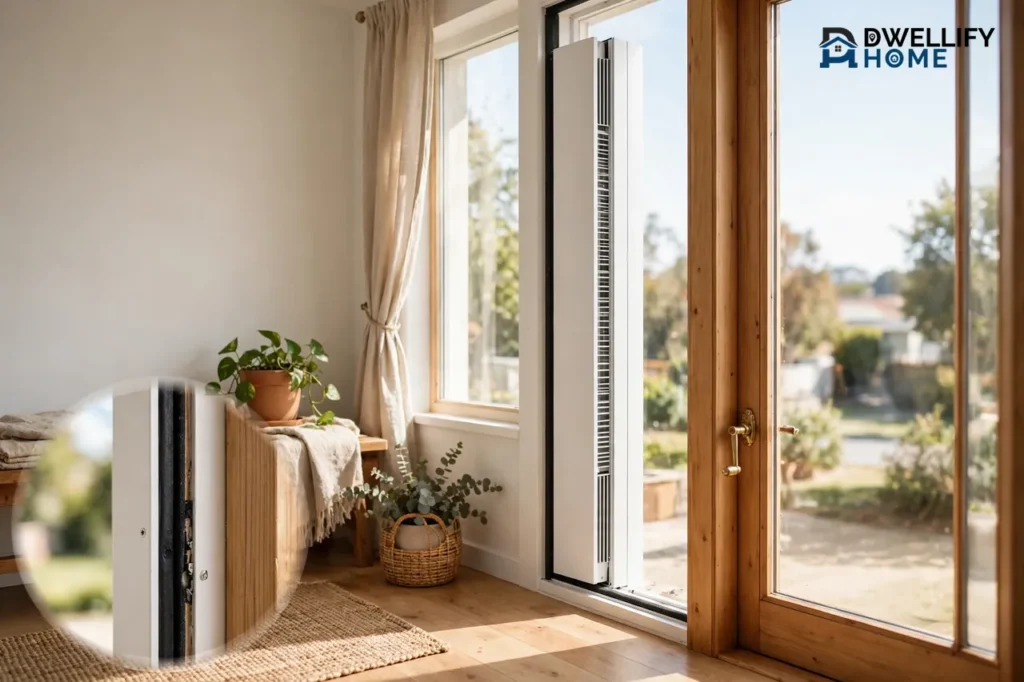
A low profile AC unit is one built shorter than a standard model so it fits tighter openings and blocks less of the view. Standard window units stand roughly 14 to 16 inches tall or more. Low-profile window units run about 12 to 14 inches. U-shaped and saddle designs go further still, with the indoor body sitting as little as five inches above the sill.
That lower stance is the whole point. You keep more daylight, you keep the view, and the unit usually runs quieter because the better designs pair the short body with an inverter compressor. For renters and small-window apartments, it’s often the only thing that fits. The same phrase also describes slim outdoor condensers for central systems, which we’ll get to later.
Standard, slim, U-shape, and saddle: the four window-unit profiles
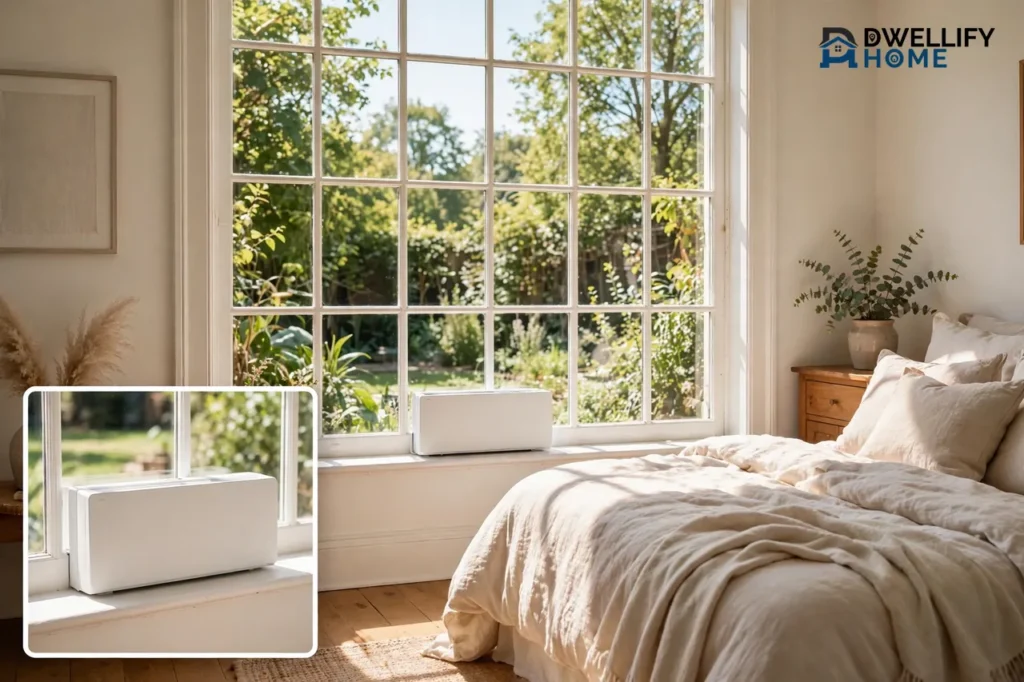
There are four shapes worth knowing. A slim traditional unit like the GE Profile PHC08LY is a shorter take on the classic box. A U-shaped window low profile AC unit, such as the Midea U or Frigidaire Gallery GHWQ085WD1, wraps around the sash so the window closes through the middle. A saddle or over-the-sill design like the GE Profile ClearView or Soleus Air Exclusive straddles the sill and barely rises into the glass. The Hisense UltraSlim takes an ultra-thin L-shape approach. Shapes matter as much as height here.
How much window opening do you actually need?
Vertical opening is the limiter, so measure that first. As a guide, the Midea U needs a window that opens at least 13.75 inches. The Hisense UltraSlim wants around 15.2 inches. The Windmill 8,000 BTU model needs roughly 14 inches. The Soleus Air Exclusive saddle unit asks for at least 16 inches.
Always confirm the figure on the spec sheet of the exact model and year you’re buying. Manufacturers revise these. Measure the clear opening with the window fully raised, not the frame, and leave yourself a little margin.
Quick fit guide by window opening
| Window opening (vertical) | Best low-profile choice |
| ~13.75–14 in | Midea U / Windmill 8K |
| ~14.6–15.2 in | Hisense UltraSlim |
| 16 in or more | Soleus Air Exclusive (saddle) |
| Crank-out / casement | Slider unit, portable, or through-the-wall |
| Tight side-yard (whole home) | Slim side-discharge condenser (Daikin Fit, Bosch IDS) |
Why people choose a low profile AC unit
- Fits short or non-standard windows a standard unit can’t clear
- Keeps more daylight and preserves the view
- Runs quieter, especially inverter models
- Easier to get past HOA or condo restrictions
- Blends into modern interiors instead of dominating the room
How to size a low profile AC by room square footage
Match BTU to the room, not to ambition. The Department of Energy’s rule of thumb is about 20 BTU per square foot, and ENERGY STAR publishes a sizing chart that’s easy to work from:
| Room size (sq ft) | Capacity (BTU/hr) |
| 100–150 | 5,000 |
| 150–250 | 6,000 |
| 250–300 | 7,000 |
| 300–350 | 8,000 |
| 350–400 | 9,000 |
| 400–450 | 10,000 |
| 450–550 | 12,000 |
Adjust from there. Drop capacity about 10 percent for a heavily shaded room and add about 10 percent for a very sunny one. Add 4,000 BTU for a kitchen, and roughly 600 BTU for each person beyond two who regularly uses the space.
Real-room examples
A 250-square-foot bedroom is comfortable on a 6,000 to 7,000 BTU unit. A 400-square-foot living room usually wants 9,000 to 10,000 BTU. A 550-square-foot open studio is a job for 12,000 BTU. Bigger is not better — an oversized unit short-cycles, never pulls enough humidity, and leaves the room cold and clammy.
How quiet is “quiet”: decibel ranges for low-profile and ultra-quiet models
Most low-profile units run somewhere between 40 and 55 decibels depending on fan speed and whether they use an inverter compressor. For reference, 30 dBA is a whisper, 40 dBA is a quiet room, 50 dBA is a refrigerator hum, and 60 dBA is normal conversation. A few decibels make a real difference in a bedroom.
The GE Profile ClearView is rated as low as 40 dB. Midea lists the U-Shaped as low as around 32 dBA, though some third-party spec sheets show closer to 42 — worth checking against the model you find. The Hisense UltraSlim sits near 37 dBA, and the Frigidaire Gallery GHWQ lands around 41 to 42. A non-inverter heat-and-cool unit like the Frigidaire FHWH runs noticeably louder, in the mid-50s.
Energy efficiency: ENERGY STAR, inverter compressors, and CEER explained
For room units, the number to read is CEER, the Combined Energy Efficiency Ratio. It measures cooling output divided by average annual power draw, and unlike the older single-point EER it includes standby electricity. Most window units fall somewhere around 8 to 15 CEER, and higher is better.
An ENERGY STAR window air conditioner clears a baseline efficiency bar. The stricter ENERGY STAR Most Efficient tier also requires the unit to run at or below 45 dB. The other thing to look for is an inverter compressor, which modulates output instead of slamming on and off. Brands cite energy savings in the 15 to 40 percent range against single-stage units — treat those as manufacturer claims, but the technology genuinely runs steadier and quieter.
The best low profile window air conditioner models worth shortlisting
These are the units I see hold up in real homes. Each note lists what matters: height behavior, capacity, noise, and who it suits. Specs change by model year, so verify before buying.
GE Profile ClearView (saddle / U-shape): preserving the window view
The most-cited “true” low-profile pick, and for good reason. The PHNT10CC delivers 10,300 BTU for rooms up to 450 square feet, and the AHTT08BC does 8,300 BTU for about 350. Its flex-depth design adjusts from 4.5 to 13.75 inches, it runs as low as 40 dB, and it pairs with SmartHQ Wi-Fi. Best for a garden view or a clean video-call background.
Midea U-Shaped and the June 2025 recall (read this before buying)
The Midea U is a strong inverter unit in 8K, 10K, and 12K BTU sizes, needs a 13.75-inch opening, and posts CEER near 15. But you need to know that on June 5, 2025, the CPSC recalled roughly 1.7 million Midea U and U+ units over a drain-pan mold risk. The recall also covers rebrands, including the Frigidaire Gallery GHWQ085WD1, Insignia NS-AC8WU3-C, Comfort Aire, Danby, Keystone, Mr. Cool, Perfect Aire, Sea Breeze, and LBG. Check your model and serial against the official CPSC recall portal before buying anything used or new old stock.
Hisense UltraSlim Inverter: the Matter-certified option
The HLAW0825TW puts out 8,000 BTU, stands about 14.6 inches tall, and weighs near 51.8 pounds. It works with ConnectLife and is Matter-certified, which matters if you run a mixed smart-home setup. Hisense claims up to 37.6 percent energy savings, a manufacturer figure rather than an independent one.
Windmill WhisperTech: the design-first DTC pick
Windmill leans into looks and quiet. The unit is around 13.3 inches tall, uses R32 refrigerant, and works with Alexa and Google. Its “9× quieter” line is marketing language; an exact decibel rating isn’t published, so judge it in person if noise is your deciding factor.
Frigidaire low profile window-mount white units: the budget mainstream
Frigidaire covers the affordable middle. The FHWW low-profile window-mount white series is the entry tier, plain and dependable, and the Frigidaire Gallery GHWW085TE1 inverter steps up to around 40 dBA. One caution: the Gallery GHWQ U-shape variant is part of the Midea recall, so don’t confuse it with the standard low-profile Frigidaire window air conditioner models.
Soleus Air Exclusive: the over-the-sill specialist
A niche saddle unit that sits about three to five inches above the sill, leaving the upper glass clear. It needs at least a 16-inch opening, which rules out the shortest windows, but nothing beats it for keeping a view intact.
Low profile window air conditioner with heat: what’s actually available
Honestly, most window units that include heat are not low-profile. The common heat-and-cool models, like the Frigidaire FHWH084, 124, and 184 series, stand 14.5 to 18 inches tall. The one widely available true low-profile heat-and-cool option is the Midea U Heat & Cool 12K inverter.
For shoulder-season warmth, heat-pump window models in the LG LW8016HR class handle mild cold efficiently, while resistance-heat units just run an electric coil. Note that ENERGY STAR excludes room ACs whose primary function is resistance heat, so don’t expect that badge on a basic heater model.
Casement, slider, and through-the-wall: when no window unit fits
Standard window ACs don’t work in crank-out casement windows — there’s no horizontal sill to rest on and no way to seal the opening. You have a few real options instead. Vertical or slider-specific units from Perfect Aire, Frigidaire (the FFRS1022R1), or Keystone are built tall and narrow for these windows.
Otherwise, a portable AC with a window seal kit, a custom plywood or plexiglass insert cut to your opening, or a through-the-wall sleeve all work. Through-the-wall is the cleanest long-term fix if you own the place, since it frees the window entirely.
Installation, support brackets, and drainage: what to plan before delivery
Get these five things right and the install goes smoothly:
- Measure the window opening vertically first. It’s the limiter, and it decides whether the unit fits at all.
- Use a metal support bracket on anything over 50 pounds. Heavier units like the GE Profile ClearView and Windmill belong on a bracket, not just the sill.
- Tilt the unit about a quarter inch toward the outside so condensate drains away from your wall — unless it has a built-in pump like the ClearView.
- Seal the side panels with weather-strip foam and a bead of exterior caulk. The foam blocks drafts; the caulk keeps insects out.
- Plug into a dedicated 115V outlet. Most low-profile units run on 115V; 230V circuits are usually reserved for higher-BTU heat-and-cool models.
Central low profile AC unit: side-discharge outdoor condensers
A central low profile AC unit is a different machine from a window unit, even though it shares the name. Here, “low profile” means a slim side-discharge outdoor condenser that protrudes only a foot or so from the wall, paired with an indoor air handler. You’d choose one for a narrow side-yard, not for an in-room footprint.
The Daikin Fit (DZ6VS and DX6VS) runs about 12.6 to 13.8 inches deep, needs only 4 to 6 inches of wall clearance, reaches up to 17.2 SEER2, and runs as low as 45 dBA. The Bosch IDS Premium Connected is a variable inverter system rated up to 19 SEER2 and 10.8 HSPF2, modulating from 26 to 130 percent and heating down to minus 4 degrees. The GE Profile Connect Series Side-Discharge is another slim option. By contrast, something like the Carrier Infinity 26 is wonderfully quiet but a traditional cube — great unit, not low-profile.
Low profile AC unit for RV: a quick crossover for full-timers
Yes, the same idea exists for RVs, and search results mix the two. The category exists there because rigs have to clear the federal 13-foot-6-inch road height, so a tall rooftop unit eats into your margin and adds drag.
The benchmark is the Coleman-Mach 8 Plus: about 8.25 inches tall, 13,500 or 15,000 BTU, sized for the standard 14-by-14-inch roof vent, and light at roughly 90 pounds. The Furrion Chill HE and Dometic Penguin II are common alternatives, and heat-pump rooftop versions exist too. It’s a real product family, just a different fit problem than a home window.
Common problems and how to troubleshoot a low profile AC
Most issues I’m called out for fall into a short list:
- Musty smell or visible mold: check the drain pan and confirm the unit pitches slightly outward so water drains. If it’s a Midea U or a rebrand, verify it isn’t on the recall list.
- Ice on the coils: usually an undersized unit working too hard, low refrigerant, or a clogged filter. Clean the filter first.
A couple more worth knowing:
- Rattling or buzzing: almost always a loose bracket, an unlevel sill, or panels that need re-sealing.
- Wi-Fi won’t pair: most smart units only join a 2.4 GHz network, so split your router bands or connect to the 2.4 GHz one.
Will your HOA or landlord let you install one?
Sometimes no, and you need to check before you buy. HOAs can legally restrict window units — a Montgomery County, Maryland Commission on Common Ownership Communities decision upheld an association’s right to ban them. On the other side, Oregon’s SB 1536 (2022) protects residents’ use of portable cooling devices in many situations.
So read your CC&Rs or lease, then ask for written approval. If the rule targets visible window units, a saddle-style model that stays below the glass is an easier sell, and a slim side-discharge condenser sidesteps the window issue entirely. Get the yes in writing before delivery day.
Frequently asked questions
What height counts as a low profile AC unit?
Roughly 12 to 14 inches tall for a window unit, versus 14 to 16-plus inches for a standard model. U-shape and saddle designs sit even lower, as little as five inches above the sill.
What’s the minimum window opening for a low profile window AC?
It varies by model, commonly 13.75 to 16 inches of vertical clearance. Measure the clear opening with the window fully raised and confirm against your exact model’s spec sheet.
Is a U-shaped AC the same as a low profile AC?
Not exactly. U-shaped is one low-profile design — the sash closes through the middle. Saddle, slim traditional, and ultra-thin L-shape units also count as low-profile.
Can a low profile window AC also provide heat?
Rarely. Most heat-and-cool window units aren’t low-profile. The Midea U Heat & Cool 12K is the main true low-profile exception currently available.
How loud is a typical low profile window AC?
Generally 40 to 55 dBA. Inverter models like the GE Profile ClearView and Hisense UltraSlim run quietest, in the high 30s to low 40s.
Which BTU do I need for my room?
Around 20 BTU per square foot. A 250-square-foot room wants about 6,000 to 7,000 BTU; a 550-square-foot space wants about 12,000.
Is the Midea U safe to buy after the 2025 recall?
Check the model and serial against the CPSC recall portal first. The June 2025 recall covered roughly 1.7 million units over mold risk, including several rebrands.
Will a low profile AC unit work in a casement window?
No standard window unit will. Use a vertical slider unit, a portable AC with a seal kit, a custom insert, or a through-the-wall sleeve.
Can my HOA legally ban a window AC?
In many places, yes. Read your CC&Rs, request written approval, and consider a saddle unit or slim outdoor condenser if visible window units are restricted.
Is a “central low profile AC unit” the same product?
No. That term means a slim side-discharge outdoor condenser for a central system, like the Daikin Fit or Bosch IDS — a different machine from a window unit.
Choosing the right low profile AC: your window, your watts, and your walls
Start with the window. If you want to keep the view, go saddle or U-shape. If you need the most cooling per dollar, a slim traditional unit wins. If you’re cooling a whole home and the side-yard is tight, look at a side-discharge condenser instead.
Then sanity-check the BTU against the ENERGY STAR chart, favor an inverter compressor with a 45 dB or lower rating, and confirm your pick isn’t on the Midea recall list. Done right, a low profile AC unit gives up almost nothing in cooling while handing back light, view, quiet, and an easier conversation with your HOA.
Disclaimer:
This content is for general informational purposes only. Product specifications, model availability, and recall status can change, and individual homes, windows, and preferences vary — always confirm current details with the manufacturer or a qualified professional before purchasing or installing.