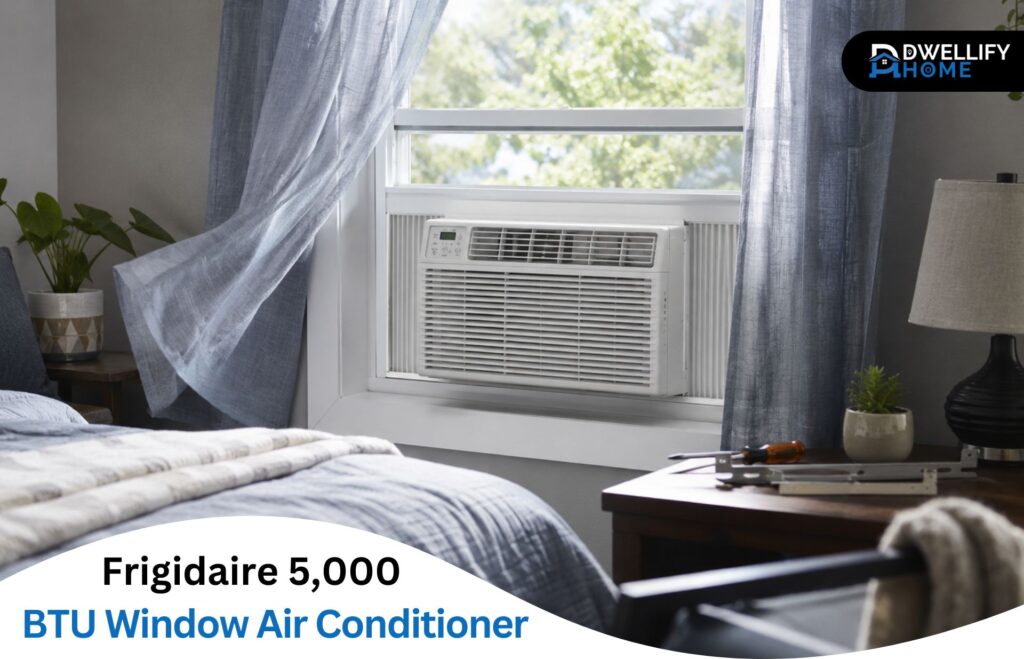
A 5,000 BTU window unit has one job: cool a small room without much fuss or much electricity. The Frigidaire 5,000 BTU window air conditioner does that job well, as long as you respect what it’s built for — a space up to roughly 150 square feet, priced somewhere around $160 to $230 depending on the model and the season. Frigidaire sells this size in a few versions right now, and the right one depends on whether you care most about price, features, or efficiency. Here’s how they actually perform, how to get one into your window, and whether it’s worth the money.
The short answer — who the Frigidaire 5,000 BTU window AC is right for
The Frigidaire 5,000 BTU window air conditioner is the right pick for one small, enclosed room — a bedroom, home office, nursery, or studio up to about 150 square feet. It suits one or two people in a single closed space. It’s the wrong tool for open-plan rooms, kitchens, or sun-baked spaces, which need more cooling power to keep up.
Our Mission
Dwellify Home helps homeowners, renters, and property enthusiasts make practical, confident decisions about their living spaces — translating real-world experience into clear guidance, so choosing something like the right window air conditioner feels straightforward rather than overwhelming.
Specs at a glance
These three models share the same core hardware. The numbers below apply across the lineup, with interpretation that the spec sheet leaves out.
Cooling capacity, coverage, and what 5,000 BTU actually means
BTU measures how much heat the unit can pull out of a room in an hour. At 5,000 BTU, this Frigidaire is rated for spaces up to about 150 square feet — a standard bedroom, not a great room. More BTU isn’t automatically better. An oversized unit cools too fast, never runs long enough to pull humidity, and leaves the room cold and clammy.
Electrical, dimensions, and window range
These run on a standard 115-volt household outlet and pull around 450 watts, which works out to under 5 amps — well within what a normal bedroom circuit handles. They weigh roughly 35 to 45 pounds depending on the model, use a standard three-prong (NEMA 5-15) plug, and the current units use R-32 refrigerant. Window openings generally need to be about 23 to 36 inches wide with a minimum height around 13 inches, but check your exact model’s spec sheet.
What 52 dBA actually sounds like in a bedroom
Around 52 decibels is the quoted noise level, which in plain terms sits close to a quiet conversation or steady light rain. It’s not silent. You’ll hear a low whoosh of the fan and the compressor cycling on and off as it holds temperature. Most people sleep through it fine — many like it as white noise — but light sleepers should know that cycling is noticeable.
Model comparison
| Model | Controls | Remote | Best for |
| FFRA051WAE | Rotary dials | No | Lowest price, simplicity |
| FHWC054TE1 | Electronic | Yes | Features, sleep mode, 3 speeds |
| FFRE053WAE | Electronic | Typically yes | Lowest running cost |
Key reasons people choose it
- Cools a small room (up to ~150 sq ft) quickly
- Runs on a standard 115V outlet at low cost
- Installs in a standard double-hung window in about 20 minutes
- Compact and light enough for one person to mount
- Auto-restart returns to your last setting after a power blip
The current Frigidaire 5,000 BTU lineup, model by model
The cooling is nearly identical across models. What you’re really choosing between is controls, a remote, and efficiency.
FFRA051WAE — the mechanical-controls budget pick
This is the no-frills, lowest-price option. You get rotary knobs — actual dials, not buttons — two fan speeds, and no remote. There’s nothing to program and nothing to break on a touchpad. For a guest room or a tight budget, the FFRA051WAE just cools the room and gets out of the way.
FHWC054TE1 — the feature pick with remote, sleep mode, and 3 fan speeds
Step up to the FHWC054TE1 and you get electronic controls, a remote, three fan speeds, a sleep mode that eases the temperature up overnight, multi-directional airflow louvers, and Frigidaire’s washable PureAir filter. This is the Frigidaire 5,000 BTU air conditioner with remote that most people picture — useful when the unit sits across the room from the bed.
FFRE053WAE — the efficiency-focused option
The FFRE053WAE is positioned as the efficiency-minded model in the line. If lower running cost is your priority, this is the one to look at — and the one to check for Energy Star certification, since that status varies by model and model year. Confirm it on energystar.gov before you buy rather than trusting a store badge.
Side-by-side comparison
| Model | Controls | Remote | Fan speeds | Notable | Best for |
| FFRA051WAE | Rotary dials | No | 2 | Simplest, lowest cost | Budget, guest rooms |
| FHWC054TE1 | Electronic | Yes | 3 | Sleep mode, PureAir filter, directional airflow | Features, convenience |
| FFRE053WAE | Electronic | Typically yes | Multiple | Efficiency-focused (verify Energy Star) | Lowest running cost |
Should you buy an older model (FFRA0511R1, FFRA0522R1)?
You’ll still see older models like the FFRA0511R1 or FFRA0522R1 on clearance or secondhand. They cool the same and can be a fair deal. The main trade-off is small: some older units had a manual fresh-air vent and slightly different filters. If the price is right and it’s in good shape, an older one is worth buying.
Does 5,000 BTU actually fit your room?
It fits if the room is enclosed and no bigger than about 150 square feet. Beyond that, or in a sunny room, a kitchen, or an open-plan space, a 5,000 BTU unit will struggle to keep up. The trick is matching capacity to the room and its conditions, not just the square footage on the box.
The sizing rules, in plain numbers
Start with 150 square feet as the baseline and adjust from there:
- Heavily shaded room: reduce capacity by about 10%
- Very sunny room: add about 10%
- More than two people in the room regularly: add 600 BTU per extra person
- Kitchen: add about 4,000 BTU
- Ceilings over 8 feet: add about 10%
These are the standard Energy Star sizing guidelines, and they’re the same adjustments I run on a real estimate.
When to step up to 6,000 or 8,000 BTU
Move up to 6,000 or 8,000 BTU once you cross roughly 150 square feet, cool a sunny room, an open layout, or anything near a kitchen. Resist oversizing “just in case.” A too-big unit short-cycles, leaves humidity behind, and wastes energy. Right-sizing beats overpowering every time.
Why some listings say 250 sq ft
Some listings claim 250 square feet for a 5,000 BTU unit. Treat that as optimistic marketing, not a spec change. The honest, comfortable coverage is about 150 square feet. The DOE testing change people mention online applies to portable air conditioners, not window units, so it doesn’t make a 5,000 BTU window AC right for a big room.
How it installs in a standard double-hung window
Putting one of these into a window is usually a 20-minute job, and you don’t need a contractor.
What’s in the box and what isn’t
Out of the box you get the unit, the adjustable side panels (accordion-style curtains), the mounting rail and screws, and foam weather seal. For most standard double-hung windows, that’s everything you need. These small units don’t require a separate support bracket, though one adds peace of mind on an upper floor.
Window width, height, and the SpaceWise side panels
The SpaceWise side panels extend like fans to fill the gap between the unit and your frame. Your opening needs to be roughly 23 to 36 inches wide and about 13 inches minimum height. Measure before you buy — a window an inch too narrow is the single most common reason a unit goes back to the store.
Step-by-step installation
- Measure the window width and height against the spec sheet.
- Raise the lower sash and center the unit on the sill.
- Seat the bottom flange behind the sill lip so the unit can’t slide outward.
- Lower the sash onto the top of the unit, into its channel.
- Extend the side panels to the frame and screw them to the unit.
- Add the foam seal where the two sashes overlap in the middle.
- Tilt the unit slightly toward the outside so condensation drains out, not in.
That last step matters more than people expect.
Outlets, cord length, and why a power strip isn’t safe
The cord runs about six feet and is meant to reach a wall outlet directly. Don’t run it through a power strip or an extension cord. The manual says this plainly, and it isn’t red tape — the compressor’s startup draw can overheat a light-gauge cord. Plug it straight into a grounded outlet, ideally one that isn’t already loaded with other appliances.
Can it go in a sliding, casement, or vertical window?
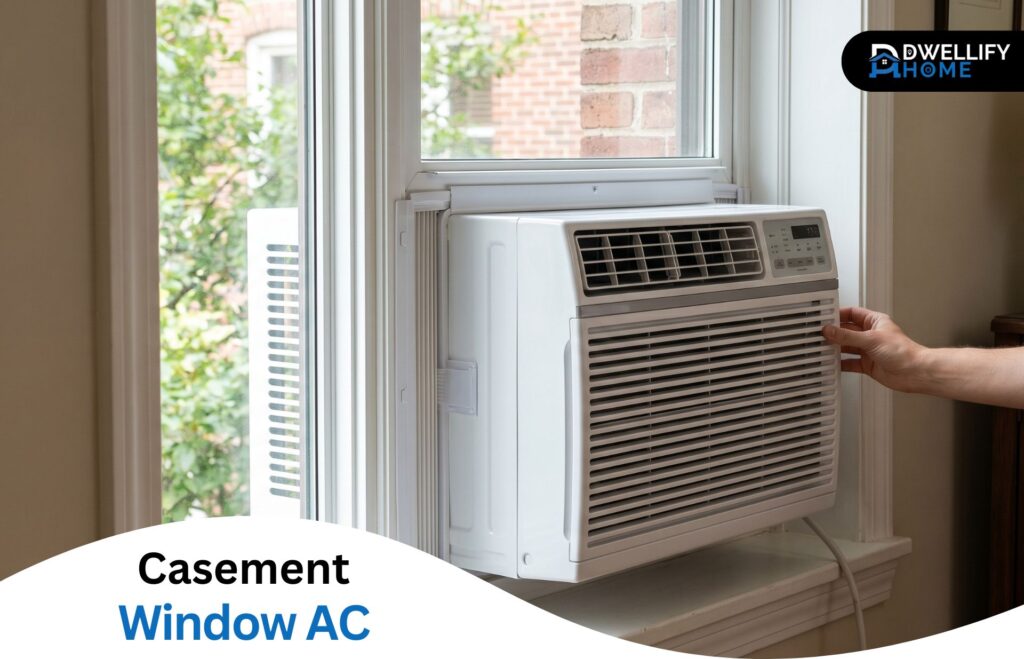
These are built for standard double-hung windows that close down onto the unit. A horizontal slider needs a special kit or a different unit, since the panels expand the wrong way. Casement (crank-out) windows generally won’t work at all. Mounting one vertically or on its side risks the compressor and drainage — don’t do it.
Real-world performance — what to expect from day one to day thirty
Here’s how it behaves once it’s running in a properly sized room.
How fast it cools a 150-sq-ft room
On a hot day, a right-sized room cools quickly. In independent lab testing, the FHWC054TE1 dropped a test room about 8°F within an hour. In a real 12-by-12 bedroom, you’ll feel it within minutes and reach a comfortable set point well inside half an hour, as long as the door stays shut.
Energy use and what it costs to run
Running cost is modest. The same testing measured about 0.47 kWh at full output. With normal cycling, a rough estimate lands somewhere around $10 to $20 a month at average U.S. electricity rates — less if you use sleep mode or a timer. Your actual cost depends on your rate and runtime, so treat that as a ballpark, not a promise.
Noise on low vs. high, and how sleep mode behaves
On low, it settles into steady background noise most people sleep through. On high, the fan is clearly louder and moves noticeably more air. Sleep mode on the FHWC054TE1 nudges the temperature up gradually overnight and lowers the fan speed, so it runs quieter and cheaper while you sleep.
Dehumidification and condensate — is dripping normal?
A little water is normal. That’s humidity being pulled from the air, and it’s supposed to drip outside. Water dripping inside the room is not normal. It almost always means the unit is sitting dead level or tilted slightly inward instead of outward. The mechanics are simple; the fix lives in the next section.
Maintenance and simple fixes that keep it running for years
Upkeep is light, and it’s most of what separates a unit that lasts from one that doesn’t.
Cleaning the washable filter and how often
Pop the front grille and pull the washable filter every two to four weeks during heavy use. Rinse it under the tap, let it dry fully, and slide it back. A clogged filter is the number-one reason one of these stops cooling well — it chokes airflow and can ice the coil.
Where the drain hole is and what to do about water inside
Water dripping inside is almost always a tilt problem. Check that the unit slopes slightly toward the outdoors — a quarter to half an inch of drop across its depth is plenty. Make sure the rear drain hole isn’t blocked by debris or a leaf. Nine times out of ten, leveling it correctly and clearing that hole stops the dripping.
Winter storage
At the end of the season, either pull the unit and store it upright indoors, or cover the exterior with a proper AC cover. Letting rain and snow sit in a mounted unit all winter is what rusts the fan motor and shortens its life — I’ve seen that alone cut years off otherwise healthy units.
Quick troubleshooting checklist
- Not cooling: dirty filter, blocked coil, or wrong room size — clean the filter first.
- Won’t restart right away: normal. Wait about three minutes for the compressor’s built-in protection.
- Ice on the coil: airflow is choked or the room’s too cold — clean the filter and run fan mode to thaw it.
- Rattling on startup: usually loose side panels or a sash that isn’t seated — tighten and reseat.
Where to find the official manual and what’s in it
Every model’s manual, quick-start guide, and spec sheet are free on Frigidaire’s Owner Center — search your model number for the Frigidaire 5,000 BTU air conditioner manual or the manual PDF. It’s worth a skim, especially the R-32 refrigerant safety notes. R-32 is mildly flammable, so the manual is firm about never poking at the sealed system or using sharp tools to clear ice.
Frigidaire vs. GE vs. LG at 5,000 BTU
At 5,000 BTU, the differences between brands are smaller than the marketing suggests. They all cool about 150 square feet on similar power. What separates them is noise, controls, a remote, and price — not raw cooling.
GE 5,000 BTU
GE’s small window units are straightforward and well-built, with both knob and electronic versions in this class. Pricing tends to run close to Frigidaire’s. If you already trust GE appliances, their 5,000 BTU window air conditioner is a safe, comparable choice.
LG 5,000 BTU
LG’s 5,000 BTU window air conditioner has a reputation for running a touch quieter on low fan, which light sleepers notice. Build quality is solid. Expect to pay similar money, occasionally a little more for that quieter operation.
Midea EasyCool as a value alternative
Midea’s EasyCool line is the usual value alternative — often the cheapest of the group, and some versions add smart controls the basic Frigidaire models skip. Quality is decent for the price; its long-term reputation sits a half-step behind the bigger names.
Pick by priority
| Priority | Best choice |
| Lowest price | Frigidaire FFRA051WAE or Midea EasyCool |
| Quietest on low | LG 5,000 BTU |
| Best remote and features | Frigidaire FHWC054TE1 |
| Lowest running cost | Frigidaire FFRE053WAE (verify Energy Star) |
| Simplest to operate | Any rotary-control model |
What owners praise — and the complaints worth taking seriously
Across years of these units, the praise and the gripes are consistent.
What consistently works well
Owners reliably like how easy these are to install, how fast they cool a small room, and how little space they take. The auto-restart feature — it returns to its last setting after a power blip — is quietly one of the most appreciated touches, especially in areas with flickering power.
Recurring issues worth knowing
The honest downsides: a few units develop fan-motor trouble in the first year or two, the side panels can let air leak if you don’t seal them well, and condensate drips inside when the unit isn’t tilted right. Newer models also dropped the fresh-air vent that some long-time owners miss.
Long-term reliability — what landlords and multi-year owners report
On the other side, plenty of long-term owners and landlords report these running reliably for years across multiple rental units. That’s the pattern worth trusting: install it level with a slight outward tilt, seal it well, clean the filter, and store it dry, and most of these last a long time.
Pricing and where to buy
Here’s what to expect on price and the logistics of buying.
Typical price range across major retailers
Expect to pay roughly $160 to $230 for a current Frigidaire 5,000 BTU window air conditioner, with the basic rotary model at the low end and the remote-equipped model higher. Prices swing with the season more than the store — Home Depot, Lowe’s, Amazon, Walmart, Best Buy, and PC Richard all land in a similar band.
What warranty you actually get
These come with a one-year parts-and-labor warranty, which covers manufacturing defects and the sealed system for the first year. Keep your receipt and register the unit. It makes a claim far smoother if the compressor or fan motor fails early.
When it’s worth waiting for a sale
The best prices show up in the shoulder seasons — late spring before the heat arrives, and the end of summer when stores clear inventory. Buying in the middle of a July heat wave is when you’ll pay the most. Plan a few weeks ahead and you’ll usually save.
Frequently asked questions
How many square feet does a Frigidaire 5,000 BTU air conditioner cool?
A Frigidaire 5,000 BTU air conditioner comfortably cools a room up to about 150 square feet — a standard bedroom, office, or small studio. Some listings claim up to 250, but 150 is the realistic figure for steady comfort, especially in a sunny or poorly insulated space.
Does the Frigidaire 5,000 BTU window AC come with a remote?
It depends on the model. The FHWC054TE1 includes a remote, while the basic FFRA051WAE uses rotary dials and has none. If a remote matters to you, check the model number before buying, because the cheapest units in this size skip it.
What window size do I need for it?
You’ll want a double-hung window roughly 23 to 36 inches wide with a minimum height around 13 inches. The adjustable side panels fill the gap to your frame. Always measure your exact opening against the model’s spec sheet before you purchase.
How many amps does it draw, and what breaker should I use?
A 5,000 BTU Frigidaire draws around 4 to 5 amps on a standard 115-volt outlet, so a normal 15-amp household circuit handles it easily. Just avoid sharing that circuit with other heavy appliances running at the same time.
Can I plug it into a power strip or extension cord?
No. Plug it directly into a grounded wall outlet. The manual specifically warns against power strips and extension cords, because the compressor’s startup draw can overheat a light-gauge cord and create a fire risk. A direct connection is the only safe option.
How loud is it on low vs. high?
On low fan it produces steady background noise around 52 decibels, similar to light rain, which most people sleep through. On high it’s clearly louder. Sleep mode, on models that have it, lowers both the fan speed and the noise overnight.
Is the Frigidaire 5,000 BTU window AC Energy Star certified?
Some models in this range carry Energy Star certification and some don’t, and it varies by model year. Frigidaire’s efficiency-focused FFRE053WAE is the one to check first. Confirm current certification on energystar.gov rather than relying on a store listing.
Why is water dripping from my window AC?
A little water draining outside is normal. Water dripping inside usually means the unit is level or tilted inward instead of slightly outward. Re-tilt it so the back sits about half an inch lower, and clear any debris from the rear drain hole.
Where can I download the Frigidaire 5,000 BTU manual?
Every Frigidaire 5,000 BTU manual is free on Frigidaire’s Owner Center — search your model number to download the manual PDF, plus the quick-start guide and spec sheet. Retail product pages at Home Depot and PC Richard often link the same documents.
How long does a Frigidaire 5,000 BTU window AC last?
Maintained well, a 5,000 BTU window unit typically lasts several years, and many owners get close to a decade. Reliability comes down to clean filters, a correct slight outward tilt, good sealing, and dry winter storage. Neglect and a rusted fan motor are what cut their life short.
The bottom line on the Frigidaire 5,000 BTU window air conditioner
The Frigidaire 5,000 BTU window air conditioner earns its place in one specific job: cooling a single room up to about 150 square feet, affordably and without much fuss. Pick the FFRA051WAE for the lowest price and dead-simple dials. Choose the FHWC054TE1 for a remote, three fan speeds, and a sleep mode. Look at the FFRE053WAE if running cost is your priority, and confirm its Energy Star status before buying. Size it to the room, install it with a slight outward tilt, seal it well, and keep the filter clean. Do that, and it’ll keep that room comfortable for years.
Disclaimer: This article is for general informational purposes only. Product specifications, pricing, and model availability can change, and individual rooms, preferences, and situations vary. Always confirm details against the manufacturer’s official documentation before purchasing or installing.