Most of the portable AC calls I get are for rooms nothing else can cool easily — a finished attic, an apartment that won’t allow a window unit, a home office sitting over the garage. Midea keeps coming up as the brand people land on, and a Midea portable air conditioner can be a strong fit for those spaces, as long as you pick the right one. This guide covers how they work, how to size them, what the features actually do in practice, and how to keep one running for years. It spans the cooling-only models and the heat-pump versions, from the 8,000 BTU units up to the 14,000 BTU Duo.
Snippet-Ready Definition
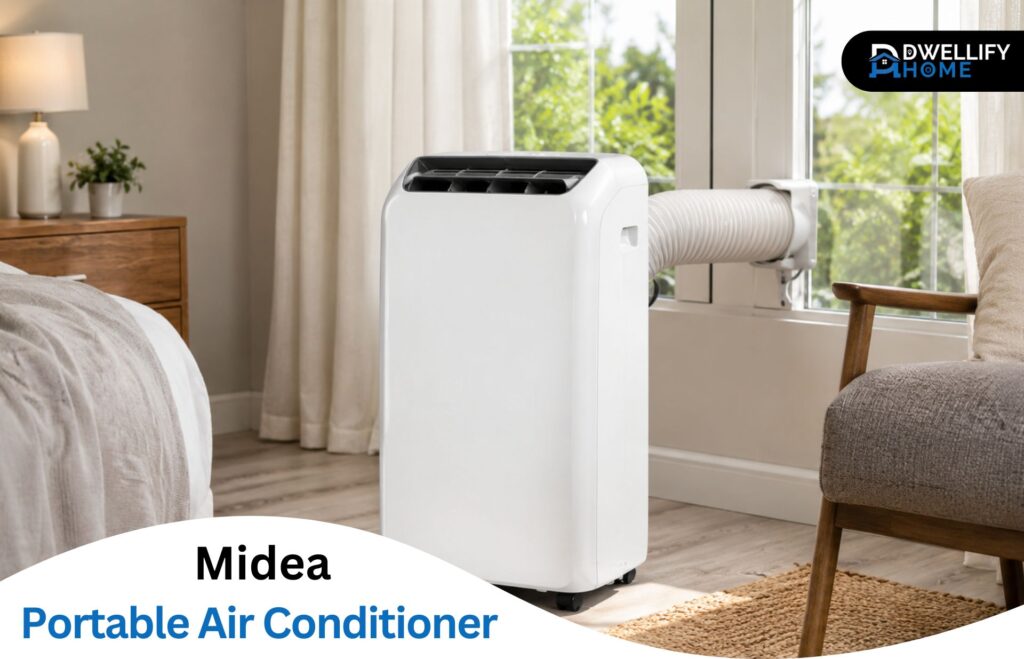
A Midea portable air conditioner is a freestanding, wheeled cooling unit that vents hot air through a window hose. Homeowners and renters use it to cool single rooms where window units or central air aren’t practical.
Our Mission
Dwellify Home exists to help homeowners and renters make confident, practical decisions about the spaces they live in. This guide reflects that goal — clear, honest information to help you choose, set up, and maintain the right portable air conditioner for your home.
How Does a Midea Portable Air Conditioner Work?
A Midea portable air conditioner pulls warm air from the room, passes it over cold refrigerant coils to strip out heat and moisture, then blows the cooled air back out. The heat it removes gets pushed through an exhaust hose to a window. It’s the same refrigeration cycle as any AC, just packed into a rolling cabinet.
That exhaust hose is the part people underestimate. The unit has to send hot air somewhere, so it always needs to vent out a window or wall — there’s no such thing as a portable AC that works in a sealed room. Most Midea units are also self-evaporative, meaning they recycle the condensation they pull from the air and breathe most of it out the exhaust, so you rarely deal with a water tank. Alongside cooling, they run a dehumidify mode and a fan-only mode, and the heat-pump models add heating.
Quick model mini-guide
| Model tier | Hose type | Best for |
| 8,000 BTU | Single-hose | Bedrooms, small offices (~350 sq ft) |
| 10,000 BTU | Single-hose or Duo | Larger bedrooms, living rooms (~450 sq ft) |
| 12,000 BTU Duo | Dual-hose inverter | Open living areas, attics (~550 sq ft) |
| 14,000 BTU (ASHRAE) Duo | Dual-hose, heat option | Year-round use; same unit as 12k SACC |
Key benefits at a glance
- Self-evaporative design — rarely needs draining in most climates
- Inverter Duo models run quietly and efficiently (CEER around 13.5, Energy Star certified)
- DIY setup in about 20 minutes with the included window kit
- 3-in-1 cooling, dehumidifying, and fan, with heat on the Duo heat-pump models
- Smart control through the SmartHome app, voice assistants, and remote
Is a Portable AC the Right Choice for Your Home?
A portable AC is worth it when a window unit or mini-split isn’t practical — rental rules, casement windows, a room with no good window, or a space you only need to cool now and then. For a single room, a Midea handles the job well. It is not the most efficient way to cool a whole house, and it won’t match central air across a large open floor plan.
Two things I tell people to weigh carefully. First, these units are heavy, often in the 70 to 85 pound range, so hauling one up to a third-floor bedroom is a real chore worth planning for. Second, the exhaust hose radiates some heat back into the room — that’s simple physics, and every portable does it. For a bedroom, office, or den, none of that is a dealbreaker. For cooling four rooms at once, you’d be better served by another type of system.
What Size Midea Portable AC Do You Need?
Match the unit to the room’s square footage. As a working rule, an 8,000 BTU Midea suits rooms up to roughly 350 square feet, a 10,000 BTU unit handles around 450, and the 12,000 to 14,000 BTU Duo models cover up to about 550. Sun exposure, high ceilings, and kitchen heat all push you toward the larger end of those ranges.
BTU and Room Size: A Quick Sizing Guide
| Model size | Approx. room coverage | Good for |
| 8,000 BTU | Up to ~350 sq ft | Bedrooms, small offices |
| 10,000 BTU | Up to ~450 sq ft | Living rooms, larger bedrooms |
| 12,000–14,000 BTU | Up to ~550 sq ft | Open living areas, attics |
Oversizing has a real downside on portables. A unit too big for the room cools the air fast, shuts off, and never runs long enough to pull out humidity, so the space feels cold and clammy. Sizing to the room actually feels more comfortable.
Why Midea’s BTU Numbers Look Lower (SACC vs ASHRAE)
People often notice that a newer Midea is rated 12,000 BTU where an older unit said 14,000, and assume it got weaker. It didn’t. The Department of Energy moved portable ACs to a tougher, more honest standard called SACC, or Seasonally Adjusted Cooling Capacity, which accounts for real-world losses the old ASHRAE number ignored. A 12,000 BTU SACC Midea Duo is the same machine that would have been labeled around 14,000 BTU under the old scale. SACC is the rating to trust, because it reflects how the unit performs in your room rather than on paper.
The Midea Portable Air Conditioner Lineup
Midea’s portable range is organized mostly by cooling capacity, with the bigger split being between the basic single-hose units and the dual-hose Duo line. Higher tiers add the inverter compressor, better efficiency, and on some models, heat. Capacity ratings below use the SACC standard, with dual labeling where Midea lists both.
Midea 8,000 BTU Models
The 8,000 BTU class, like the MPX0812CWRU, is the entry point — a 3-in-1 cooling, dehumidifying, and fan unit with dual filtration and a remote. It cools spaces up to about 350 square feet, which covers most bedrooms and small offices. These are single-hose units, lighter and cheaper, and a sensible pick when you don’t need heat or maximum efficiency.
Midea 10,000 BTU Models
Stepping up to 10,000 BTU gets you coverage to roughly 450 square feet, with both standard single-hose units and Duo dual-hose options available. This is the middle of the range and a good match for a main bedroom or a modest living room. The Duo versions at this size bring the inverter compressor and quieter, steadier cooling.
Midea 12,000 BTU Duo Models
The 12,000 BTU Duo is the flagship and the one I see most often. It uses the dual-hose design and an inverter compressor, cools up to about 550 square feet, and carries the smart features and stronger efficiency numbers. For one unit that does the most, this is usually it.
Midea 14,000 BTU (ASHRAE) Duo Models
A Midea Duo listed at 14,000 BTU is showing the ASHRAE figure for the same 12,000 BTU SACC unit — not a separate, larger machine. This top tier is where the heat-pump variants live, so these are the models to look at for year-round use rather than cooling alone.
Key Features That Set Midea Portable ACs Apart
A few features genuinely change how these units perform day to day. Here’s what each one means once it’s running in your room.
Inverter Technology and Energy Efficiency
An inverter compressor varies its speed instead of slamming fully on and off, so it holds temperature steady and sips power once the room is cool. Midea pairs this with strong efficiency ratings — the Duo models carry a CEER around 13.5 and Energy Star certification — and advertises up to 40 percent energy savings versus the federal minimum. In practice, the steady draw after cooldown is far lower than the startup load, which is what keeps running cost reasonable.
The Dual-Hose “Duo” Design
The Duo uses a hose-in-hose design: one channel draws in outside air to cool the compressor, the other exhausts it, all inside a single concentric hose. Midea markets it as roughly twice as fast and twice as strong as a single-hose unit. The real benefit is efficiency — it cools without pulling hot, unconditioned air into the room the way single-hose units do.
Cooling, Dehumidifying, Fan, and Heat Modes (3-in-1 and 4-in-1)
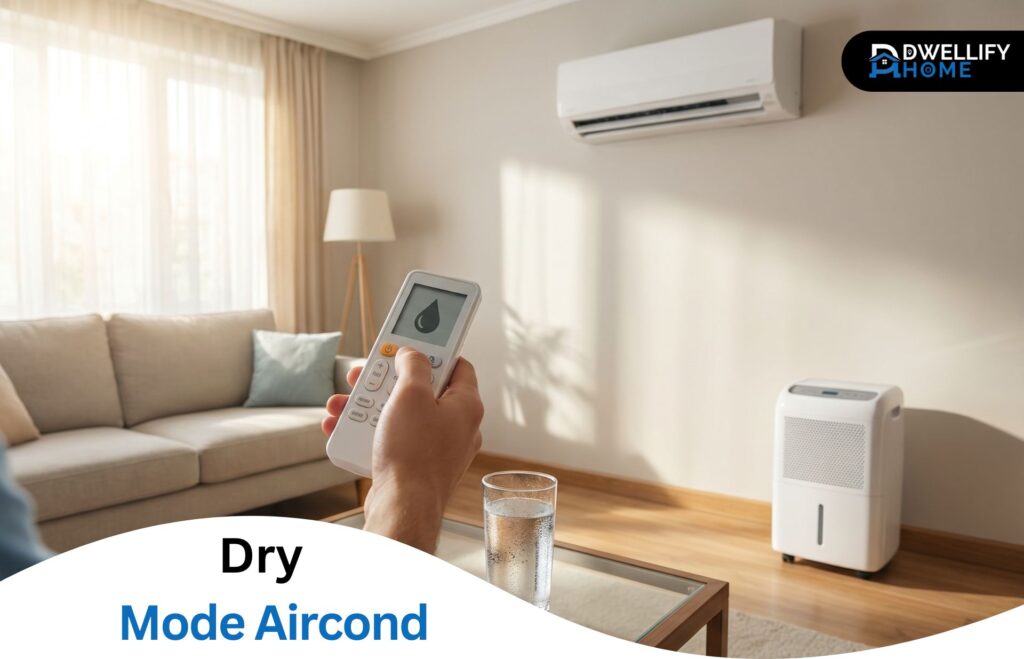
Every Midea portable does three jobs: it cools, dehumidifies, and runs as a plain fan. That’s the 3-in-1 setup. The heat-pump models add a fourth mode, heating, which makes them 4-in-1 and useful in shoulder seasons. The dehumidify mode on its own is handy on muggy days when you want drier air without the chill.
Smart Controls: SmartHome App, Voice, and Remote
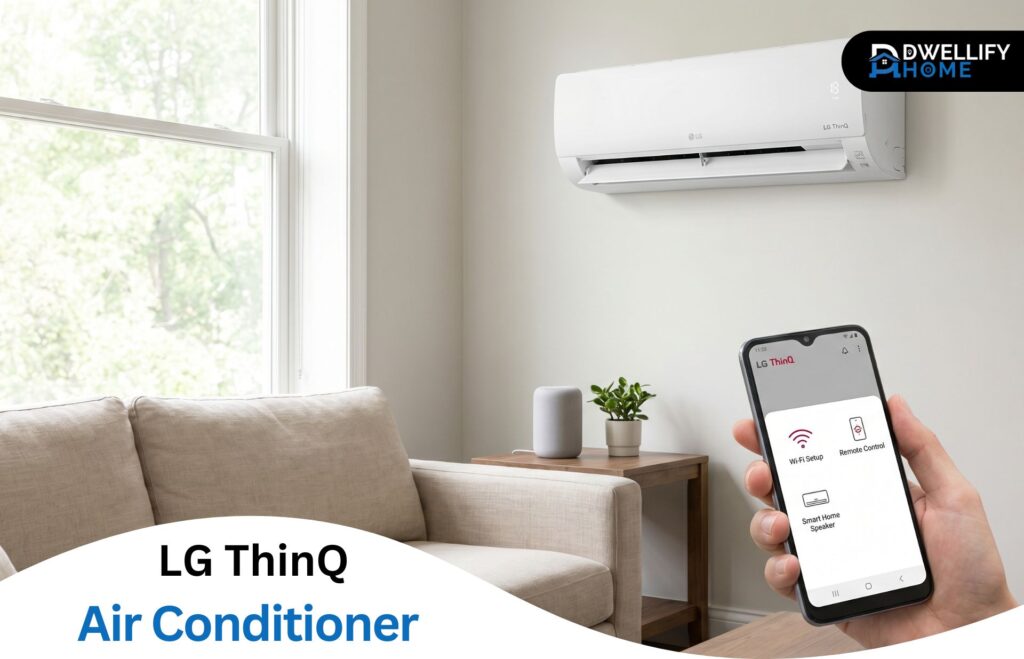
Most current Midea units are Wi-Fi connected and work with the Midea SmartHome app, plus Alexa and Google voice control, with Matter certification on newer models for easier smart-home pairing. The included remote does more than change settings — its Follow Me feature, sometimes called ComfortSense, reads the temperature at the remote rather than the unit, so cooling targets where you actually are.
Air Filtration and MShield
Midea units use a washable dual filtration system, and some models add MShield ionizer technology that helps cut odors, smoke, and gases. It’s a useful extra for air quality, but set expectations: it’s a supplement, not a replacement for a real air purifier or proper ventilation.
Single Hose vs Dual Hose: Which Should You Choose?
Choose dual-hose if efficiency matters or the room has a gas appliance; choose single-hose to save money in a simple, sealed room. The difference comes down to air pressure. A single-hose unit blows room air out the exhaust, creating slight negative pressure that draws warm outside air back in through gaps.
That pressure point is also a safety one, and it’s the part most buyers never hear. In a room with a furnace, gas water heater, or other combustion appliance, the negative pressure from a single-hose unit can pull exhaust gases back down the flue — a backdraft risk that can include carbon monoxide. Dual-hose units stay pressure-neutral and avoid this entirely. For most sealed bedrooms a single hose is fine, but anywhere near a combustion appliance, go dual-hose without a second thought.
How to Install a Midea Portable Air Conditioner
Setup is a one-person, 20-minute job. You assemble the window bracket to fit your opening, slide the exhaust hose onto the unit and the bracket, set the bracket in the window, and close the sash down onto it. Midea includes the window kit and the adapters you need, and the manual lays out the exact steps for your model.
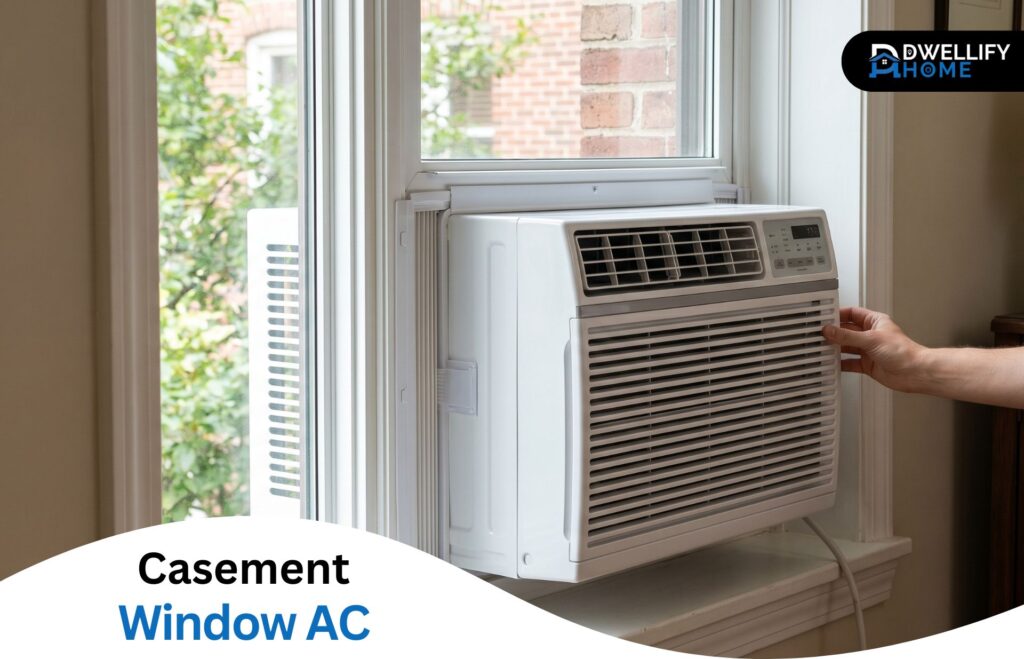
A few field notes. The hose has a round adapter on the unit end and a flat rectangular adapter on the window end — both are in the box, so don’t toss packaging before you’ve found them. The kits fit standard double-hung and horizontal sliding windows out of the box; for casement or crank-out windows you’ll likely need a separate panel or a little plexiglass work. Seal any leftover gaps around the bracket with the foam tape provided, keep the hose as short and straight as you can, and plug into a standard 120-volt outlet — these don’t need special wiring.
Do Midea Portable ACs Need to Be Drained?
In most climates, no — you won’t routinely drain a Midea. The self-evaporative system recycles condensation out through the exhaust, so under normal conditions the tank never fills. In humid coastal areas, or if you run heavy dehumidify cycles, you may need to attach a drain hose for continuous draining or empty a reservoir now and then.
The Duo models have two drain plugs, one in the middle and one near the bottom, serving different internal reservoirs, which trips people up. The lower plug is for fully emptying the unit, usually at end of season. A P1 code on the display simply means the internal tray is full — pull the plug, let it drain, and it clears. If it fills repeatedly in a short time, you’re in humid conditions and should set up continuous drainage.
Using Heat Mode on Midea Duo Models
On the heat-pump Duo models, heat mode runs the refrigeration cycle in reverse to warm the room, and it works best in mild cold rather than deep winter — typically rated to operate down around 41°F and up to about 86°F. Check your model’s manual for its exact range. You still vent the hose out the window in heat mode, same as cooling.
Treat it as shoulder-season heating — taking the chill off a room in spring or fall — not as a furnace replacement. In colder conditions the unit may run a brief defrost cycle, pausing heat output while it clears frost from the coil. That’s normal behavior, not a fault.
Cleaning and Maintenance
A portable AC is low-maintenance, but the filter is not optional. Rinse the washable filter about once a month during cooling season — a clogged filter is the single most common reason a unit stops cooling well, and it’s a five-minute fix people skip until performance drops off.
Mold is the other thing to stay ahead of. Because these units handle moisture, the inside can develop mildew over a season if it’s always shut down wet. Before storing it, run fan-only mode for a few hours to dry the interior, pull the lower drain plug to empty any standing water, then store it upright somewhere dry. Wipe the exterior and clear the exhaust grille while you’re at it. That short routine separates a unit that lasts a decade from one that smells musty by year two.
Troubleshooting Common Problems and Error Codes
Most Midea portable issues are simple and clear themselves once you know what the display is telling you. Here are the ones that come up most, though exact code meanings can vary by model, so confirm against your manual.
| Code / issue | What it usually means | What to do |
| P1 | Water tray is full | Drain via the plug; it clears on its own |
| AP | Wi-Fi pairing mode | Normal during setup; pair in the app or ignore |
| E1–E4 | Sensor or communication fault | Unplug 5 min; if it returns, have it serviced |
| EH 06 | Internal error flagged | Power-cycle; a persistent code needs support |
| Runs but no cold air | Dirty filter, or in fan/dehumidify mode | Clean the filter; confirm cool mode is selected |
| Water leaking inside | Tilted unit or loose drain plug | Level the unit; reseat the plug |
| Rattle or buzz | Loose panel or hose | Check panels and the hose connection are seated |
To reset most Midea portables, unplug the unit for about five minutes, or use the manual control button on the unit to restart it. A full power-cycle clears the majority of one-off electronic glitches.
How Midea Compares to Other Portable AC Brands
Midea earns its reputation mainly on the dual-hose Duo design and inverter efficiency, and it tends to undercut comparable units on price — that combination is why it gets recommended so often. Against Hisense, which also makes capable dual-hose units, Midea is usually the value pick while the two trade blows on features. LG’s inverter portables are strong and quiet but often cost more. Frigidaire and Black+Decker lean toward simpler, single-hose, budget units that cool fine but don’t match the Duo’s efficiency.
The short version: for efficient, quieter cooling in a single unit, the Midea Duo is hard to beat for the money. To cool a small sealed room occasionally for the least cash, a basic single-hose competitor will do the job.
How Midea Portable ACs Perform in Extreme Heat
In normal summer heat these units hold their own, but in truly extreme conditions — think 100°F and up — even a good dual-hose unit can struggle, and that’s true across the category, not a Midea flaw. The compressor and the air feeding it can simply get too hot to keep pace.
I’ve seen dual-hose units in very hot, dry climates do better switched to single-hose operation during the peak of the day. The intake air on a dual-hose setup is drawn from outside, so when outdoor air is brutally hot, that intake works against you; running single-hose pulls cooler indoor air across the compressor instead. If your unit allows reconfiguration and you’re in a desert climate, that’s a practical trick worth knowing. Set realistic expectations — any portable loses ground when it’s punishingly hot outside.
Where to Buy and How to Get the Best Price
Midea portables show up at Costco, Home Depot, Lowe’s, Best Buy, Walmart, and Amazon, and pricing moves around a lot by season and retailer. The same Duo can swing by a hundred dollars or more depending on where and when you buy, so it pays to compare before committing.
Two things matter more than chasing the lowest sticker. First, warranty: Home Depot has offered a longer warranty on some Midea units than you’ll get on a clearance or refurbished one elsewhere, and on an appliance with a compressor, that coverage is worth real money. Second, refurbished units — often found cheap at warehouse and deal sites — can be a fair deal, but they typically carry a much shorter warranty, sometimes just 90 days. If you buy refurbished, go in knowing the coverage is thin. Buy in spring or early fall and you’ll usually pay less than at the peak of a heat wave.
Frequently Asked Questions
Do Midea portable air conditioners run on a standard outlet?
Yes. The 8,000 through 14,000 BTU models run on a standard 120-volt household outlet and don’t need special wiring. Plug into a dedicated circuit where you can, and avoid sharing a circuit with other heavy appliances to keep from tripping breakers.
Can a Midea portable AC cool more than one room?
Not effectively. These units are built to cool the single room they sit in and vent from. Open one to several rooms and the air just gets diluted, leaving every space lukewarm. For multiple rooms, use one unit per room or look at a different cooling system.
Do I need professional installation?
No. A Midea portable is designed for DIY setup, and most people have it running in under half an hour with just the included window kit. The only time you’d want help is fitting a casement or unusually shaped window, which may need a custom panel.
How loud is a Midea portable air conditioner?
The quieter Duo models run around 42 decibels on low, with real-world averages closer to the high 40s under load — roughly the level of a quiet conversation or a soft fan. The inverter models are noticeably quieter and steadier than older on-off compressors.
Can it be used in a room without a window?
It still needs to vent somewhere. Without a window, the options are venting through a sliding door with a kit, a dryer-vent-style wall opening, or a drop ceiling. The hot air has to leave the space, or the room won’t cool.
How do I connect the remote or app?
The remote works out of the box once batteries are in. For the app, download Midea SmartHome, put the unit in Wi-Fi pairing mode shown by the AP indicator, and follow the in-app steps to connect it to your network and, if you want, to Alexa or Google.
Is a Midea portable air conditioner good?
Yes, Midea portable air conditioners are generally well regarded, especially the dual-hose Duo line with its inverter compressor and strong efficiency ratings. They cool single rooms effectively and tend to cost less than comparable rivals. Like any portable AC, they’re best for one room rather than whole-home cooling.
Do Midea portable air conditioners need to be drained?
In most climates, no. Midea portable units are self-evaporative, recycling condensation out through the exhaust hose, so the tank rarely fills. In humid coastal areas or during heavy dehumidifying, you may need continuous drainage or to empty a reservoir. A P1 code means the internal tray is full.
Why is Midea being recalled?
In June 2025, the CPSC and Midea recalled about 1.7 million U and U+ window air conditioners — not portable models — over a drainage flaw that let water pool and mold grow. If you own an affected window unit, contact Midea for a free repair or refund.
Is Midea AC good or bad?
Midea is a reputable, widely sold appliance brand with solid portable AC performance and good value. Reliability is generally fair, though like any brand it has occasional unit failures. The 2025 recall affected its U-shaped window units, not portables. Routine filter cleaning and drying prevent most long-term problems.
How long does a Midea portable AC last?
With regular maintenance, a Midea portable air conditioner typically lasts several years of seasonal use — commonly in the range of five to ten years. Lifespan depends heavily on care: cleaning the filter monthly, drying the interior before storage, and preventing mold are what keep it running longest.
Conclusion
Choosing a Midea portable air conditioner comes down to the room and how you’ll use it. For a bedroom or small office, an 8,000 BTU single-hose unit is plenty. For a larger living space, step up to a 10,000 BTU model, and for the most cooling, quieter operation, and best efficiency, the 12,000 BTU Duo is the one I’d point most people to. Add a heat-pump Duo if you want it earning its keep year-round, and lean toward a single-hose unit only when budget is tight and the room is simple. Size it right, vent it well, rinse the filter, and one of these will keep a room comfortable for years.
Disclaimer: This content is provided for general informational purposes only. Individual results, room conditions, and preferences vary, and specific model features or availability may change. Always check your unit’s manual and current manufacturer details before purchasing or operating.