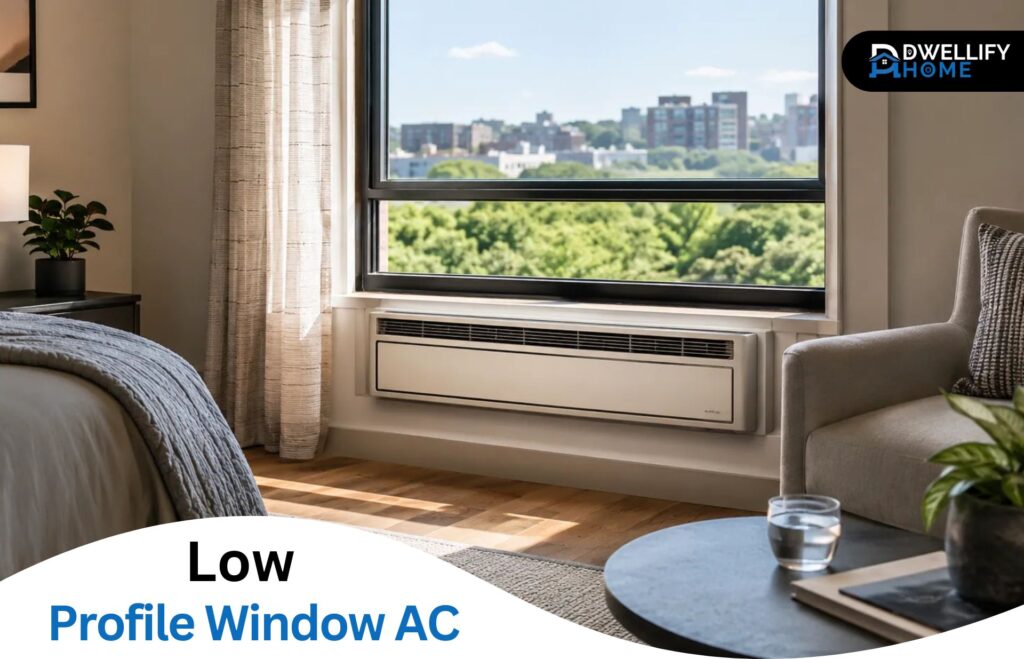
The biggest complaint I hear about window air conditioners isn’t the cooling — it’s the bulky box that swallows half the window and turns a nice view into a wall of beige plastic. A low profile window AC fixes that. These units sit lower in the opening, leave more glass exposed, and squeeze into short or odd-sized windows that a standard unit won’t touch.
Below are seven of the best low profile window air conditioners worth your money right now, plus the part most guides skip: how to actually match one to your window so it fits the first time. Get the measuring right and the rest is easy.
Snippet-Ready Definition
A low profile window air conditioner is a unit built shorter than a standard window box, usually under 13 inches tall. People choose it to fit short or non-standard windows and keep more of their view unobstructed.
Our Mission
Dwellify Home helps homeowners and renters make practical, well-informed decisions about their living spaces. With this guide, our aim is simple — help you choose a low profile window AC that truly fits your window, cools your room, and keeps your view, without the guesswork.
What Is a Low Profile Window AC? (And How Short Do They Get?)
A low profile window AC is a unit built shorter than a standard window box — usually under 13 inches tall — so it fits short windows and blocks less of your view. There’s no official industry definition, so “low profile” is really a height convention rather than a regulated label.
In practice, the heights range more than people expect. The Kapsul W5 is about 7 inches tall, LG’s LW5016 measures right around 11 inches, and GE’s Profile ClearView units sit near 12.8 inches. Anything taller than about 13 inches starts behaving like a regular window unit.
Quick comparison of the top picks
| Model | BTU | Height | Best for |
| GE Profile ClearView | 8,300–12,200 | ~12.8″ | View + quiet, midsize rooms |
| Midea U-Shaped (2026) | 6,000–12,000 | ~13.5″ | Quietest; open-window flexibility |
| LG LW5016 | 5,000 | ~11.1″ | Smallest rooms, shortest windows |
| LG LW6017R | 6,000 | ~11.1″ | Midsize value |
| Frigidaire FHWC054TE1 | 5,000 | ~12.3″ | Budget Frigidaire pick |
| Soleus Air Saddle | 10,000–12,000 + heat | Over-sill | Heat + cooling, view |
| Kapsul W5 | 5,000 | ~7″ | Maximum view (premium) |
Why choose a low profile window AC
- Fits short or non-standard windows a standard unit won’t clear
- Leaves more of the glass and outside view exposed
- Often quieter, especially inverter models
- Easier to live with in bedrooms, offices, and rentals
Low Profile vs. U-Shaped, Saddle, and Slider Units: What Actually Counts
This trips up a lot of buyers. A U-shaped unit and a saddle unit both keep your view, but they aren’t the same thing as a true low profile slide-in, and they don’t all fit the same windows.
| Type | How it sits | Window opening needed | View |
| True low profile | ~11–13″ tall in the opening | Matches unit height | Frees the top half of the glass |
| U-shaped | Compressor sits outside the glass | ~13.75″+ | Open view, window still opens |
| Saddle / over-sill | Drapes ~3–6″ over the sill | ~16″+ | Almost fully clear |
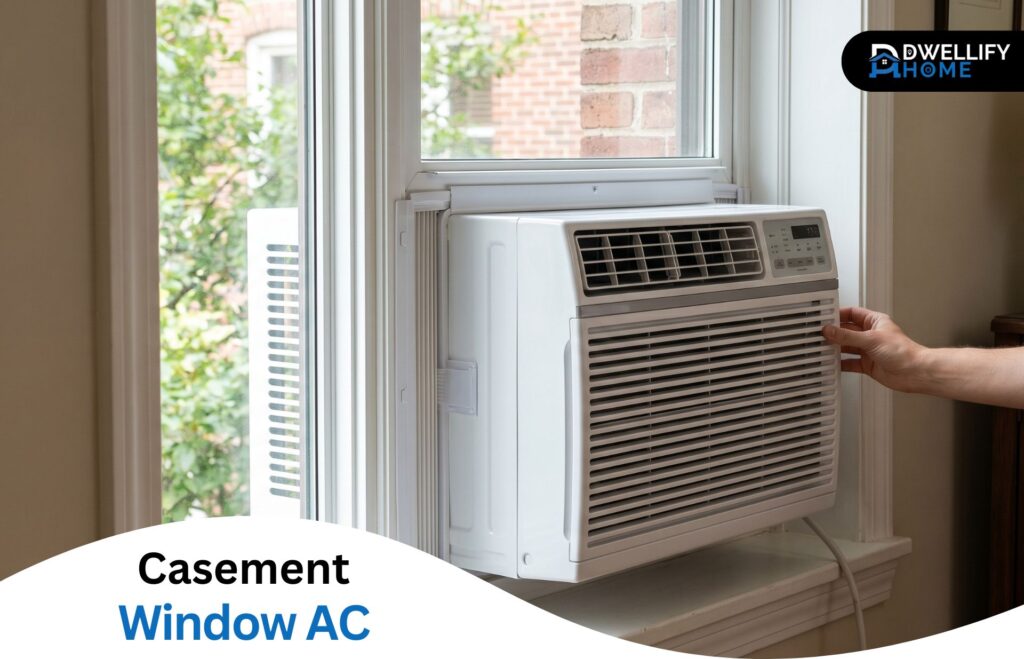
| Slider / casement | 20″+ tall, narrow | For crank or sliding windows | Blocked |
Here’s the honest version: a Midea U-Shaped needs almost 14 inches of opening, and a Soleus saddle needs about 16 — taller than some standard units. They look sleek, but by install height they aren’t really “low profile.” Slider and casement units are a different animal built for windows that crank open or slide sideways.
Before You Buy: The Midea U-Shaped Recall You Should Know About
Yes, the Midea U is still sold, but check which version you’re buying. In June 2025 the U.S. Consumer Product Safety Commission recalled about 1.7 million Midea U and U+ window units (recall 25-320) because poor drainage let water pool inside and grow mold.
Affected units sold from 2020 through mid-2025 qualify for a refund or a free repair kit. The units on shelves now are the redesigned 2026 edition with a corrected drain — those are fine. Just confirm it’s the new version before you click buy. GE and LG units were not part of this recall.
The 7 Best Low Profile Window AC Units
These picks cover the real range of needs — shortest window, quietest room, smallest space, heat, and budget. The table gives you the quick comparison; the notes below explain who each one is actually for.
| Model | BTU | Height | Min. opening | Noise (low) | Smart | Best for |
| GE Profile ClearView | 8,300–12,200 | ~12.8″ | 13″ | ~40–41 dB | Yes | View + quiet, midsize rooms |
| Midea U-Shaped (2026) | 6,000–12,000 | ~13.5″ | 13.75″ | ~32 dB | Yes | Quietest; open-window flexibility |
| LG LW5016 | 5,000 | ~11.1″ | 13″ | ~52 dB | No | Smallest rooms, shortest windows |
| LG LW6017R | 6,000 | ~11.1″ | 13″ | ~52 dB | Remote | Midsize value |
| Frigidaire FHWC054TE1 | 5,000 | ~12.3″ | 13″ | — | No | Budget Frigidaire pick |
| Soleus Air Saddle | 10,000–12,000 + heat | Over-sill | ~16″ | ~48 dB | Yes | Heat + cooling, view |
| Kapsul W5 | 5,000 | ~7″ | ~7″+ | <50 dB | Yes | Maximum view (premium) |
How We Chose These Picks
I judged these the way I’d size up a unit before installing it: real height versus the window it has to fit, how quiet it runs at low speed, efficiency, how easy it is to mount, and how much glass it leaves you. I’ve also flagged the trade-offs honestly, including a popular model that’s been discontinued and one that was recalled.
Best Overall: GE Profile ClearView Inverter
The ClearView is the one I’d put in most homes. It’s a U-shaped inverter unit that runs around 40 to 41 decibels — quiet enough for a bedroom — and because more than half the body sits below the sill, you keep nearly the whole window.
It’s smart-enabled through SmartHQ with Alexa and Google, and the Flex-Depth design adjusts to wall thicknesses from about 4.5 to 13.75 inches, which matters more than people realize on older homes. You’ll want a 13-inch opening and roughly 10 inches of clearance below it. It comes in 8,300 up to 12,200 BTU.
Quietest: Midea U-Shaped (2026 Redesign)
Nothing else in this class is quieter. The Midea U runs as low as 32 decibels — below a typical refrigerator hum — because the compressor sits in the outdoor half, behind the glass. The U-shape also lets you open and close the window, which renters love.
Buy the 2026 redesign only, for the recall reason above. It’s an inverter unit, carries an ENERGY STAR Most Efficient rating, and needs roughly a 13.75-inch opening. Ideal for nurseries and light sleepers.
Best for Small Rooms (and Best 5,000 BTU): LG LW5016
For a small low profile window AC, this is my default. At about 11 inches tall it’s the shortest mainstream unit, so it clears short windows others can’t, and as a low profile window air conditioner 5,000 BTU model it’s right for rooms up to roughly 150 square feet.
The catch is the controls: mechanical dials, no Wi-Fi, no remote. It’s also one of the louder units here at about 52 decibels. For a bedroom that’s a fair trade for the price and the height; for a media room, look at an inverter instead.
Best Midsize Value: LG LW6017R
The 6,000 BTU LW6017R is the same short profile as the LW5016 with a bit more muscle, good for rooms up to about 250 square feet, and it adds a remote. For a no-frills second bedroom or home office, it’s hard to beat on value.
Want the modern look and a quieter inverter? The Windmill WhisperTech is the alternative — just know it stands around 13.3 inches, the upper edge of what counts as low profile, so measure before you commit.
Best Frigidaire Option (and the Discontinued Model to Skip)
A lot of people still search for the Frigidaire low profile window mount air conditioner in white — the FFRL0633Q1. I’ll save you the hunt: that exact model has been discontinued, so any listing you find is leftover stock or resale.
For a current Frigidaire low profile window air conditioner, the FHWC054TE1 is the one to look at — a 5,000 BTU unit around 12.3 inches tall for small rooms. Simple and solid, no smart features. If you need more than 5,000 BTU and want to stay short, the GE ClearView is the better path.
Best Low Profile-Style With Heat: Soleus Air Saddle Heat Pump
Want one unit for warm summers and chilly shoulder seasons? The Soleus saddle is the closest thing to a low profile window air conditioner with heat. It drapes over the sill like a saddle on a horse, so the indoor part barely rises above the windowsill and the view stays open.
Be clear-eyed about the fit: a saddle needs about a 16-inch opening — taller than a standard unit — so it’s “low profile” in looks, not in install height. The WS5 series adds a heat-pump cycle and Wi-Fi. Great for spring and fall, not a deep-winter furnace.
Shortest Profile (Premium, With Caveats): Kapsul W5
At about 7 inches tall, the Kapsul W5 is the shortest window AC made, and it leaves more glass than anything else here. It’s the unit for someone who cares about the view above all and is willing to pay for it.
Two honest cautions: it costs several times what a comparable 5,000 BTU unit does, and supply and reliability have been spotty. I’d only steer someone here who has a specific reason the height matters and the budget to match.
How to Measure Your Window for a Low Profile AC
Measure the inside of the window opening, not the glass: the height from the sill to the bottom of the raised sash, and the width between the side tracks. Height is what makes or breaks a low profile fit, so check it first.
Match that height to the unit’s minimum opening:
| Unit | Minimum opening height |
| LG LW5016 / LW6017R | 13″ |
| GE Profile ClearView | 13″ (plus ~10″ clearance below) |
| Midea U-Shaped | 13.75″ |
| Soleus saddle | 16″ |
Most of these need a single-hung or double-hung window — the kind that slides up. If your opening is just shy, you can sometimes remove the lower sash to gain an inch or two, though that’s a permanent-feeling change in a rental. And if the numbers simply don’t work, a casement or slider window needs a slider-specific unit, while a window that can’t take any of these is where a portable AC earns its place.
What Size (BTU) Do You Need for Your Room?
Match BTUs to square footage. Undersize it and the unit runs nonstop without ever catching up; oversize it and it short-cycles, leaving the room cold but clammy because it never runs long enough to pull humidity out of the air. The Energy Star guidance is a reliable starting point:
| Room size | BTU |
| 100–150 sq ft | 5,000 |
| 150–250 sq ft | 6,000 |
| 250–300 sq ft | 7,000 |
| 300–350 sq ft | 8,000 |
| 350–450 sq ft | 9,000–10,000 |
| 450–550 sq ft | 12,000 |
Then adjust: knock off about 10 percent for a heavily shaded room, add 10 percent for a sunny one, add 600 BTU per person beyond two, and add 4,000 for a kitchen. When you land between sizes, round down.
How to Install a Low Profile Window AC
Most of these are a one-person job, but the order matters. Here’s the sequence I follow:
- Measure the opening one more time against the unit’s specs.
- Mount the support bracket or sill bracket — heavier units especially need the outside supported, not just the sash holding the weight.
- Set the unit in the opening and lower the sash onto the top channel.
- Tilt the unit about half an inch lower at the back so condensate drains outside, not onto your floor.
- Extend the side curtains and seal the gaps with foam to keep hot air and bugs out.
- Plug into a dedicated outlet — don’t run it on a power strip or a shared kitchen circuit.
Renters: pick a lighter unit, use a no-drill bracket, and keep the box for seasonal removal so you’re not wrestling it every spring.
Maintenance and Common Problems to Avoid
The number one issue I see is mold, and it almost always comes back to drainage. Water that can’t escape pools inside and grows mildew — exactly what triggered the Midea recall. Keep the unit tilted slightly outward and make sure the drain channel stays clear.
Clean or rinse the filter every two to four weeks during cooling season; a clogged filter chokes airflow and efficiency. On units without a built-in pump, check that water is actually draining outside and not backing up. At season’s end, dry it out, cover it, or pull and store it. Five minutes of upkeep is what separates a unit that lasts a decade from one that smells by August.
Noise, Efficiency, and the 2026 Standards That Change Your Options
For a bedroom, aim for 50 decibels or lower on the low fan setting — that’s the line between background noise and something that keeps you up. Inverter units like the Midea U and GE ClearView run well under that; older fixed-speed units like the LG LW5016 sit higher.
For efficiency, window units are rated by CEER, not SEER — SEER is for central systems and mini-splits, so ignore it on a window box. As of May 26, 2026, the Department of Energy raised the minimum CEER to 12.8 for smaller units, which effectively pushes larger units toward inverter compressors, and ENERGY STAR’s Version 7.0 took effect the same day. You’ll also see newer units using R-32 refrigerant as the industry moves off R-410A. The net effect is simple: the units you buy now are quieter and more efficient than the ones they replaced.
Do Low Profile Window ACs Come With Heat?
Mostly, no — a true sub-13-inch heat-and-cool unit barely exists. The closest options sit just above that line or use a different shape. Midea’s heat/cool inverter runs about 13.9 inches tall, and the Soleus saddle covered above adds a heat-pump cycle while keeping the view open.
For real cold there’s a newer category: the Midea Packaged Window Heat Pump, a saddle-style unit built to heat in genuinely low temperatures. Quick distinction — a heat pump is efficient but fades as it gets very cold outside, while electric resistance heat works anywhere but costs more to run. For most people, a heat-capable unit is a shoulder-season convenience, not a winter furnace.
Low Profile Options for Solar and Off-Grid Setups
Running on batteries or a small inverter changes the math. The lowest-draw 5,000 BTU units pull roughly 385 watts (Midea’s EcoSave) to about 440 watts (the LG LW5016), and some Frigidaire 5,000 BTU units advertise a low-voltage startup that’s friendlier to small inverters.
The honest limitation: as of 2026 there’s no 5,000 BTU inverter window AC from a major brand, so every unit that size is a fixed-speed compressor with a hard startup surge that can trip an undersized inverter. Stepping up to a 6,000 BTU inverter model gives you a soft start and a much lower running draw, which is usually the smarter buy for a solar setup.
Frequently Asked Questions
What is the smallest window air conditioner?
The Kapsul W5 is the shortest at about 7 inches tall. Among mainstream brands, the LG LW5016 is the smallest at roughly 11 inches. Height is what matters for short windows, so check the unit’s minimum opening rather than its BTU rating.
Is a U-shaped window AC better than a traditional low profile unit?
For noise and keeping your window operable, yes — U-shaped units are quieter and let the window still open. But they need a taller opening, around 13.75 inches, and cost more. A traditional low profile unit is cheaper and fits shorter windows.
Is it better to oversize or undersize a window AC?
Neither. An undersized unit runs constantly and never catches up; an oversized one short-cycles and leaves the room cold but humid. Size to your square footage using the Energy Star chart, then round down when you’re between two sizes.
What’s the price range for a low profile window AC?
Roughly, a basic 5,000 BTU unit runs around $150 to $230, midsize smart inverter units land near $400 to $600, and specialty units like the Kapsul W5 cost considerably more. Saddle and heat-pump models sit toward the higher end.
Can I install a low profile window AC myself?
Usually, yes. Lighter units are a one-person job; heavier ones go easier with a second set of hands. Support the weight with a bracket, tilt it slightly outward for drainage, seal the side gaps, and use a dedicated outlet rather than a power strip.
How often should I clean the filter?
Every two to four weeks during cooling season. Rinse it, let it dry, and put it back. A dirty filter chokes airflow, raises your power bill, and is one of the most common causes of weak cooling and musty smells.
What is the smallest low profile window AC?
The shortest is the Kapsul W5 at about 7 inches tall, though it’s a premium unit with limited availability. Among mainstream brands, LG’s LW5016 is the smallest at roughly 11 inches. For a short window, judge a unit by its height and minimum opening, not its BTU rating.
How much window height do I need?
Most true low profile units need about a 13-inch opening; the LG LW5016 and GE Profile ClearView both fit there, with the GE also needing roughly 10 inches of clearance below. A Midea U-Shaped needs about 13.75 inches, and a Soleus saddle needs around 16. Measure your opening height before buying.
Is a U-shaped AC the same as a low profile unit?
Not exactly. A U-shaped unit keeps your view and lets the window still open, but its installed height is taller than a true low profile slide-in — usually needing about 13.75 inches of opening. U-shaped models are quieter and more efficient; true low profile units are cheaper and fit shorter windows.
Should I oversize or undersize the unit?
Aim for the right size, not bigger. An undersized unit runs nonstop and never cools the room; an oversized one short-cycles and leaves the space cold but humid because it shuts off before removing moisture. Match BTUs to your square footage, then round down when you fall between two sizes.
Do low profile window ACs come with heat?
Rarely. A true sub-13-inch heat-and-cool window unit barely exists. The closest options sit just above that height, like Midea’s heat/cool inverter at about 13.9 inches, or use a saddle design such as the Soleus heat pump. For most people these are a shoulder-season convenience, not a deep-winter heating system.
Conclusion: Choosing the Right Low Profile Window AC
A low profile window AC gives you real cooling without losing your view or fighting a window that’s too short for a standard box. For most homes, the GE Profile ClearView is the one I’d reach for first — quiet, efficient, and it keeps the glass clear.
Whatever you choose, measure your window opening before you order. Get the height right, match the BTUs to the room, and you’ll end up with a unit that fits clean and disappears into the background — which is exactly what a good one should do.
Disclaimer: This content is for general informational purposes only. Product specifications, availability, and prices change over time, and individual homes, windows, and preferences vary. Always confirm current details and measurements before purchasing or installing.