A cooling system can only remove heat from your home when the outdoor unit can get rid of that heat properly. That outdoor unit is what many homeowners call the aircond condenser, AC condenser, or air conditioner condenser.
It’s easy to ignore because it sits outside and usually only gets attention when the house feels warm, the unit starts making noise, or the electric bill suddenly feels heavier than normal. But the condenser does a hard job every time the system runs. It handles heat, airflow, refrigerant pressure, electrical controls, outdoor dirt, rain, leaves, and long operating hours.
Understanding what it does helps you spot small issues before they turn into expensive repairs. It also helps you know what’s safe to check yourself and what should be left to a qualified HVAC technician.
Snippet-Ready Definition
An aircond condenser is the outdoor AC unit that releases heat from refrigerant so your home can keep cooling. It solves poor heat removal by moving indoor heat outdoors.
Mission Statement:
Dwellify Home helps homeowners, renters, and property enthusiasts make practical, informed decisions about home comfort, maintenance, and everyday property care.
Key Benefits / Uses
- Releases indoor heat outside so the AC can keep cooling.
- Helps refrigerant change back into liquid during the cooling cycle.
- Houses major parts such as the condenser coil, fan, compressor, and capacitor.
- Gives early warning signs through noise, weak cooling, short cycling, or fan problems.
- Needs clear airflow and routine maintenance to work efficiently.
What Is an Aircond Condenser?
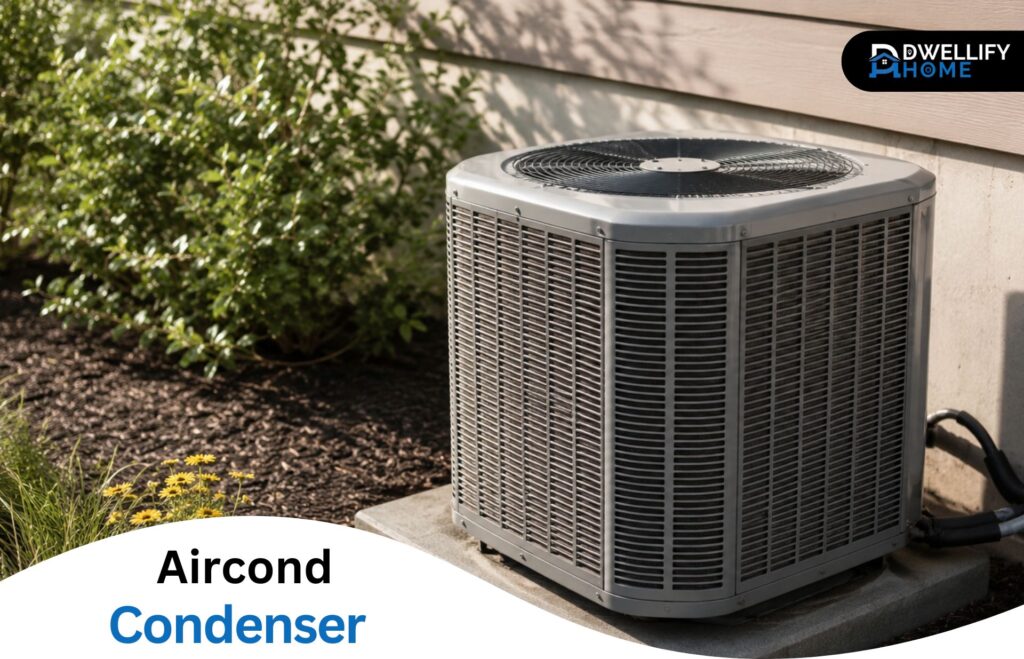
An aircond condenser is the outdoor part of a central air conditioning or heat pump system. In everyday language, people often use “aircond condenser,” “AC condenser,” and “air conditioner condenser” to describe the same outdoor cabinet.
That metal cabinet usually contains the condenser coil, compressor, condenser fan, capacitor, contactor, wiring, and refrigerant line connections. The indoor side of the system handles air movement through the home, while the outdoor condenser handles heat release.
A useful way to picture it is this: the indoor equipment collects heat from your rooms, and the outdoor condenser throws that heat outside. Both sides need to work together. A clean indoor filter won’t solve a badly clogged outdoor coil, and a new outdoor unit won’t perform well if the indoor coil or ductwork is poorly matched.
Is the AC Condenser Unit Inside or Outside?
The AC condenser unit is normally outside the home. The indoor part of the system is usually the evaporator coil, air handler, or furnace blower section, depending on the setup.
This matters because homeowners often point to the indoor cabinet and call it the condenser. That mix-up can make repair conversations confusing. The outdoor condenser needs open airflow around it, enough clearance from plants and walls, and clear access for service. The indoor side needs clean filters, proper airflow, and a healthy evaporator coil.
The outdoor location also explains why condenser problems are so common. Grass clippings, leaves, pet hair, lint, dust, and storm debris can all collect around the coil. Even a system that was installed correctly can struggle if the outdoor unit slowly gets buried in everyday yard buildup.
What Does an Aircond Condenser Do?
An aircond condenser releases heat from the refrigerant into the outdoor air. It helps turn hot refrigerant gas back into liquid so the cooling cycle can continue inside the home.
That’s the simple answer, and it’s the most important one. Your AC does not create cold air in the way people often imagine. It removes heat from indoor air and moves that heat outdoors. The condenser is where much of that heat is rejected.
When the condenser is dirty, blocked, undercharged, overworked, or electrically weak, the whole system can lose cooling capacity. The indoor vents may still blow air, and the outdoor unit may still sound like it’s running, but the system won’t remove heat properly.
How Does an Aircond Condenser Work?
The aircond condenser works by receiving hot, high-pressure refrigerant from the compressor, moving outdoor air across the condenser coil, and allowing heat to leave the refrigerant. As heat is released, the refrigerant changes back toward a liquid state and continues through the cooling cycle.
Here’s the process in plain English. The indoor evaporator coil absorbs heat from the air inside your home. The refrigerant carries that heat outside. The compressor then raises the refrigerant pressure and temperature so heat can be pushed out through the condenser coil.
The outdoor fan pulls or blows air across the coil fins. Those fins increase surface area, which helps heat move from the refrigerant into the outdoor air. Once the refrigerant has shed enough heat, it travels back toward the indoor side to absorb more heat again.
That loop repeats over and over while the AC is running. Anything that weakens airflow, refrigerant movement, heat transfer, or electrical operation can reduce cooling.
What Parts Are Inside an Aircond Condenser Unit?
Most residential aircond condenser units share the same basic parts, although designs vary by brand, size, efficiency rating, and system type.
| Part | What it does |
| Condenser coil | Releases heat from the refrigerant to outdoor air |
| Compressor | Pressurizes and moves refrigerant through the system |
| Condenser fan | Moves outdoor air across the coil |
| Capacitor | Helps start or run the fan motor and compressor |
| Contactor | Acts like an electrical switch for the outdoor unit |
| Refrigerant lines | Carry refrigerant between indoor and outdoor equipment |
| Coil fins | Increase surface area for better heat transfer |
| Service valves | Allow technicians to test and service the refrigerant circuit |
The compressor is usually the most expensive part inside the condenser. The capacitor and contactor are smaller electrical parts, but they can stop the whole unit from running when they fail.
Modern units may also use different compressor designs, such as single-stage, two-stage, or variable-speed operation. The basic job is still the same, but the way the system manages cooling output and energy use can differ.
AC Condenser vs Compressor: What Is the Difference?
The AC condenser is the full outdoor unit, while the compressor is one major component inside that unit. The compressor moves and pressurizes refrigerant; the condenser assembly releases heat outdoors.
This distinction matters during diagnosis. A technician might say the compressor has failed, but that doesn’t always mean every part of the condenser cabinet is bad. On the other hand, a badly corroded coil or incompatible old unit may make full condenser replacement more practical than replacing one internal part.
Think of the condenser as the outdoor machine and the compressor as one of its hardest-working internal parts. The fan, coil, capacitor, contactor, and refrigerant circuit all still matter.
What Is the Aircond Condenser Coil and Why Does It Matter?
The aircond condenser coil is the heat-releasing coil inside the outdoor unit. It matters because heat must pass through this coil before your AC can keep cooling the home effectively.
A condenser coil is made to transfer heat efficiently. The thin metal fins around the coil give it more surface area, which is why damage or dirt on those fins can cause trouble. A light layer of dust may not seem serious, but once dirt, cottonwood fluff, dryer lint, leaves, or grass clippings block airflow, the coil cannot reject heat properly.
A dirty condenser coil can make the system run longer, work harder, cool poorly, and place extra stress on the compressor. Bent fins can cause similar airflow problems. That’s why coil condition is one of the first things worth checking when a system runs but doesn’t cool well.
Common Aircond Condenser Problems and Warning Signs
A failing or struggling aircond condenser usually gives warning signs before it stops completely. The most common signs are weak cooling, warm air, unusual noises, short cycling, poor airflow around the unit, visible damage, and refrigerant-related symptoms such as oily residue near lines or coils.
Some warning signs are easy to notice:
- The house takes much longer to cool.
- Air from the vents feels warmer than usual.
- The outdoor fan doesn’t spin.
- The unit hums but doesn’t start.
- The system starts and stops too often.
- You hear grinding, rattling, buzzing, or clanking.
- Ice appears on refrigerant lines or indoor coil areas.
- Plants, leaves, or dirt are packed around the outdoor cabinet.
A condenser can also look fine from a distance and still have a problem. Weak capacitors, failing contactors, refrigerant leaks, fan motor issues, and compressor problems are not always obvious without testing. The key is to notice changes early rather than waiting until the system quits during heavy heat.
Why Is My Aircond Condenser Running but Not Cooling?
An aircond condenser can run without cooling properly when heat transfer, refrigerant flow, airflow, or electrical performance is weak. Common causes include dirty condenser coils, blocked outdoor airflow, low refrigerant, a weak capacitor, a failing fan motor, thermostat issues, or aging equipment that no longer performs well.
Start with the simple clues. A condenser packed with leaves or grass clippings may run loudly and continuously because it can’t breathe. A fan that spins slowly, starts late, or stops during operation may point toward a motor or capacitor issue.
Refrigerant problems feel different. The system may run for a long time, cool poorly, and sometimes show frost or ice on lines or coils. Refrigerant is not something to “top off” casually. A low charge usually means there is a leak or another issue that needs proper diagnosis.
Thermostat settings can also create false alarms. Make sure the system is set to cooling, the temperature setting is below room temperature, and the fan is not only set to “on” while cooling is off.
What Does a Bad AC Condenser Capacitor Do?
A bad AC condenser capacitor can stop the outdoor fan or compressor from starting correctly. It may cause humming, hard starting, intermittent operation, weak fan movement, overheating, or a condenser that clicks but does not run.
The capacitor is a small electrical component, but it plays a big role. Many condenser motors need that stored electrical boost to start and run properly. When the capacitor gets weak, the unit may act like it has a much larger problem.
A classic sign is a condenser that hums while the fan blade doesn’t start. Sometimes the fan may start later, spin slowly, or shut down again. These symptoms need care because the unit contains high-voltage components even when it looks harmless. Capacitor diagnosis and replacement should be handled by someone who knows how to discharge and test it safely.
What Can Homeowners Safely Check Before Calling a Technician?
Homeowners can safely check thermostat settings, breakers, air filters, outdoor debris, visible coil blockage, blocked clearance, unusual sounds, and whether the outdoor fan is spinning. Refrigerant work, compressor testing, capacitor replacement, and high-voltage electrical repair should be left to a licensed HVAC technician.
A safe homeowner check should be visual and simple. Look around the outdoor unit. Clear leaves, loose weeds, and debris from the outside. Make sure furniture, storage boxes, fencing, or plants are not choking airflow.
Check the indoor filter too. A dirty filter can cause indoor airflow problems that feel like condenser trouble. Also look at the breaker panel. A tripped breaker may reset once, but a breaker that trips again is a warning sign, not something to keep forcing.
Do not remove panels and start touching wires unless you’re trained. Outdoor AC units use serious voltage, and capacitors can hold a charge. It’s not worth turning a repair call into an injury.
Aircond Condenser Maintenance Tips for Better Cooling
Good aircond condenser maintenance is mostly about airflow, cleanliness, and early attention. Keep the outdoor unit clear, protect the coil from heavy buildup, trim plants back, watch for damage, and schedule professional service before small issues become major failures.
A practical maintenance routine looks like this:
- Keep leaves and loose debris away from the cabinet.
- Trim shrubs and plants so the unit has room to breathe.
- Avoid blowing grass clippings directly into the coil.
- Keep mulch, soil, and stored items away from the base.
- Listen for new noises when the system starts.
- Watch for fan wobble, rust, or visible coil damage.
- Have the system checked when cooling performance changes.
Do not use a pressure washer on the coil. Strong water pressure can bend fins and create more problems than it solves. Gentle cleaning methods are safer, and a technician can clean deeper buildup without damaging the coil.
How Often Should You Clean or Service an Aircond Condenser?
An aircond condenser should be visually checked several times during the cooling season and professionally serviced on a routine schedule, often before heavy cooling weather begins. Homes with dusty yards, nearby trees, pets, storms, or heavy AC use may need more frequent attention.
The best timing depends on the home. A unit sitting beside a clean paved area may stay cleaner than one surrounded by shrubs, loose soil, cottonwood trees, or lawn mowing debris. Coastal areas can add corrosion concerns, while dusty regions can clog coils faster.
A quick homeowner look every few weeks during heavy use is sensible. That doesn’t mean taking the unit apart. It means checking whether the coil is blocked, the fan area is clear, and the system sounds normal.
Professional service goes deeper. A technician can test electrical parts, check refrigerant performance, inspect coils, confirm airflow, and catch weak components before they fail under peak load.
How Much Does AC Condenser Replacement Cost?
AC condenser replacement cost varies widely because the final price depends on unit size, efficiency rating, refrigerant type, system design, labor difficulty, local market rates, warranty coverage, and whether the indoor equipment must be matched or changed.
The price of condenser for air conditioner replacement is not just the metal box. Tonnage matters because larger homes usually need larger equipment. SEER2 and EER2 efficiency ratings can affect equipment cost. Refrigerant type and compatibility also matter, especially when older systems use parts that do not match newer equipment standards.
Labor can change the total as much as equipment. A simple outdoor swap with good access is different from a difficult installation with line-set issues, electrical upgrades, poor pad condition, or indoor coil compatibility problems.
Treat any online number as a starting point, not a quote. A proper estimate should explain what equipment is included, whether the indoor coil matches, what warranty applies, and whether any refrigerant-line, electrical, or permit work is needed.
Should You Repair or Replace an Aircond Condenser?
Repair makes sense when the condenser is fairly healthy, the problem is limited, parts are available, and the rest of the system is in good condition. Replacement becomes more sensible when the unit is older, repeatedly failing, leaking refrigerant, badly corroded, inefficient, or has major compressor or coil damage.
Small repairs are often reasonable. A failed capacitor, contactor, or fan motor does not automatically mean the condenser should be replaced. The age and condition of the full system matter more than one bad part.
Replacement deserves a serious look when the compressor has failed, the coil is leaking, the system uses outdated or costly refrigerant, or the unit has had repeated service calls. Another key point is matching. A new outdoor condenser must work properly with the indoor coil and system controls.
The smartest decision is rarely based on one factor. Compare repair cost, system age, comfort problems, energy use, warranty status, and how long you plan to stay in the home.
How to Choose the Right Replacement AC Condenser Unit
The right replacement AC condenser unit must be correctly sized, compatible with the indoor system, suited to the home’s cooling load, matched to the proper refrigerant, and installed according to manufacturer requirements. Bigger is not better when it comes to AC sizing.
Tonnage is one of the first details people notice, but it should not be guessed from square footage alone. A proper load calculation considers insulation, windows, ceiling height, climate, ductwork, air leakage, and sun exposure. Oversized equipment can short cycle, remove humidity poorly, and wear out faster.
Efficiency also matters. SEER2 and EER2 ratings help describe cooling efficiency, but the best choice depends on budget, climate, usage, and system compatibility. A heat pump condenser is different from a cooling-only condenser, and a split system is different from packaged equipment.
Refrigerant compatibility is another important detail. Newer equipment may use refrigerants such as R-32 or R-454B, while many existing systems use R-410A. The indoor coil, line set, metering device, and outdoor unit all need to be evaluated together.
Home AC Condenser vs Car AC Condenser: What Is Different?
A home AC condenser is part of a residential HVAC system and normally sits outside the house. A car AC condenser is a vehicle heat exchanger located near the front grille or radiator area, where it releases heat from refrigerant used to cool the cabin.
The basic heat-transfer idea is similar, but the equipment, layout, failure points, and repair process are different. A car AC condenser can be damaged by road debris, front-end impact, corrosion, or leaks near the vehicle’s cooling area. A home condenser is more likely to deal with yard debris, airflow restriction, electrical parts, refrigerant leaks, and outdoor weather exposure.
The cost to replace AC condenser car parts is a separate topic from residential condenser replacement. Labor, refrigerant handling, part access, and vehicle model all affect automotive repair pricing. For this guide, the main focus stays on home air conditioning systems.
FAQs About Aircond Condensers
How long does an AC condenser last?
An AC condenser can last many years when it is properly installed, matched, maintained, and protected from airflow blockage. Lifespan depends on climate, usage, maintenance, installation quality, refrigerant health, and how often the system runs under heavy load.
Can you replace just the condenser?
Sometimes you can replace just the condenser, but it must be compatible with the indoor coil, refrigerant, line set, controls, and system requirements. Replacing only the outdoor unit without checking the full system can create performance and warranty problems.
Is the condenser the same as the compressor?
No. The condenser is the outdoor unit or heat-rejection assembly. The compressor is a major part inside that outdoor unit. The compressor moves and pressurizes refrigerant, while the condenser coil and fan help release heat outdoors.
Does a dirty condenser coil raise energy use?
A dirty condenser coil can increase energy use because the system has to run longer and work harder to release heat. It may also raise operating pressure and add stress to the compressor and fan motor.
Why does my condenser fan stop spinning?
A condenser fan may stop because of a bad capacitor, failed fan motor, wiring problem, contactor issue, control problem, or overheating. Since electrical testing is involved, this is a good point to call a technician.
What is an aircond condenser?
An aircond condenser is the outdoor part of a central AC or heat pump system. It contains parts such as the condenser coil, fan, compressor, and electrical controls. Its main job is to release heat outdoors so refrigerant can continue cooling the home.
How much does it cost to replace an AC condenser?
AC condenser replacement cost varies widely based on size, efficiency rating, refrigerant type, labor, system compatibility, and warranty coverage. A proper quote should explain the equipment, indoor coil match, refrigerant requirements, labor scope, and any electrical or line-set work.
What is the condenser in the AC unit?
The condenser is the outdoor heat-release section of the AC system. It receives hot refrigerant from the compressor, moves outdoor air across the condenser coil, and helps turn the refrigerant back into liquid before it returns indoors to absorb more heat.
How do I know if my AC condenser is bad?
Common signs include warm air, weak cooling, unusual buzzing or grinding noises, short cycling, refrigerant leaks, a fan that won’t spin, or a unit that runs but doesn’t cool. Some issues are simple airflow problems, while others need professional testing.
Is an AC condenser the same as a compressor?
No. The condenser is the full outdoor unit or heat-rejection assembly. The compressor is one important part inside that unit. The compressor moves and pressurizes refrigerant, while the condenser coil and fan help release heat outdoors.
Conclusion: Keeping Your Aircond Condenser Efficient, Safe, and Reliable
The aircond condenser is one of the hardest-working parts of a home cooling system. It releases heat outdoors, protects the cooling cycle, and depends heavily on clean airflow, healthy electrical parts, proper refrigerant movement, and correct equipment matching.
The best habit is simple: keep the outdoor unit clear, notice changes early, and don’t ignore weak cooling, strange sounds, short cycling, or a fan that struggles to start. A little attention around the condenser can prevent a lot of discomfort later.
For anything involving refrigerant, high-voltage electrical parts, compressor testing, or major replacement decisions, bring in a qualified HVAC technician. Safe checks are useful, but proper diagnosis is what keeps the system reliable.
Disclaimer:
This content is for general informational purposes only. Individual systems, homes, costs, and repair needs can vary, so major AC issues should be checked by a qualified HVAC professional.