
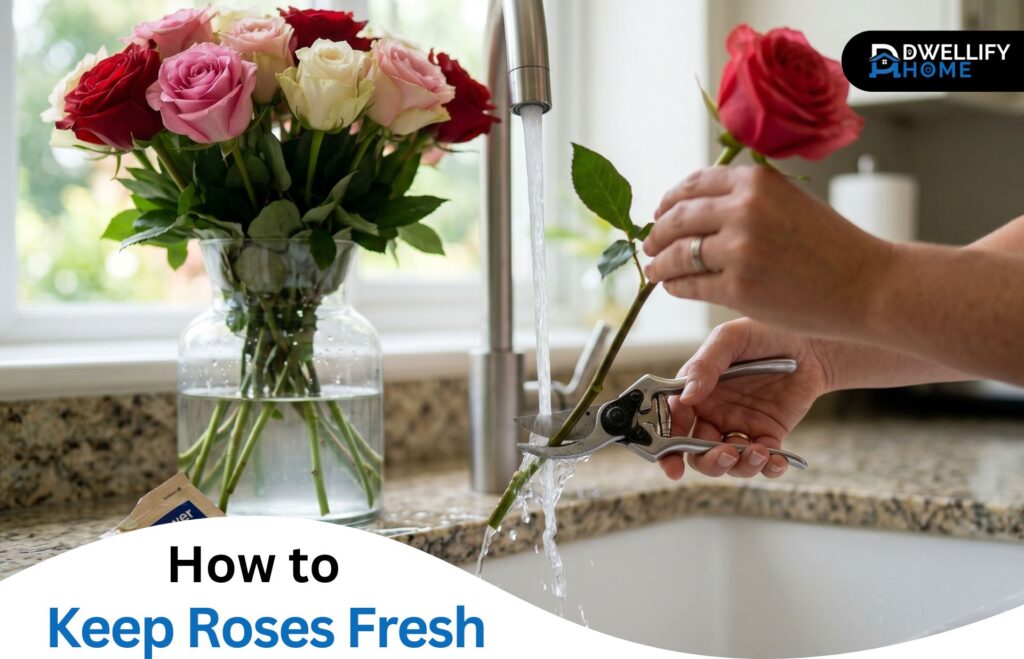
Roses have a reputation for being temperamental, but most of the time, they’re not the problem — the care routine is. Over the years, I’ve watched clients bring home gorgeous bouquets that wilted in three days, and I’ve seen the same roses last close to two weeks with just a few small changes. The difference rarely comes down to luck or rose quality. It comes down to what happens in the first hour, and what you do every couple of days afterward.
This guide walks through everything I’ve learned about how to keep roses fresh — the practical steps, the small details that get overlooked, and the situational tricks for things like overnight storage and gifting. None of it is complicated. You just need to know what actually matters.
The Short Answer
To keep roses fresh, place them in a clean vase with lukewarm water and flower food, trim stems at a 45-degree angle, remove submerged leaves, and change the water every 2 to 3 days. Keep them in a cool spot away from sunlight, heat, and ripening fruit.
Mission Statement
At Dwellify Home, we help homeowners make practical, stylish, and informed décor decisions. From everyday home solutions to garden care and lifestyle inspiration, our goal is simple: give you clear, trustworthy guidance you can actually use to make your home feel like yours.
How Long Do Fresh-Cut Roses Last?
A typical bouquet of cut roses lasts about 5 to 7 days with average care. With proper handling, that same bouquet can stay beautiful for 10 to 14 days, and certain florist-grade varieties push even further than that.
Three things mostly decide how long your roses will last: the variety itself, how fresh they were when you got them, and the environment they’re sitting in.
Roses bought from a supermarket cooler that’s been sitting there for four days will never last as long as ones from a local florist who got them fresh that morning. That’s worth knowing before you start blaming yourself for a short bouquet.
Key Benefits of Proper Rose Care
- Extends bouquet life from 5–7 days to 10–14 days
- Prevents droopy stems caused by air bubbles and bacteria
- Keeps water clean and petals vibrant for longer
- Saves money by getting the most from every bouquet
- Works for both florist roses and garden-cut blooms
Quick Care Reference
| Care Step | Frequency | Why It Matters |
| Change vase water | Every 2–3 days | Stops bacterial buildup |
| Re-trim stems | Each water change | Reopens water channels |
| Remove submerged leaves | Day one | Prevents rot and bacteria |
| Refrigerate overnight | Optional, daily | Adds 3–5 days to life |
| Keep away from fruit | Always | Avoids ethylene gas damage |
Why Cut Roses Wilt Faster Than They Should
Most premature wilting comes from one of four causes, and once you know them, you’ll spot the issue in seconds.
The first is bacteria. Vase water turns into a bacterial soup faster than people think, usually within 48 hours. That bacteria clogs the stems and stops water from reaching the bloom.
The second is air bubbles. When you cut a stem and expose it to air for too long, tiny air pockets travel up the stem and block water uptake. This is the number one reason for sudden droopy heads.
The third is ethylene gas, which ripening fruit gives off. A bowl of bananas across the room can age your roses by days.
And finally, heat, drafts, and dry air pull moisture out of petals faster than the stems can replace it.
What You Need to Keep Roses Fresh
You don’t need much. Just four basics:
- A clean vase, scrubbed with hot soapy water (residue from the last bouquet matters more than people realize)
- Sharp scissors or floral shears, since kitchen scissors crush stems and crushed stems can’t drink properly
- Lukewarm or room-temperature water (cold shocks them, hot damages them)
- Flower food, either the packet from the florist or a simple homemade mix
If you’ve ever wondered why some bouquets last and others don’t, this is usually where it starts. A dirty vase alone can knock 3 to 4 days off the life of your roses.
Step-by-Step: How to Keep Roses Fresh in a Vase
This is the routine I follow with every bouquet, and it takes about ten minutes.
Step 1: Clean the vase thoroughly. Hot water, dish soap, scrub the inside with a brush. If the vase has been in storage, wash it again. Dust and old residue both shorten rose life.
Step 2: Fill with lukewarm water and add flower food. Lukewarm water moves up the stems faster than cold, helping thirsty roses rehydrate quickly.
Step 3: Trim the stems at a 45-degree angle, ideally under running water or in a bowl. The angled cut gives more surface area for water uptake. Cutting under water prevents air bubbles from sneaking into the stem.
Step 4: Remove every leaf that would sit below the waterline. Submerged leaves rot fast and breed bacteria.
Step 5: Arrange the stems with a little breathing space. Crowded stems trap moisture between blooms and speed up petal damage.
Step 6: Place the vase in a cool spot with indirect light. Avoid windowsills with direct afternoon sun.
Where to Place Your Roses for Maximum Freshness
Roses prefer rooms between 65 and 72°F. Cooler is fine. Warmer is risky.
Things to keep them away from:
- Direct sunlight, especially afternoon windows
- Heaters and vents
- Drafty doorways and air conditioner blasts
- Anywhere near a fruit bowl
That last one catches almost everyone off guard. Apples, bananas, tomatoes, and avocados release ethylene gas as they ripen, and ethylene tells flowers it’s time to age. I’ve seen bouquets fade in three days simply because they were sharing a kitchen counter with a fruit basket.
Daily Care and Maintenance
This is where most people lose their roses early. The bouquet looks fine, so they leave it alone, but the water is already turning.
Change the water every two to three days. Don’t just top it off. Pour it out, rinse the vase, and refill with fresh lukewarm water and a new dose of flower food.
Each time you change the water, take the roses out and trim half an inch off the bottom of each stem. The cut end seals over within a day or two, and a fresh cut reopens the channels.
Pull out fading petals and any blooms that have given up. One wilted rose left in the bunch releases ethylene of its own and pulls the rest down with it. Cloudy water and bent necks are early warnings. Don’t ignore them.
Homemade Rose Preservatives That Actually Work
If you don’t have the florist packet, a few homemade mixes do a respectable job. The goal is the same: feed the rose, kill bacteria, and slightly acidify the water.
- Sugar and apple cider vinegar: Two tablespoons of each per quart of water. Sugar feeds the bloom, vinegar slows bacteria.
- Crushed aspirin: One regular aspirin per quart. The salicylic acid lowers water pH and helps the stems drink. Studies on this are mixed, but in practice, it works better than plain water.
- Lemon-lime soda (non-diet): Mix about one part soda to three parts water. Sugar and acid in one go.
- Vodka or diluted bleach: A few drops only. Both reduce bacterial growth. Use bleach sparingly — a quarter teaspoon per quart is plenty.
What I’d avoid: softened water (the salt content is rough on stems), pennies (the old copper trick rarely outperforms a clean vase), and anything you read on social media without context. Fancy isn’t better. Clean and consistent is better.
How to Keep Roses Fresh Overnight
The fridge is your best friend for overnight storage. A cold environment slows aging dramatically.
Set the fridge between 34 and 40°F if you can. The vase goes in upright, water and all. Before you put them in, take out any fruits or vegetables. That ethylene issue applies in the fridge too, sometimes worse because of the small enclosed space.
Roses can sit in the fridge for 6 to 8 hours overnight without issue. I do this for clients who need their bouquet to look perfect for an event the next day. Just bring them back out in the morning to a cool, indirect-light spot.
How to Keep Roses Fresh Without Water for Short Periods
Sometimes you can’t get them into water immediately. There’s a workable short-term fix.
Wrap the cut ends of the stems in a damp paper towel, then cover that with a small piece of plastic wrap or a plastic bag. Secure it loosely with a rubber band. This holds enough moisture to keep the stems hydrated for several hours.
Keep them cool while they’re out of water. A car trunk in summer heat will kill a bouquet faster than anything else on this list.
Realistically, roses can survive 4 to 6 hours without proper water, sometimes longer in cool conditions. Beyond that, you’ll start to lose them.
How to Keep Roses Fresh Before Giving Them as a Gift
Gifting roses the next day, or two days later, is something I deal with constantly. The trick is treating them like you’re going to use them yourself, then storing them properly.
Trim and condition them first: clean cut, fresh water, flower food, no submerged leaves. Let them rest in water for at least an hour before storage.
For overnight storage, the fridge is ideal. For 24 to 48 hours, keep them refrigerated overnight and in the coolest part of your home during the day, away from light and ethylene sources. Don’t rewrap them tightly until the moment of gifting. Wrapping a hydrated rose for hours leads to bent stems and squished petals.
How to Revive Wilting or Drooping Roses
A drooping rose isn’t always a dead rose. Most of the time, it’s a hydration block, and you can pull it back.
The warm-water bath method works on most cases. Recut the stem at a 45-degree angle, then place the rose in water around 110°F for 30 to 60 minutes. The warmth pushes through air blockages and gets the stem drinking again.
For severe wilting, lay the entire rose horizontally in a sink or bathtub of cool water with the bloom, leaves, and stem all submerged. Leave it for 30 to 60 minutes. The petals absorb moisture directly and often perk up.
Always recut under water afterward to keep new air bubbles from forming.
A rose is beyond saving when the neck has shriveled or turned papery, the petals feel dry and crisp, or the bloom has gone limp for more than a day. Past that point, the cell structure has collapsed and water can’t fix it.
How to Cut Garden Roses for Maximum Vase Life
Garden roses are a different game. They’re not bred for shipping, so the cutting process matters more.
Cut early in the morning, ideally between 6 and 9 AM, before the sun pulls moisture out of the petals. Roses are at their plumpest then.
The night before, give the rose bush a deep watering. The plant absorbs that water through the night, and the stems you cut the next morning will have noticeably more substance.
Choose buds that are just starting to open, with petals beginning to unfurl but not fully spread. Tight buds may never open in the vase, and fully open blooms drop petals within days.
Once cut, get them into a bucket of lukewarm water immediately, then condition them in a cool, dark spot for an hour before arranging.
Long-Lasting Rose Varieties Worth Knowing
Some roses simply last longer. If vase life matters to you, these are worth asking for by name.
Among florist-grade varieties, Black Magic, Red Intuition, Crystalline, and Veteran’s Honor consistently last 10 to 14 days. They were bred for shipping and shelf life, and it shows.
Garden roses, including most David Austin varieties, are gorgeous but shorter-lived, usually 4 to 7 days. Hybrid teas tend to last longer than antique or shrub roses.
In general: thicker stems, fewer petals dropping at the bud stage, and tighter bud structure all signal longer life. Florist-grade roses with rigid stems and uniform blooms hold up best.
Common Mistakes That Shorten Rose Life
A few things I see clients do over and over:
- Using softened tap water (the sodium damages stems)
- Cutting with kitchen scissors or pruning shears that haven’t been sharpened in years
- Topping off old water instead of replacing it fully
- Leaving roses next to a fruit bowl, on top of a microwave, or beside a sunny window
- Not noticing the water has gone cloudy until the bouquet has already wilted
- Forgetting to clean the vase between bouquets
Most of these add up over a few days. Catch them early and your roses will reward you.
How to Keep Roses Forever: Preservation Methods
Cut roses don’t have to be temporary. Once a bouquet has had its run, you can preserve the blooms in several ways.
Air-drying is the easiest. Hang the roses upside down by their stems in a dry, well-ventilated room for two to three weeks. Colors darken slightly, but the shape holds.
Pressing works well for individual petals or smaller blooms. A heavy book, parchment paper between the pages, and two to three weeks of patience.
Glycerin preservation keeps petals soft and flexible. A solution of one part glycerin to two parts water, stems submerged for several days, gives you roses that look almost living for months.
Silica gel drying preserves the full bloom shape best. Bury the rose head in silica gel crystals in a sealed container for about a week, and the bloom comes out looking nearly fresh.
Frequently Asked Questions
How do I keep roses fresh for 2 days before an event?
Clean cut, fresh water with flower food, refrigerate overnight, keep cool during the day, and avoid ethylene sources. Don’t wrap them tightly until just before the event.
Can I keep roses alive indoors year-round?
Cut roses, no. They have a natural lifespan. Potted miniature roses, yes, with bright light and consistent watering. Most cut bouquets max out at 14 days.
Does adding sugar really help roses last longer?
Yes, in moderation. Sugar gives the bloom energy. Pair it with something that controls bacteria, like vinegar or a few drops of bleach, or it’ll backfire.
How often should I change the vase water?
Every 2 to 3 days at minimum. Daily is better if you have the time.
Should I refrigerate my roses every night?
You can, and it does extend life by 3 to 5 days. It’s worth it for special bouquets but optional for everyday ones.
Can wilted roses be brought back to life?
Often, yes. The warm-water bath or full-submersion method works on most early wilting. Once the neck shrivels, it’s too late.
Why do my roses droop within 24 hours?
Almost always an air bubble in the stem or a dirty vase. Recut underwater and start fresh.
Conclusion
Knowing how to keep roses fresh comes down to a handful of small habits done consistently. Clean vase, sharp cut, fresh water every couple of days, and keeping them away from heat and fruit. None of it is hard. It just needs to be done with a little care.
The bouquets that last the longest aren’t the most expensive ones. They’re the ones whose owners paid attention in the first hour and showed up again every two days. Do that, and your roses will hold their beauty far longer than most people think possible.
Disclaimer
The information shared in this article is for general informational purposes only. Individual results may vary depending on rose variety, environment, and handling. Always use your own judgment when applying any care tips to your specific situation.