A single buck can strip the bark off a young maple in one evening, and most people don’t notice until the damage is already done. Deer rarely give you a warning. Learning how to protect trees from deer starts with one honest question: what are you protecting, and from what? A lone backyard sapling, a row of young fruit trees, and a wooded property line each call for a different answer. The deer themselves do two very different kinds of damage — they browse on leaves and buds, and the bucks rub their antlers against trunks. The dependable fix is almost never one product. It’s a layered approach matched to how much deer pressure you have, how old your trees are, and the season.
Snippet-Ready Definition
Protecting trees from deer means using physical barriers, fencing, repellents, or resistant plants to stop deer browsing on foliage and bucks rubbing trunks. The right method depends on tree size, deer pressure, and season, since no single fix works everywhere.
Our Mission:
Dwellify Home helps homeowners and property enthusiasts make practical, informed decisions about their home, garden, and outdoor spaces — turning common problems like deer damage into clear, manageable plans built on trustworthy guidance.
Key methods at a glance:
- Individual barriers — wire cages and tree tubes for single trees and saplings
- Perimeter fencing — an 8-foot fence for orchards or whole plantings
- Repellents — taste and scent sprays as backup for light to moderate pressure
- Plant choice — deer-resistant species to lower long-term pressure
- Seasonal timing — heavier protection through the autumn rut and winter
How do you protect trees from deer? The short answer
The most reliable way to protect trees from deer is a physical barrier: a five- to six-foot wire cage or a tree tube around each trunk, or an eight-foot fence around a whole planting. Repellents help but won’t replace a barrier, and choosing deer-resistant species lowers pressure over time. Match the method to tree size, deer pressure, and the season.
Everything below builds on those three tiers — individual barriers, perimeter fencing, and repellents or plant choice as backup. Before you spend a dollar, though, it pays to know exactly what the deer are doing.
Why deer damage trees — and which problem you actually have
Deer hurt trees in two distinct ways, and mixing them up leads to the wrong fix. Browsing is feeding — does and fawns nipping off leaves, buds, and tender shoots, worst on fresh spring growth and during lean winters. Rubbing is what bucks do in autumn, scraping their antlers against trunks to mark territory and shed velvet. Rubbing is the more dangerous of the two. It tears away bark, and a trunk stripped most of the way around can’t move water and nutrients past the wound, so the tree slowly starves even though nothing touched its leaves. Bucks favor smooth, small-diameter trunks, so young pines, junipers, redcedar, and poplars get hit again and again.
Knowing which animal you’re dealing with matters too. Deer have no upper front teeth, so they tear and leave a ragged, stripped end on twigs. Rabbits bite clean, leaving a neat angled cut like pruners made it, and voles and mice gnaw down near the soil or snow line. Height is the giveaway: deer browse from the ground up to about five or six feet, so torn damage in that band points to deer. This is worth sorting out when you’re trying to protect young trees from deer and rabbits at the same time, since the two need guards at different heights.
Pressure also shifts through the year. Spring draws deer to soft new growth, summer is steady browsing, and October and November bring the rut, when buck rubbing spikes and most trunk damage happens. Winter is the hungry season, when natural food runs short and deer lean on whatever’s left, including bark. Knowing your local rhythm tells you when protection needs to be up.
Choose your protection strategy in three questions
Before buying anything, work through three questions. First, how many trees are you protecting? One tree or a handful is a job for individual cages or tubes, which are cheaper and quicker than fencing. A whole orchard, a long row, or a wooded edge is where a perimeter fence earns its keep, because caging every trunk gets expensive fast. Second, how heavy is the deer pressure? Light, occasional visits can sometimes be handled with repellents and resistant plants alone, but daily traffic and well-worn trails mean barriers aren’t optional.
Third, how old and valuable is each tree? Saplings and fruit trees justify solid protection, while a large shade tree with thick bark may only need its trunk guarded against rubbing. A good habit from the field is to plan around the worst damage you’ve seen over a few years, not an average season. And don’t worry that fencing deer out of your yard will starve them — they range widely and feed across a large area.
Individual tree barriers — the most reliable single-tree fix
For one tree at a time, nothing beats a physical barrier between the deer and the trunk. As a bonus, a guard also keeps mower decks and string trimmers off the bark, which is a surprisingly common cause of the same girdling damage a buck does.
Wire cages that actually work
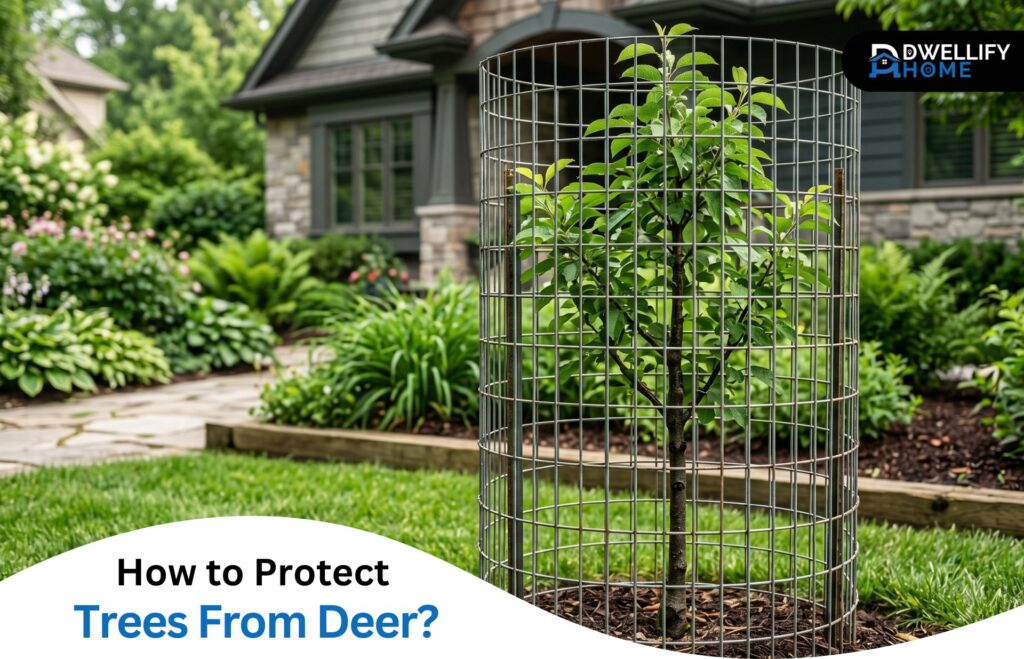
A cage that works is five to six feet tall and wide enough to leave a foot or two of clearance around the trunk, held up by a couple of T-posts or rebar driven into the ground. That standoff matters. The cage takes the rub instead of the bark, and the tree can still sway and build strength in the wind. Welded wire or hardware cloth holds its shape best. Chicken wire works as a staked, standoff cage, but don’t wrap it tight to the trunk — it collapses against the bark and rubs it raw, which is the opposite of what you want from metal tree guards for deer.
Tree tubes and shelters for seedlings and saplings
Tree tubes are translucent, vented sleeves, usually four to six feet tall, that slip over a seedling and protect it from browsing and weather at once while creating a warm microclimate that speeds early growth. They’re ideal for bare-root seedlings and small saplings. One caution from experience: use light-colored tubes. Dark ones soak up sun and overheat, and the swing between warm winter days and freezing nights can cook the trunk inside.
Trunk guards — spiral wraps, mesh, and DIY drain tile
When the canopy is already above browse height and only the trunk needs help, a guard is enough. Options run from spiral plastic wraps to commercial mesh sleeves to a cheap length of corrugated drain pipe slit down one side. Leave at least an inch of air between guard and bark so moisture doesn’t get trapped, and if you wrap anything, spiral it upward from the base and secure it with tape, never twine — twine left on will girdle the tree as it grows. Treat wraps as seasonal, not permanent.
Common mistakes when installing tree guards
The same handful of errors show up over and over. Dark, solid tubes that overheat and damage the trunk. Wraps or twine left tight and year-round until they strangle the tree. Cages set so close the deer can still reach the bark through the wire. And guards left on indefinitely, trapping moisture and giving insects and rodents a place to hide. A guard you forget about can do as much harm as the deer.
Perimeter deer fencing for orchards and larger properties
Once you’re protecting more than a few trees, a fence around the whole area is usually the better investment, and it’s the closest thing to a permanent fix. A woven-wire fence eight feet tall is the dependable standard for keeping deer out completely. It costs more upfront and takes work to install, but it needs little maintenance afterward and answers the most common search for how to protect trees from deer with a fence.
How tall does a deer fence need to be?
Plan on eight feet for white-tailed deer and ten feet where mule deer live, and add a couple of feet of effective height on a downhill slope, since deer launch from the high side. A six-foot fence won’t hold them — a healthy deer clears that without much effort and can cover roughly a dozen feet horizontally in a single bound.
Where a tall fixed fence isn’t practical, electric does well. Common designs use several smart-spaced wires, stacked vertically or set on an angled outrigger so the deer meets the fence on a slant. A charged line carries a few thousand volts at very low amperage, enough to sting and teach, not to injure. A classic trick is a single training wire baited with peanut butter: the deer noses it, gets one memorable zap, and learns to keep away. For lighter pressure, cheaper designs work because deer dislike jumping both high and wide — a fence angled outward at about thirty degrees, two shorter parallel fences a few feet apart, or even a near-invisible monofilament line at nose height can turn them back.
One detail most people get backwards: deer try to go under or through a fence before they try to go over it. They’ll push at a loose bottom edge long before they bother jumping. So stake the bottom down tight to the ground. A sagging lower edge invites the exact problem the fence was built to stop.
Do deer repellents actually work?
Repellents work as a supplement, not a guarantee. Egg-based and other scent or taste sprays can cut browsing meaningfully when deer pressure is light to moderate, but they wash off, need reapplying, and fail on truly hungry deer or on new growth that appears after you spray. And no repellent stops antler rubbing — a determined buck ignores smell and taste entirely.
There are two basic kinds. Contact repellents go on the plant and work by taste, so the deer takes a bite, dislikes it, and moves on. Area repellents work by smell, placed nearby to warn deer off before they nibble. The most consistently effective active ingredient in independent extension testing is putrescent egg solids — the spoiled-egg odor deer instinctively avoid. Products built around it, like Bobbex and a few others, tend to outperform simpler home mixes in those trials, while hot pepper, predator scent, and blood meal give more variable results. A homemade spray can still hold up under light pressure: blend a couple of eggs into a quart of water with a splash of milk, a spoonful of cayenne, and some crushed garlic, then strain it. The milk matters more than people expect, because its casein helps the mix cling to bark and leaves.
How often should you reapply deer repellent?
Reapply every two to four weeks, and again after heavy rain or snow washes the last coat off. Spray on a dry day above freezing so it can dry and bind to the surface. Rotate between a couple of different scents so deer don’t get used to one, and re-coat new growth, which the earlier spray never touched. Deep winter, fast spring growth, and genuine hunger all defeat sprays no matter the brand, so lean on barriers then.
Are deer repellents safe for fruit trees and edible plants?
Not all of them are. Many repellents carry a label warning against use on anything you plan to eat, and egg- or blood-based sprays in particular often aren’t cleared for food crops. Before you spray a fruit tree, read the label and use only a product approved for edibles. When in doubt, a physical barrier sidesteps the question entirely.
Scare devices, dogs, and home remedies — what’s worth your money
A motion-activated sprinkler that fires a sudden burst of water genuinely startles deer and can clear a small area for a while. The catch is habituation — deer are smart and adjust to a device that never actually harms them, so move it around and pair it with something else. The folk remedies are weaker. Bar soap and bags of human hair show limited, inconsistent results, and hair hung at about four feet sits right at a deer’s nose, which doesn’t help. Coffee grounds have no real support at all.
It’s worth remembering that a well-known extension study found weed-fabric mats actually increased browsing on some seedlings, a good reminder that common-sense tricks sometimes backfire. The most effective live deterrent on the list is a dog. On a larger property, a dog that roams the yard keeps deer genuinely wary in a way no gadget matches. It won’t suit every household, but where it fits, it works.
Plant choice as your long-term defense
The quietest long-term strategy is planting things deer tend to leave alone, though no plant is truly deer-proof when they’re hungry enough. Deer usually pass over boxwood, beautyberry, river birch, magnolia, and ginkgo, along with most pines, spruces, and junipers, because aromatic or tough, prickly foliage puts them off. The opposite list is just as useful: arborvitae and yew are deer magnets, followed by apple and crabapple, rhododendron, hostas, and Japanese maple.
Placement is a tool too. Keep the plants deer love close to the house, where foot traffic and noise make them nervous, and put your resistant species out along the property edges and deer trails, where they’ll be tested most. University plant lists rate species by how often they’re browsed and are worth a look before you buy.
Inexpensive ways to protect trees from deer
Good protection doesn’t have to be costly. A short length of welded-wire fencing bent into a cylinder and staked with rebar makes a solid cage for under twenty dollars in materials, and for small saplings a sturdy tomato cage, a wire basket, or a milk crate can buy time. Black corrugated drain pipe is one of the cheapest trunk guards there is, only a few dollars a foot — cut it to length, slit it down one side, and slip it around the trunk, keeping that inch of breathing room.
A clever low-cost fix for buck rubbing is three sturdy stakes driven in a tight triangle around the trunk, about a foot and a half out, so the buck can’t reach the bark with his antlers. These are the kind of diy tree protectors from deer that cost almost nothing and save a tree. Cheap fixes shine under light pressure and for short stretches, but under heavy daily pressure, or for a tree you can’t afford to lose, spend the money on a proper cage or fence. A failed budget guard that lets a buck through costs you the whole tree.
How to protect trees from deer in winter
Winter changes the math. Food gets scarce, deer get bolder, and both browsing and bark stripping climb. Burlap is the cold-weather workhorse: wrapped loosely around an evergreen or arborvitae, it shields the foliage from browsing and winter burn, and a small paper bud cap folded over the top bud of a young conifer protects next year’s leader. Knowing how to protect trees from deer in winter often comes down to these simple, seasonal habits.
Snow is a ladder. Deer stand on packed drifts and reach higher than they can on bare ground, so a guard that was tall enough in fall comes up short in February. In snow country, protect the trunk and lower branches to about six feet above the deepest snow you expect. Get protection up before the rut and the first snow, ideally in early fall, then take wraps and tubes off in spring so the bark can breathe and dry out through the growing season.
Layering methods when deer pressure is high
When one method isn’t holding, stack them. The strongest setups combine a perimeter fence to cut the overall numbers, individual cages on the youngest and most valuable trees, a repellent rotation on the foliage in between, and resistant species filling the spaces deer reach most. Set expectations honestly, though. No combination gets you to zero damage. A good layered plan is about cutting your losses by more than half and protecting what matters most, not winning every skirmish. Treat it as ongoing management, not a one-time install, and adjust as the seasons and the deer change.
How long do young trees need protection from deer?
Most young trees need protection for about three to five years — until the trunk is roughly four to six inches across and the lowest branches sit above the five-to-six-foot browse line. Trunks stay vulnerable to buck rubbing while the bark is thin and smooth, so in high-deer areas keep a loose guard on a few seasons longer. After you pull the cage, a loose collar of wire mesh around the trunk gives lasting, low-effort protection against rubbing.
What to do if a deer already damaged your tree
First, look at how far the bark loss wraps around the trunk. A tree can heal a partial wound and seal it over time, but once the bark is stripped more than about halfway around, it usually can’t move water and nutrients past the damage, and full recovery is unlikely. A trunk girdled all the way around rarely makes it. Resist the urge to paint the wound. The long-standing advice from tree specialists is that dressings, pruning paints, and latex coatings don’t speed healing on rub or girdle wounds and can trap moisture against the wood, making things worse. Clean any loose, torn edges and let the tree seal itself.
For a large or valuable tree, severe girdling, or a case where you can’t tell if it’ll pull through, bring in a certified arborist. They can judge the odds, treat what’s treatable, and tell you honestly when a tree is past saving and should come out before it becomes a hazard.
Quick answers to common deer-and-tree questions
Can deer jump a 6-foot fence?
Yes, easily. A healthy white-tailed deer clears six feet without much effort, which is exactly why eight feet is the standard recommendation for a deer fence. Where mule deer are present, go to ten. A six-foot fence may slow a casual deer but won’t stop a motivated one.
Do coffee grounds keep deer away from trees?
Not reliably. Coffee grounds are a popular tip, but there’s no solid evidence deer are deterred by them, and any effect fades fast as the smell weathers away. Your effort is better spent on a barrier or a tested repellent than on scattering grounds around the trunk.
Does Irish Spring soap actually protect trees?
Only a little, and not dependably. Strongly scented bar soap shows limited, inconsistent results in testing. It might nudge a casual deer along under light pressure, but it won’t hold back hungry or determined deer, and it’s no substitute for a guard on a tree you care about.
Will burlap protect trees from deer?
Partly. Burlap wrapped around evergreens helps shield them from winter browsing and winter burn, and it’s a good cold-weather habit. On its own, though, it won’t stop heavy browsing or any antler rubbing, so pair it with a guard or cage where the pressure is real.
Do repellents stop antler rubbing?
No. Repellents work on feeding behavior through taste and smell, but a buck rubbing his antlers isn’t eating — he’s marking territory and shedding velvet, and scent won’t deter him. The only thing that reliably stops rubbing is a physical barrier between his antlers and the bark.
Are metal tree guards better than plastic for deer?
For rubbing, yes. A metal cage or hardware-cloth sleeve resists antlers and lasts for years. Plastic tubes are excellent for small seedlings and weather protection but can overheat in sun. Match the material to the job: metal for rub-prone trunks, light-colored plastic tubes for young saplings.
Building a deer-defense plan that lasts
Protecting trees from deer comes down to matching the method to the tree, the pressure, and the season, then sticking with it. Start by naming the real threat — browsing, rubbing, or both. Put solid barriers on your youngest and most valuable trees, fence the bigger plantings, use repellents and smart plant choices as backup, and step protection up through the rut and into winter. No single product solves it, and nothing reaches zero damage. Consistent, well-matched protection is what keeps your trees standing, and it’s the most dependable answer to how to protect trees from deer over the long run.
Disclaimer: This article is for general informational purposes only. Individual results, local deer behavior, climate, and property conditions vary, so choose and adapt methods to fit your own situation.