A ripe Flavortop nectarine eaten warm off the tree is the kind of thing that turns a casual gardener into someone with a backyard orchard. It’s a variety that’s been around for decades, and it has earned its place by doing one thing better than most: flavor. People who run side-by-side fruit tastings keep ranking it near the top, year after year.
What makes it a sensible pick for home growers is the combination behind that flavor. It’s self-fertile, so a single tree will fruit on its own. It throws a generous show of pink blossom in spring, so it earns its spot even before harvest. And the fruit is freestone, which makes it a pleasure to work with in the kitchen.
This guide walks through what the tree is really like, how it tastes, where it grows, and how to plant, care for, and harvest it. It’s honest about the work involved too, because a nectarine is rewarding but not hands-off.
Snippet-Ready Definition
The Flavortop nectarine is a large, yellow-fleshed, freestone variety with red-gold skin, grown for its rich, sweet-tangy flavor that ranks among the top in taste tests. Self-fertile and ornamental in bloom, it’s a reliable choice for home orchards in suitable climates.
Our Mission:
Dwellify Home helps homeowners and property enthusiasts make practical, informed choices for their gardens and outdoor spaces — like knowing exactly what to expect from a Flavortop nectarine before it goes in the ground.
Key things to know about the Flavortop nectarine
- Large, yellow-fleshed, freestone fruit with deep red-gold skin and rich, sweet-tangy flavor
- Self-fertile, so a single tree fruits on its own; a second nectarine boosts yield
- Suited to USDA zones 5–9 and needs about 650 chill hours to fruit well
- Showy pink spring blossoms give it ornamental value alongside the harvest
- Not specially disease-resistant, so plan to spray, prune, and thin the fruit
What is the Flavortop nectarine?
The Flavortop nectarine is a large, yellow-fleshed, freestone variety with red-gold skin, developed in Fresno, California, in 1969. Its botanical name is Prunus persica var. nucipersica ‘Flavortop’. It’s prized above all for taste, consistently scoring among the highest nectarines in formal fruit tastings, and it remains a dependable home-orchard standard rather than a passing novelty.
You’ll sometimes see it sold as a “modern” or “new” cultivar. It isn’t. It’s a long-established variety that has stayed popular precisely because it delivers. That track record matters when you’re choosing a tree you’ll live with for years, since you’re not gambling on something unproven.
Flavortop nectarine at a glance
| Trait | Detail |
| Type | Yellow-fleshed, freestone nectarine |
| Botanical name | Prunus persica var. nucipersica ‘Flavortop’ |
| USDA zones | 5–9 (some catalogs list 5–8) |
| Chill hours | About 650 |
| Mature size | Around 10–15 ft tall and wide when pruned |
| Bloom | Showy pink, early spring |
| Harvest | Mid to late summer, depending on climate |
| Pollination | Self-fertile |
| Fruit | Large, red-gold skin, golden flesh |
What does a Flavortop nectarine taste like?
A Flavortop nectarine tastes rich and sweet with a clean, slightly tangy edge that keeps it from being one-note. There’s a citrusy brightness underneath the sugar that gives it depth. That balance is why it scores so well in taste tests, and why a tree-ripened one is worth growing.
Here’s the part most people don’t realize until they grow their own. Supermarket nectarines are picked firm and early so they survive shipping and handling, which means they never finish ripening the way the tree intended. A Flavortop left to ripen on the branch develops sugars and aroma you simply can’t buy. The first season your tree fruits properly, the difference is obvious in one bite.
Fruit characteristics: size, color, and texture
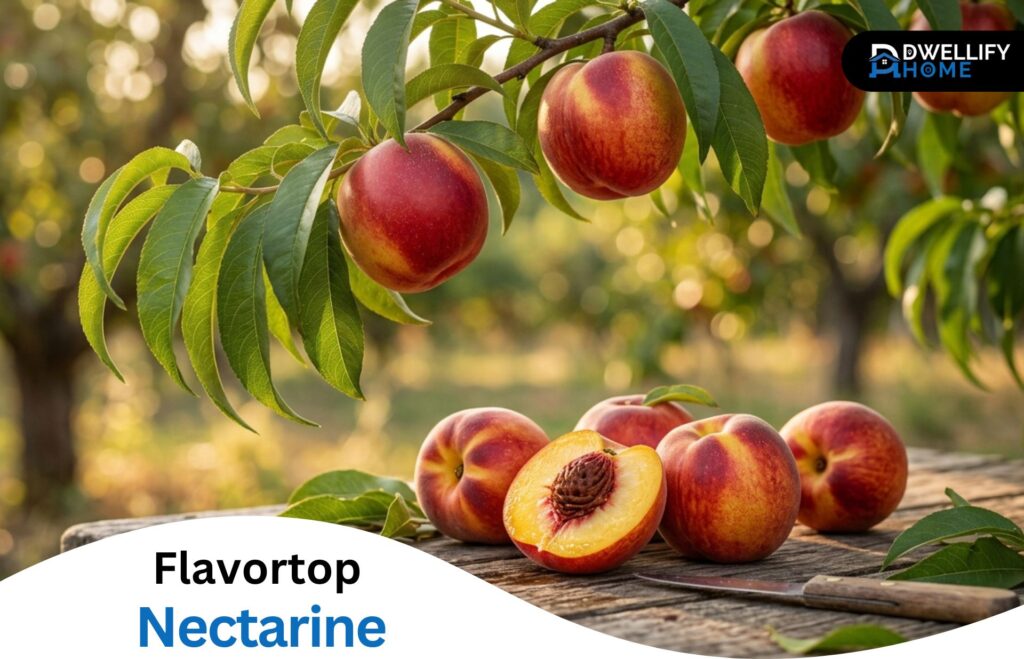
The fruit runs large, with skin that colors up to a deep red over a golden background, almost candy-apple in good sun. Inside, the flesh is golden-yellow, firm but juicy, and it holds its shape well when sliced. That firmness is part of why it’s such a good all-rounder, since it doesn’t collapse into mush the moment you cut it.
Is Flavortop a freestone or clingstone nectarine?
Flavortop is a freestone nectarine, which means the pit separates cleanly from the flesh when you cut around it. With a clingstone, the flesh grips the pit and you end up fighting it. Freestone makes everything in the kitchen faster, whether you’re slicing for a bowl, halving for the grill, or prepping a big batch for canning.
Best uses: fresh eating, baking, and canning
Fresh off the tree is where it shines, but the firm freestone flesh makes it just as good for pies, crumbles, jams, and canning, and it freezes well in slices. Ripe fruit keeps roughly two to three weeks in the refrigerator, though it rarely lasts that long once a household gets into it. The clean pit and sturdy texture mean far less prep time when you’re putting up a large harvest.
The Flavortop tree: blossoms, size, and ornamental value
The tree pulls double duty. In early spring it opens large pink blossoms from deep rose buds, before the leaves come out, and it’s genuinely one of the prettier things in the yard at that point in the season. It’s a vigorous grower, and the narrow leaves turn a soft yellow in fall, so it adds something in more than one season.
On size, expect a tree of roughly 10 to 15 feet tall and wide if you prune it each year. Left completely alone, it can push considerably larger, and one horticultural database lists a potential height closer to 20 feet. The practical takeaway is that you control the size with annual pruning, which also keeps the fruit within reach. Plenty of growers use it as an accent or edible-landscaping tree for exactly this reason.
Where does the Flavortop nectarine grow? USDA zones and chill hours
Flavortop grows best in USDA zones 5 through 9, with some catalogs listing a slightly narrower 5 to 8. It needs around 650 chill hours, meaning roughly 650 hours below about 45°F over winter, to break dormancy and fruit properly. In regions with very mild winters, it won’t get enough chill and fruiting suffers.
Chill hours trip up a lot of new growers, so it’s worth being plain about. A fruit tree uses cold winter time as a signal that it’s safe to wake up and bloom. If your winters stay too warm to bank those hours, the tree leafs out and blooms erratically and sets little fruit. Before you buy, check your area’s average chill hours against that 650 figure. Comfortably inside zones 5 to 8, you’re almost certainly fine.
How to plant a Flavortop nectarine tree
Planting is straightforward, and getting the site and timing right matters far more than any clever technique. The goal is simple: full sun, good drainage, and roots that settle in without sitting in water.
Sunlight, soil, and spacing
Give it full sun, six to eight hours of direct light a day, since sun drives both fruiting and flavor. It wants fertile, well-drained soil and won’t tolerate standing water, though it isn’t fussy about soil pH. Space it with about 8 to 20 feet of room depending on how large you’ll let it grow. Planting on the sunniest side of a house or fence helps buffer wind and gives a little protection from early frost.
When and how to plant (bare-root vs. potted)
In colder zones, plant in spring once the ground is workable. In milder zones, fall through spring works well. Dig a hole twice as wide as the root ball and about as deep, loosen the sides, and set the tree so it sits straight at the same depth it grew before. Backfill while watering as you go to remove air pockets, then mulch around the base, keeping the mulch off the trunk. Bare-root trees go in dormant and are the most economical start, while a potted tree can go in across a longer window and establishes with less transplant shock.
Is the Flavortop nectarine self-pollinating?
Yes, the Flavortop nectarine is self-fertile, so a single tree will set fruit on its own without a pollination partner. That said, planting a second nectarine nearby tends to improve fruit set and overall yield, and at least one cold-climate nursery recommends a partner for that reason. It’s a worthwhile nudge, not a contradiction.
One small detail surprises people: nectarines and peaches can cross-pollinate, since they’re the same species. So if you already have a peach blooming at the same time, it can lend a hand, and the reverse is true as well. For most home growers, though, one Flavortop on its own will crop just fine.
How to care for your Flavortop nectarine
Once it’s in the ground, the upkeep settles into a yearly rhythm: water it well while it’s young, feed it lightly in spring, prune it in late winter, and thin the fruit in early summer. None of it is hard, but skipping the last two steps is where most disappointing harvests come from.
Watering and fertilizing
While the tree is establishing in its first season or two, water deeply and regularly, a long slow soak about once a week rather than frequent sips, so the roots chase moisture downward. Once established, you can ease off and let rainfall do more of the work, watering through dry spells. Feed with a balanced fertilizer in early spring after the danger of hard frost has passed, and go light rather than heavy.
Pruning for an open-center shape
Prune in late winter or early spring, once the threat of extreme cold has passed. The aim is an open-center, or vase, shape: a short trunk with a few main limbs spreading outward and an open middle. That open center lets light and air reach the fruit, which improves ripening and helps cut down on disease. Pruning is also how you keep the tree at a height where you can actually pick and spray it.
Why fruit thinning matters
Flavortop sets fruit heavily, and this is the step people skip and later regret. After the tree’s natural early-summer fruit drop, thin what’s left so there’s roughly one nectarine every 6 to 8 inches along the branch. It feels wrong to pull off perfectly good young fruit, but you’re trading quantity for size and flavor. Thinning also protects the limbs, since a branch overloaded with fruit can snap.
When is a Flavortop nectarine ready to harvest?
Flavortop ripens in mid to late summer, but the exact timing depends far more on your climate than on the variety. In warm regions it can be ready by mid-July, in cooler areas it slides into August, and in cold-winter regions it can run as late as August into September. The tree behaves the same everywhere; your local heat sets the clock.
This is the most common point of confusion I see, because one catalog says July and another says September and growers assume something’s wrong. Nothing is. A Flavortop in a warm central valley ripens weeks ahead of the same tree in the Pacific Northwest or a northern garden. Judge ripeness by the fruit, not the calendar: a ripe nectarine gives slightly to gentle pressure, colors fully, and comes away from the branch with an easy twist.
Common problems and how to manage them
Flavortop is rewarding, but it’s a nectarine, and nectarines come with a few predictable challenges. Knowing them upfront lets you plan around them instead of reacting after the fact. The big three are disease, late frost, and the simple mess of dropped fruit.
Peach leaf curl and bacterial spot
Flavortop is not specially bred for disease resistance. You’ll see one retailer describe it as disease-resistant, but the broader picture from growers is that it’s susceptible to bacterial spot and, like most peaches and nectarines, to peach leaf curl. Leaf curl shows up as puckered, reddened leaves in spring. The standard defense is dormant copper sprays applied a couple of times over winter while the tree is leafless, plus the good airflow that open-center pruning provides. Honest expectation: plan to spray, especially in damp climates.
Late spring frosts and blossom protection
Because Flavortop blooms early, a late frost can damage the blossoms and cost you that year’s crop. Siting helps a lot here. Plant against a warm south- or west-facing wall, which holds heat and takes the edge off cold nights. In cool, wet regions, growers often train these trees flat against a wall as an espalier, both to capture warmth and to keep the foliage drier, which discourages disease.
Messy fruit drop and cleanup
A productive nectarine drops fruit, and ripe fruit on a lawn or path gets messy and draws wasps and other insects. It’s a small thing, but it’s worth thinking about before you plant. Keep the tree away from patios, walkways, and parking spots, and plan on a bit of cleanup during the few weeks of harvest. Thinning and timely picking keep the drop manageable.
How does Flavortop compare to similar nectarines?
Flavortop often comes down to a choice against a few other popular yellow nectarines. Here’s a quick side-by-side, followed by where each one pulls ahead.
| Variety | Zones | Flesh / Stone | Flavor | Harvest |
| Flavortop | 5–9 | Yellow, freestone | Sweet with tangy depth; taste-test favorite | Mid–late summer |
| Fantasia | 5–9 | Yellow, freestone | Sweet and tangy, reliable | Late summer |
| Harko | 4–8 | Yellow, freestone | Sweet and juicy | Late summer |
| Panamint | 6–9 | Bright yellow, freestone | Sweet-tart | Late summer |
Flavortop vs. Fantasia
Both are large, yellow, freestone nectarines that ripen in the back half of summer, and you won’t go wrong with either. Fantasia is a dependable, sweet-tangy workhorse. Flavortop’s edge is flavor reputation, since it’s the one that keeps winning tastings, so it’s the pick when eating quality is your top priority.
Flavortop vs. Harko
Harko’s standout trait is cold-hardiness, holding up down to around zone 4, which makes it the safer bet in colder gardens where Flavortop sits near the edge of its comfortable range. In zone 5 or warmer, Flavortop’s flavor wins; colder than that, Harko buys you a margin of safety.
Flavortop vs. Panamint
Panamint is known for adapting to a range of climates and carries a brighter sweet-tart profile. It’s a strong all-purpose choice when your conditions are less than ideal, whereas Flavortop rewards you most when it gets the sun, drainage, and chill it likes.
Is the Flavortop nectarine right for your garden?
It comes down to four honest questions. First, space: can you give a tree 10 to 15 feet and full sun? Second, climate: are you in zones 5 to 9 with enough winter chill? Third, effort: are you willing to spray for disease, prune yearly, thin the fruit, and clean up drops? Fourth, pollination, which is the easy one, since a single self-fertile tree is enough.
With yes to space, climate, and a bit of yearly effort, Flavortop is one of the most satisfying fruit trees you can plant, and a healthy one can produce for decades. Short on room or in a colder spot? It also grows in a large container, which lets you keep it smaller and even move it to shelter in hard winters. The flavor is the payoff, and for most people it’s well worth the work.
Where to buy a Flavortop nectarine tree (and what you’ll get)
Flavortop is widely sold, and you’ll find it two main ways. Bare-root trees ship dormant without soil, usually in the cooler months, and they’re the most affordable way to start. Containerized, or potted, trees cost more but can be planted across a longer season and tend to establish with less stress. Both grow into the same tree, so the choice is about timing and budget.
Listings often describe size and age, such as a “2-year, 3 to 4 foot” tree, which simply tells you how far along it is, not how big it will get. Many Flavortops are grafted onto Lovell rootstock, a widely adapted standard. Prices vary by size and seller, with small bare-root trees at the low end and larger potted specimens costing noticeably more, so match the size to your patience and your budget.
Flavortop nectarine FAQ
How big does a Flavortop nectarine tree get?
With yearly pruning, expect roughly 10 to 15 feet tall and wide. Left unpruned it can grow larger, with some sources citing close to 20 feet. Pruning keeps it at a manageable, pickable size, and it also adapts well to a container if you want to keep it more compact.
How many chill hours does Flavortop need?
Flavortop needs about 650 chill hours, meaning roughly 650 winter hours below about 45°F, to break dormancy and fruit reliably. In regions with very mild winters it won’t accumulate enough chill, which leads to poor bloom and light fruit set. On this front it suits zones 5 through 8 well.
Can you grow a Flavortop nectarine in a container?
Yes. Flavortop grows well in a large container, which naturally limits its size and makes it a good option for patios, small yards, or cold regions where you may want to move it to shelter. Use a big pot with excellent drainage, water consistently, and prune to keep it compact and productive.
How long until a Flavortop tree bears fruit?
Most Flavortop trees begin bearing about two to three years after planting, depending on the tree’s starting size and your growing conditions. A larger nursery tree may fruit sooner. Good sun, steady care, and yearly pruning all help the tree reach reliable production faster.
Will a nectarine pollinate a peach tree?
Yes. Nectarines and peaches are the same species, so they can cross-pollinate when they bloom at the same time. Flavortop is self-fertile and doesn’t need it, but a nearby peach blooming alongside it can still contribute, and a Flavortop can likewise help pollinate a peach.
Does Flavortop nectarine need a pollinator?
No. Flavortop is self-fertile, so a single tree will set fruit on its own without a pollination partner. Planting a second nectarine nearby can improve fruit set and increase your overall yield, but it isn’t required. Nectarines and peaches blooming at the same time can also cross-pollinate.
What is the best tasting nectarine?
Taste is subjective, but Flavortop is widely considered one of the best-tasting nectarines, consistently scoring among the highest in formal fruit tastings. Its appeal comes from a rich, sweet flavor balanced by a clean, slightly tangy edge. Other well-regarded yellow varieties include Fantasia and Panamint.
How do you care for a Flavortop nectarine tree?
Plant it in full sun and well-drained soil, water deeply while it establishes, then feed lightly with a balanced fertilizer in early spring. Prune in late winter to an open-center shape, thin fruit to one every 6–8 inches, and use dormant copper sprays to manage disease.
How big does a Flavortop nectarine tree get?
With yearly pruning, a Flavortop nectarine typically reaches about 10 to 15 feet tall and wide. Left unpruned it can grow larger, with some sources citing close to 20 feet. Regular pruning keeps it at a manageable, pickable size, and it also grows well in a large container.
Conclusion
The Flavortop nectarine earns its long-standing reputation honestly: a self-fertile, freestone tree with a beautiful spring bloom and fruit that tastes the way nectarines are supposed to. It asks for full sun, decent drainage, enough winter chill, and a willingness to spray, prune, thin, and tidy up after it. Meet it halfway on those, and few backyard trees give back as much. For the right garden and a grower who enjoys the work, it’s hard to beat.
Disclaimer: This content is for general informational purposes only. Growing conditions, climate, and individual results may vary, so use your own judgment and local guidance when planting and caring for your trees.