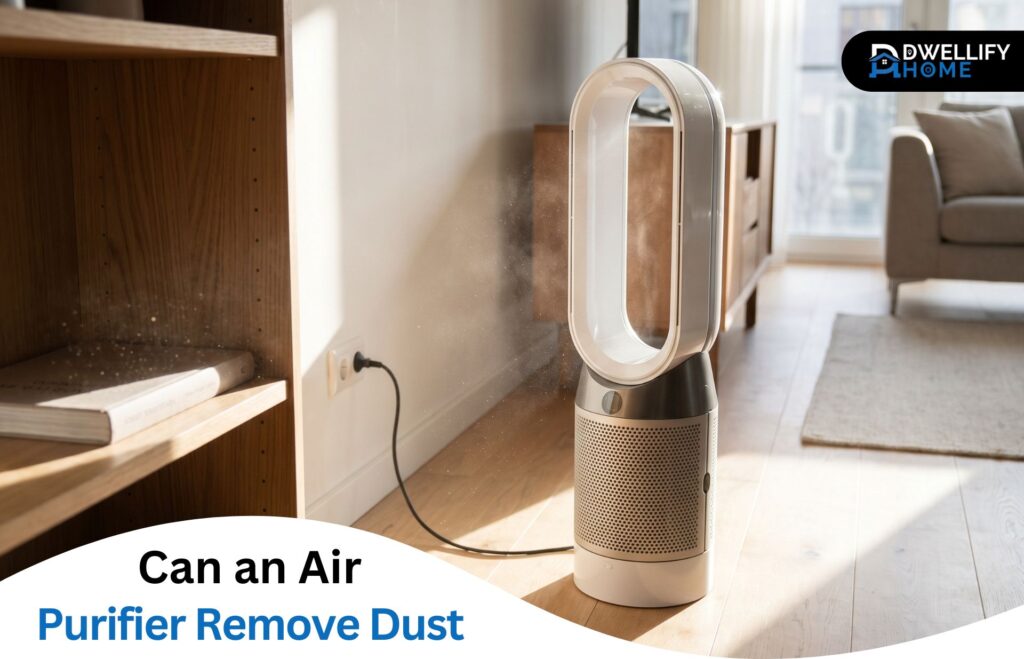
You wipe down the bookshelf on Monday. By Wednesday, there’s a thin layer of grey film sitting on it again. It’s one of the most frustrating things about keeping a home clean — dust is relentless. So it makes sense that more and more homeowners are asking whether an air purifier can actually do something about it.
The short answer is yes — an air purifier can remove dust. But the fuller answer is more nuanced than that, and understanding the difference between what these devices genuinely do and what they can’t will save you both money and disappointment. This guide covers the science, the practical realities, and everything you need to make a smart decision about using one in your home.
The Short Answer
Yes, an air purifier can remove dust from the air. Units with True HEPA filters capture 99.97% of airborne particles, including dust, pollen, and pet dander. They reduce how much dust settles on surfaces but cannot clean dust that has already accumulated.
Mission Statement
Dwellify Home exists to help homeowners make practical, confident decisions about their living spaces — from indoor air quality to everyday home comfort. We cut through the noise so you get clear, honest guidance you can actually use.
What Is Household Dust and Where Does It Actually Come From?
Most people picture dust as just settled dirt. In reality, it’s a mixture of many different particles, and knowing what it’s made of helps explain why it’s such a persistent problem.
The Surprising Ingredients in Your Home’s Dust
Household dust is a blend of skin cells, pet dander, pollen, fabric fibers, dust mite debris, soil tracked in from outside, and in many homes, trace amounts of lead or chemical residue from older building materials.
The exact mix varies from home to home. A house with two dogs and carpeted floors will have very different dust than a minimalist apartment with hardwood and no pets. But in almost every case, a significant portion of what lands on your surfaces actually came in through windows, doors, and shoes — not just from the people living inside.
Dust mite debris deserves a special mention here. Dust mites themselves are microscopic, but their waste particles and shed casings are a major component of indoor dust and one of the most common allergy triggers found in homes.
Why Dust Keeps Coming Back No Matter How Often You Clean
Dust doesn’t just appear once and stay put. It cycles continuously. Particles float in the air, eventually settle on a surface, get disturbed by movement or airflow, and then float again. Every time someone walks across a room, sits on a couch, or opens a window, settled dust gets kicked back up into the air.
This is important because it means the air in your home always contains a floating inventory of particles — some freshly introduced, some recycled from your own surfaces. An air purifier works on that airborne portion of the cycle.
Quick Comparison: What an Air Purifier Does and Doesn’t Do for Dust
| Task | Air Purifier | HEPA Vacuum | Regular Dusting |
| Removes airborne dust particles | Yes | No | No |
| Reduces dust settling on furniture | Yes | No | No |
| Cleans settled surface dust | No | No | Yes |
| Removes dust from carpet fibers | No | Yes | No |
| Captures dust mite allergens | Yes | Yes | No |
| Works continuously without effort | Yes | No | No |
Key Benefits of Using an Air Purifier for Dust
- Continuously captures airborne dust particles without any manual effort
- Reduces the speed at which dust accumulates on furniture and floors
- Filters dust mite allergens, pet dander, and pollen that trigger allergy symptoms
- Improves overall indoor air quality in the rooms where you spend the most time
- Extends time between dusting sessions when used consistently in the right room size
So, Can an Air Purifier Remove Dust? Here’s the Direct Answer
Yes, an air purifier can remove dust — specifically the dust that is suspended in the air. A unit fitted with a True HEPA filter captures airborne dust particles as small as 0.3 microns with 99.97% efficiency, continuously reducing the concentration of particles circulating in your home. It does not, however, clean dust that has already settled on surfaces.
What an Air Purifier Actually Does to Airborne Dust
The mechanism is straightforward. A fan draws room air through a series of filter layers. Larger particles like lint and hair get caught early. Finer particles — the ones you can’t see — pass through to the HEPA layer, where they become physically trapped in a dense web of fibers. Clean air is then released back into the room.
This process repeats continuously as long as the unit is running. Over hours and days, the concentration of airborne dust in a room measurably drops. Less airborne dust means less dust settling onto your furniture, floors, and bedding.
What an Air Purifier Cannot Do — The Honest Limitation
Here’s the part many product descriptions quietly skip over. An air purifier only works on what’s in the air. Dust sitting on your coffee table, embedded in your carpet fibers, or settled into your bedding is completely outside its reach.
This doesn’t make the device useless — far from it. But it does mean that an air purifier is a preventative tool, not a cleaning device. It reduces how quickly dust accumulates on surfaces. It doesn’t replace wiping things down.
How Does an Air Purifier Remove Dust? The Filter Layers Explained
Understanding the filtration stages helps you evaluate any unit you’re considering — and explains why some cheaper models fall short.
The Pre-Filter: Why It Matters More Than People Realize
The pre-filter is the first stage and catches the largest particles: visible dust, hair, lint, and pet fur. It’s easy to underestimate, but it plays a critical role in protecting the HEPA filter downstream.
Without a functional pre-filter, large particles overwhelm the HEPA layer prematurely, reducing its lifespan significantly. Many people replace their HEPA filter too soon simply because they neglected the pre-filter. On most units, the pre-filter can be vacuumed or rinsed, making it the lowest-cost maintenance step you can do.
How a True HEPA Filter Traps Dust Particles
A True HEPA filter captures 99.97% of airborne particles at 0.3 microns — the size considered hardest to trap, because particles at this diameter are too small to be reliably caught by inertia but too large to pass through Brownian motion. The filter is engineered to catch this precise range, which covers the majority of dust components including pollen, mold spores, and dust mite allergens.
The EPA recognizes the True HEPA standard, and it’s the benchmark you should insist on. Anything labeled “HEPA-type,” “HEPA-like,” or “99% HEPA” is not the same and has not been tested to the same threshold.
Does Activated Carbon Help with Dust?
No. Activated carbon is designed to adsorb gases, odors, and volatile organic compounds (VOCs). It has no meaningful effect on dust particles.
Many units combine a HEPA filter with an activated carbon layer, which is useful if you also want to address cooking smells or chemical off-gassing from furniture. But if your primary goal is dust reduction, the carbon layer is a secondary feature — not the reason to buy.
How Effective Are Air Purifiers at Reducing Dust? What the Research Shows
The evidence is consistent and well-documented. Studies using portable air cleaners with HEPA filtration have recorded reductions in indoor PM2.5 concentrations — fine airborne particles that include dust — of between 52% and 60% under real household conditions.
The U.S. Environmental Protection Agency states that HEPA-equipped air purifiers remove at least 99.97% of airborne particles at 0.3 microns, including the key components of household dust. Alen’s internal testing across room environments found that medical-grade HEPA filtration captured up to 99.9% of particles down to 0.1 microns.
These figures translate to a practical reality: run a properly sized unit continuously in a room, and you will notice surfaces staying cleaner for longer, fewer airborne particles visible in sunlight, and reduced allergy symptoms for sensitive household members. The improvement is real — it’s just not instant and it’s not total.
Do Air Purifiers Help with Dust Mites?
An air purifier helps with dust mite-related allergens but does not eliminate dust mites themselves. Dust mites live in mattresses, upholstery, and carpets — places no air purifier can reach. However, HEPA-filtered units capture the airborne mite debris and waste particles that trigger allergy and asthma symptoms, providing meaningful relief for sensitive individuals.
If dust mite allergies are a serious concern, an air purifier is a useful part of the solution — alongside mattress encasements, regular hot-water washing of bedding, and keeping indoor humidity below 50%, which discourages mite populations.
Do Air Purifiers Help with Dust Allergies?
Yes. An air purifier with a True HEPA filter significantly reduces the concentration of airborne allergens — including dust mite debris, pollen, pet dander, and mold spores — which are the primary triggers for most dust-related allergy symptoms.
What Allergy Sufferers Should Realistically Expect
A well-placed, properly sized unit running continuously in a bedroom typically produces the most noticeable relief — fewer morning symptoms, less nighttime congestion, and reduced eye irritation. Results are more pronounced in enclosed spaces than in open-plan areas where air volume is larger and allergen sources are more varied.
The improvement tends to build over days rather than hours. The unit clears suspended particles steadily, and as fewer particles settle and get re-disturbed, the overall allergen load in the room gradually decreases. For people with asthma, consistent use in sleeping and living areas is generally where the benefit is most consistently felt.
Do Air Purifiers Help with Dust on Furniture?
Yes — indirectly. An air purifier doesn’t clean your furniture, but by continuously removing dust from the air, it reduces how much eventually settles on surfaces. Many homeowners with units running around the clock notice they dust less frequently and find less accumulation between cleans.
Think of it this way: dust lands on your table because it was floating in the air first. Reduce what’s floating, and you reduce what lands. It won’t make dusting unnecessary, but it meaningfully extends the time between cleans in rooms where the unit is placed.
Can an Air Purifier Remove Dust from Carpet?
No. An air purifier cannot pull dust out of carpet fibers — that requires physical agitation and suction. What it can do is capture the dust that gets released into the air when you walk across the carpet, reducing how much re-settles elsewhere in the room.
For carpet dust, a HEPA vacuum is the essential tool. Standard vacuums without HEPA filtration can actually make things worse by exhausting fine particles back into the air. Pairing a HEPA vacuum for carpet cleaning with an air purifier for airborne control gives you the most complete approach.
Do Air Purifiers Help with Dust and Pet Hair?
Yes, with some nuance. Pet hair itself is relatively large and tends to settle quickly rather than staying airborne for long. Most of it ends up on floors and furniture where a vacuum handles it better.
What an air purifier genuinely helps with is pet dander — the microscopic flecks of skin that shed continuously from animals and float in the air for hours. Dander is a major dust contributor and one of the most potent household allergens. A True HEPA filter captures it effectively. The pre-filter handles larger fur fragments before they can clog the main filter layer.
Homes with multiple pets benefit noticeably from continuous air purifier use, particularly in rooms where animals sleep or spend most of their time.
What to Look for in an Air Purifier for Dust
Not all air purifiers perform equally well on dust. These are the factors that actually matter.
True HEPA vs. “HEPA-Type” — Why the Difference Matters
Only units labeled True HEPA or H13 HEPA meet the verified standard of 99.97% particle capture at 0.3 microns. “HEPA-type” or “HEPA-style” filters are marketing terms with no standardized performance requirement. For dust control, this distinction is non-negotiable.
What Is CADR and Why It Matters for Dust Removal
CADR stands for Clean Air Delivery Rate. It measures how quickly a unit can filter a specific volume of air — and for dust, a higher CADR means the room’s air gets cleaned faster.
A unit with a dust CADR of 200+ is suitable for most medium-sized living rooms. For bedrooms, a CADR of 100–150 is generally sufficient. CADR is the most honest performance metric available because it’s independently tested.
Room Coverage and Air Changes Per Hour (ACH)
ACH tells you how many times per hour the air in a room passes through the filter. For effective dust control, aim for at least 4–5 ACH. Most manufacturers provide a recommended room size — but check that it’s based on 4–5 ACH, not 2, which is the lower standard some brands quietly use to inflate their coverage claims.
Should You Avoid Ionizers When Buying for Dust?
It’s worth being cautious. Some air purifiers include ionizers, which release charged ions to cause particles to clump and fall. The problem is that ionizers can produce ozone as a byproduct, and ozone is a respiratory irritant — the last thing you want if dust allergies or asthma are the reason you’re buying the unit.
For dust removal, a True HEPA filter without an ionizer is the cleaner, safer choice.
Where Should You Place an Air Purifier for Maximum Dust Reduction?
Placement has a bigger impact on results than most people expect. A good unit in the wrong spot underperforms consistently.
Best Rooms to Target First: Bedroom, Living Room, Home Office
The bedroom is almost always the highest priority. You spend 7–9 hours there, often with the door closed, and dust mite allergens are concentrated in bedding and mattresses nearby. Running a unit in the bedroom produces the most consistent relief for allergy and asthma sufferers.
Living rooms and home offices are next — high-traffic areas with more dust-generating activity, more fabric surfaces, and often pets. If you can only afford one unit, the bedroom comes first. The second goes in whichever room you occupy most during the day.
Placement Mistakes That Reduce Effectiveness
Keep the unit away from walls and large furniture. It needs clear airflow on at least two sides to draw and circulate air effectively. Placing it in a corner, behind a sofa, or against a wall restricts intake and significantly reduces performance.
Also avoid placing it near windows or doors that are frequently opened — you’re pulling in fresh outdoor dust faster than the filter can handle. A central position in the room, or near the most active area, generally works best.
How to Use Your Air Purifier So It Actually Works on Dust
Should You Run It Continuously or Only When Needed?
For dust control, continuous low-speed operation outperforms running the unit on high for a few hours. Dust is constantly being generated and reintroduced, so a unit that runs steadily — even quietly in the background — maintains a consistently lower particle count throughout the day.
Running it only when you notice dust or during cleaning is better than nothing, but it won’t produce the kind of sustained improvement most people are hoping for.
How a Dirty Filter Quietly Defeats the Purpose
A clogged HEPA filter doesn’t just lose efficiency — in some units, it causes air to bypass the filter entirely through gaps or reduced pressure differentials. You end up with a unit that’s running but barely filtering.
Most HEPA filters should be replaced every 6–12 months, depending on usage and air quality. Pre-filters typically need attention every 2–4 weeks. Check the manufacturer’s guidance and stick to it. The filter is the entire point of the device.
Cleaning Habits That Work With Your Air Purifier, Not Against It
Dry dusting with a feather duster or regular cloth sends particles airborne and directly into the room’s air. That’s actually a good thing if your air purifier is running — it captures what you’ve just disturbed. But if the unit is off, you’re just redistributing dust.
Use a damp microfiber cloth for surfaces to trap particles rather than scatter them. Vacuum with a HEPA-equipped vacuum before you dust, not after. And run your air purifier on a higher fan setting for 30–60 minutes after any cleaning activity to handle the surge of airborne particles.
Air Purifier vs. HVAC Filter — Which Does More for Dust?
They serve different functions, and comparing them directly misses the point. Your HVAC filter is designed to protect the HVAC system from large particles that could damage the equipment. Most standard HVAC filters are not fine enough to capture the small particles that make up most airborne dust — they’re rated for system protection, not air quality.
A portable air purifier with a True HEPA filter, by contrast, is specifically designed to capture fine particles and operates at a room level where you actually breathe. It’s more targeted and generally more effective for dust and allergen control in specific spaces.
If you upgrade your HVAC filter to a high-MERV rating (MERV 11–13), it will help capture more particles throughout the whole house. But it still won’t match the efficiency of a room-level HEPA unit for the spaces where you spend most of your time. For the best dust control, both working together is the strongest approach.
How to Tell If Your Air Purifier Is Actually Working on Dust
The clearest sign is a visibly dirtier filter. A grey or brown HEPA filter after a few months of use isn’t a problem — it’s evidence the unit has been pulling particles out of your air. A filter that looks clean after months of use in a dusty home suggests the unit isn’t drawing air effectively.
Other practical signs include:
- Surfaces in the room staying cleaner for longer between wipes
- Reduced sneezing or morning congestion for allergy-prone household members
- Noticeably cleaner air visible in sunlight coming through windows
- Improved sleep quality in the bedroom where the unit runs overnight
- Less visible dust stirred up when you sit on the couch or walk across the room
None of these are instant. Give a properly placed, correctly sized unit two to four weeks of continuous use before drawing conclusions.
Frequently Asked Questions
Can an air purifier remove all the dust in my home?
No. An air purifier removes airborne dust particles as they circulate through the room, but it cannot capture dust that has already settled on surfaces, embedded in carpets, or built up in fabrics. It significantly reduces dust accumulation over time but works best as part of a broader cleaning routine.
How long does it take for an air purifier to reduce dust?
In a properly sized room with continuous operation, most people notice a measurable reduction in airborne particles within a few hours. Visible improvement in surface dust accumulation — needing to dust less frequently — typically becomes apparent after one to two weeks of consistent use.
Is it worth running an air purifier 24/7 for dust?
Yes, for dust control it’s the most effective approach. Dust is continuously generated and reintroduced into the air, so intermittent use creates gaps. Running on a low, quiet setting around the clock consumes modest energy — typically 20–50 watts for most mid-range units — while maintaining consistently cleaner air.
What is the best air purifier for dust in a bedroom?
Look for a True HEPA unit sized correctly for your bedroom’s square footage with a dust CADR of at least 100–150, a low decibel rating on its quietest setting, and a pre-filter that can be maintained separately. Units with a sleep mode — low fan speed, dimmed display — are practical for overnight use.
Do budget air purifiers actually work on dust?
Some do, some don’t. The key question is whether the unit contains a genuine True HEPA filter, not a “HEPA-type” alternative. A budget unit with a certified True HEPA filter and appropriate CADR for the room size will outperform an expensive unit with an inferior filter. Check the filter certification before you check the price.
Can I use an air purifier instead of regular dusting?
No. An air purifier intercepts dust while it’s airborne and slows how quickly it accumulates on surfaces. But dust that’s already settled needs to be physically removed. Think of the air purifier as reducing your cleaning frequency, not eliminating the need for it.
The Bottom Line on Air Purifiers and Dust
A quality air purifier with a True HEPA filter genuinely reduces the amount of dust circulating in your home’s air. That leads to less settling on surfaces, fewer allergen-related symptoms, and a measurably cleaner indoor environment over time. The question of whether an air purifier can remove dust is really a question about which part of the dust problem you’re solving.
For the airborne portion — the part you breathe, the part that feeds allergies, the part that lands on your furniture after floating for hours — an air purifier handles it well. For the dust already sitting on surfaces or buried in carpet, you still need a microfiber cloth and a HEPA vacuum.
Used consistently, placed correctly, and maintained properly, an air purifier is one of the most practical investments you can make for your home’s indoor air quality. It won’t do everything. But what it does, it does well.
Disclaimer: The content on Dwellify Home is intended for general informational purposes only. Individual results will vary based on home size, air quality conditions, product choice, and usage habits. Always refer to manufacturer guidelines for specific product recommendations