Skunk smell inside the house is one of those situations where most people panic and immediately do the wrong things. The smell hits, the eyes start watering, and someone reaches for tomato juice or lights a scented candle — neither of which does a thing. Getting skunk smell out of your house requires a specific order of operations, the right chemistry matched to each surface, and a clear understanding of why this odor is so resistant in the first place.
This guide walks through the full process surface by surface, room by room — from the first thing you should do in the next ten minutes, to handling your HVAC system, carpets, clothes, and your foundation if a skunk sprayed underneath the house. Whether the smell came through a pet, an open window, or a skunk living under your deck, the approach is the same: work fast, work in the right order, and don’t skip the HVAC.
The Short Answer
To get skunk smell out of your house, you need to neutralize sulfur-based compounds called thiols — not just mask them. The process involves ventilation, vinegar bowls for airborne odor, a hydrogen peroxide solution for surfaces, and HVAC filter replacement to stop the smell from recirculating.
Mission Statement
At Dwellify Home, we help homeowners make confident, practical decisions about their living spaces — from everyday maintenance and odor removal to thoughtful design choices and outdoor living. Our goal is straightforward: give you real, honest guidance that makes your home work better for the way you actually live.
Why Is Skunk Smell So Hard to Get Out of Your House?
Skunk spray contains sulfur-based compounds called thiols, which bond tightly to surfaces and fabrics on contact. A second compound — thioacetate — stays dormant at first, then converts back into smell-producing thiols when it contacts moisture or humidity. This is why the odor seems to return days after you thought you had cleared it. Speed and the right chemistry both matter here.
What’s Actually in Skunk Spray — Thiols and Thioacetates Explained
Most standard household cleaners don’t break down sulfur-based compounds. They sit on top of them. Thiols are oily and volatile, meaning they evaporate slowly into the air while simultaneously bonding to whatever surface they touch.
Thioacetates are the part that catches people off guard. They function as a time-release mechanism for the same odor. Water reactivates them — so if you cleaned with a damp cloth and the smell came back stronger hours later, that’s exactly why.
How the Smell Travels and Settles Through Your Home So Fast
Skunk spray is an aerosol. Within minutes of entering the house — through an open door, a crawl space vent, or on a dog’s fur — it becomes airborne and begins settling on soft surfaces. Curtains, carpet fibers, upholstered furniture, and HVAC return vents all become collection points for the odor compounds.
The heavier the source concentration, the faster it spreads. One affected room can contaminate others through air circulation alone, especially if your HVAC system was already running when the spray entered.
Quick Comparison Table — DIY Remedies vs. Commercial Products
| Method | Best For | Effectiveness | Cost |
| Hydrogen peroxide + baking soda + dish soap | Carpets, pet fur, hard surfaces | High — neutralizes thiols chemically | Very low |
| White vinegar bowls | Airborne odor, room deodorizing | Moderate — works passively over time | Very low |
| Activated charcoal bags | Background absorption in rooms | Moderate — best as a secondary tool | Low |
| Enzymatic cleaner (commercial) | Deep fabric and upholstery odor | High — breaks down organic compounds | Moderate |
| Professional ozone treatment | Severe cases, crawl spaces, ductwork | Very high — reaches areas no cleaner can | High |
Key Steps at a Glance
- Ventilate immediately — open windows and set fans to blow outward
- Place white vinegar bowls in every room for 24 to 48 hours
- Apply the hydrogen peroxide, baking soda, and dish soap formula to carpets and hard surfaces
- Wash affected clothing in hot water with baking soda — never use the dryer until the smell is fully gone
- Turn off your HVAC initially, then replace the air filter once the acute phase has passed
- Address the source if a skunk sprayed under the deck or near the foundation
How Quickly Do You Need to Act?
The first 30 minutes are the most critical window. The longer thiols remain on surfaces, the more deeply they bond — particularly into porous materials like carpet, upholstery, and drywall. Acting within the first hour significantly reduces the time and number of treatment rounds the job will require.
What to Do in the First 30 Minutes
Start two things at the same time: get air moving, and stop the smell from spreading further. Open every window. If the spray just happened, temporarily turn off the HVAC system — you don’t want it pulling contaminated air through the ductwork before the source area has been addressed.
Don’t touch contaminated surfaces with your bare hands. The oily compounds transfer easily, and spreading them to additional surfaces only expands the problem.
What to Do Before You Start Cleaning (Stopping the Spread)
If a pet brought the smell in, keep them outside or in a contained area until they’ve been treated. A skunked dog that runs through three rooms has effectively distributed the spray across three rooms worth of carpet and furniture.
Remove any clothing you were wearing when the smell hit. Bag it separately. Deal with the house first and circle back to laundry.
Step 1 — Ventilate Your Entire Home Immediately
Open every window and door in the house. The goal is cross-ventilation — air moving in from one side and actively out the other, not just circulating within the same space.
How to Set Up Cross-Ventilation That Actually Pushes the Smell Out
Position box fans in windows facing outward in the most affected rooms. This draws fresh air in through other windows while pushing contaminated air outside. One fan blowing in and one blowing out on opposite ends of the house works significantly better than several fans all pointed in the same direction.
Should You Run Your HVAC Fan Right Now? (The Right Answer)
Not immediately. Running the HVAC fan when the spray just entered the house will pull contaminated air directly into your ductwork and then redistribute it to every room. Wait until initial ventilation and surface neutralizing are underway. Once the acute phase has passed, you can run the fan without heating or cooling to help circulate cleaner air — then replace the filter.
How Long to Keep Windows Open for Maximum Effect
Keep windows open for a minimum of two to three hours after the initial spray event. For strong concentrations, overnight ventilation is worth it. Sunlight and fresh air help break down sulfur compounds through natural oxidation — the process is genuinely useful, not just psychological.
Step 2 — Neutralize the Airborne Odor Room by Room
While ventilation runs, place odor absorbers throughout the house to work passively on the airborne compounds.
The Vinegar Bowl Method — How to Do It Correctly
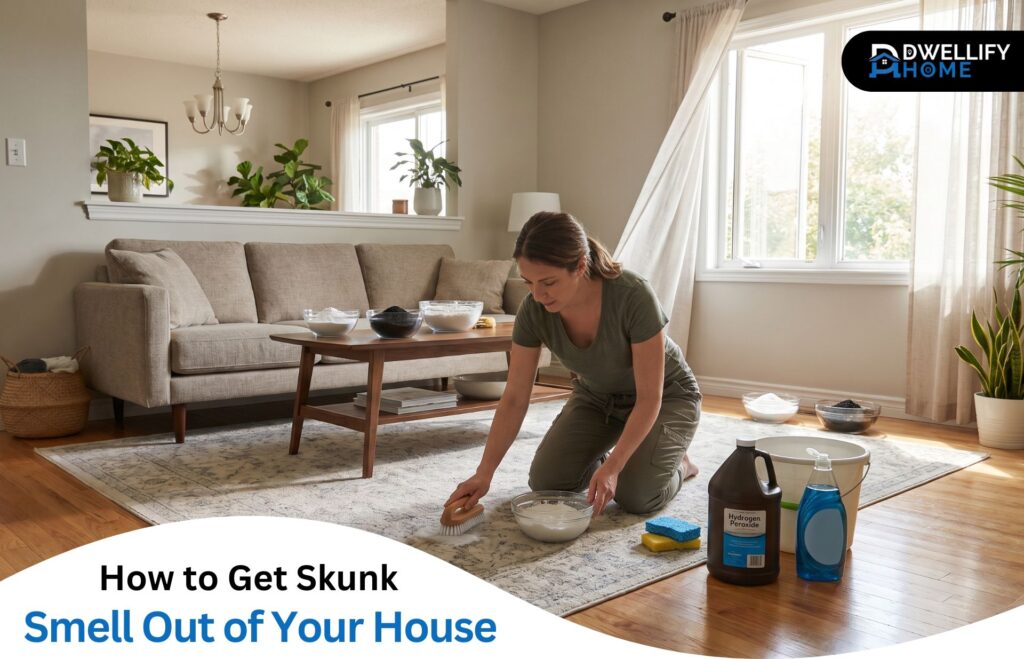
Fill shallow bowls with plain white vinegar and place one in each room, including hallways. Put them near the floor in corners — that’s where heavier odor compounds tend to accumulate. Leave them for 24 to 48 hours and replace them if the smell remains strong after the first day. Don’t cover the bowls. The surface area of the liquid is what does the work.
Using Activated Charcoal and Baking Soda as Passive Odor Absorbers
Activated charcoal bags are genuinely useful as a secondary absorber running in the background. Place them near soft furnishings and inside closets. Baking soda can be spread directly on carpets and left for several hours before vacuuming if you haven’t started the full carpet treatment yet.
The Baking Soda Steam Trick for Stubborn Lingering Odor
For rooms where the smell has really embedded itself, bring a pot of water to a gentle boil, add two to three tablespoons of baking soda and a lemon peel, and let the steam move through the space. The alkaline steam helps neutralize acidic odor compounds on nearby surfaces. This is especially useful in kitchens and bathrooms where vinegar bowls aren’t practical to leave unattended.
Step 3 — Clean Hard Surfaces (Floors, Walls, and Counters)
Hard non-porous surfaces are the most straightforward to treat — the spray doesn’t soak in, it sits on top.
Bleach-and-Water Solution for Non-Porous Floors and Hard Surfaces
Mix one part bleach to nine parts water. This ratio is effective on tile, linoleum, stone counters, and concrete without causing surface damage. Wear gloves, apply with a sponge or mop, and rinse with plain water immediately afterward. Don’t allow the bleach solution to dry on the surface.
Vinegar-and-Water Mix for Painted Walls and Wood Floors
For painted walls and finished wood, a 1:9 ratio of white vinegar to water is the safer choice. Apply lightly with a cloth — you’re wiping, not saturating. On wood floors, use as little moisture as possible and dry thoroughly. Excess water on wood can reactivate the dormant thioacetate compounds.
TSP and Bleach for Outdoor Decks, Patios, and Concrete
For outdoor wood surfaces like decks, mix one cup of household bleach with one cup of liquid TSP (trisodium phosphate) in a gallon of water. The TSP breaks down the residue holding the smell while bleach handles the organic compounds. Always patch-test in a hidden area first — bleach can discolor certain wood species and stone finishes.
Step 4 — How to Get Skunk Smell Out of Carpets and Rugs
Carpet holds skunk odor longer than nearly any other surface in your home. The fibers trap the oily spray compounds deep in the pile, and the longer it sits untreated, the harder the job becomes.
The Hydrogen Peroxide, Baking Soda, and Dish Soap Formula
Mix one quart of 3% hydrogen peroxide, a quarter cup of baking soda, and one teaspoon of liquid dish soap. Apply it to the affected area, work it gently into the fibers, and let it sit for five to ten minutes before blotting and rinsing. Blot — don’t rub. Rubbing pushes the compounds deeper into the pile.
One important caution: hydrogen peroxide can lighten carpet color, especially in darker shades. Always test on a hidden section first.
When Steam Cleaning Works Better Than a DIY Solution
If the contamination is widespread, or if the smell has been sitting for more than a few hours, a steam cleaner is worth using. The heat helps break down the compounds while the extraction pulls them out of the fibers. A single pass is rarely enough — run over the affected area two or three times for full effect.
Area Rugs vs. Wall-to-Wall Carpet — Why the Treatment Differs
Area rugs offer a significant advantage: you can take them outside for treatment and drying in direct sunlight, which speeds up the oxidation process considerably. For wall-to-wall carpet, you’re working in place — which means slower drying and a higher risk of residual odor if moisture sits too long in the padding underneath.
Step 5 — Treating Upholstery, Curtains, and Mattresses
These surfaces get skipped or under-treated more than any others — and it’s often why some homes still carry a faint odor weeks after the initial cleanup.
Safe Methods for Sofas, Foam Cushions, and Fabric Surfaces
Apply the hydrogen peroxide formula or an enzymatic cleaner to upholstered surfaces using a spray bottle, then blot. Don’t scrub — working the compounds into foam makes them harder to remove, not easier. For removable cushion covers, take them off and treat them separately from the foam.
How to Handle Curtains and Drapes Without Ruining Them
Machine-washable curtains can go directly into the wash using the baking soda laundry method covered in the next step. For dry-clean-only drapes, spot-treat with a diluted vinegar solution and hang them outside in fresh air and sunlight for as long as possible before sending them for professional cleaning.
When to Bring In a Professional Upholstery Cleaner
If you’re dealing with a heavily saturated sofa, a mattress that absorbed direct spray, or upholstery that didn’t respond after two treatment rounds — a professional is the right call. A hot-water extraction service reaches deeper into foam and batting than any home method can. It’s not a failure; it’s the right tool for the scale of the problem.
Step 6 — Getting Skunk Smell Out of Clothes and Bedding
The Baking Soda Laundry Method That Actually Works
Add half a cup of baking soda directly to the wash drum along with your regular detergent. Use the hottest water setting the fabric label permits. Run the full cycle, then check the clothing before it goes anywhere near a dryer. If any smell remains, wash again. Most items clear within two cycles.
Why You Must Never Put Skunked Clothes in the Dryer
The heat from a dryer doesn’t remove skunk odor — it bakes it into the fibers. Once that happens, the smell is essentially set and further washing will have very limited effect. Always air-dry skunked clothing, preferably outside in sunlight. Check that items are completely odor-free before they go near a dryer.
How to Treat Delicate Fabrics Without Causing Damage
For fabrics that can’t handle hot water or agitation, soak them in one part white vinegar to four parts cool water for up to 30 minutes. Rinse gently and hang to air dry. Hydrogen peroxide is not suitable for delicate fabrics — the risk of affecting dye or weakening material is too high.
Step 7 — Dealing With Your HVAC System and Air Filters
This is where many households get stuck in a loop. They clean everything thoroughly, and the smell keeps returning. Nine times out of ten, the HVAC system is the reason.
Why Your HVAC System Could Be Spreading the Smell to Every Room
When skunk spray is in the air, your return vents actively pull that contaminated air into the system. The filter catches some of it. The ductwork catches the rest. Every time the system cycles on, it redistributes that trapped odor through every supply vent in the house. It’s a circuit that keeps running until you deliberately break it.
How to Clean Return Vents and Ductwork the Right Way
Turn the system off. Remove the return vent cover and spray a non-corrosive, fragrance-free odor neutralizer into the return duct for a few seconds. Turn the fan on without heating or cooling and run it for five to ten minutes to push the cleaner through the system. Repeat if necessary. The return vent — not just the filter — is the critical point that most people miss.
When to Replace Filters vs. When Cleaning Them Is Enough
Always replace the filter after a skunk event. Don’t try to clean it. Filters are inexpensive and the trapped compounds in the fibers are not reversible. Once the smell in the house has cleared, install a fresh filter. If the ductwork retains a noticeable odor, an HVAC professional can perform a full duct cleaning.
What to Do When Your Pet Brought the Skunk Smell Inside
This is the most common scenario by a wide margin — a dog sprayed in the backyard at 10pm that ran through the house before anyone understood what had happened.
De-Skunk Your Pet Outdoors Before They Come Back In
The moment you realize your pet has been sprayed, keep them outside. Every surface they touch becomes a transfer point for the spray. Have one person restrain the pet outside while another prepares the treatment mixture. The few minutes it takes to organize are worth it.
The Peroxide, Baking Soda, and Dish Soap Formula for Dogs and Cats
Mix one quart of 3% hydrogen peroxide, a quarter cup of baking soda, and one to two teaspoons of dish soap. Work it into your pet’s coat thoroughly, avoiding eyes, ears, and mouth. Leave it for five minutes — not longer, as hydrogen peroxide can lighten fur — then rinse completely and follow with their regular shampoo.
Don’t store leftover solution in a sealed container. The chemical reaction produces gas that builds pressure over time.
Pet-Safe Commercial Products Worth Keeping in Your Home
If you live in an area where skunk encounters are regular, keep a commercial de-skunking product on hand. Look for enzymatic formulas designed specifically for skunk odor — they break down sulfur compounds rather than masking them. Having one available means you’re not mixing solutions from scratch at midnight.
What to Do If a Skunk Sprayed Under or Near Your House
When the source is outside — under a deck, near the foundation, or in a crawl space — the odor seeps in through vents, gaps, and the building materials themselves. Cleaning indoors alone won’t solve it.
How to Locate the Spray Source Around Your Foundation
Walk the perimeter of your house. The concentration will be noticeably stronger near the spray point. Check under decks, behind lattice panels, near HVAC condenser units, and along the base of the foundation. If a skunk is actually living under the structure, you need wildlife removal before deodorizing produces any lasting result.
Treating Crawl Spaces, Foundation Vents, and Soil
Saturated soil can hold and slowly re-release odor for weeks. A diluted enzyme-based cleaner applied to affected soil helps, but ventilation is the primary driver of recovery. Ensure crawl space vents are open and clear. For confined spaces with heavy contamination, professional ozone treatment may be the most complete solution available.
Deodorizing Outdoor Wood, Concrete, and Stone Surfaces
Use the TSP and bleach mixture from Step 3. For concrete, allow the solution to sit for two to three minutes before rinsing — concrete is porous and needs the contact time to work. Natural stone varies widely; always test before using any bleach-based solution on it.
Is Skunk Smell in Your House Dangerous?
For most people, skunk smell in the house is intensely unpleasant but not medically dangerous. High concentrations in enclosed spaces can cause temporary nausea, watering eyes, headaches, and in people with respiratory sensitivities, some breathing discomfort. These effects typically resolve quickly once the space is properly ventilated.
Short-Term Health Effects You Should Know About
The symptoms most commonly reported are nausea, eye irritation, and a burning sensation in the nasal passages or throat. Skunk spray and tear gas actually share chemically similar compounds — both are lachrymatory agents designed to irritate mucous membranes. For most healthy adults, symptoms pass within an hour of being in fresh air.
When the Smell Signals a Skunk Living Under or Near Your Home
A one-time spray event near your property produces a sharp, overwhelming odor that fades progressively over days. A skunk living under your deck or house produces a lower-level but persistent smell that doesn’t fully clear regardless of how much you clean. If the odor keeps returning without an obvious trigger, treat it as a wildlife issue first and a cleaning issue second.
Safety Precautions When Using Chemical Cleaning Solutions Indoors
Keep windows open when using bleach-based solutions indoors, and wear gloves throughout. Never mix bleach and ammonia — the reaction produces chloramine vapor, which is genuinely hazardous. When using hydrogen peroxide and baking soda together, use the mixture immediately and never store it in a sealed container.
What Doesn’t Work — Myths and Mistakes to Avoid
Why Tomato Juice Does Not Remove Skunk Smell
Tomato juice doesn’t neutralize skunk odor. What it does is temporarily overwhelm your nose with a competing scent — a well-documented phenomenon called olfactory fatigue — making it seem like the smell is gone. Once the tomato scent fades, the skunk odor returns unchanged. The myth persists because the effect feels convincing in the moment.
Why Scented Candles and Air Fresheners Make Things Worse
Air fresheners and candles layer a new scent on top of an existing odor. They don’t break down or neutralize the sulfur compounds at all. The result is typically a combined smell of skunk and artificial fragrance that many people find harder to tolerate than the original. Masking is not remediation.
The Dryer Mistake That Can Set the Smell in Permanently
Worth repeating here with emphasis: putting skunked clothing or bedding in a dryer before the smell is completely gone will heat-bond the sulfur compounds to the fabric fibers. This is very difficult — and often impossible — to reverse. Always confirm that clothing is fully odor-free before it goes anywhere near a dryer.
How to Get Rid of Skunk Smell in Your House Overnight
A realistic overnight recovery is achievable for mild-to-moderate cases if you act promptly and work through the right steps before bed. For severe or deep-set cases, expect meaningful improvement but not necessarily complete resolution by morning.
The Fast-Action Evening Checklist
- Open all windows and position outward-facing fans
- Turn off the HVAC temporarily and place vinegar bowls in every room
- Bag affected clothing and set it aside for washing
- Apply the peroxide formula to carpets and let it work overnight
- De-skunk your pet outside if they were the entry point
- Wipe down all hard surfaces with your chosen cleaning solution
What to Leave Running While You Sleep
Leave fans running in windows facing outward. Activated charcoal bags and vinegar bowls work passively and need no attention overnight. Don’t run HVAC heating or cooling until you’ve replaced the filter in the morning.
What to Expect by Morning — and What to Do If the Smell Remains
By morning, the sharp intensity of the initial spray should be noticeably reduced. What often lingers is a lower-level background odor coming from surfaces that weren’t fully treated, or from the HVAC system. Start the morning by replacing your HVAC filter first, then do a room-by-room check and address anything you missed the evening before.
DIY Remedies vs. Commercial Products — Which One Do You Actually Need?
When Homemade Solutions Are Enough
For a mild event — a dog that had a near miss with a skunk, or odor that drifted in through a window — the hydrogen peroxide, baking soda, and dish soap combination handles most surfaces effectively when caught early. Combined with vinegar bowls and proper ventilation, it covers the majority of household situations.
The Best Types of Commercial Skunk Odor Neutralizers
When contamination is heavy or has had time to set, enzymatic cleaners and molecular-bonding neutralizers are worth using. Enzymatic formulas break down organic compounds biologically. Non-enzymatic formulas — such as those used by professional remediation teams — work at the molecular level and are particularly effective when prior treatments have been partially applied but didn’t finish the job.
How to Know When You’ve Crossed Into Product Territory
If you’ve completed two full rounds of DIY treatment, replaced your HVAC filter, and the smell is still clearly present — you’ve crossed into product territory. A commercial-grade odor neutralizer isn’t a last resort; it’s the appropriate next step when the chemistry of the problem requires it.
When Should You Call a Professional Odor Removal Service?
Signs the Smell Has Gone Too Deep for DIY
The main indicators are: the smell persists in one area regardless of what you apply, it returns reliably a day or two after treatment, or it’s strongest in areas you can’t physically clean — behind walls, under floors, or inside ductwork. These patterns point to contamination beyond the surface level.
What Professionals Use — Ozone Generators, Thermal Fogging, and Enzyme Treatments
Ozone generators produce reactive oxygen molecules that break down organic odor compounds at the molecular level, including in areas no cleaning product can physically reach. Thermal fogging releases a deodorizing vapor that travels through the same pathways the skunk spray followed. These are not consumer tools — ozone generators require the space to be fully evacuated during use and properly ventilated before re-entry.
What Does Professional Skunk Odor Removal Typically Cost?
Single-room treatment typically runs $200 to $500 depending on method and location. Whole-home treatments using ozone generation or thermal fogging generally range from $500 to $1,500. Crawl space and foundation work adds cost based on accessibility. For a severe case, that investment is substantially faster and more thorough than extended DIY attempts.
How to Keep Skunks Away From Your Home Going Forward
Seal Off Entry Points Under Decks, Porches, and Crawl Spaces
Hardware cloth — rigid wire mesh — buried at least six inches into the ground and attached to the base of your deck or porch is the most reliable physical barrier. Skunks dig, so surface-level barriers alone aren’t enough. This is a one-time job that pays for itself quickly if you’ve already been through a spray event.
Remove the Food Sources That Attract Skunks in the First Place
Skunks are opportunistic feeders. Unsecured garbage bins, fallen fruit, birdseed scattered on the ground, and outdoor pet food bowls left overnight are all consistent attractants. Use bins with locking lids, pick up fallen fruit regularly, and don’t leave pet food outdoors after dark.
Motion-Activated Lights and Deterrents That Actually Work
Skunks are nocturnal and genuinely dislike bright, sudden light. Motion-activated floodlights positioned around your deck and foundation perimeter are an effective and low-maintenance deterrent. Motion-activated sprinkler systems also work well. Ultrasonic devices have a more variable track record — results depend heavily on product quality and placement.
Frequently Asked Questions
How long does skunk smell last in a house?
Without treatment, skunk smell can linger in a house for two to four weeks — sometimes longer if it’s embedded in carpet, upholstery, or ductwork. With prompt treatment using the right neutralizing agents, most homeowners can bring the smell to a low, manageable level within 24 to 48 hours and eliminate it fully within a week.
What neutralizes skunk smell the fastest?
The fastest-acting solution for most surfaces is a mixture of one quart of 3% hydrogen peroxide, a quarter cup of baking soda, and one teaspoon of dish soap. This combination chemically oxidizes the thiol compounds in skunk spray. For airborne odor, vinegar bowls combined with cross-ventilation work together to reduce concentration quickly.
Can skunk smell come in through walls or vents?
Yes. If a skunk sprays near a foundation vent, crawl space opening, or HVAC condenser unit, the odor travels directly into the ductwork and distributes through the house. It can also seep through gaps in siding, around pipe penetrations, and through unsealed crawl space vents. When the smell seems to come from everywhere at once, the HVAC system is almost always involved.
Does skunk smell go away on its own eventually?
Eventually, yes — but much more slowly than most people expect. Untreated, the smell on porous surfaces can persist for months. The thioacetate compounds in skunk spray are particularly stubborn because they reactivate with humidity over time. Active treatment dramatically accelerates the recovery timeline.
How do I get skunk smell out of my house when it came from outside?
Start by identifying and treating the external spray point — soil, decking, or foundation — with an outdoor odor neutralizer. Seal any vents or gaps that allowed the odor to enter. Inside the house, run the full ventilation and surface treatment process. Replace HVAC filters once the exterior source has been neutralized.
Is it safe to stay in a house that smells like skunk?
For most people, yes. The smell is genuinely unpleasant but not toxic at typical household concentrations. Those with asthma, respiratory sensitivities, or persistent symptoms like ongoing eye irritation or headache should step outside until ventilation has significantly reduced indoor concentration. Prioritize getting fresh air moving before starting any chemical-based cleaning work.
Final Thoughts
Skunk smell is one of the most disorienting odors a homeowner can face — but it is fully solvable. The process works when you do it in the right order: ventilate first, neutralize the air, treat surfaces from hardest to softest, and don’t skip the HVAC system. That last step alone explains why so many people clean thoroughly and still wonder why the smell keeps returning days later.
Work through each surface systematically, stay patient with anything that needs a second round, and never put skunked fabric in the dryer before it’s completely clear. Done correctly, you can get skunk smell out of your house entirely — and in most cases, much faster than you’d expect.
Disclaimer
The content on Dwellify Home is provided for general informational purposes only. While every effort is made to ensure accuracy and practical usefulness, individual results may vary depending on the severity of the situation, the materials involved, and the specific conditions of your home. Always follow product instructions and take appropriate safety precautions when using cleaning solutions indoors. For serious infestations or persistent odor issues, consulting a licensed professional is recommended.