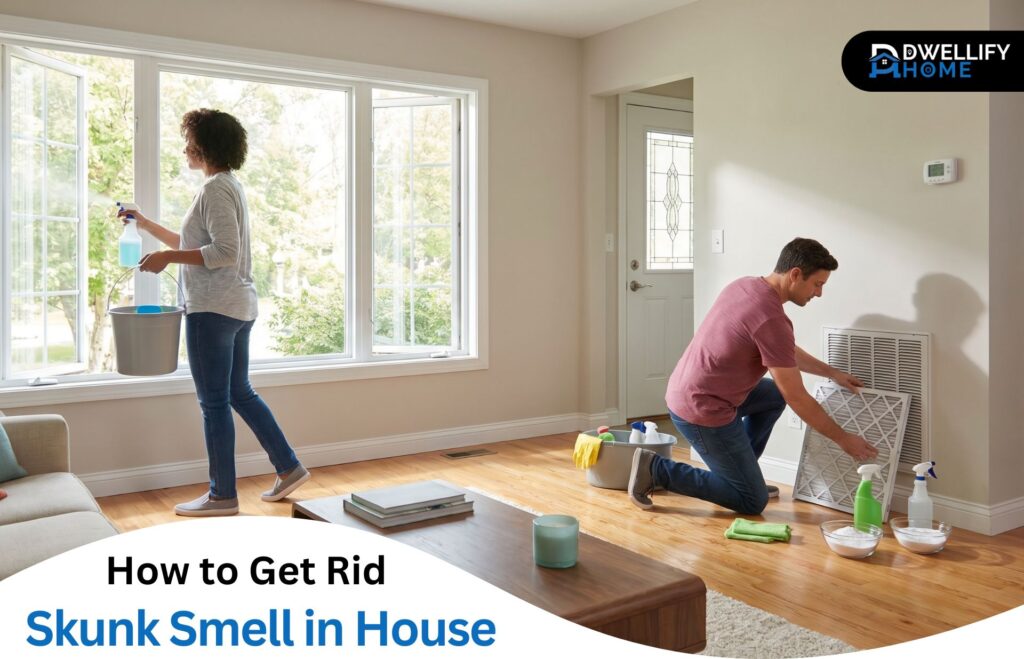
You wake up at 2 a.m. to a smell that hits you before you even open your eyes. Somewhere outside, a skunk fired off — and now that smell is inside your home. Maybe your dog came bolting through the dog door. Maybe a skunk sprayed under the porch and the odor crept in through the HVAC intake. Either way, you’ve got minutes to act before this gets significantly harder to deal with.
This guide covers how to get rid of skunk smell in house situations — fast, thoroughly, and room by room. We’ll skip the myths, explain why the smell behaves the way it does, and give you a clear, surface-by-surface plan that works.
Snippet-Ready Definition
To get rid of skunk smell in a house, ventilate immediately, neutralize surfaces with a hydrogen peroxide and baking soda solution, and replace HVAC filters. Acting within the first 15–20 minutes prevents odor from bonding deeply into carpets, furniture, and walls.
Mission Statement
At Dwellify Home, we help homeowners make practical, well-informed decisions about their living spaces — whether that’s solving an unexpected problem, improving comfort, or making the home work better for the people in it. Every guide we publish is written to give you real answers, not generic advice.
Why Skunk Smell Spreads Through a House So Quickly
Skunk spray contains sulfur-based compounds called thiols, which vaporize on contact and cling to nearly every surface — fabric, walls, carpet, and even your HVAC ducts. Because thiols are oil-based, they bond deeply to porous materials. Acting within the first 15–20 minutes dramatically reduces how far the smell penetrates and how long it lingers.
The Science Behind the Smell — Thiols and Thioacetates
The rotten-egg intensity of skunk spray comes from thiols — sulfur compounds that are detectable by the human nose at concentrations as low as 1 part per 10 billion. That’s not a typo. Your nose is extraordinarily sensitive to this chemical, which is exactly why even a small outdoor spray can make an entire house unbearable.
But here’s what most people don’t realize: skunk spray also contains thioacetates. These sit dormant at first and don’t smell nearly as strong. The problem is that thioacetates convert into more thiols when they come into contact with moisture or humidity — including the steam from a shower, a rainy day, or even a damp mop. That’s the science behind why the smell seems to “come back” days after you thought you’d cleaned it.
Why the Smell Seems to Come Back Even After Cleaning
This is one of the most frustrating parts of dealing with a skunk event. You clean everything, the smell fades, and then two days later someone takes a hot shower and the whole house smells like it happened again. That’s thioacetate reactivation — not a cleaning failure.
The fix isn’t to clean harder. It’s to use a neutralizer that chemically converts those dormant thioacetates before they have a chance to activate. Standard household cleaners, air fresheners, and even some enzyme products don’t do this. The peroxide formula does — more on that shortly.
How Long Does Skunk Smell Last in a House?
With no treatment at all, mild skunk odor can linger for two to three weeks. On porous surfaces like carpet, upholstery, or unfinished wood, it can persist for months or longer. Untreated crawlspace contamination has been known to cause recurring smell for over a year.
Act fast and use the right methods, and you can clear most cases in two to three days. The difference between a 48-hour fix and a three-week ordeal almost always comes down to what you do in that first hour.
Quick Method Comparison — What Works vs. What Doesn’t
| Method | Does It Neutralize? | Best Used For |
| Hydrogen peroxide + baking soda + dish soap | Yes — chemically | Pets, skin, surfaces, fabric |
| Enzyme-based cleaner | Yes — biologically | Carpets, upholstery, bedding |
| White vinegar bowls | Partially — absorbs | Air, passive overnight use |
| Activated charcoal bags | Partially — absorbs | Vents, enclosed spaces |
| Tomato juice | No — masks only | Nothing — skip it |
| Air freshener / Febreze | No — masks only | Temporary only |
| Ozone treatment (professional) | Yes — fully | Severe or structural cases |
Key Steps at a Glance
- Shut off the HVAC immediately to stop odor spreading through ducts
- Open all windows and set fans to push air outward, not inward
- Isolate any sprayed pets before they transfer oil to furniture
- Apply the peroxide formula fresh — never store it in a sealed container
- Replace all air filters with activated carbon filters after the event
- Place white vinegar bowls in every affected room and replace every 24 hours
- Use enzyme-based cleaners on carpets, upholstery, and bedding
- Address the crawlspace or basement separately — concrete holds odor deeply
Is Skunk Smell in the House Dangerous?
Skunk spray is not immediately life-threatening indoors, but concentrated exposure can cause eye irritation, nausea, headaches, and respiratory discomfort — similar to tear gas. The greater concern is mistaking a gas leak for skunk odor. If no skunk encounter occurred and the smell appeared suddenly, evacuate and call your gas company immediately.
Health Effects of Skunk Spray Indoors
Most healthy adults experience temporary symptoms: burning or watering eyes, mild nausea, and headache. In enclosed spaces with heavy concentration, some people — especially children, the elderly, or those with respiratory conditions — may experience more pronounced reactions, including vomiting or difficulty breathing.
Getting outdoors to fresh air resolves most symptoms quickly. If someone was sprayed directly in the eyes, rinse with room-temperature water for 15 minutes. Persistent symptoms warrant a call to a medical professional.
Skunk Smell but No Skunk — Could It Be a Gas Leak?
This is an important safety note. Natural gas is odorless on its own, so gas companies add methyl mercaptan as a warning odorant — and it smells remarkably similar to skunk spray. If you smell something skunk-like but no skunk encounter has occurred, don’t assume it’s wildlife. Leave the house immediately, avoid switching any electrical appliances on or off, and call your gas company from outside. This isn’t an overreaction — it’s the right call.
The First 15 Minutes — Your Immediate Action Plan
The first 15 minutes after a skunk spray event are the most critical. Ventilate every room immediately, isolate and contain affected pets before they transfer the oil to furniture, remove all clothing worn during the incident, and seal it in a bag. Every minute of delay allows thiols to bond deeper into surfaces.
Open Everything and Create Airflow Now
Open every window and door in the house right now — not just the ones closest to the smell. Set up box fans in windows to push air outward, not inward. You want to create a pressure differential that forces the contaminated air out. Let sunlight in where possible; UV exposure helps oxidize airborne odor molecules.
Isolate Your Pet Before They Spread the Oil Indoors
If your dog was the one that got sprayed and they’ve already been inside, this is your top priority — even before cleaning surfaces. A sprayed dog running through the house transfers skunk oil to every carpet, couch, and bed they touch. Contain them in one washable room, or take them straight outside, before you do anything else.
Remove and Bag Contaminated Clothing Immediately
Take off any clothing you were wearing during the event and place it directly into a sealed plastic bag. Don’t drop it in the hamper with other clothes — the oil transfers easily through fabric. Set it aside for washing separately.
Do Not Run Your HVAC Yet — Here’s Why
This is the mistake I see most often. A homeowner’s instinct is to crank the air conditioning to “air the place out,” but if your HVAC was running when the skunk spray happened — or if you turn it on now — it will pull odor molecules through your ductwork and distribute them to every room in the house. Shut it off. Ventilate manually with fans and open windows until you’ve treated the main affected areas.
The Most Effective Skunk Smell Neutralizer — The Peroxide Formula
The most proven method for neutralizing skunk odor — on pets, skin, fabric, and surfaces — is a fresh mixture of 1 quart 3% hydrogen peroxide, ¼ cup baking soda, and 1–2 teaspoons of liquid dish soap. This combination chemically oxidizes the thiols into odorless sulfonic acids. Never store this mixture in a sealed container — it can build pressure and burst.
Why This Formula Works — The Chemistry in Plain English
The hydrogen peroxide does the heavy lifting: it oxidizes the thiol molecules and converts them into sulfonic acids, which have virtually no detectable odor. The dish soap breaks down the oily base of the spray so it releases from surfaces instead of sitting on top of them. Baking soda helps neutralize the pH and provides mild abrasive action on hard surfaces.
This is why the formula works when tomato juice and air fresheners don’t — it changes the chemical structure of the odor compound rather than just covering it.
How to Use It Safely — On Surfaces, Pets, and Skin
Mix it fresh each time — the reaction starts immediately and the solution loses effectiveness as it sits. On surfaces, apply with a cloth and let it sit for a few minutes before wiping. On pet fur, work it in gently, avoiding eyes and mouth, and rinse after no more than five minutes — longer exposure can lighten fur color. On skin, apply and rinse the same way.
Always patch-test on colored fabrics before full application. Hydrogen peroxide can lighten some dyes.
What to Do When You Don’t Have Hydrogen Peroxide
Every pharmacy and most grocery stores carry 3% hydrogen peroxide — it’s the standard brown bottle. If you genuinely can’t get it right away, diluted white vinegar is a reasonable short-term measure. It won’t neutralize as thoroughly, but it will slow the spread while you get the right supplies.
How to Get Rid of Skunk Smell in the House — Room by Room
Different rooms require different treatments because skunk odor behaves differently across materials. Soft, porous surfaces like sofas and carpets absorb thiols deeply and need enzyme-based or peroxide treatment. Hard surfaces like tile, counters, and walls respond well to diluted bleach or vinegar. Each room below has its own approach.
Living Room — Furniture, Upholstery, and Curtains
Apply the peroxide formula to upholstered furniture with a cloth — don’t saturate, just dampen. If the piece is small enough, move it outside while you treat it. Curtains should go straight into the washing machine with your regular detergent and half a cup of baking soda. Place bowls of white vinegar around the room and replace them every 24 hours while the room airs out.
For deeply embedded odors in upholstery, a steam cleaner is worth renting. Steam combined with a vinegar-water tank solution reaches into fabric in a way that surface treatments can’t.
Bedrooms — Mattresses and Bedding
Strip the bed immediately and wash everything in hot water with baking soda. For the mattress, mix equal parts white vinegar and water in a spray bottle and mist the surface lightly — don’t soak it. Follow up with an enzyme cleaner once the vinegar spray has dried. Air-dry in sunlight if at all possible; sunlight helps break down residual odor compounds.
Kitchen — Hard Surfaces, Counters, and Walls
Mix nine parts water to one part bleach and wipe down walls, counters, and hard floors. Always patch-test first, especially on painted surfaces or natural stone. If you’re uncomfortable using bleach, diluted white vinegar is effective on most kitchen surfaces. Leave bowls of vinegar near vents or wall outlets where odor tends to concentrate.
Basement and Crawlspace — The Hardest Area to Clear
Concrete is highly porous and absorbs skunk oil deeply, which is why basements and crawlspaces are often the most stubborn areas to treat. Scrub concrete surfaces with a bleach-water solution and lay out activated charcoal bags for passive ongoing absorption. If the smell originated from a skunk spraying directly in or under the crawlspace, this is where DIY often hits its limits — professional help is frequently needed.
Garage — Concrete Floors and Stored Items
Ventilate with the garage door fully open and set up fans pushing air outward. Scrub the floor with bleach-water. Any stored fabrics — blankets, sports gear bags, cloth storage bins — need to be washed or discarded if heavily contaminated. Cardboard boxes absorb and hold skunk odor reliably; if they smell, they need to go.
How to Get Skunk Smell Out of Carpets and Rugs
For carpets, start with a baking soda, vinegar, and warm water solution on affected patches — let it sit, then blot and repeat. For heavy odor or larger areas, steam cleaning is the most effective DIY approach. Area rugs that can be moved should go outside immediately. Avoid machine-drying anything until the smell is completely gone — heat bakes the odor in.
Start by sprinkling a generous amount of dry baking soda directly on the carpet. Let it sit for 15–20 minutes, then follow with a light spray of diluted white vinegar. The mild fizzing reaction helps loosen odor compounds from carpet fibers. Blot — don’t scrub — then repeat.
For wool or sensitive fibers, skip the peroxide formula and use an enzyme-based cleaner designed for organic odors. These break down the biological compounds without the bleaching risk.
How to Get Skunk Smell Out of Walls and Hard Floors
Mix a spray solution of nine parts water to one part bleach, apply to walls and hard floors, and wipe clean with a cloth. For wood floors or surfaces where bleach could cause discoloration, substitute diluted white vinegar.
For particularly stubborn odor embedded in wood — especially older or unfinished wood — a TSP (trisodium phosphate) and bleach combination is more effective. Mix roughly one cup of liquid TSP with one cup of household bleach per gallon of water. Apply in small sections, rinse quickly, and don’t let it sit for more than a few minutes on wood surfaces. This is an expert-level step that most articles skip over, but it’s worth knowing when standard methods aren’t cutting it.
Don’t Forget Your HVAC — It Could Be Recirculating the Smell
If your HVAC system was running when the skunk event occurred, it likely pulled odor molecules through your ductwork and distributed them to every room. The immediate fix is to replace all air filters — skunk odor binds to filter material and keeps recirculating. For severe cases, duct cleaning by a professional may be necessary.
Why Skunk Odor Recirculates Through Your Vents
Standard air filters aren’t designed to capture oil-based odor compounds. Once skunk spray gets into the intake, the filter holds onto those molecules and releases them back into your air supply every time the system runs. This is why homes with HVAC exposure often report a persistent low-level smell for weeks after the initial event — even after thorough surface cleaning.
When to Replace Filters and Which Type Works Best
Replace filters immediately after a skunk event — don’t wait. Activated carbon filters are the best option for odor situations because the carbon material actively binds to odor molecules rather than just filtering particles. HEPA filters are excellent for air quality but less effective specifically at trapping organic odor compounds.
Should You Run or Shut Off Your AC During a Skunk Event?
Shut it off first. Ventilate the house manually with open windows and fans while you treat surfaces and replace the filters. Once the filters are swapped and the primary surfaces are treated, you can restart the system. Running it before those steps are done is one of the main reasons people end up with smell that won’t clear.
How to Get Skunk Smell Off Your Dog — and Stop It Spreading Indoors
If your dog was sprayed and came inside, act before doing anything else in the house. Wash them immediately using the peroxide-baking soda-dish soap formula outdoors or in a contained space. Do not let them on furniture, beds, or carpet until they are fully de-skunked. The spray oil transfers easily to every surface they touch.
Step-by-Step: Washing a Sprayed Dog
- Put on rubber gloves before you start.
- Take the dog outside or directly to the bathtub — no detours through the living room.
- Mix the peroxide formula fresh: 1 quart 3% hydrogen peroxide, ¼ cup baking soda, 1–2 teaspoons dish soap.
- Apply generously to fur and work it in, avoiding eyes and mouth.
- Let it sit for three to five minutes — you’ll see some foaming, which is normal.
- Rinse thoroughly, then follow with regular pet shampoo.
- Repeat if the smell is still strong.
Keep the dog contained in a clean room until fully dry. A damp dog that still carries trace spray oil can re-contaminate surfaces.
What to Do If the Smell Already Got on Your Couch or Bed
Apply an enzyme-based cleaner to the affected upholstery and let it dwell for 10 minutes before blotting. For mattresses, use the vinegar-water spray method, allow to dry fully, then follow with the enzyme cleaner. Wash all removable covers in hot water with baking soda.
Pet-Safe Commercial Products Worth Having on Hand
Nature’s Miracle Skunk Odor Remover is enzyme-based and widely trusted for both pet fur and household surfaces. Zero Odor works well on upholstery and fabrics. Odorcide Skunk-Off uses a non-enzymatic formula that works even when other products have already been applied — useful when you’ve tried something else first and it didn’t finish the job.
How to Wash Skunk Smell Out of Clothing and Bedding
Add your regular laundry detergent plus half a cup of baking soda and wash in the hottest water the fabric can safely handle. For a vinegar alternative — particularly useful on delicates — soak the garment in a one-part vinegar to four-parts water solution for up to 30 minutes, then hand-wash or machine-wash as usual.
Air-dry everything. Don’t put anything in the dryer until you’re certain the smell is completely gone. Heat from a dryer sets odors into fabric permanently, turning a fixable problem into one that requires discarding the item. Shoes and items that can’t be washed should be hung outdoors to air.
Natural Odor Absorbers That Help Overnight
For ongoing odor absorption — especially while sleeping or at work — several natural materials passively pull skunk smell from the air. White vinegar bowls, activated charcoal bags, and fresh coffee grounds are the most effective. Positioning them near fans or in rooms with poor airflow makes them significantly more useful.
Place bowls of white vinegar in each affected room and replace them every 24 hours. For a faster effect, simmer a pot of white vinegar on the stove for one to two hours — the vapors actively deodorize the air throughout the house.
Activated charcoal bags work silently and continuously, making them ideal near HVAC vents and in enclosed spaces like closets or the basement. Coffee grounds — fresh or used — absorb ambient odor effectively and are worth placing in bowls wherever the smell is strongest. Baking soda sprinkled on carpets and left overnight provides passive absorption before you vacuum it up in the morning.
What If the Skunk Sprayed Outside but the Smell Got Inside?
This is actually the most common scenario — a skunk sprays near a vent, window, or under a porch, and the smell infiltrates through gaps in insulation, open windows, or the HVAC intake. No pet or person needs to be directly sprayed for your entire house to smell. The approach here is different: focus on the entry points and air system, not just surface cleaning.
Start by locating where the smell is strongest — that tells you where it’s entering. Check crawlspace vents, window gaps, dryer exhaust openings, and any foundation gaps. Shut off the HVAC intake if possible, and temporarily seal the entry point with towels or tape while you work.
Set up fans pushing air out through windows on the opposite side of the house. Replace HVAC filters immediately. Place vinegar bowls near the identified entry points. For crawlspace contamination, lay activated charcoal bags directly inside the space, and scrub any concrete surfaces with diluted bleach once it’s safe to access.
This scenario often resolves faster than a direct indoor spray because the source is outside — but only if you seal the entry point and stop the ongoing infiltration.
Common Skunk Smell Myths — What Doesn’t Actually Work
Several widely repeated remedies for skunk smell either don’t work at all or only mask the odor temporarily. Tomato juice is the most famous — it triggers olfactory fatigue, making you think the smell is gone when it isn’t. The same applies to beer, oatmeal, and standard air fresheners. None of these chemically neutralize thiols.
Tomato juice creates a second strong smell that temporarily overwhelms your sense of skunk. Your nose fatigues from the combination and stops registering the skunk — but the thiol compounds are still there. When the tomato smell fades, the skunk comes right back.
Beer and oatmeal are similarly ineffective — they’re surface rinses with no chemical action on thiols. Febreze and standard air fresheners mask odor briefly and are fine as a temporary measure while you treat the actual problem, but they will not solve it on their own. Burning sugar is an old folk remedy that’s unreliable and not worth attempting. These are the methods that tend to circulate online, especially in community forums, but field experience makes it very clear — none of them replace proper chemical neutralization.
Best Commercial Products for Skunk Odor Removal
Enzyme-based cleaners like Nature’s Miracle Skunk Odor Remover and Zero Odor work by breaking down the organic compounds in skunk spray at the molecular level. They’re effective on fabrics, carpets, and upholstery, and they’re safe for most surfaces. These are solid first-choice options for most household situations.
Non-enzymatic formulas like Odorcide Skunk-Off are worth knowing about for cases where enzyme products have already been tried or when the odor is severe and embedded. The formula works differently — it bonds with odor-producing molecules directly — which is why it can succeed where enzymatic cleaners fall short.
For most homeowners, the DIY peroxide formula handles fresh events well. Commercial products earn their value when odor has had time to set in, when the contamination is widespread, or when you’ve tried the DIY approach and still have residual smell.
When to Call a Professional — and What They’ll Actually Do
If the smell persists for more than 7–10 days despite thorough treatment, or if the skunk sprayed inside a crawlspace, under the house, or directly into ductwork, professional remediation is likely needed. Professionals use ozone treatment and commercial-grade fogging — methods that are not safe for DIY use with people or pets present.
Signs the Smell Is Beyond DIY
- The smell returns consistently after multiple rounds of thorough cleaning
- The source was under the house, in a crawlspace, or inside ductwork
- The odor has spread into structural materials like wall insulation or subfloor
- You’ve been treating for over a week with no meaningful improvement
These aren’t signs that you did something wrong. They’re signs that the scope of contamination requires industrial-grade equipment to resolve.
What Ozone Treatment Is and When It’s Appropriate
Ozone generators produce O3, which is highly reactive and destroys odor molecules at the molecular level rather than masking them. It’s one of the most effective tools available for severe skunk odor — but it is hazardous to people, pets, and plants. Anyone using an ozone generator must vacate the property for the duration of treatment and for a period afterward. This is not a consumer DIY tool. Trained odor remediation professionals use it safely with proper equipment and protocols.
How Much Does Professional Skunk Odor Removal Cost?
DIY treatment typically costs $5–$50 in materials. Professional odor remediation runs $200–$1,000 depending on home size, severity of contamination, and the methods required. If a skunk is still present on the property and needs to be removed, wildlife removal adds $200–$600 depending on the situation. These costs are worth weighing against the time and ongoing disruption of an untreated or poorly treated skunk event.
How to Stop Skunks from Coming Back
Skunks don’t go looking for trouble. They’re after food and shelter — and residential properties offer both in abundance. Removing the appeal is the most straightforward prevention strategy.
- Secure trash cans with tight-fitting lids and store bins away from the house perimeter
- Remove outdoor pet food, birdseed spills, and fallen fruit promptly
- Seal gaps under decks, porches, and sheds with heavy-gauge hardware cloth buried a few inches into the ground to prevent digging
- Install motion-activated lights around the perimeter — skunks are nocturnal and tend to avoid well-lit areas
- Keep brush piles, woodpiles, and dense vegetation trimmed back from the foundation
- Inspect crawlspace vents and screens seasonally and repair any damage
None of these steps are difficult. Combined, they make your property significantly less attractive to skunks looking for an easy meal or a sheltered den site.
Frequently Asked Questions
How long does it take for skunk smell to go away in a house?
With proper treatment, mild skunk odor can clear in two to three days. Without treatment, it can linger for several weeks and potentially months if embedded in porous materials like carpet or upholstery.
What neutralizes skunk smell the fastest?
The fastest neutralizer is a fresh mix of 1 quart 3% hydrogen peroxide, ¼ cup baking soda, and 1–2 teaspoons of dish soap. This chemically converts thiols into odorless sulfonic acids rather than masking the smell.
Can skunk smell make you sick?
Yes, in concentrated amounts. Exposure can cause eye irritation, nausea, vomiting, and respiratory discomfort. Most symptoms are temporary and resolve once you move to fresh air. People with asthma or respiratory conditions may be more sensitive.
Why does my house smell like skunk but there’s no skunk?
A skunk-like smell with no known animal encounter could indicate a natural gas leak — methyl mercaptan is added to natural gas as a safety odorant. Leave the house immediately and call your gas company from outside if you’re unsure of the source.
Does skunk smell go away on its own?
Partially. Over several weeks, untreated skunk odor will fade but rarely disappears completely — especially from porous materials. Thioacetates can reactivate with humidity, bringing the smell back unexpectedly even after it seemed to have cleared.
How do I get rid of skunk smell in my house overnight?
Place bowls of white vinegar in every affected room, run fans pushing air to the outside, and apply baking soda to carpets and soft surfaces before bed. Activated charcoal bags near vents will continue absorbing odor passively through the night.
One Last Thing Before the Smell Wins
Speed matters more than anything else when it comes to skunk odor. The longer thiols sit on surfaces, the deeper they bond — and the harder they are to fully remove. The sequence is straightforward: ventilate first, isolate the source, neutralize with the peroxide formula, let passive absorbers work overnight, and address prevention so it doesn’t happen again.
Knowing how to get rid of skunk smell in house situations thoroughly — not just temporarily — comes down to understanding what the odor actually is and responding to it correctly. Most of the difficulty people experience comes from wasted time on ineffective remedies or missing key areas like the HVAC system and crawlspace.
Use this guide as your reference from the first moment the smell hits, and you’ll be in a much better position than most. The smell is genuinely treatable — you just have to treat the right thing, the right way, quickly.
Disclaimer: The content on Dwellify Home is provided for general informational purposes only. Results may vary depending on the severity of the situation, the materials involved, and the products used. Always follow product label instructions and consult a professional for severe or persistent issues.