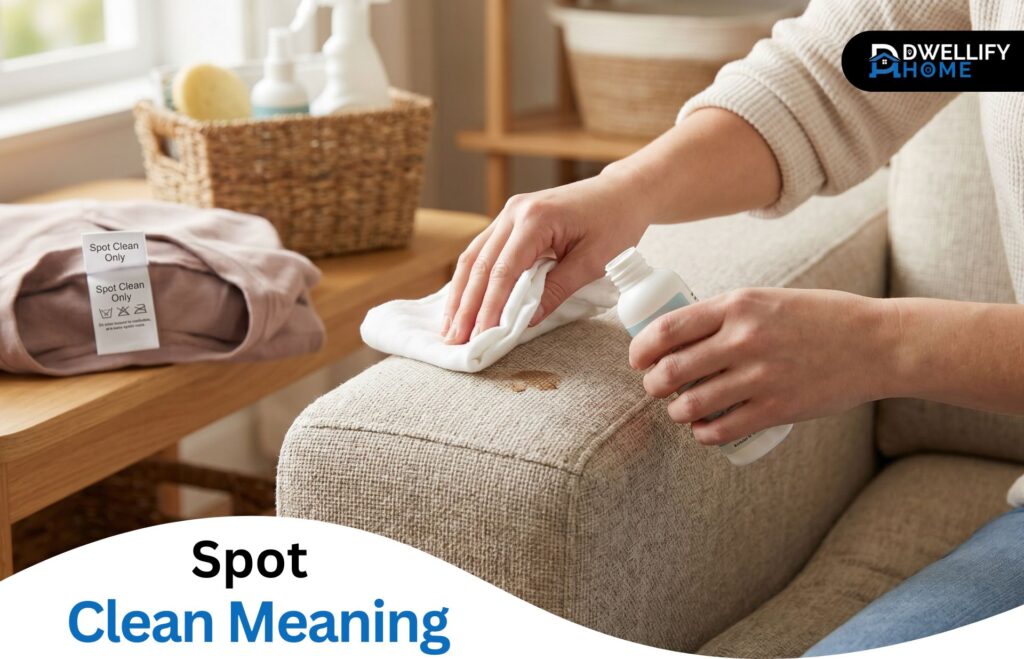
You pull a decorative pillow off your sofa, flip it over to check the label, and there it is — “Spot Clean Only.” Maybe you’ve seen those words before and just nodded along. Maybe you’ve ignored them entirely. Either way, most people don’t fully understand what they mean until something goes wrong.
Spot cleaning is one of those household tasks that looks simple on the surface but has more to it than most people expect. Get it right and you protect your belongings. Get it wrong and a small stain becomes a permanent problem — or worse, a ruined item.
This guide breaks down the spot clean meaning clearly, explains why it exists, and walks you through exactly what to do when you encounter it — whether it’s on a garment, your sofa, your car seat, or a pillow from the guest room.
The Short Answer
Spot cleaning means removing a stain from one specific area of an item without washing the whole thing. It protects delicate fabrics and bulky items that can’t tolerate full washing, solving the problem of localized stains with minimal moisture and targeted treatment.
Mission Statement
At Dwellify Home, we help homeowners make practical, confident, and well-informed decisions about their living spaces — from fabric care and home maintenance to décor and everyday home solutions. Our goal is to make home knowledge accessible, honest, and genuinely useful.
What Does “Spot Clean” Actually Mean?
Spot cleaning means removing a stain or soiled area from one specific part of an item — without washing or wetting the entire thing. Instead of soaking, machine washing, or dry cleaning the whole piece, you apply a targeted cleaning solution directly to the affected area, blot it gently, and leave the rest of the item untouched.
The core principle is simple: treat only what needs treating.
Spot Clean vs. Spot Clean Only — Is There a Difference?
Yes, and it’s worth understanding the distinction.
“Spot clean” used as general advice means that for minor stains, targeted treatment is a practical first step — but a full wash is still an option when needed.
“Spot clean only” is a strict care instruction. It means the item must not be soaked, machine washed, hand washed, or dry cleaned as a whole. The only safe way to clean it is by treating individual stains directly. This isn’t a suggestion — it’s a structural limitation of the item itself.
Where Does the Term Come From?
The term has roots in both garment care and professional housekeeping. In the clothing industry, it developed alongside delicate fabrics that couldn’t tolerate immersion or agitation. In commercial cleaning — hotels, offices, rental properties — spot cleaning became standard practice for maintaining upholstery and soft furnishings between deep cleans. Today, the label appears across clothing, home textiles, furniture, automotive interiors, and more.
Quick Comparison Table
| Method | Full Item Cleaned? | Best For | Water Used? |
| Spot Clean | No — area only | Small stains, delicate items | Minimal |
| Hand Wash | Yes | Soft, washable fabrics | Yes |
| Dry Clean | Yes | Structured or sensitive garments | No (solvents) |
| Machine Wash | Yes | Durable, everyday fabrics | Yes |
Key Uses of Spot Cleaning
- Treating a single stain on a sofa, rug, or pillow without disrupting the whole item
- Caring for delicate fabrics like silk, wool, or lace that can’t be fully washed
- Maintaining car seat upholstery and interior fabrics between deep cleans
- Extending the life of clothing by avoiding unnecessary wash cycles
- Addressing stains on mattresses, curtains, and large items that can’t go in a machine
How to Read the Spot Clean Symbol on a Care Label
Most care labels use written instructions rather than a dedicated spot clean symbol, so you’ll typically see the words “Spot Clean Only” or “Surface Wash Only” printed directly on the tag. Unlike washing symbols or dry clean symbols, there’s no universal spot clean icon standardized across all manufacturers — which is why reading the full label matters.
When you see these words, treat them as a definitive instruction, not a preference.
Spot Clean Only vs. Hand Wash vs. Dry Clean — Key Differences
These three instructions confuse a lot of people. Here’s the clearest way to understand them:
- Spot Clean Only — Clean the stained area only. Do not wet or wash the entire item under any circumstances.
- Hand Wash — The full item can be gently washed by hand in water, just not machine-washed.
- Dry Clean — The full item requires professional cleaning using chemical solvents, not water.
Spot clean only is the most restrictive of the three. It rules out everything else — including dry cleaning the whole garment.
What Fabrics and Items Carry the Spot Clean Only Label?
Generally, this label appears on items that can’t handle full immersion, mechanical agitation, or chemical saturation. You’ll commonly see it on:
- Silk, lace, and heavily embellished garments
- Structured blazers and coats with internal padding or interfacing
- Decorative throw pillows and cushion covers
- Upholstered furniture and chair seats
- Rugs with natural or delicate fibers
- Car seat fabrics and floor mats
- Stuffed toys with internal components
Why Some Items Can Only Be Spot Cleaned
Some items carry this label because their materials, construction, or dyes cannot survive full washing without permanent damage. This includes fabrics with poor dye retention, materials bonded with water-soluble adhesives, structured items that lose their shape when saturated, and natural fibers that shrink or felt with agitation.
Spot cleaning protects all of these by using minimal moisture, applied only where it’s actually needed.
What Happens If You Wash a “Spot Clean Only” Item?
This is where things go wrong in real homes. A common scenario: someone machine washes a decorative pillow labeled “spot clean only” because it looks fine going in. It comes out misshapen, the filling has clumped, the outer fabric has pilled, and the colors have bled onto one another.
Here’s what full washing can do to a spot clean only item:
- Shrinkage — Many delicate fibers contract significantly when fully soaked, especially wool and certain silks.
- Dye bleeding — The dyes used in some fabrics aren’t water-stable and will run when fully immersed.
- Shape distortion — Internal padding, adhesives, and structural interfacing can dissolve or warp.
- Surface damage — Embellishments, embroidery, and lace can snag, stretch, or fray in a wash cycle.
- Permanent staining — Heat and full saturation can actually set a stain deeper into the fabric rather than removing it.
The label is there for a reason. Ignoring it rarely ends well.
When Should You Spot Clean Instead of Washing?
Spot clean when the problem is isolated — a single stain, a small spill, or a mark on one area of an item that is otherwise clean. You don’t need to wash the whole thing for one spot.
Use a full wash when the item is generally soiled, has absorbed sweat or odor across its surface, or when multiple stains have accumulated over time.
Signs That Spot Cleaning Is the Right Move
- There’s a single visible stain from a recent spill
- The rest of the item looks and smells clean
- The care label says “spot clean only”
- The item is too large or bulky to wash easily — a sofa cushion, a rug, a mattress
- The fabric is delicate and a full wash would risk damage
Signs That a Full Wash or Professional Clean Is Needed
- The entire item smells — sweat, pet odor, or general mustiness
- Multiple stains are spread across the surface
- The item hasn’t been cleaned in a long time and looks dull overall
- A stain has already set and isn’t responding to spot treatment
- The care label allows for full washing
How to Spot Clean — The Right Way, Step by Step
Step 1 — Act Fast: Why Timing Changes Everything
Fresh stains are dramatically easier to remove than dried ones. The moment a liquid hits fabric, it begins bonding with the fibers. Within an hour, most stains are significantly harder to lift. Within 24 hours, some are nearly permanent. The first thing to do — before reaching for any product — is blot up as much of the stain as possible with a clean, dry cloth.
Step 2 — Know Your Stain Before You Touch It
Different stains respond to different treatments. Applying the wrong solution can permanently set a stain or spread it further. Before you do anything:
- Protein-based stains (blood, egg, dairy) — use cold water, never hot
- Oil and grease stains — use a dry solvent or dish soap, not plain water
- Tannin stains (wine, coffee, tea) — water-based cleaners work well
- Ink and dye — rubbing alcohol or a specialized ink remover
Step 3 — Always Test Your Cleaning Solution First
Before applying anything to the visible stain, test it on a hidden area of the same fabric — the back of a cushion, an inner seam on clothing, or the underside of a rug. Some solutions affect color or texture in ways you won’t expect. Give it two minutes and check before proceeding.
Step 4 — Blot, Never Rub (The Rule That Protects Your Fabric)
Rubbing is the single most common spot cleaning mistake. It pushes the stain deeper into the fibers and spreads it outward. Always blot — press down firmly with a clean cloth and lift straight up. Use a fresh section of the cloth each time so you’re lifting the stain, not redistributing it.
Step 5 — Work From the Outside In
Start at the outer edge of the stain and work toward the center. This prevents the stain from spreading into a larger ring on the surrounding fabric.
Step 6 — Rinse Lightly, Dry Properly, and Check
Once the stain is gone, blot the area lightly with a cloth dampened with plain cold water to remove any cleaning solution residue. Then press a dry cloth against it to absorb moisture, and allow it to air dry completely. Avoid applying heat — a hairdryer or direct sunlight can set any remaining traces of the stain.
Spot Cleaning Around the Home — Surface by Surface
Sofas and Upholstered Furniture
For upholstered sofas, always check the cleaning code on the label — typically found under the cushion or on the frame. “W” means water-based cleaners are safe. “S” means solvent-based only. “WS” allows both. “X” means vacuum only — no liquid at all. If the label says spot clean only, treat stains with minimal moisture and blot thoroughly to prevent water rings.
Rugs and Carpets
Act quickly — carpets and rugs absorb liquid fast. Blot up as much as possible first, then apply a small amount of cleaning solution. For natural fiber rugs like wool or jute, be especially cautious with water volume, as over-wetting can cause fiber damage or backing deterioration. Always rinse lightly and dry fully to prevent mildew.
Pillows and Cushions (What “Spot Clean” Means on a Pillow)
When a pillow label says spot clean only, it means the inner filling — whether foam, down, or a synthetic blend — cannot tolerate full washing. The outer cover might be removable and washable separately, but the pillow itself must only be treated at the surface. Use a lightly dampened cloth with a mild cleaning solution and avoid saturating the cover so moisture doesn’t reach the filling.
Mattresses
A mattress is one of the most common items that can only be spot cleaned. Apply a cleaning solution to the stained area using a cloth — never pour liquid directly onto the mattress. Blot thoroughly, then allow the area to dry completely before putting bedding back on. A fan pointed at the area speeds up drying.
Curtains and Drapes
Many curtains — particularly lined or structured ones — carry spot clean only instructions because the lining and outer fabric react differently to water and washing. Treat marks with a damp cloth and a small amount of mild detergent. Work gently along the fabric grain and avoid scrubbing.
What Spot Clean Means for Clothes and Delicate Garments
Delicate Fabrics — Silk, Wool, Lace, and Embellished Pieces
These fabrics are labeled spot clean only because their structure is genuinely fragile. Silk loses its sheen with repeated water contact. Wool felts under agitation. Lace catches and tears. Embellished pieces — sequins, beading, appliqué — can detach or discolor in water.
For these garments, use the smallest amount of moisture possible. A clean cloth barely dampened with cold water, or a specialized fabric spot cleaner, applied very gently — that’s the approach.
Everyday Clothes — When Spot Cleaning Between Washes Makes Sense
Spot cleaning isn’t just for delicate items. It’s a practical strategy for everyday clothing too. A small food stain on a shirt you’ve only worn for two hours doesn’t warrant a full wash cycle. Treating the stain directly and letting the garment air means it lasts longer and holds its shape better over time. Less washing means less wear on fabric fibers.
What to Avoid When Spot Cleaning Any Fabric
- Hot water — it sets protein-based stains permanently
- Bleach on colored or natural fabrics — it strips color unevenly
- Harsh scrubbing or stiff brushes — they damage surface fibers
- Over-wetting — excess moisture spreads the stain and can cause water marks
- Skipping the patch test — always test first, without exception
Spot Clean Meaning for Car Interiors
In a car, “spot clean” refers to treating stains on upholstered seats, headliners, door panels, and floor mats without saturating the underlying materials. Car interiors have foam padding, electrical components, and backing materials that don’t tolerate heavy moisture well.
How Car Fabric Differs From Home Upholstery
Car seat fabrics are generally tighter-woven and more resistant to light spills than home upholstery, but the layers beneath — foam padding, adhesive-bonded backing — are vulnerable to moisture. Over-wetting can lead to mold growth inside the seat, which is both a health hazard and very difficult to resolve.
Best Approach for Spot Cleaning Car Seats and Interiors
Use a fabric-safe car upholstery cleaner applied to a cloth, not directly to the seat. Work in small sections, blot thoroughly, and allow the area to dry with the car doors open or windows down. For leather seats, use a dedicated leather cleaner and conditioner rather than water-based products.
What Spot Cleaning Means in Housekeeping
In professional housekeeping — hotels, serviced apartments, and commercial cleaning — spot cleaning is a structured daily practice, not a reactive emergency response.
How Professional Housekeepers Use Spot Cleaning Daily
Housekeeping staff are trained to scan surfaces for marks and treat them before they set. A smudge on a fabric headboard, a small stain on carpet near the entrance, a fingerprint on a suede chair — these are addressed during every room turnover using targeted cleaning products matched to each surface. The goal is to maintain a consistently clean appearance between scheduled deep cleans.
What Home Owners Can Learn From the Housekeeping Approach
The professional approach comes down to two habits: keeping a basic spot cleaning kit accessible, and treating stains the moment they happen rather than waiting. A clean white cloth, a mild multipurpose fabric cleaner, and a small spray bottle of plain water cover most household situations. Treat it immediately, and you’ll rarely need anything more.
Spot Cleaning Products and Tools — What Actually Works
Store-Bought Spot Cleaners Worth Keeping at Home
A few categories of spot cleaning products are genuinely worth having:
- Enzyme-based stain removers — effective on protein stains like blood, food, and pet accidents
- Solvent-based cleaners — work well on oil, grease, and ink
- Upholstery foam cleaners — low-moisture options ideal for sofas and car interiors
- Fabric-safe multi-surface sprays — practical for everyday stains on mixed-fiber textiles
Always check that the product is compatible with your fabric type before use.
Natural DIY Solutions — Vinegar, Baking Soda, and Mild Dish Soap
These aren’t myths — they do work, within limits. A solution of cold water and a few drops of mild dish soap handles most food and drink stains well. White vinegar diluted with water helps with odors and some tannin-based stains like coffee. Baking soda paste applied to oil stains draws out grease before it sets.
The key is using these in small amounts and rinsing well, since residue can attract dirt over time.
Portable Spot Clean Machines — Are They Worth It?
Portable spot cleaners — small handheld devices that spray, scrub, and extract in one motion — are worth considering for households with children, pets, or high-traffic upholstered furniture. They remove more moisture than manual blotting and reduce the risk of over-wetting. They’re not necessary for occasional stains, but they make a noticeable difference for frequent use.
Common Stains and How to Spot Clean Them
Food and Drink Stains
Scrape or blot away any solid material first. For water-based stains like juice, coffee, or tea, use a cold water and mild soap solution and blot from the outside in. For sauces or food with oil content, treat the oil component first with a dry solvent before addressing the residue with water-based cleaning.
Oil and Grease Stains
Apply a small amount of dish soap or a dry-solvent cleaner directly to the stain. Let it sit for two to three minutes to break down the oil before blotting. Avoid water initially — adding water to grease spreads it before the oil is broken down.
Ink, Dye, and Marker Stains
Rubbing alcohol applied with a cotton pad works well on most ink stains — blot, don’t rub. Work quickly before the ink dries. For fabric dye transfer, a specialized dye remover or dry-cleaning solvent applied carefully will give the best result.
Pet Stains and Odors
Blot up as much liquid as possible immediately. Apply an enzyme-based cleaner, which breaks down the organic compounds that cause both the stain and the odor. Standard cleaners mask the smell temporarily, but enzyme cleaners eliminate it at the source — especially important on carpets and upholstery.
Mud and Dirt
Let mud dry completely before treating it. Attempting to clean wet mud pushes it deeper into fabric fibers. Once dry, brush away as much as possible, then treat any remaining discoloration with a mild soap solution and cold water.
Spot Cleaning Mistakes That Make Stains Worse
Even people who know the basics make these errors regularly:
- Rubbing instead of blotting — spreads the stain and drives it deeper
- Using hot water — sets protein stains and can cause dye to run
- Applying too much liquid — creates water rings and can damage backing materials
- Skipping the patch test — some cleaners bleach or alter color in ways that can’t be reversed
- Working from the center outward — this spreads the stain into a larger ring
- Using colored cloths — dye from the cloth can transfer to the fabric, especially when wet
- Waiting too long — stains that have dried or set are significantly harder to remove
Frequently Asked Questions About Spot Cleaning
Is spot clean the same as dry clean?
No. Spot cleaning means treating an isolated stain on a specific area using minimal moisture, without processing the full item. Dry cleaning involves taking the entire garment to a professional who uses chemical solvents to clean it completely. They are entirely different processes, and a “spot clean only” label means dry cleaning the whole item is also not recommended.
Can I machine wash something labeled spot clean only?
No. A “spot clean only” label means the item cannot safely tolerate any form of full washing — machine or hand. Putting it through a wash cycle risks shrinkage, dye bleeding, shape distortion, or structural damage. The label exists because the item’s materials genuinely cannot withstand immersion or agitation.
What does spot clean mean on a pillow?
On a pillow, “spot clean only” means the inner filling cannot handle full washing. The moisture and agitation of a wash cycle can cause the filling to clump, shift, or deteriorate, and the outer fabric may also be vulnerable to water damage or shrinkage. Treat only the visible stained area on the surface, using minimal moisture and blotting carefully to avoid saturating the fill.
Can I spot clean with just water?
For some light, surface-level stains — particularly those caused by muddy splashes or minor food residue — plain cold water and a clean cloth can be enough. However, oily stains, protein stains, and ink require a cleaning agent to break down the stain properly. Water alone can also leave water marks on certain fabrics, so always blot dry thoroughly.
How do I know when spot cleaning isn’t enough?
Spot cleaning has reached its limit when the stain has already fully dried and set, when an odor persists after treatment, when the staining covers a large area, or when repeated treatment isn’t producing visible improvement. At that point, professional cleaning is usually the appropriate next step — especially for valuable or structurally complex items.
What does the spot clean symbol look like?
There is no single standardized spot clean symbol used across all care labels. Most manufacturers simply write “Spot Clean Only” or “Surface Wash” in text. Some may use a small hand icon with a dot to suggest localized cleaning. The clearest indicator is always the written instruction — read the label fully rather than relying on symbols alone.
The Bottom Line on Spot Clean Meaning
Spot clean meaning, at its simplest, is this: treat the problem where it is, and leave the rest of the item alone. It’s a precise approach — the right amount of solution, in the right place, at the right time.
Understanding it properly means you won’t panic when you see that label, and you won’t make the kind of mistake that turns a minor stain into an expensive replacement. The label is there to help you, not restrict you. Once you know what it’s actually telling you, and you have a basic process to follow, spot cleaning becomes one of the more straightforward parts of keeping a home in good shape.
Disclaimer: The content on Dwellify Home is provided for general informational purposes only. While we aim to offer accurate and helpful guidance, individual results may vary depending on fabric type, stain severity, product used, and specific circumstances. Always check your item’s care label and test any cleaning solution in a hidden area before use.