Most people don’t realize they already have a decent roach killer sitting in their laundry cabinet. Borax has been around for over a century, and it still works — but not the way most homeowners use it. Over the years, I’ve seen the same mistakes repeated in kitchen after kitchen: too much powder, wrong location, no attractant, and then frustration when nothing changes after a week.
This guide covers everything you actually need to know — how borax works, the four most effective application methods, a room-by-room placement breakdown, and the honest truth about when it’s enough and when it isn’t.
Snippet-Ready Definition
Borax is a naturally occurring mineral compound that kills roaches by damaging their digestive system once ingested. Homeowners use it as an affordable, low-toxicity alternative to chemical sprays for controlling mild to moderate cockroach infestations.
Mission Statement
At Dwellify Home, we help homeowners make practical, confident decisions about their living spaces — from everyday home maintenance to creating spaces that feel both comfortable and well-considered. Every guide we publish is built on honest, researched information that respects your time and your home.
What Is Borax — and Why Does It Work on Roaches?
Borax is a naturally occurring mineral compound — sodium tetraborate — commonly found in laundry aisles. It works against roaches not by repelling them, but by physically damaging their digestive systems and outer shells once ingested. It is affordable, widely available, and significantly less harsh than most commercial chemical sprays.
You’ll find it on store shelves as a white powder, often labeled as a laundry booster. It’s not marketed as a pesticide, but that doesn’t mean it doesn’t function as one. The mineral boron, which gives borax its pest-control properties, disrupts a roach’s internal chemistry in a way that’s slow but highly effective.
Is Borax the Same as Boric Acid?
No — and this distinction matters. Borax is the raw mineral form: sodium tetraborate. Boric acid is what you get when borax is processed and purified with hydrochloric acid. Both kill roaches through similar mechanisms, but boric acid is more concentrated and potent at lower doses.
Borax is more commonly available and easier to find in standard grocery stores. For mild to moderate infestations, borax works well. For persistent or heavier problems, boric acid is the stronger choice. Neither works as a contact kill — both require the roach to ingest the compound.
Where to Buy Borax for Roaches
Look in the laundry aisle of most grocery stores, hardware stores, or online retailers. The most widely recognized product is 20 Mule Team Borax, which has been used for this purpose for decades.
On the label, look for sodium tetraborate or sodium borate as the listed ingredient. Don’t be put off by the laundry booster branding — that’s simply how it’s sold. The product itself is what you need.
Quick Comparison Table
| Method | Best For | Difficulty | Pet/Child Safe |
| Borax + Sugar Dry Bait | General areas, baseboards | Easy | Use with caution |
| Borax Paste Balls | Cracks, voids, under appliances | Easy | Use with caution |
| Borax Powder Dusting | Wall voids, kick-plates | Moderate | Safer — enclosed areas |
| Borax Bait Stations | Homes with pets or children | Easy | Safest option |
| Boric Acid | Heavy infestations | Moderate | Use with caution |
| Gel Baits (Advion, Combat) | Severe infestations | Easy | Varies by product |
| Diatomaceous Earth | Damp zones, contact kill | Easy | Generally safe |
Key Benefits at a Glance
- Works on the most common species including German and American cockroaches
- Affordable and available in most grocery and hardware stores
- Slow-acting by design — spreads through the colony before killing
- Can be combined with natural food attractants for better results
- Significantly less harsh than most chemical pesticide sprays
- Effective in dry conditions with a long-lasting residual when kept moisture-free
How Borax Kills Roaches — The Science Behind It
Borax kills roaches through a two-step process. First, the powder sticks to a roach’s legs and body via static electricity. Then, when the roach grooms itself, it ingests the borax. Once inside, it damages the digestive lining and dehydrates the insect, leading to death within 24 to 72 hours.
What makes this mechanism so useful is that it doesn’t kill on contact. The roach walks through the powder, goes back to its nest, grooms itself, and dies there — often near other roaches that may then come into contact with the body or the borax it carried in.
Does Borax Kill Roaches Instantly?
No, and that’s actually a good thing. A slow-acting treatment gives the exposed roach time to return to the colony before dying. This spreads the borax deeper into the infestation than any contact spray ever could.
You likely won’t see dead roaches piling up in the open. What you will notice is a steady decline in activity over one to two weeks, as the compound works its way through the population.
Can Borax Kill Roach Eggs?
This is one of the most important things to understand — and most sources gloss right over it. Borax cannot penetrate the roach egg casing, called the ootheca. The eggs inside are fully protected.
This is why borax alone rarely eliminates a full infestation. The adults and nymphs die off, but new roaches hatch and the cycle continues. To close that gap, you need to combine borax treatment with consistent sanitation, moisture control, and sealing of any entry points around pipes, baseboards, and wall gaps.
How Long Does It Take for Borax to Kill Roaches?
Borax typically kills an individual roach within 24 to 72 hours after ingestion. However, noticeable reduction in roach activity across your home usually takes one to two weeks of consistent treatment. For heavier infestations, full control can take four to six weeks with regular reapplication.
The timeline depends on how well the treatment is placed, whether a food attractant is used, and how consistently bait is refreshed. Inconsistent application is the single biggest reason treatments stall.
Does Borax Kill Roaches Overnight? Honest Expectations
It doesn’t. I’ve had homeowners call me frustrated after one night, thinking they did something wrong. Borax simply doesn’t work that way — and any product claiming overnight roach elimination is almost certainly overpromising.
What you can realistically expect: individual roaches that ingest borax will start dying within a day or two. Population-level reduction — meaning you’re genuinely seeing fewer roaches — takes one to two weeks. Complete control of a moderate infestation typically takes four to six weeks of consistent, correctly placed treatment.
4 Proven Ways to Use Borax for Roaches
Borax does not attract roaches on its own — you must combine it with a food lure or apply it strategically where roaches naturally travel. Here are the four most effective methods.
Method 1 — Borax and Sugar Dry Bait
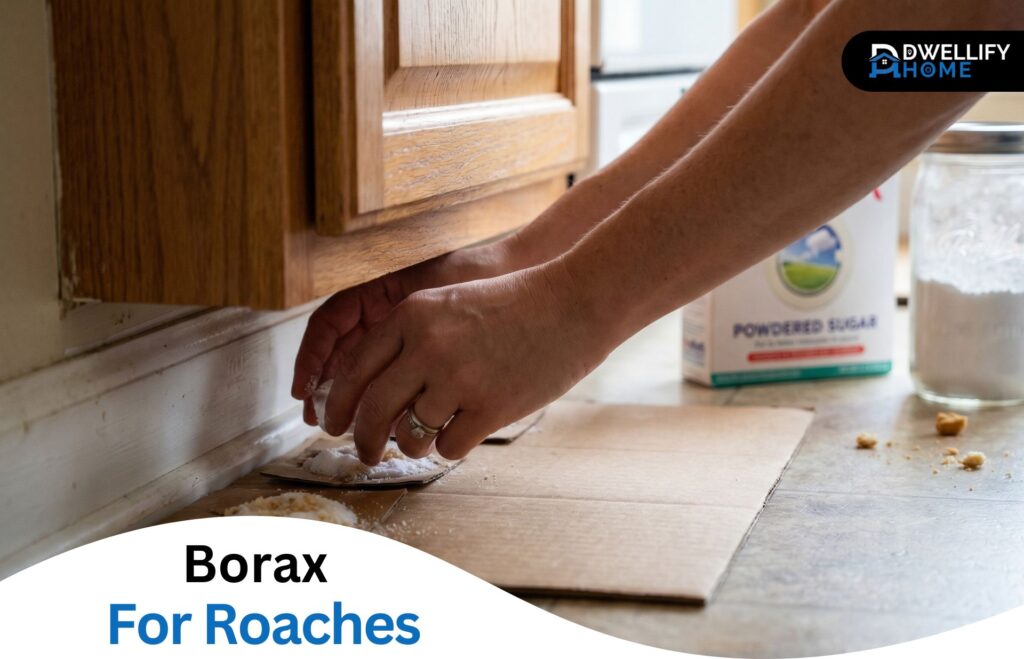
Mix equal parts borax powder and powdered sugar. Powdered sugar works better than granulated because both ingredients blend into a finer, more uniform mix that roaches can’t easily separate. Pour the mixture into a squeezable bottle or powder duster. Add a few small pebbles or pennies to break up clumps when you shake it.
Apply a thin, barely visible dusting along baseboards, cabinet corners, and floor-level crevices. The sugar draws the roaches in; the borax gets consumed alongside it. Thick piles don’t work — roaches detect and avoid them.
Method 2 — Borax Paste Balls
Combine borax powder with flour and a small amount of sugar, then slowly add water until you can form a soft dough. You can add peanut butter, a drop of honey, or cocoa powder to increase the attraction. Roll the mixture into small balls about the size of a marble.
Place these in cracks, under sink pipes, behind appliances, and anywhere you’ve seen roach activity. They stay put better than loose powder and work well in enclosed spaces where dusting is difficult. Replace them every one to two weeks as they dry out.
A practical tip: wrapping each ball loosely in a small piece of plastic wrap makes replacing them much cleaner and faster.
Method 3 — Borax Powder Dusting
This method works best for wall voids, behind kick-plates under cabinets, and inside the hollow spaces around electrical outlets. Use a powder duster — or a squeeze bottle with a long, narrow nozzle — to apply a faint layer in these inaccessible zones.
The key word is faint. You should barely be able to see the application. If you can clearly see a white coating, you’ve applied too much. Roaches walking through these areas will pick up particles on their legs and body without realizing it.
For kick-plate areas with no existing access, it’s worth drilling a small hole to get the duster nozzle in. It sounds like extra work, but those hollow spaces behind cabinetry are some of the most heavily trafficked roach corridors in any kitchen.
Method 4 — Borax Bait Stations
This is the right approach for households with pets or small children. Place the borax-sugar mixture inside a small container — bottle caps, plastic lids, or purpose-built bait station housings all work. The goal is to keep the bait accessible to roaches while putting a physical barrier between it and curious pets or kids.
Position stations inside cabinets, behind appliances, and under sinks — anywhere out of general reach. Check and replace them on the same schedule as paste balls: every seven to fourteen days.
Where to Place Borax for Roaches — Room-by-Room Guide
Roaches follow moisture, heat, and food. The most effective borax placement targets the routes they use to find all three. Focus heavily on the kitchen and bathrooms, then extend to utility areas and entry points.
Kitchen — The Highest-Priority Area
The kitchen is where most infestations concentrate, and it needs the most thorough coverage.
- Behind and under the refrigerator, stove, and dishwasher
- Inside cabinet corners and along the underside of lower cabinet shelves
- Along the baseboard behind the trash bin
- Under the sink, around plumbing pipe entry points
One firm rule: never apply borax on countertops, inside open pantry shelves, or anywhere it could come into contact with food, dishes, or utensils. Keep treatment strictly to concealed, inaccessible zones.
Bathrooms
Bathrooms are the second most common roach zone because of constant moisture and warm pipes.
- Under the sink, around drain pipes
- Behind the toilet base
- Inside vanity cabinet corners
- Along baseboards near the tub or shower floor
Because bathrooms have high moisture exposure, check these placements more frequently and replace borax powder as soon as it gets wet or becomes invisible.
Laundry Room and Utility Areas
These spaces are often overlooked, but they connect to the rest of the house through pipe runs and wall gaps.
- Along the floor behind the washer and dryer
- Near the water heater and utility pipe entry points
- Around any floor drain openings
Basement, Garage, and Entry Points
Roaches enter from outside, and these areas are common entry corridors.
- Along perimeter walls and floor joints
- Near visible cracks in the foundation or around the base of exterior walls
- Around door frames and utility line entry points
The Most Common Borax Mistakes — And Why Your Treatment Isn’t Working
Most borax treatments fail not because borax is ineffective, but because of how it is applied. The most common errors are applying too much powder, placing it in the wrong locations, skipping the food attractant, and allowing the powder to get wet.
Applying Too Much Powder
This is the number one mistake. A thick white line of borax along a baseboard looks thorough, but roaches will simply walk around it. They’re cautious creatures, and anything that disrupts their path signals danger. The application needs to be so thin it’s barely noticeable.
Placing It in the Wrong Spots
Putting borax in open, well-lit, high-traffic areas of your home wastes both the product and your time. Roaches travel through dark, warm, enclosed zones — inside cabinet walls, behind appliances, inside plumbing voids. That’s where the treatment needs to go.
Skipping the Food Attractant
Plain borax powder sitting in a corner accomplishes almost nothing. Roaches don’t seek it out. You need to mix it with something they want — sugar, flour, peanut butter, cocoa powder — so they actively approach and consume it.
Letting It Get Wet
Moisture is borax’s biggest weakness. Once the powder gets wet, it clumps, loses its static-charge adhesion, and stops sticking to roach legs. Areas under sinks and near drains need to be checked regularly and treated again after any moisture exposure.
Not Reapplying on Schedule
Borax is not a set-and-forget solution. Bait dries out, powder gets disturbed by cleaning, and new roaches hatch from protected eggs. Without consistent reapplication, even a well-placed initial treatment will lose its effectiveness within a few weeks.
Is Borax Safe for Pets and Children?
Borax is significantly less toxic than most chemical pesticides, but it is not harmless. It can cause serious health problems if ingested in sufficient quantities by pets or children. Safe application depends entirely on where and how you place it — not just what it is.
What Happens If a Pet or Child Ingests Borax?
Ingesting a small amount of borax can cause digestive upset, nausea, and vomiting. Larger quantities can cause more serious symptoms requiring medical or veterinary attention. Skin and eye irritation can also occur with direct contact.
Keep the powder stored in a sealed, labeled container well out of reach. Never leave loose borax accessible on floors or low surfaces in homes with young children or pets that roam freely.
How to Use Borax Safely in a Home With Pets or Children
- Use enclosed bait stations rather than open powder dusting in accessible areas
- Apply powder only inside wall voids, behind appliances, or under furniture that doesn’t move
- Keep pets and children away from treated areas during application and until the powder has settled
- Never place borax near pet food bowls, water dishes, or children’s play areas
When in doubt, the bait station method is always the safest approach. It controls exactly where the borax sits and limits any chance of accidental exposure.
Borax vs Boric Acid vs Other Roach Killers — Which Is Best for Your Situation?
Borax, boric acid, gel baits, and diatomaceous earth all kill roaches through different mechanisms. The right choice depends on the severity of your infestation, your household’s safety needs, and how much time you are willing to invest in monitoring and reapplication.
Borax vs Boric Acid
Boric acid is the more potent option — it’s refined specifically for pest control and works at lower concentrations. Borax is the more accessible choice, available in most grocery stores without any specialized sourcing.
For a mild cockroach infestation, borax applied correctly will do the job. For a persistent or spreading infestation, stepping up to boric acid makes sense. Neither works on contact — both require ingestion, which is why pairing either one with a food attractant is non-negotiable.
Borax vs Gel Baits (Combat, Advion)
Commercial gel baits like Advion or Combat use professional-grade attractants combined with faster-acting compounds. They’re more expensive than borax but require less monitoring and generally outperform borax in heavy infestations.
The most practical approach is to use both: apply gel bait in the highest-activity zones and use borax dusting or paste balls in the surrounding areas. This creates overlapping coverage that addresses both primary feeding zones and roach travel routes.
Borax vs Diatomaceous Earth
Diatomaceous earth kills differently — it damages the roach’s exoskeleton through abrasion, causing dehydration without requiring ingestion. This makes it useful in areas where borax would get wet and lose effectiveness, such as near drains or in damp utility rooms.
Both are low-toxicity, natural options that work well together. Use borax where conditions are dry and concealed; use diatomaceous earth in zones with moisture exposure or where roaches are more likely to walk through without stopping to feed.
How Often Should You Reapply Borax for Roaches?
Reapply borax bait and powder every one to two weeks as a standard schedule. Reapply immediately if the treated area gets wet, is cleaned, or if the bait has been consumed. Continue treatment for at least four to six weeks even after you stop seeing roaches.
Dry powder dusting should be checked weekly. If it’s no longer visible or has gotten wet, replace it. Paste balls and bait stations should be refreshed every seven to fourteen days as they dry out and lose effectiveness.
The most useful habit you can build is keeping a simple log — a note on your phone or a piece of paper taped inside a cabinet — marking where each treatment is placed and when it was last refreshed. It sounds basic, but it removes the guesswork and ensures nothing gets missed.
When Borax Alone Won’t Be Enough — Signs You Need Professional Help
Borax is an effective tool for mild to moderate roach problems. But if you are seeing roaches during daylight hours, finding them in multiple rooms simultaneously, or noticing no reduction after four weeks of consistent treatment, it is time to contact a licensed pest control professional.
Daytime roach sightings are a reliable signal of a serious infestation. Roaches are nocturnal. When they appear during the day, it usually means the hidden population has grown large enough that competition for food and space is forcing them out into the open.
Professional treatment uses integrated pest management — a combination of targeted chemical application, physical exclusion, and sanitation recommendations that works on multiple levels simultaneously. It addresses not just the roaches you can see but the conditions that allowed them to establish in the first place.
Borax is a solid first step. But it has real limitations, and recognizing those limitations early saves a lot of time, money, and frustration.
Frequently Asked Questions About Borax for Roaches
Can I use 20 Mule Team Borax for roaches?
Yes — 20 Mule Team Borax is the most commonly used borax product for this purpose. It contains sodium tetraborate as its active ingredient and works effectively when mixed with a food attractant and applied in the right locations. It’s readily available in grocery stores and hardware stores.
Will borax work on German cockroaches specifically?
Yes. German cockroaches are one of the most common and resilient indoor species, and they are susceptible to borax. Because they groom frequently and live in tight social groups, borax tends to spread through a German roach colony effectively once it gets established in their travel routes.
Is it safe to use borax in the kitchen?
Borax can be used in the kitchen, but only in completely concealed, inaccessible areas — inside cabinet corners, behind and under appliances, and around plumbing entry points under the sink. Never apply it on countertops, food prep surfaces, or anywhere it could contact food, dishes, or cooking utensils.
Can I mix borax with vinegar or bleach?
No to both. Mixing borax with vinegar introduces an acid that reduces its effectiveness significantly. Mixing borax with bleach can produce hazardous fumes and should never be done. Stick to dry food-based attractants: sugar, flour, cocoa powder, or peanut butter.
How long does borax remain effective once applied?
Borax powder stays effective indefinitely as long as it remains completely dry. Moisture is the only thing that compromises it. In naturally dry areas — inside wall voids, behind appliances in low-humidity environments — a single application can remain active for several weeks before needing a refresh.
Does borax prevent roaches from coming back?
Borax reduces an existing population but does not function as a repellent or a barrier. It won’t stop new roaches from entering your home. Long-term prevention requires sealing entry points around pipes and baseboards, fixing any moisture issues, and maintaining consistent sanitation. Borax is one useful part of that effort — not the whole solution.
Conclusion
Borax is one of the most practical, low-cost tools available for managing a roach problem at home — but only when used correctly. The mistakes that undermine most treatments are all avoidable: too much powder, wrong placement, no attractant, and inconsistent reapplication.
Used the right way, with a proper food lure, placed in the dark enclosed zones roaches actually use, and refreshed on a regular schedule, borax for roaches is genuinely effective against mild to moderate infestations. For anything more serious, treat it as one layer of a broader cockroach control strategy — not a standalone fix.
Stay consistent, be patient with the timeline, and keep the safety precautions in mind if you have pets or children at home. That combination gives you the best realistic outcome from this simple, accessible treatment.
Disclaimer: The content on Dwellify Home is provided for general informational purposes only. Results may vary depending on infestation severity, application method, household conditions, and individual circumstances. For serious pest control concerns, consulting a licensed professional is always recommended.