
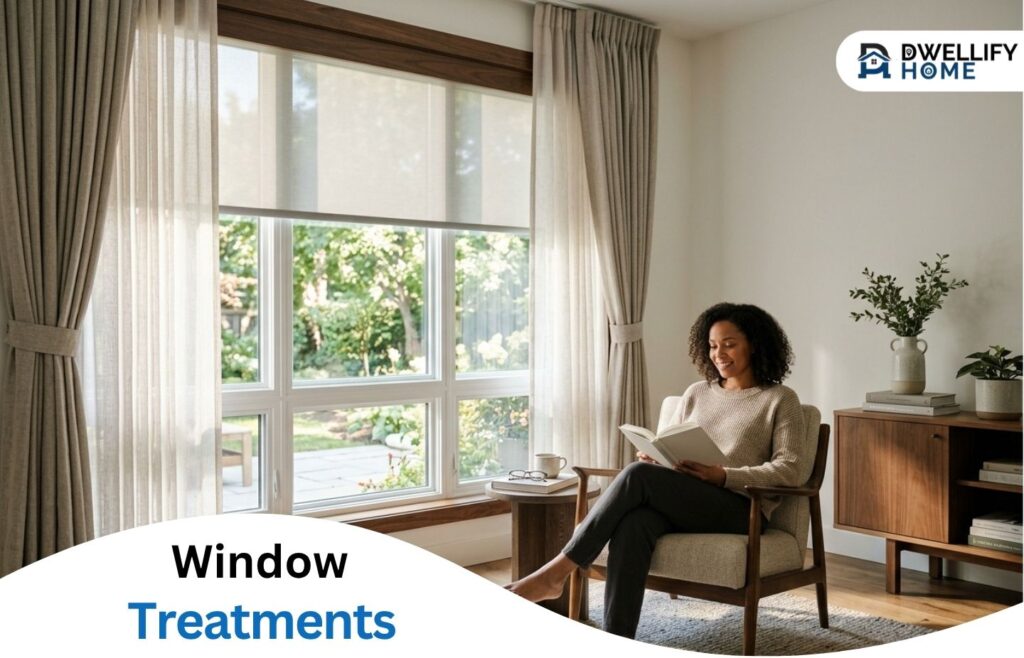
A room can have plenty of sun and still feel wrong. Low-angle light hits the TV. One chair gets hot by late day. The shade fixes the glare, but makes the whole room dim.
The fix does not start with a color swatch. Start with the window. Note which way it faces, when direct sun hits, how much privacy you need, and what you do in the room.
Quick answer: How do you choose the right window treatment?
Choose the treatment that solves the main problem at each window. Cellular shades are a strong pick for insulation. Solar shades cut glare while keeping much of the view. Slatted blinds and shutters let you aim the light. Light-filtering shades soften sun, while room-darkening shades suit sleep and screens.
Then check the fit. Even the right fabric can fail if light pours around its edges.
Blinds and shutters use slats, so they can aim light. Shades move as one panel. Drapes slide aside and need wall space for their stack.
Read the light before you shop
Direct sun and useful daylight are not the same thing. Direct rays cause sharp glare and heat the floor, furniture, and other surfaces they strike. Soft, scattered daylight can light the room without the same bright beam.
A U.S. Department of Energy Building America guide says summer shade often matters most on east- and west-facing glass. The low sun reaches deep into rooms in the morning and late day. It is hard for a short roof overhang to block.
Use direction as a starting point:
- East-facing windows may need glare control at breakfast or early work hours.
- West-facing glass often needs stronger shade in late afternoon.
- South-facing windows get more direct sun in the colder part of the year. A roof overhang may block much of the high summer sun.
- North-facing windows often have soft light in much of the United States. Farther south, low summer sun can still reach them early and late in the day.
Trees, nearby homes, porches, and glass coatings can change that pattern. Check each room at 8 a.m., noon, 4 p.m., and after dark. A four-photo record will tell you more than a fabric sample under store lights.
Give each window one main job
A single shade may affect heat, light, privacy, and the look of the room. It rarely does each job equally well. Rank the needs at each window before you compare products.
Ask four questions:
- When is the room hard to use? Name the hour. “Morning” or “afternoon” is too broad.
- What happens near the glass? Note sleep, screen use, cooking, play, or reading.
- Who can see in during the day and after dark?
- Is the view worth keeping while the shade is down?
This short audit prevents a common mistake. A buyer picks a dark shade for one hot hour, then lives in a dim room for the rest of the day.
Match the treatment to the job
| Treatment | Best starting point for | What you give up |
|—|—|—|
| Cellular shade | Insulation, soft light, room-darkening options | No view when closed |
| Solar shade | Glare control with a daytime view | Weak privacy after dark |
| Light-filtering roller shade | Soft daylight and a clean line | Less insulation than a cellular shade |
| Blind or interior shutter | Fine control of light and sight lines | More parts to dust; slats do not make a tight air layer |
| Lined Roman shade or drape | Soft texture, privacy, and added cover at the glass | Fabric stack can block part of the window when open |
| Layered treatment | Different day and night settings | More cost, depth, and hardware |
Choose cellular shades when insulation comes first
Cellular shades use rows of fabric pockets. Those pockets trap air at the window. This is why they tend to insulate better than common flat shades or open slats.
Choose a light-filtering cell for a living room that needs a soft glow. Pick a room-darkening cell for a bedroom. A top-down, bottom-up model can cover the view at eye level while leaving the top of the glass open.
The tradeoff is clear. You cannot keep an outdoor view through a closed cellular shade. If the view matters all day, a solar shade may serve the room better.
Choose solar shades for glare and a daytime view
A solar shade uses screen-like fabric. The small holes let some light and view pass through. Makers call the open part of the weave its openness factor.
A lower openness number has a tighter weave. It passes less beam light, but it also cuts daylight and view. A more open weave keeps more of the view, yet lets more bright light through.
Compare color and openness together. Dark fabric often gives a clearer outward view and stronger glare control. A light, reflective face can reject more solar energy. The glass behind the shade also changes the result, so test the full fabric-and-window pairing.
Solar fabric is not a safe bet for privacy at night. Once the room is brighter than the yard or street, people outside may see in. Pair it with a private second layer if that is a concern.
Choose slats when the light keeps moving
Blinds and interior shutters do something a flat shade cannot. Their slats tilt. You can block a direct beam, send light toward the ceiling, or open the view.
This control works well where the sun angle shifts fast. It also suits a street-facing room that needs light above eye level. Closed slats still have seams, so use a room-darkening shade if sleep is the main goal.
Choose a soft layer when the room needs visual weight
Roller shades have a quiet, flat look. Roman shades add folds and texture. Drapes frame the wall and can make a narrow window look wider.
The fabric should still match the job. A sheer drape spreads light but offers little night privacy. A lined panel gives more cover, yet its stack can sit over the glass when open. Extend the rod far enough past the frame so the panel can clear most of the window.
What makes energy-efficient window treatments work?
Energy performance starts with the product and its fit. Your daily use then decides how often the shade helps.
Start with the product. Cellular shades are often the best interior starting point for insulation. Solar shades focus more on direct sun and glare. Exterior screens or shades can stop solar heat before it passes through the glass, but they face weather and wind.
Next, look for test data. The Attachments Energy Rating Council, or AERC, rates some window products. Its Warm and Cool Climate Ratings are modeled annual energy-improvement scores. They compare an attachment with a standard window that has no attachment. A higher score means more improvement for that climate. It is not a promised cut to your whole energy bill.
Treat savings claims with care. In a final PNNL report, scheduled cellular shades used 15.3% less HVAC cooling energy than scheduled vinyl blinds. The uncertainty was plus or minus 2.9 percentage points. When both coverings stayed down, the cellular shades used 16.6% less, with the same uncertainty.
The test used two matched 1,500-square-foot lab homes. They had double-pane, aluminum-frame windows and one six-layer cell-in-cell shade design.
Those figures are not a promise for your home. Glass, climate, shade design, fit, and daily use all change the result. The study is useful for a simpler point: the kind of shade matters, and so does the time you close it.
Fit can fix a good idea or spoil it
An inside mount sits within the window frame. It looks neat and leaves the trim in view. The frame must be deep and square enough for the hardware. Roller shades also leave small gaps at the sides because the fabric is narrower than the top tube.
An outside mount covers the wall or trim around the opening. It can hide an uneven frame and reduce side light. It also makes the shade more visible on the wall.
Measure the width at the top, middle, and bottom. Measure the height on both sides and in the center. Follow the maker’s rule for which number to use, since inside and outside mounts use those numbers in different ways.
For a hot Gulf Coast home, test fit and fabric together. Before you order custom-fitted shades, hold two or three samples at the problem window. Low west sun can reveal glare and side gaps. It can also change how a color reads.
Use the shade when it can do the most work
In a hot season, close an east-facing shade before direct morning sun hits the glass. Close a west-facing shade before the late-day beam reaches the room. Reopen it when the sun moves away if you want more daylight.
In a cold season, open sunny shades when free heat helps. Close an insulating shade after sunset. Check the glass now and then. A tight shade can make the glass colder, so indoor moisture may form on some windows. If it does, open the shade so the glass can dry and lower the room’s humidity. Persistent moisture may point to a window or moisture problem.
A timer or motor can help with tall glass or windows you tend to forget. It will not make a weak fabric perform like an insulated one. It helps the product work on time.
Make different treatments look like one plan
Every room does not need the same shade. The windows only need a shared visual rule.
Keep the top line level across windows that sit on one wall. Repeat one main color in rooms you can see at the same time. You can change the backing or cell type as each room needs.
Watch the stack, too. A thick Roman shade can cover the top of a short window when raised. A drape needs clear wall space at the side. A slim roller shade hides less glass and suits a tight frame.
Layer only when each layer has a job. A solar shade with a lined drape can keep a view by day and add privacy at night. Two weak layers will cost more without solving the main problem.
Do not skip safety or storm needs
The U.S. Consumer Product Safety Commission recommends cordless window coverings in every room where a child may be present. Move cribs, beds, furniture, and toys away from windows as an added safeguard.
Decorative indoor shades do not protect glass from storm debris. Homes in hurricane zones need products rated for that use, such as approved shutters or impact protection. Treat solar control and storm safety as two separate specs unless a product is tested for both.
Frequently asked questions
What is the most energy-efficient window treatment?
For a common interior covering, a well-fitted cellular shade is often the best place to start. Its pockets trap air. AERC ratings can help you compare tested products for a warm or cool climate.
Which shade cuts glare but keeps the room bright?
A solar shade or light-filtering roller shade can soften direct sun without making the room fully dark. Solar fabric keeps more of the daytime view. Test the weave on the problem window before you order it.
Can solar shades give privacy at night?
Do not count on it. Bright indoor light can make the view reverse after dark. Hold the sample at the glass, turn on the room lights, and check it from outside.
Should all windows in one room match?
They should share a clear design rule, such as the same color or top line. The working parts may differ. A west window may need a tighter weave than a shaded north window.
Are blackout and room-darkening shades the same?
No. Room-darkening fabric cuts much of the light. A true blackout setup also deals with light at the sides and top. Ask how the whole installed shade performs. The fabric is only one part.
Test the worst window first
Pick the room’s hardest window and watch it at the hour when the problem peaks. Test two or three fabric samples at the glass. Check the view, the glare, and the room color. Then repeat the winning rule across windows that face the same way.
That one-window test is cheaper than fixing the same wrong choice in every room.
This content may include links from affiliate or sponsored partnerships. Dwellifyhome.com may receive compensation from qualifying purchases made through these links. Such compensation does not influence our editorial opinions, recommendations, or the information presented in this article.