
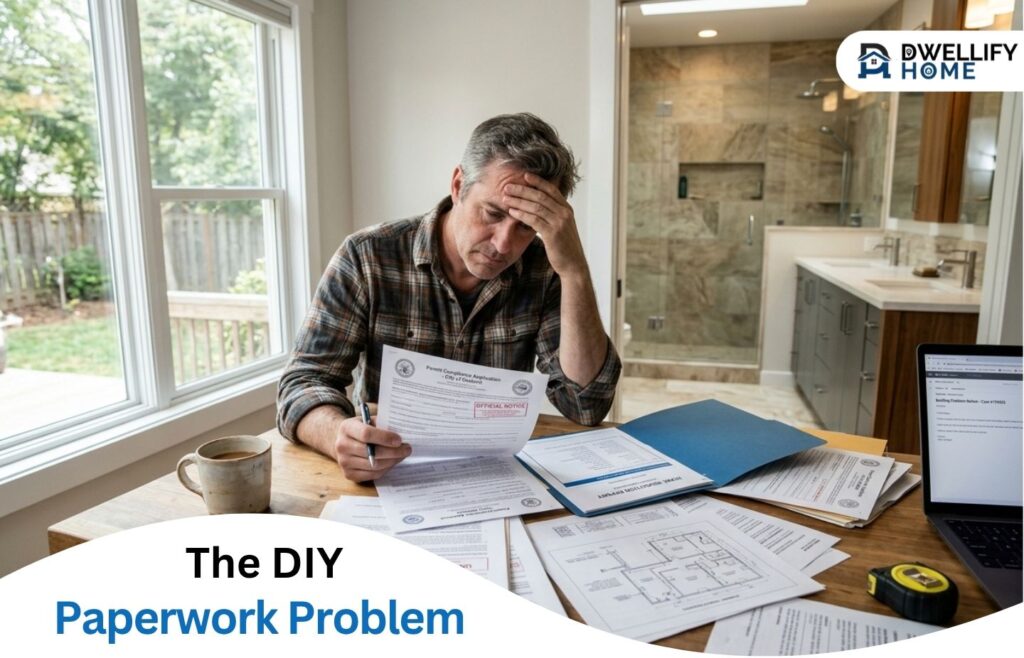
The bathroom came out beautifully. You moved the vanity, ran a new line for a second sink, tiled the whole thing yourself over three long weekends, and it looks better than anything a contractor quoted you for. Nobody inspected it. Nobody needed to — it’s your house.
Then, six years later, you sell. And somewhere in the closing paperwork there is a question about whether the work was permitted, and suddenly the nicest room in the house is the one holding up the deal.
This is the least glamorous topic in home improvement and one of the most expensive to get wrong. It is worth twenty minutes of your attention before your next project, not after.
What Actually Needs a Permit
The rule of thumb most building departments work from: cosmetic work is free, and anything touching structure, systems, or the building envelope is not.
Painting, wallpaper, flooring, cabinet refacing, swapping a light fixture for another light fixture, and replacing a faucet are almost universally permit-free. What typically does require a permit:
- Moving or adding plumbing lines; including relocating a sink, toilet, or shower
- New electrical circuits, panel work, or adding outlets to a room
- Removing or altering a wall, particularly a load-bearing one
- Windows and doors where the opening size changes
- Decks, and anything structural outdoors
- Finishing a basement or attic into habitable space
- HVAC replacement or relocation, and water heater replacement in many jurisdictions
- Roof replacement, in a great many jurisdictions
The critical caveat: this varies enormously by municipality, and sometimes between neighboring towns. Some places require a permit for a fence over a certain height; others don’t. Some require one for a water heater swap; others treat it as maintenance. The only reliable answer comes from your local building department, and the call is usually short and free.
Do not take your contractor’s word for it as the final answer, either. “You don’t need a permit for that” is sometimes accurate and sometimes means “I’d rather not deal with the inspection.” The permit protects you more than it protects them because the record follows the house, not the tradesperson.
Why It Surfaces Years Later
Unpermitted work is invisible right up until the moment several different parties are all looking at the house at once.
The buyer’s inspector. Inspectors notice work that doesn’t match the age of the house, and they are trained to flag it. A basement bathroom that isn’t on any plan, a subpanel nobody filed for, a deck with no footings visible — these end up in the report, and the report is what a buyer negotiates from.
The appraiser and the lender. Finished square footage that isn’t legally habitable space may not count toward value. A finished basement you spent $40,000 on can appraise at close to nothing if it was never permitted as living space, which is a problem when the buyer’s mortgage depends on the appraisal supporting the price.
Open permits. This one catches honest people. Sometimes a permit was pulled and the final inspection never happened, so the permit sits open on the municipal record for years. An open permit can be worse than no permit at all, because it is documentary proof that work began and was never signed off.
The disclosure form. Most states require sellers of residential property to complete a written condition disclosure, and the questions are more specific than people expect.
The Disclosure Question People Don’t See Coming
New York is a useful example because the form is public and unambiguous. Sellers of one-to-four-family residential property complete a Property Condition Disclosure Statement (the current revision of form DOS-1614-f is dated February 2025) and it must be delivered to the buyer before the buyer signs a binding contract of sale.
Among the questions is this one, in plain language: are there certificates of occupancy related to the property? If no, explain below.
That question does a lot of work. A certificate of occupancy, or its local equivalent, is the municipality’s sign-off that a space is legal to occupy for its stated use. If you converted an attic into a bedroom and never permitted it, that room’s legality is precisely what the question is asking about — and the disclosure is made on the seller’s actual knowledge, in writing, before contract.
Rules differ by state, and the forms themselves get revised. Licensed agents in New York are required to complete continuing education for real estate every two years, including hours specifically on recent legal developments, which is a large part of why a working agent usually knows which version of a disclosure form is current and what the local building department expects. If you have unpermitted work in your history, that conversation belongs at the listing appointment, not at the inspection.
Fixing It After The Fact
The situation is usually recoverable, and it is much cheaper to handle on your own timeline than under a contract deadline.
Many jurisdictions allow a retroactive or “as-built” permit: you apply for the work already done, an inspector visits, and if it meets code it gets signed off. Expect to pay the permit fee, possibly a penalty, and the cost of opening up finished surfaces so an inspector can see wiring or plumbing. Unpleasant, but bounded.
Closing out an open permit is often simpler: sometimes it is just scheduling the final inspection that never happened. Pull your property’s permit history from the building department and check for anything still open. Homeowners are routinely surprised by permits pulled by previous owners, or by a contractor a decade ago.
Where work genuinely cannot be brought to code, the honest options are to remove it or to disclose it and price accordingly. Concealing it is the one approach that reliably makes things worse.
If Renovating is Becoming a Habit
There is a point where this stops being about one bathroom. Homeowners who renovate and sell repeatedly, or who keep a first property as a rental when they move, find themselves dealing with contracts, disclosures, appraisals and local code as a recurring part of life rather than a once-a-decade event.
At that stage some people take online real estate courses — not necessarily to change careers, but because the transaction side is a body of knowledge like any other, and understanding disclosure obligations and agency relationships properly is useful whether or not you ever represent anyone else.
The Short Version
Before your next project: call the building department and ask.
During: keep every permit, inspection card, invoice and receipt in one folder.
After: confirm the permit was closed out, not just issued.
None of that improves the finished tile work. It is simply the difference between a renovation that adds value on paper and one that only adds it in person. This article is general information, not legal advice. Permit requirements and disclosure obligations vary by state and municipality; confirm the rules that apply to your property with your local building department or a qualified professional.
Just a quick disclosure: this article may contain affiliate or sponsored links. We may earn a small commission if you purchase through these links. Your support helps us maintain Dwellifyhome.com and continue sharing practical, informative, and helpful content.