
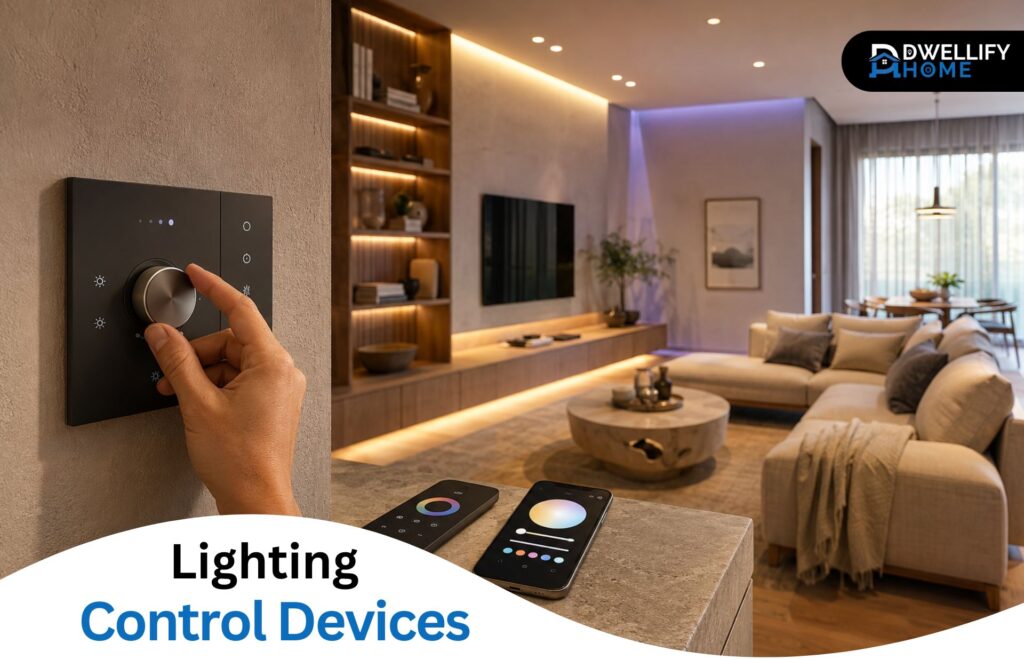
LED lighting is no longer limited to switching luminaires on and off. A properly designed control system allows users to adjust brightness, change colour temperature, create dynamic RGB effects, automate individual lighting zones and combine several groups of luminaires into one convenient system. These functions are useful in apartments and houses, but they are equally relevant for offices, shops, restaurants, hotels and other commercial premises.
The choice of control equipment depends on the type of light source and the tasks that the lighting system has to perform. A simple monochrome LED strip requires a different control method from an RGB or RGBW installation. Stair lighting needs sequential activation of separate sections, while furniture lighting benefits from compact sensors that respond to movement, touch or door opening.
Dimmers controllers and sensors for LED lighting
A dimmer regulates the brightness of a compatible LED light source. Instead of operating permanently at full output, the lighting can be adjusted to the current situation. Bright illumination is convenient for work, cooking or cleaning, while a lower level creates softer evening lighting and reduces unnecessary power consumption.
Controllers provide considerably more functions. RGB controllers manage separate colour channels and allow the user to select colours, change brightness and activate various lighting effects. RGBW systems add a dedicated white channel, which makes it possible to combine decorative coloured illumination with practical white light.
CCT controllers are designed for systems in which the colour temperature can be adjusted. By controlling warm and cool white LED channels separately, the user can move from warm light suitable for relaxation to a cooler white light appropriate for concentrated work. This is useful in living rooms, bedrooms, offices, kitchens and multifunctional commercial spaces.
The LEDUA range of Lighting Control Devices includes control panels, lighting regulators, RGB amplifiers, RGB and Smart controllers, sensors and other components for different LED lighting projects. The category also contains specialised control solutions for luminaires and systems where several lighting parameters have to be managed from a single interface.
Sensors make lighting automatic. Furniture sensors are suitable for wardrobes, kitchen cabinets and display furniture. In-profile sensors can be integrated directly into aluminium LED profiles, which helps keep the installation compact and visually clean. Wall and ceiling sensors are used for larger lighting zones, while photoelectric sensors react to ambient illumination and can switch lighting according to the available daylight.
Smart control and automation in different rooms
Smart lighting control changes the way separate luminaires are used. Instead of controlling every group manually, selected light sources can be integrated into predefined scenarios. A room can have different settings for working, relaxing, watching television or evening navigation.
Wireless technologies are especially useful when several independent zones need to work together. ZigBee-based devices can become part of a wider smart-home system, while compatible Smart controllers allow users to manage selected lighting functions remotely. Depending on the controller, the system can support brightness adjustment, colour selection, colour temperature control and lighting scenes.
In a kitchen, one control zone can operate the general ceiling lighting while another manages LED strips under wall cabinets. In a living room, decorative illumination behind furniture or along the ceiling can work independently from the main luminaires. In a bedroom, dimmed warm light can be used in the evening without switching on the brightest ceiling fixtures.
Automation is particularly practical on stairs. Dedicated staircase controllers can activate individual steps in sequence when a person approaches the staircase. Combined with correctly positioned sensors, such a system provides illumination exactly when it is needed and creates an attractive visual effect.
Commercial premises use the same principles on a larger scale. Shops can divide lighting into general, shelf, showcase and decorative zones. Restaurants can change the brightness between daytime service and evening hours. Offices can use sensors to control light in corridors, utility areas and rooms with irregular occupancy.
How to select compatible lighting control equipment
The first parameter to check is the operating voltage of the lighting system. Low-voltage LED strips and luminaires are commonly built around specific DC voltages, so the controller, amplifier, power supply and light source must be electrically compatible.
The next parameter is load. A controller has a defined maximum current or power for each output channel and for the entire device. If the LED installation is too large for one controller output, an RGB amplifier can be added to extend the system. The amplifier repeats the control signal while supplying additional LED sections from a suitable power source.
The number of channels also matters. Single-colour lighting uses one control channel, CCT systems require separate channels for warm and cool white LEDs, and RGB or RGBW installations use three or four colour channels. Selecting the correct controller from the beginning simplifies wiring and prevents unnecessary replacement of components later.
The physical location of the controls should be planned together with the lighting. A wall-mounted panel is convenient for central room control, while compact furniture or in-profile sensors are better suited to integrated lighting. Remote and Smart control can complement physical switches rather than replace them completely.
A well-matched control system turns separate LED strips and luminaires into one coordinated installation. Brightness, colour, automatic switching and individual lighting zones can then be adapted to the actual use of each room instead of remaining fixed after installation.
There’s more helpful content waiting for you on Dwellifyhome.com, so take a look before you leave. This post may contain affiliate or sponsored links that could provide us with a small commission from purchases. These earnings contribute to the growth of our website. All statements and opinions belong to the author and may not reflect the views of Dwellifyhome.com.