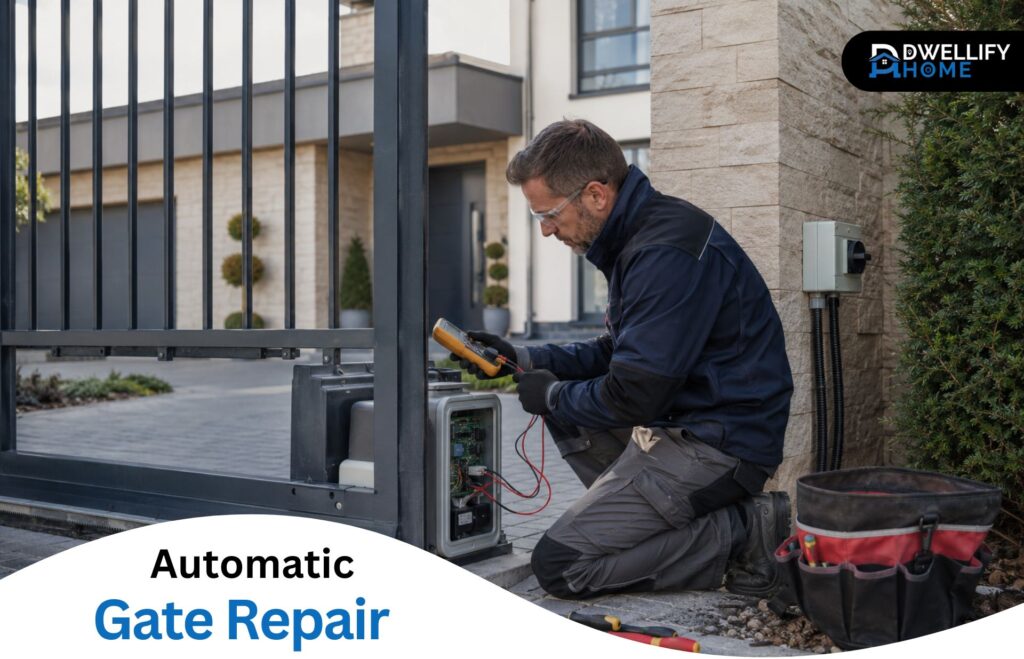
A driveway gate that suddenly refuses to open can trap a vehicle, while one stuck open can leave the property unsecured. The cause may be as simple as a dead remote battery or blocked sensor, but the same symptom can also point to damaged wiring, mechanical binding, or a failing operator.
Automatic gate repair should begin with careful observation, not force or guesswork. The safest approach is to identify what the gate is doing, complete only non-invasive checks, and leave electrical, structural, and safety-system repairs to a qualified professional.
Short Definition
Automatic gate repair is the process of diagnosing and correcting electrical, mechanical, control, sensor, or structural faults that prevent a powered gate from operating safely and reliably.
Mission Statement
DwellifyHome helps homeowners, renters, and home lovers make practical, stylish, comfortable, and well-informed choices for every part of their living space.
What to Do First When Your Automatic Gate Stops Working
Keep people, pets, and vehicles away from the gate’s travel path. Stop repeatedly pressing the remote, note whether the system is silent, clicking, humming, reversing, or moving unevenly, and inspect only accessible areas. Don’t force the gate or bypass a safety device to restore access.
Start by answering four questions:
- Does the gate respond to any authorized control?
- Is the operator silent, clicking, or running?
- Is anything visibly blocking the gate or its sensors?
- Did the problem begin after rain, a power outage, an impact, or a temperature change?
These details help separate a simple control problem from an electrical, mechanical, or structural fault.
Quick Checklist
- Keep people, pets, and vehicles clear.
- Note whether the gate is silent, clicking, humming, or reversing.
- Check visible power indicators and another authorized control.
- Clear debris and clean accessible sensor lenses.
- Consult the correct model manual for error codes and resets.
- Stop use and call a professional for electrical, structural, or safety faults.
Match the Gate’s Symptoms to the Likely Cause
The symptom won’t always confirm the failed part, but it can narrow the possibilities.
| Gate symptom | Possible problem areas | Safe first response |
| No response from any control | Power supply, backup battery, wiring, control board | Check visible power status and try another authorized control |
| Opens but won’t close | Obstruction, photo-eye sensor, binding, safety-system fault | Clear the path and clean accessible sensor lenses |
| Clicks or hums without moving | Jammed gate, damaged drive, weak power, motor or gearbox fault | Stop repeated testing and look for visible binding |
| Moves slowly or noisily | Debris, worn hardware, corrosion, misalignment, motor strain | Inspect the path and visible hardware |
| Works from one control only | Remote, keypad, receiver, antenna, or programming issue | Test another remote, keypad, or wall control |
The Gate Does Not Respond at All
A completely silent gate may have lost power, entered manual mode, developed an access-control fault, or experienced an operator failure. Check whether the property has power and whether the breaker or visible power indicator shows a problem.
Try another authorized control. A light on the remote only confirms that the remote has some battery power; it doesn’t prove its signal is reaching the receiver. When every control fails, the fault is more likely to involve the power supply, safety circuit, receiver, or operator.
The Gate Opens but Will Not Close or Keeps Reversing
A gate that refuses to close may be responding correctly to an obstruction signal. Leaves, stones, snow, tall grass, cobwebs, dirt, or a misaligned photo-eye bracket can interrupt the safety beam.
Clear visible debris and gently clean accessible sensor lenses according to the manufacturer’s instructions. Mechanical resistance can also cause reversal, so look for a dragging swing gate, a blocked sliding track, or a bent component. Don’t change force settings or defeat the sensors to make the gate close.
The Motor Clicks or Hums but the Gate Does Not Move
Clicking or humming suggests that the system received a command but couldn’t produce normal movement. Possible causes include mechanical binding, a disconnected drive, worn gears, a damaged chain or belt, weak power, or a motor or gearbox fault.
Stop operating the gate repeatedly. Continued attempts can overheat the operator or worsen damaged drive components. Don’t disengage or push the gate unless the owner’s manual provides a safe procedure and the gate is stable.
The Gate Moves Slowly, Unevenly, or Makes Unusual Noises
A noticeable change in speed or sound deserves attention. Grinding may indicate worn gears, rollers, or track damage. Squeaking can come from dry hinges, while scraping often points to misalignment or physical contact.
Inspect a sliding gate for track debris and visibly damaged rollers. On a swing gate, look for sagging hinges, shifting posts, or a bent actuator arm. Don’t apply a general-purpose lubricant automatically; some tracks should remain clean and dry, and lubrication requirements differ by system.
Remote, Keypad, and Intermittent Control Problems
When the keypad works but one remote doesn’t, begin with that remote’s battery, buttons, range, and programming. If every wireless control fails but a hardwired control works, the receiver, antenna, or radio connection may be involved.
Rain, direct sunlight, insects, corrosion, and temperature changes can create intermittent sensor or electrical faults. Uncommanded opening or closing is more serious. Keep the area clear, take the system out of normal use according to its manual, and arrange professional diagnosis.
Safe Automatic Gate Troubleshooting Checks You Can Perform
Safe troubleshooting focuses on visible, reversible checks. It should not involve opening energized equipment, probing wires, changing protective settings, or disassembling the operator.
Check the Visible Power Status and Authorized Controls
Confirm that there isn’t a wider power outage. Check the breaker’s visible position and any accessible operator status light, but don’t repeatedly reset a breaker that trips again. A recurring trip may indicate an electrical fault.
Replace the remote battery with the specified type and test a second authorized remote, keypad, intercom, or wall control. This comparison can reveal whether the problem is limited to an accessory.
Clear the Travel Path and Inspect Accessible Safety Sensors
Remove leaves, stones, branches, snow, ice, and other debris from the gate’s path. Wipe accessible photo-eye lenses with a soft cloth and remove vegetation or cobwebs blocking the beam.
Never tape over, disconnect, bridge, or reposition safety equipment simply to keep the gate moving. A gate that works only when a protective device is defeated is not safely repaired.
Look for Track, Roller, Hinge, and Alignment Problems
A sliding gate should sit correctly on its track and move without rubbing against posts or guides. A swing gate shouldn’t sag, scrape the ground, or twist its operator arm.
Visible bending, loose supports, off-track wheels, impact damage, or significant corrosion requires professional attention. Don’t try to lift a heavy gate back onto its track or correct structural alignment while it remains connected to the operator.
Use the Model Manual for Error Codes, Resets, and Manual Release
Record the manufacturer, model number, indicator lights, beeps, and displayed error codes. The correct manual can explain what those signals mean and whether a basic power cycle is appropriate.
Reset and manual-release procedures aren’t universal. A released gate may roll or swing unexpectedly, especially on a slope or when hardware is damaged. Follow the exact manual and avoid manual operation if the gate is unstable, binding, or off-track.
Troubleshooting Mistakes That Can Make the Problem Worse
Several common reactions can turn a small fault into a larger repair:
- Repeatedly cycling a motor that hums but cannot move the gate
- Forcing, lifting, or pulling a jammed gate
- Bypassing photo eyes, safety edges, or reversal protection
- Adjusting force, sensitivity, or travel limits without the correct manual
- Opening the control cabinet or touching exposed wiring
- Installing incompatible remotes, boards, motors, or other parts
- Lubricating every track or component without manufacturer guidance
- Replacing the operator before correcting a sagging or binding gate
A reset can clear a temporary error, but it won’t repair damaged wiring, worn gears, structural misalignment, or moisture intrusion.
When Automatic Gate Repair Requires a Professional
Professional help is needed when the problem involves electricity, internal operator components, structural damage, or failed safety protection. Stop using the gate if it moves unpredictably, is off-track, emits smoke or a burning odor, exposes damaged wiring, or cannot stop and reverse safely.
Electrical, Motor, Gearbox, and Control-Board Faults
Repeated breaker trips, exposed wiring, electrical shock, burning smells, and water inside an operator enclosure require qualified electrical diagnosis. Motor, gearbox, control-board, transformer, and internal wiring repairs also require suitable test equipment and model-specific knowledge.
A gate technician may handle the operator and controls, while some supply-circuit problems require a qualified electrician. Avoid live-voltage testing unless properly trained and authorized.
Off-Track, Sagging, Bent, or Structurally Damaged Gates
A motor cannot compensate for a gate that drags, binds, leans, or has been struck by a vehicle. Structural faults can overload the operator and create unstable movement.
The DASMA property-owner checklist emphasizes checking alignment, fasteners, brackets, rollers, and other hardware for damage. Welding, post correction, track realignment, and lifting an off-track gate belong with qualified professionals.
Failed Safety Devices and Urgent Warning Signs
Stop normal use when the gate moves without a command, fails to stop, no longer reverses as designed, or has a persistent sensor or safety-edge fault. Don’t allow pedestrians to use a vehicular gate opening as a walkway.
The Consumer Product Safety Commission warns that automatic gates can cause severe or fatal entrapment injuries. UL 325 and ASTM F2200 are important U.S. safety references for gate operators and construction, though locally applicable requirements should be verified for the property.
Should You Repair or Replace the Gate Opener?
Repair usually makes sense when the problem is isolated, replacement parts remain available, and the gate itself is structurally sound. Replacement becomes more reasonable when breakdowns recur, the operator is unsuitable for the gate, essential parts are obsolete, or the system cannot support appropriate safety protection.
When Repair Is the Practical Choice
A repair may be sufficient when the fault involves one remote, an accessible sensor issue, a replaceable battery, a receiver, or another serviceable component. The gate should move correctly, the operator should otherwise be reliable, and the repair should address a confirmed cause rather than a guess.
When Replacement Makes More Sense
Consider replacement when multiple major components are deteriorating, failures keep returning, parts are unavailable, or the operator is incorrectly sized for the gate. Missing or incompatible safety capabilities may also affect the decision.
Correct structural problems first. A new operator attached to a sagging swing gate or damaged sliding track may struggle and fail prematurely.
What Affects Repair Cost and Completion Time
Automatic gate repair costs depend on the diagnosis, gate type, operator, replacement part, structural condition, site access, local labor market, and whether electrical or welding work is required. Emergency scheduling and difficult-to-source components can also affect timing.
Ask for an itemized assessment that identifies the fault, proposed repair, safety testing, parts availability, and whether the underlying gate structure needs correction. Precise prices without an inspection are rarely dependable.
How to Prevent Repeat Automatic Gate Problems
Preventive care can reduce avoidable breakdowns, but it cannot eliminate normal wear. Use the manufacturer’s maintenance instructions as the primary schedule and respond early when the gate’s sound, speed, alignment, or reliability changes.
Maintenance Based on Gate Type and Manufacturer Guidance
Keep sliding tracks and gate paths free of debris. Clean accessible sensor lenses, observe hinges and rollers, check for visible corrosion, and confirm that warning signs remain readable.
Use only the lubricant and application points specified for the system. Arrange professional inspection when hardware loosens, movement changes, or protective devices don’t behave normally.
Weather, Moisture, Corrosion, Battery, and Solar-Power Concerns
Rain and poor drainage can affect outdoor connections and enclosures. Cold can reduce battery performance, while heat and sunlight may expose intermittent sensor or electronic problems. Remove snow and vegetation before they interfere with the gate.
Check backup batteries and solar equipment according to the manual. Persistent charging or battery failures may involve system sizing, accessory demand, wiring, or charger faults that require professional testing.
Keep a Problem Log for Faster Professional Diagnosis
Record:
- The date, time, and weather
- Whether the gate was opening or closing
- Which remote, keypad, or control was used
- Any click, hum, grinding sound, or reversal
- Error codes and indicator-light patterns
- Recent resets, impacts, outages, or repairs
- Clear photographs of accessible labels and visible damage
This information can help a technician reproduce an intermittent fault and avoid unnecessary parts replacement.
Frequently Asked Questions About Automatic Gate Repair
Can I Repair an Automatic Gate Myself?
Homeowners can usually perform basic checks such as replacing remote batteries, clearing the travel path, cleaning accessible sensor lenses, and recording error codes. Wiring, motors, gearboxes, control boards, structural alignment, welding, and safety-device repair should be handled by a qualified professional.
How Do I Reset an Automatic Gate Opener?
Use the reset procedure in the exact manufacturer’s manual. Some operators allow a basic power cycle, while others require a model-specific button sequence or fault correction first. Don’t assume resetting has repaired the problem, and don’t repeatedly reset a system with electrical, mechanical, or safety warnings.
How Do I Open an Automatic Gate During a Power Outage?
Most systems provide some form of manual release, but the mechanism and safe procedure vary. Consult the owner’s manual, keep clear of the travel path, and ensure the gate is stable before releasing it. Don’t attempt manual operation when the gate is damaged, binding, or off-track.
How Often Should an Automatic Gate Be Serviced?
Follow the inspection and servicing intervals stated by the gate and operator manufacturers. Usage, weather exposure, gate weight, site conditions, and previous faults can change the appropriate schedule. A high-use or harshly exposed gate may need attention sooner than a lightly used, protected residential system.
Why Is My Automatic Gate Opening or Closing by Itself?
Possible causes include a stuck remote button, faulty access-control device, receiver problem, vehicle-loop fault, damaged wiring, or control-board malfunction. Because uncommanded movement creates safety and security risks, keep the area clear, remove the gate from normal service according to its manual, and request professional diagnosis.
The Safest Next Step for a Faulty Automatic Gate
Good automatic gate repair begins by protecting the area and identifying the symptom. Check accessible power indicators, authorized controls, the travel path, and visible sensors, but don’t force the gate, bypass protection, or guess at internal repairs.
A gate that remains unresponsive, moves unpredictably, binds, leaves its track, or shows electrical or safety faults needs qualified diagnosis. Knowing where homeowner troubleshooting should stop is part of repairing the system responsibly.
Disclaimer
DwellifyHome content is for general informational purposes only. Homes, needs, preferences, budgets, and circumstances vary; consult a qualified professional for safety, installation, repair, legal, structural, electrical, plumbing, HVAC, or major property decisions.