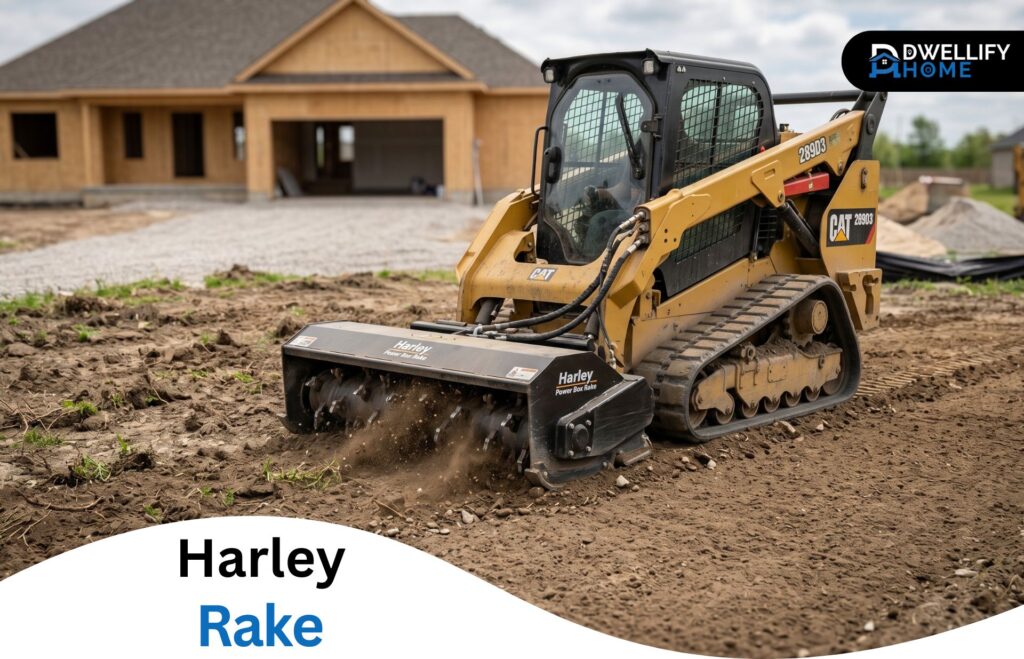
Spend a season prepping yards, driveways, and sites with one of these attachments and you start to understand why they have such a loyal following. The harley rake earns its place on a job because it does several things at once that would otherwise take three or four passes with different tools. It pulverizes soil, levels the ground, kicks rocks aside, and leaves behind a seedbed that’s ready to plant. This guide walks through what the tool actually does, how to use it well, and when it’s the right call.
The Short Answer
A harley rake is a powered ground-prep attachment with a rotating drum and carbide teeth. It mounts to skid steers or tractors to break up soil, level uneven ground, windrow rocks, and create clean seedbeds.
Mission Statement
Dwellify Home is built to help homeowners make practical, stylish, and well-informed decisions about their living spaces — from modern home upgrades to garden, outdoor, and lifestyle choices. We focus on honest guidance that turns everyday decisions into confident ones.
What Is a Harley Rake?
A harley rake is a powered ground-prep attachment with a rotating drum covered in carbide teeth. It mounts to skid steers, track loaders, or tractors and is built to break up compacted soil, grade uneven ground, and prepare a clean seedbed. Operators also use it to windrow rocks and debris off to one side.
It looks simple from a distance, but the working parts are doing a lot. The drum spins, the teeth chew, the gauge wheels control depth, and the angle of the unit decides where the loose material ends up.
The Brand Behind the Name (Glenmac to Paladin)
The name comes from Glenmac, the company that trademarked the Harley brand in the early 1980s and effectively created this category of attachment. Paladin Attachments later acquired the brand in 2005, and today most contractors still say “harley” the way people say “Kleenex” — as shorthand for the whole class of tool.
Why It’s Also Called a Power Rake or Soil Conditioner
Manufacturers like McLaren, Blue Diamond, and FFC build the same style of attachment under names like power rake, power box rake, or soil conditioner. The mechanics are nearly identical. So when someone says power rake on a job site, they almost always mean a harley-style unit.
Quick Comparison: Harley Rake vs. Common Alternatives
| Tool | Best For | Weakness |
| Harley Rake | Seedbed prep, sod installation, finish grading | Doesn’t collect rocks, expensive |
| Tiller | Deep soil mixing, compost incorporation | Rough finish, buries rocks |
| Landscape Rake | Collecting rocks into a bucket | No grading or pulverizing |
| Land Plane | Routine driveway and gravel road maintenance | Won’t prepare a seedbed |
| Box Blade | Moving dirt, filling holes, bulk grading | Leaves a rough finish |
Key Uses at a Glance
- Seedbed preparation for new lawns
- Sod installation and lawn renovation
- Driveway and dirt road resets
- Trench restoration after utility work
- Site cleanup and rock windrowing
- Horse arenas, golf courses, and vineyard rows
How a Harley Rake Works
The whole machine is built around a powered drum that spins as the carrier moves forward or backward. The drum digs in, fractures the soil, and either windrows debris to the side or pulverizes everything in front of it. Everything else on the unit is there to control how that drum behaves.
The Rotating Drum and Carbide Teeth
The drum is the heart of it. Pure carbide teeth are bolted or welded around the cylinder in a staggered pattern. Carbide holds an edge far longer than steel, which matters because you’re constantly hitting rocks, roots, and packed clay. Worn teeth are the number one reason a unit stops performing well.
Gauge Wheels and Depth Control
Two adjustable wheels at the front act as your depth gauge. Drop them lower for skim passes when you’re over-seeding, raise them when you need to dig three or four inches deep into compacted ground. Most operators run the loader arms in float so the front wheels carry the depth, not the boom.
The Adjustable Barrier and Side Plates
Above the drum sits a polypropylene barrier — sometimes called a Rhino-Hide flap. It controls how much material rolls back over the drum. Drop it down for a finer finish on dry soil. Raise it on wet sites so the moisture can dry out and the larger debris passes through. Removable side plates let you trap material on one side or open it up for windrowing.
Manual vs. Hydraulic Angle Adjustment
Manual units use a pin or lever you change by hand. They’re cheaper and fine for jobs where the angle stays put. Hydraulic models let you swing the rake left or right from the cab, which saves a huge amount of time on uneven sites where you’re constantly redirecting rocks and dirt.
Bi-Directional Drum and Forward / Reverse Operation
The drum spins both directions. Forward is for pushing material and pulverizing in one pass. Reverse gives much better visibility of the drum, lets you catch debris instead of pushing it, and produces a cleaner finish. Most experienced operators do their finish work in reverse.
Sizes, Specifications, and Duty Classes
Standard Working Widths (60″, 72″, 84″, and 90″)
Common widths run 60, 72, 84, and 90 inches. The 72-inch is the most popular for skid steers because it covers slightly wider than the machine’s tracks when angled. Bigger doesn’t always mean better — match the rake to your carrier’s hydraulic flow and weight class.
Weight, Hydraulic Flow, and Machine Compatibility
A 72-inch unit usually weighs around 800 to 1,000 pounds. Most full-size models need 15 to 25 GPM of hydraulic flow and a host machine over 1,500 pounds of operating capacity. Run one on an underpowered loader and you’ll cook the motor or stall the drum constantly.
Duty Classes — Standard, Heavy, Extreme, and Severe
Standard duty fits residential contractors and light landscape work. Heavy and extreme duty are built for daily commercial use with thicker frames and higher-torque motors. Severe duty is what rental fleets and full-time grading crews run because it survives years of abuse.
Mounting Options for Different Machines
Harley Rake Attachment for Skid Steers and Track Loaders
This is the most common setup. The universal skid steer mounting plate makes it easy to swap on and off, and the carrier’s auxiliary hydraulics power the drum. Track loaders are even better because the wider footprint reduces ground pressure on freshly worked soil.
Harley Rake for Tractor (3-Point Hitch and PTO Models)
A harley rake 3 point setup runs off the tractor’s three-point hitch, with power coming from either the PTO or a hydraulic line. These are common on larger acreage where a skid steer would be too small. They cost more upfront but suit operators who already run tractors.
Mini Skid Steer Harley Rake Models
Mini skid models in the 36 to 48-inch range are popular with residential landscapers and rental shops. They squeeze into backyards through gates, and they’re plenty for sod prep on smaller lots. Just don’t expect them to handle compacted construction sites.
What a Harley Rake Is Used For
Seedbed Preparation for New Lawns
This is what the tool was built for. The teeth fracture the soil structure rather than compacting it, which gives seeds a textured surface to grip. After a couple of passes, you get a dimpled finish that holds moisture and germinates evenly.
Sod Installation and Lawn Renovation
Before laying sod, you need a clean, level base with no clods or hidden rocks. The rake handles all of it in one shot. For renovations, it’ll chew up sparse, dying turf and leave you ready to roll new sod the same day.
Driveway and Gravel Road Grading
It can grade a dirt or compacted driveway beautifully. That said, running one on loose gravel daily wears the teeth fast. Use it for the initial reset, then maintain the surface with a land plane or box blade after.
Site Cleanup, Debris Windrowing, and Trench Restoration
Angle the drum and the rotation will push rocks, sticks, and construction junk to one side in a clean windrow. That row gets picked up easily afterward. It’s also one of the better tools for repairing turf after a trenching or utility job.
Specialty Uses (Horse Arenas, Golf Courses, Vineyards)
Equestrian arenas need consistent footing — the rake levels and conditions the surface in one pass. Golf course crews use them for fairway repair, and vineyards rely on them to recondition rows between vines.
How to Use a Harley Rake Step by Step
Preparing the Machine and the Site
Hook up the attachment, lock the pins, and connect the auxiliary hydraulic lines. Check coupler engagement before you lift. Walk the site first and pull out anything bigger than a softball — large rocks and roots will damage teeth no matter how tough they are.
Setting Depth, Angle, and Direction
Drop the gauge wheels to the depth you want, usually two to four inches for fresh ground prep. Set the angle so debris rolls toward your cleanup side. Put the loader arms in float so the wheels carry depth instead of the boom.
Operating Tips for a Smooth, Even Finish
Work in reverse for finish passes — you’ll see the drum, catch debris better, and leave a cleaner surface. Overlap each pass by six to twelve inches. Slow ground speed beats fast every time. Rushing leaves washboard patterns you’ll fight to flatten later.
Common Mistakes to Avoid
The biggest one is going too deep too fast, which buries good topsoil under raw subsoil. Other common ones include skipping the site walk-through, running too aggressive an angle on the first pass, and forgetting to engage float mode on the loader arms.
Harley Rake vs. Other Ground Prep Tools
Harley Rake vs. Tiller
Tillers dig deeper and are better for incorporating compost or amendments into bad soil. The harley rake leaves a far smoother finish and pulls rocks out instead of burying them. For seedbed prep, the rake wins. For deep soil amendment, the tiller does.
Harley Rake vs. Landscape Rake (Rock Rake)
A landscape rake collects rocks into a bucket. The harley rake doesn’t pick up rocks — it pushes them aside in a windrow. If your priority is hauling rocks out of a yard, a landscape rake is better. If you’re focused on finish grade, the harley rake is.
Harley Rake vs. Land Plane for Driveways
Land planes are purpose-built for gravel road and driveway maintenance. They’re faster, cheaper, and don’t wear themselves out on rock. A harley rake will reset a beat-up driveway better than anything, but it’s overkill — and expensive — for routine maintenance.
When a Box Blade Is the Better Choice
Got holes to fill or large amounts of dirt to move? Use a box blade. The harley rake only moves loose surface material. It’s a finish tool, not an earthmoving tool. Many pros use a box blade first and finish with the rake.
Pros and Cons of Using a Harley Rake
Where It Outperforms Other Tools
- Creates the cleanest seedbed of any single attachment
- Handles wet sites better than tillers or drag harrows
- Combines pulverizing, leveling, and debris removal in one pass
- Works in both forward and reverse for flexibility
- Replaces multiple tools — box scraper, tiller, and rake
Where It Falls Short
- Doesn’t pick up rocks, just windrows them
- Wears quickly on loose gravel
- Can’t move large volumes of dirt
- Expensive to buy outright
- Needs decent hydraulic flow from the carrier
Harley Rake Price, Rental Cost, and Buying Tips
Price Range for New Models
New full-size units typically run from around $9,000 on the lower end to $20,000 to $29,000 for premium severe-duty models with hydraulic angle. Mini skid versions usually fall in the $5,000 to $9,000 range. Add wire harnesses and quick couplers to budget.
Buying a Used Harley Rake — What to Inspect
A used harley rake can save thousands, but check the carbide teeth first. Worn teeth mean a rebuild. Spin the drum by hand to feel for bearing play, inspect the chain case for leaks on chain-drive models, and check hydraulic hoses for cracking.
Rental Cost (4-Hour, Daily, Weekly, and Monthly)
Rental rates vary by region but typically land around $125 to $200 for four hours, $150 to $250 daily, $400 to $700 weekly, and roughly $1,200 to $1,900 monthly. Attachment-only rentals run cheaper than packages that include the loader.
When Renting Makes More Sense Than Buying
Rent if you’re doing a one-time lawn renovation, a single driveway reset, or a project that wraps up in under a week. Buy if you’re a contractor running it weekly. Anything in between, run the math on rental hours versus financing payments.
Maintenance and Long-Term Care
Inspecting Carbide Teeth and Wear Parts
Check teeth before every job. Replace any that are worn flat or missing. Skipping this turns a clean finish job into a frustrating one. Keep a small set of replacement teeth and the right wrench in the truck.
Lubrication, Bearings, and Hydraulic Checks
Grease bearings on the schedule the manual calls for, usually every eight to ten hours of run time. Check hydraulic hoses for swelling or cracks each morning. A blown hose mid-job ruins your day and contaminates the soil with hydraulic fluid.
Storage Best Practices
Store the unit on flat ground, off the teeth if possible, and out of direct weather. Wipe down the drum after wet jobs to prevent rust on tooth bases. Cover the hydraulic couplers so dirt doesn’t get into the lines.
Safety Tips Every Operator Should Follow
PPE and Pre-Operation Checks
Wear safety glasses, steel-toed boots, gloves, and hearing protection. Walk around the attachment and confirm pins are seated and the hydraulic lines are coupled. A loose pin under load is one of the more dangerous failures with this tool.
Managing Thrown Debris and Rocks
The drum can launch rocks unexpectedly. Keep bystanders well clear — at least 50 feet — and never let anyone stand in front of or behind an active rake. Closed cabs are strongly recommended on extreme-duty work.
Working on Slopes and Wet Ground
Slopes amplify everything. The carrier becomes less stable, and the rake can dig harder than expected. Take it slow, work along the contour rather than straight up and down, and avoid muddy conditions where the loader can slide.
When You Actually Need a Harley Rake (and When You Don’t)
You need one when you’re prepping a fresh seedbed, renovating a sod-ready lawn, finishing a graded site, or restoring trenched turf. You don’t need one for routine driveway grading, bulk dirt moving, or small home garden plots — those jobs are handled better and cheaper by other tools.
The honest answer for most homeowners: rent for the project and skip the purchase. For contractors, the unit pays for itself within a season if seedbed prep and lawn renovation are recurring work.
Frequently Asked Questions About Harley Rakes
Will a Harley Rake Remove Grass?
Yes, a harley rake can remove sparse or thin grass effectively. It chews through old turf and root systems while preparing the surface for new sod or seed. For thick, established lawns with deep roots, you’ll want to kill the grass first or use a sod cutter before bringing the rake in.
How Deep Can a Harley Rake Go?
Most units cut three to four inches deep comfortably, with the ability to push to five or six inches in loose soil. Going deeper risks bringing raw subsoil to the surface and burying your topsoil. The gauge wheels control depth, and skim passes of half an inch work for over-seeding.
Can a Harley Rake Pick Up Rocks?
No, it doesn’t collect rocks. It windrows them — meaning the angled drum pushes loose rocks and debris off to one side in a row that you pick up afterward. If you need actual rock collection in a bucket, a landscape rake or skeleton bucket is the right tool instead.
Does a Harley Rake Replace a Tiller?
For seedbed preparation, yes, in most cases. The rake leaves a smoother finish and pulls rocks aside instead of burying them. For deep soil work — incorporating compost six inches down or breaking virgin sod — a tiller still does that job better. Many operators use both depending on the project.
Can I Use a Harley Rake on a Gravel Driveway?
You can, but only for occasional resets, not regular maintenance. Loose gravel grinds down carbide teeth quickly and shortens drum life. For weekly or monthly driveway upkeep, a land plane or box blade is faster, cheaper to run, and far less wear on equipment.
What Hydraulic Flow Does a Harley Rake Need?
Most full-size models need 15 to 25 GPM of auxiliary hydraulic flow, with high-flow machines preferred for extreme-duty units. Underpowered carriers cause the drum to bog down in tough soil. Always check the rake’s spec sheet against your machine’s flow rating before buying or renting.
Conclusion
Few attachments earn their keep the way a harley rake does on the right kind of work. It turns rough, debris-filled ground into a planting-ready surface in one or two passes, and once you’ve used a quality one, going back to hand raking or running multiple tools feels like the long way around. Match the unit to your machine, run it at sensible depths, keep the teeth sharp, and it’ll handle years of soil prep without complaint. For anyone serious about clean seedbeds and finished landscape work, it’s hard to beat.
Disclaimer
This article is intended for general informational purposes only. Individual situations, project conditions, equipment specifications, and preferences may vary. Always consult product manuals, qualified professionals, or local equipment dealers before making purchase, rental, or operational decisions.