
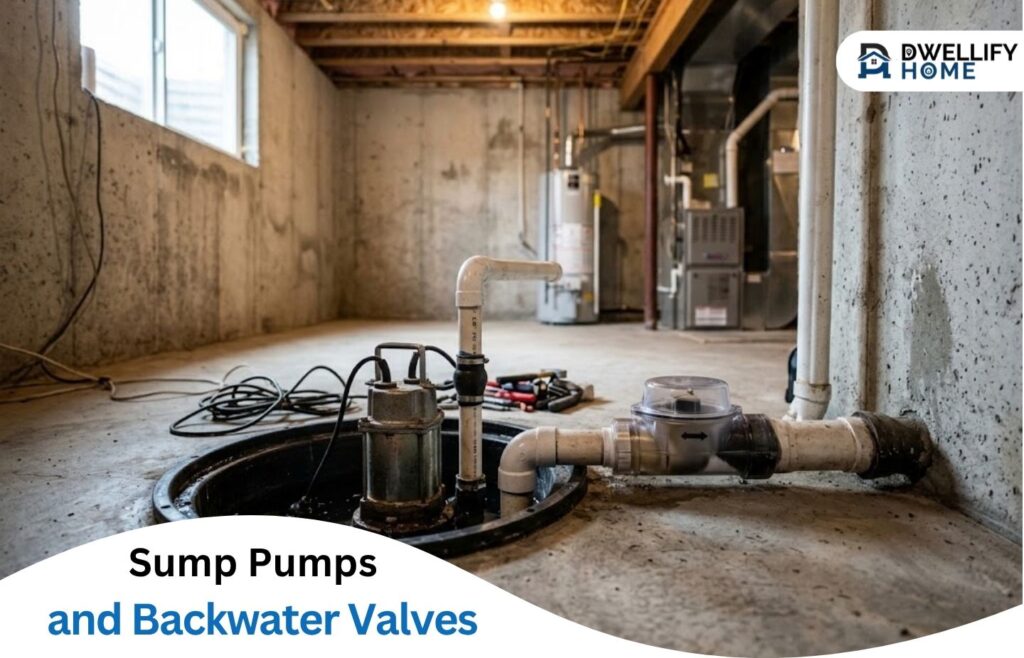
Basement flooding rarely comes from one dramatic failure. It is usually two much smaller, much less exciting systems quietly not doing their job: a sump pump that was not maintained, or a backwater valve that was never installed at all.
Both are unglamorous. Neither shows up on a home tour. And both are the difference between a wet weekend and a finished basement that gets torn out and redone.
Here is what each one actually does, and why homeowners who understand the difference tend to avoid the worst of it.
Two different problems, two different solutions
It helps to separate the two failure modes, because they are not the same problem and one device does not solve both.
Groundwater rising up from below is a sump pump problem. Heavy rain or snowmelt raises the water table around a foundation, water seeps in through the foundation walls or floor, collects in a sump pit, and the pump’s job is to move that water out before it accumulates.
Sewage backing up from the municipal line is a backwater valve problem. During heavy storms, municipal sewer systems can become overwhelmed, and if the system backs up, wastewater can travel backward through a home’s own drain lines and come up through the lowest fixtures in the house, usually a basement floor drain or a basement toilet. A sump pump does nothing for this. It is a completely separate flow path.
A basement can be perfectly protected against one and completely exposed to the other. That is the single most common gap in existing basement protection: a house with a sump pump and no backwater valve, or occasionally the reverse.
What a sump pump actually needs
A sump pump sitting in a pit is not, on its own, a finished system. A few things determine whether it works when it is actually needed.
A battery backup. The scenario where a sump pump is needed most, a major storm, is also the scenario most likely to knock out power. A pump with no backup is a pump that does nothing during exactly the event it exists for. A battery backup system keeps it running through a power outage, which is when the risk is highest.
A working check valve on the discharge line. Without one, water pumped out can flow back down into the pit once the pump cycles off, forcing it to immediately pump the same water again. This wastes pump life and can mask a system that is barely keeping up.
Regular testing, not just installation. A sump pump that has not been tested in a year is an unknown quantity. Pouring a bucket of water into the pit and watching it cycle on, pump out, and shut off cleanly takes two minutes and catches a stuck float switch or a seized motor before a storm does.
The right pump for the pit’s actual inflow rate, not just whatever came with the house. A pump that is too small for how quickly water enters during heavy rain will run constantly and still lose ground.
What a backwater valve actually does
A backwater valve is installed in the main sewer line, usually where it exits the house, and it contains a flap or gate that allows wastewater to flow out normally but closes if the flow tries to reverse. When municipal lines back up, the valve closes and stops sewage from traveling back into the house instead of continuing out to the street.
This matters because sewage backup is a different category of damage than groundwater. Groundwater is unpleasant. Sewage backup is a health hazard and typically requires a full remediation of anything it touched, not just drying out.
Homes built before backwater valves became a standard requirement in many municipal codes often do not have one, particularly if the basement was finished before that requirement existed. Retrofitting one is a real plumbing job, since it involves accessing the main line, but it is a one-time installation rather than something with ongoing maintenance the way a pump has.
Some municipalities offer financial assistance toward backwater valve installation as part of broader flood-prevention programs, though the terms and availability vary considerably by region and are worth confirming locally rather than assumed.
Why both matter together, not separately
A finished basement represents a real investment, and both flood paths can undo it independently of the other. A homeowner who installs a sump pump and stops there has solved the groundwater problem and left the sewage backup risk completely untouched. The reverse is equally true.
The honest starting point is finding out what is already in place. Many homes have one system and not the other, sometimes because the second was never mentioned when the first was installed, sometimes because it was added by a previous owner and never disclosed. A basement inspection focused specifically on these two systems, rather than a general plumbing check, is the fastest way to find the gap.
Getting it right
If a sump pit already exists but the pump inside it is old, undersized, or has no battery backup, that is usually the cheaper and faster fix of the two. Professional sump pump installation includes sizing the pump to the pit’s actual inflow and setting up the backup power that makes it useful during the exact conditions it is meant for.
If there is no backwater valve at all, that is worth treating as unfinished business rather than an optional upgrade, particularly for any basement that has already been finished once. Having a backwater valve installed closes the one flood path that a sump pump cannot touch, and for a basement that represents real money in flooring, drywall, and furniture, it is the cheaper problem to solve before the storm rather than after.
Disclosure: Some links in this article may be affiliate or sponsored links. Dwellifyhome.com may earn a small commission from qualifying purchases made through these links. This comes at no additional cost to you and helps support our website.