
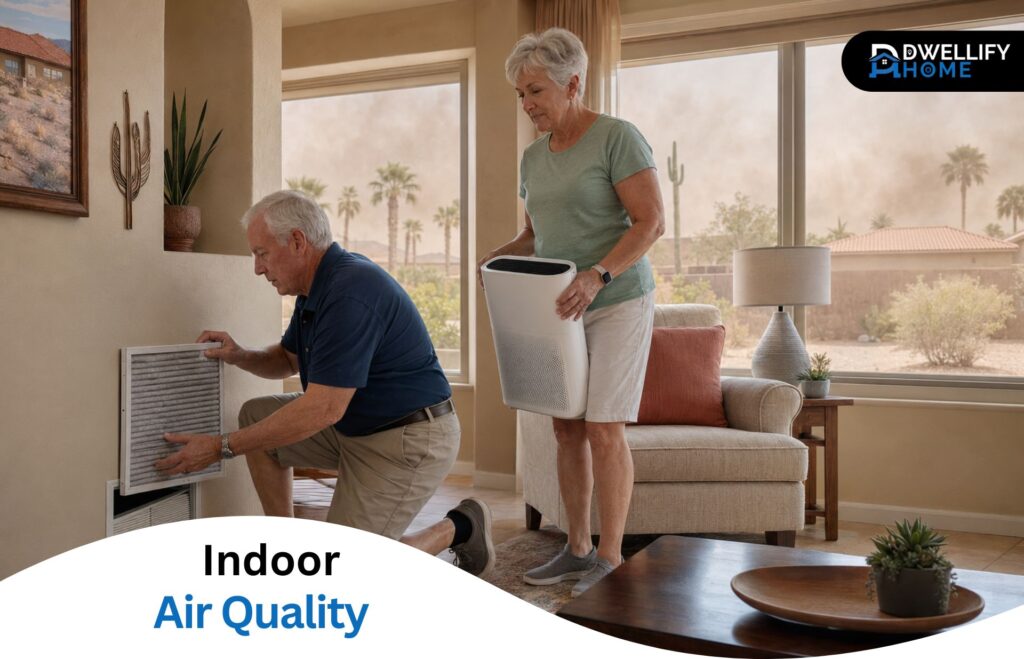
Sun City is one of Arizona’s most established active adult communities, and the rhythm of daily life here centers on the home. The long summer cooling season keeps windows closed from May through October, and the desert environment pushes fine particulates through every building with each storm event. For residents 55 and older, understanding what circulates through that indoor air and what can be done about it is more than a comfort question.
The Sealed-Home Condition and What It Creates
Phoenix-area temperatures exceed 100 degrees Fahrenheit regularly from June through September. Sun City residents keep their homes sealed against the heat for months at a time, and an HVAC system running 8 to 12 hours daily recirculates the same indoor air through filters, across the evaporator coil, and back through supply ducts into every room. Without regular fresh air exchange, whatever is in the indoor air at the start of the season becomes increasingly concentrated over time.
Dust particles, pet dander, cleaning product aerosols, off-gassing from furniture and building materials, and biological contaminants all accumulate in a home that cannot breathe naturally. This is the defining indoor air quality challenge for Sun City residents, and Arizona’s climate makes it significantly more pronounced than in regions where homeowners can open windows for several months each year.
Three Arizona-Specific Threats That Build Through the Year
Haboob events are the most visible of Arizona’s air quality threats, and they affect indoor air in ways that go well beyond what closed windows prevent. Fine silica particles with diameters below 2.5 microns penetrate door seals, utility penetrations, and return air entry points during haboob events, loading into the HVAC filter and ductwork with each occurrence. The Maricopa County area tracks PM2.5 concentrations at more than twice the World Health Organization’s annual guideline value, and haboob events produce acute spikes well above that baseline.
Monsoon season brings a different threat. When Arizona’s relative humidity spikes from the typical 5 to 15 percent into the 50 to 70 percent range during monsoon thunderstorms, cold evaporator coil surfaces inside air handlers are exposed to moisture-laden air. Mold colonization on those cold, wet surfaces can establish within 24 to 48 hours. The subsequent cooling cycles distribute biological material through the supply duct system into every occupied room. The musty odor Sun City residents sometimes notice from AC vents after a strong monsoon event is typically this biological cycle in progress.
The third threat is less dramatic but persistent. Sun City homes occupied for 15 or more years carry accumulated particulate inside their duct systems from years of operation. Standard filter replacement addresses new loading but does not remove what has settled into duct interiors, plenums, and register openings over many years of continuous use.
Why Older Adults Face Greater Sensitivity to Indoor Air Contaminants
Adults over 65 experience more significant effects from indoor air pollutants than younger adults. Respiratory reserve capacity declines with age, which means less tolerance for airborne irritants before symptoms become noticeable. Older adults also spend a higher proportion of their time indoors, particularly during Phoenix’s summer months, which increases cumulative exposure compared to working-age adults who leave the home daily for extended periods.
Residents with existing conditions affecting the lungs, sinuses, or cardiovascular system face compounded sensitivity to both fine particulate and biological contaminants in recirculated indoor air. This does not mean Sun City residents face unavoidable health risk from indoor air quality. What it does mean is that the standard filter replacement schedule adequate for many markets is not sufficient for a sealed Sun City home through an Arizona summer.
What a UV Germicidal Light Addresses
A UV germicidal light installed adjacent to the evaporator coil in the air handler emits UV-C radiation at approximately 254 nanometers, a wavelength that disrupts the DNA structure of mold spores, bacteria, and viruses on the coil surface. The Centers for Disease Control and Prevention has documented UV-C effectiveness for decontamination in ventilation systems.
In a Sun City home facing the evaporator coil mold cycle during each monsoon season, a UV germicidal light prevents biological colonization of the coil surface year-round, eliminating the source of musty supply air and the biological contamination the cooling cycle distributes through the home. Annual lamp replacement, typically combined with the spring AC tune-up, maintains germicidal effectiveness as the lamp approaches its rated output life of 9,000 to 12,000 hours.
MERV Filter Ratings and What Sun City Homes Actually Need
Standard HVAC filters carry MERV ratings between 1 and 16. The MERV 8 filters packaged with most residential systems capture larger particles but allow fine desert dust, mold spores, and pollen to pass through freely. MERV 11 filters capture particles in the 1 to 10 micron range at 65 to 95 percent efficiency, covering the mold spores, pollen, and fine desert particulate most relevant to Sun City’s air quality environment.
MERV 13 provides filtration efficiency approaching hospital-grade at 0.3 microns, but it restricts airflow more significantly. Some residential systems need their filter sizing evaluated before moving to MERV 13 to confirm the existing equipment can sustain adequate airflow at the higher resistance level. A professional assessment confirms which filter rating the system can support without compromising cooling performance.
Electronic Air Cleaners and Bipolar Ionization
Mechanical filtration captures particles as they pass through filter media. Electronic air cleaners use electrostatic precipitation to charge airborne particles and capture them on collector plates, reaching sub-micron particle sizes that MERV 11 filters pass through. Bipolar ionization generates charged ions that travel through the duct system into occupied spaces, clustering around fine particles and neutralizing biological contaminants throughout the living area rather than only at the filter location.
These technologies address different parts of the indoor air quality problem. Some Sun City homes benefit most from filtration upgrades. Others need biological contamination control at the coil level. Many benefit from a combination. A professional evaluation identifies which specific conditions are present before any equipment recommendation is made.
When a Professional Evaluation Makes Sense
Sun City homeowners who want a clear picture of what circulates through their home can schedule indoor air quality services in Sun City, AZ, with a licensed local provider to identify specific contaminants, evaluate HVAC filter performance, inspect the evaporator coil for biological growth, and recommend appropriate treatment based on the actual conditions in the home.
A professional evaluation also identifies whether the ductwork is contributing to the indoor air quality picture, which is relevant in any Sun City home that has not had a duct inspection in recent years. The goal is not to create concern about every cubic foot of indoor air. The goal is to understand the specific conditions in the home and address the ones that can be improved with practical, available solutions.
Before you leave, take a moment to explore our other helpful home-related articles. Some links included in this post may be affiliate or sponsored links, which means we may earn a small commission from qualifying purchases. This support helps Dwellifyhome.com continue publishing useful content. All opinions expressed belong solely to the author.