Vinyl vs. aluminum may headline the debate, but your real question is simple: will the pool-gate latch click shut every time? Hardware, alignment, and steady upkeep, not material, make that promise.
The U.S. Consumer Product Safety Commission reports that drowning is the leading cause of unintentional death for children ages 1 to 4, so the first step is to confirm your local code, install a self-closing, self-latching gate, and only then weigh vinyl against aluminum and price.
Start with the Los Angeles pool-barrier rules
The gate numbers homeowners confuse
For a new private pool within the City of Los Angeles, code requires a 60-inch-high barrier, no more than 2 inches of clearance at the bottom, and a gate that swings away from the water, self-closes, and self-latches with the latch at least 60 inches above finished grade.
Vinyl Fence Depot (https://www.vinylfencedepot.com/), a Los Angeles vinyl fence company, is one place to see pool-fence and gate options side by side. Whoever you buy from, ask how the gate’s posts are reinforced, which self-closing hinges and self-latching latch come with it, and which local code the layout is meant to meet, then confirm that answer with the agency that serves your address before plan check.
Which gate actually keeps self-latching?
Gate reliability is a system, not a material
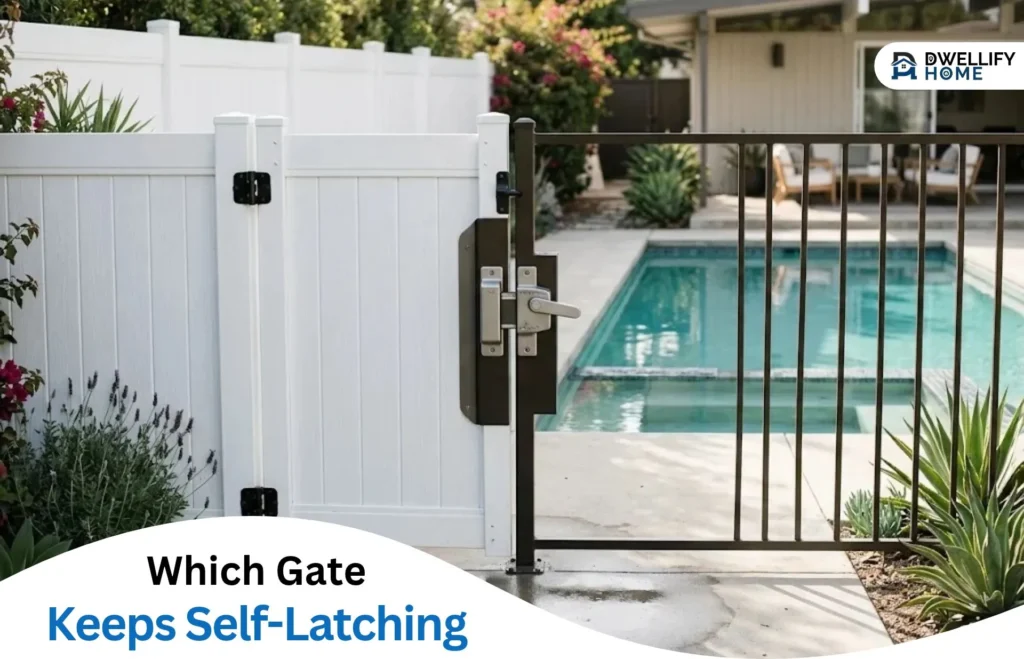
A pool gate self-latches only when every part lines up: square frame, plumb posts, hinges and closer sized for the leaf weight, and a striker that meets the latch cleanly.
PVC’s core profile standard, ASTM F964-13 (2024 update), covers dimensions, weathering, and impact, but it leaves out load-bearing items such as wind resistance and gate hardware. Coated-aluminum systems follow ASTM F2957-13 (reapproved 2025), and that standard also defers hinge and latch choice to the installer. Even the best vinyl or aluminum panel still relies on rated hardware, accurate alignment, and steady tune-ups to click shut every time.
Vinyl vs. aluminum pool fence at a glance
The chart below shows what truly changes, and what doesn’t, when you swap a solid-panel PVC fence built to ASTM F964 for an open-picket aluminum system tested under ASTM F2957.
| Decision factor | Vinyl (PVC) | Aluminum |
| Self-latching reliability | Depends on steel-reinforced posts, a reinforced gate frame, rated self-closing hinges, and a self-latching latch | Same. Depends on plumb posts, a square frame, rated hinges, and a closer |
| Privacy | Full or semiprivate panels block street and neighbor views | Open pickets preserve sight-lines to swimmers |
| Pool visibility | Can hide water unless you add windows or cut-outs | Clear view supports supervision from house or patio |
| Heat & UV | Formulation, TiO₂ content, and light colors slow fade. Confirm ASTM F964 compliance | Architectural powder coat to AAMA 2604 or 2605 resists chalking and color shift |
| Moisture | PVC itself won’t rust, but gate rails usually hide steel or aluminum reinforcement, so inspect joints annually | Non-ferrous alloy avoids red rust. Coastal sites still need stainless or coated fasteners |
| Wind | Solid face transfers more load, so ask for engineering on post size, spacing, and embedment | Open pickets pass most wind. Documentation is still required in high-exposure zones |
| Fire exposure | Combustible. Less vulnerable to embers, but direct flame or radiant heat can deform it, per CAL FIRE home-hardening guidance | Non-combustible. CAL FIRE advises a noncombustible option for the first 8 ft of fencing attached to a house |
Neither column gives an automatic gate winner. Hardware choice, post foundations, and steady tune-ups decide whether the latch clicks shut every time, while material choice shapes privacy, sight-lines, and how the fence handles sun, wind, and wildfire sparks.
The hardware that keeps a vinyl gate self-latching
A vinyl pool gate stays self-latching for the same reason any gate does: the parts that carry and close the leaf are built for the job. Ask for these by name on the quote:
- Steel-reinforced posts. A galvanized steel insert or stiffener inside the hinge post and the latch post, set in concrete, keeps both posts plumb so the gate cannot sag out of line with the latch.
- A reinforced gate frame. Aluminum or steel channel inside the gate rails holds the leaf square, so the striker keeps meeting the latch at the same spot.
- Self-closing hinges with adjustable tension. Spring or hydraulic closers sized for the leaf pull the gate shut from any angle, and the tension can be turned up as the hinges wear in.
- A self-latching pool latch. A gravity or magnetic latch, mounted at the height your code requires, catches the gate on its own every time it swings closed.
With that hardware installed and tuned, a vinyl gate closes and latches as reliably as an aluminum one. The panel material sets the look and the privacy; the posts, hinges, and latch decide the click.
Match the material to the Los Angeles lot
Choose vinyl when
Need maximum privacy. A six-foot solid tongue-and-groove panel can block second-story windows, mute traffic, and hide pool equipment in one move. Light colors reflect heat, and gate rails reinforced with aluminum or galvanized steel keep the latch aligned year after year.
Choose aluminum when
You need an unobstructed view or a yard that slopes enough to lift a solid wall off grade. Slim pickets follow contour changes while keeping the required 2-inch maximum gap below the fence, and the open profile lets you watch swimmers from the kitchen window.
Fire-zone qualifier
CAL FIRE’s home-hardening guidance advises replacing combustible fencing or gates attached to the house with a noncombustible option for the first 8 feet. The same guidance notes that vinyl fences are not as vulnerable to embers, though direct flame and radiant heat can still deform them.
The practical verdict
No fence material delivers a self-latching gate on its own. The safest barrier is the one whose gate closes and locks every trip, stands at least 60 inches high, clears the ground by no more than 2 inches, and matches the plan your inspector stamped.
Need uninterrupted sight-lines, easy slope adjustments, or a non-combustible section where the fence meets the house? Aluminum is the usual choice. Want full privacy, equipment screening, and a solid wall that muffles pump noise? Vinyl takes that round, and with steel-reinforced posts and rated self-closing, self-latching hardware its gate closes just as surely.
Pick the style that meets those goals, then focus on rock-solid posts, rated self-closing hinges, and a latch mounted 60 inches above finished grade. Keep those parts tuned, and the material debate disappears the moment you hear the gate click shut.
We appreciate your interest in our content. Some links in this article may be affiliate or sponsored links, and qualifying purchases through affiliate links may provide Dwellifyhome.com with a small commission.