The best wall safe is the Paragon Lock & Safe 7725 Superior Wall Safe: it fits the standard 14.5-inch gap between wall studs, hides flush behind a picture, and costs about $105–$160 in November 2026 listings. A wall safe is not a vault. It is a steel box that hides your valuables where nobody looks, and its best defense is never being found at all.
Most wall safes fail for the same boring reason: they do not fit the wall. American homes frame walls with studs 16 inches apart on center, which leaves about 14.5 inches between them, and a 2×4 wall is only about 3.5 inches deep inside. Buy a safe deeper than that and it pokes through the other side. This guide gives you five picks that fit real walls, the prices checked on 21 November 2026, and the install steps that keep the safe hidden and held fast.
The 5 best wall safes
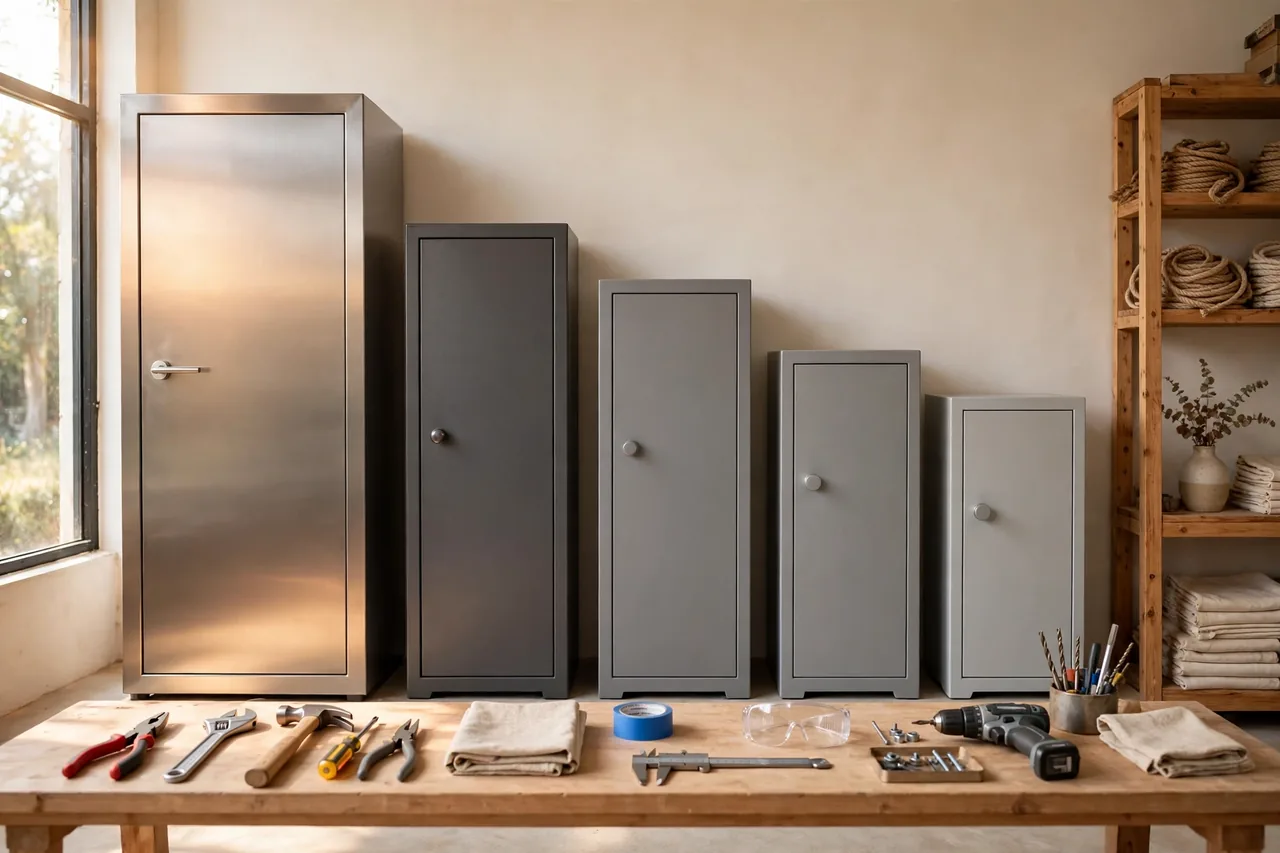
These five cover the real range: the best value, the best fingerprint lock, the best adjustable depth, the best deep option, and the best premium build. Every price below was checked on 21 November 2026 and will change, so treat it as a snapshot.
Quick comparison of the five picks:
| Pick | Best for | Size | Lock | Price checked 21 Nov 2026 |
|---|---|---|---|---|
| Paragon 7725 | Best overall value | 22 × 16 × 4 in | Keypad + key | About $105–$160 |
| Viking VS-52BLX | Best biometric | 19.3 × 14 × 4 in | Fingerprint + keypad + key | $347.97 |
| Mesa MAWS2113E | Best adjustable depth | 22.1 × 15 × 3.25–6 in | Electronic | $251.99 at Zoro |
| SnapSafe 75410 | Best deep in-wall | 14 in tall, recessed door | Electronic + key | $253.89 |
| AMSEC WS1214E5 | Best premium | 12 × 14 in front | Electronic, UL listed | $825 on sale |
Best overall: Paragon Lock & Safe 7725 Superior Wall Safe
The Paragon 7725 is the value pick that Bob Vila names best overall, and it earns that spot by fitting a standard stud bay with no fuss. It has an electronic keypad, two manual override keys, alloy-steel construction, and a flat profile that disappears behind a painting or mirror. Bob Vila lists it as its best overall wall safe, and November 2026 listings put it at about $105–$160, with one buyer guide quoting about $130.90.
| Spec | Detail |
|---|---|
| Exterior | 22 in high × 16 in wide × 4 in deep |
| Capacity | 0.83 cu ft |
| Lock | Electronic keypad + 2 override keys |
| Fits | Standard 16-in on-center studs |
| Price checked Nov 2026 | About $105–$160 in listings |
Owners rate it 4.3 out of 5 across thousands of reviews, and the steady owner point is that it is heavier and sturdier than it looks for the price. Buy it when you want a first wall safe that hides well and costs little.
Best biometric: Viking Security Safe VS-52BLX Hidden Wall Safe
The Viking VS-52BLX is the toughest box on this page. It weighs 39 pounds, has a 5 mm steel door with laser-cut seams, and two motorized 20 mm bolts. It stores fingerprints plus a code and a key, so the whole household can open it without sharing a code. ShopAbunda lists it at $347.97, checked 21 November 2026.
| Spec | Detail |
|---|---|
| Size | 19.3 × 14 × 4 in |
| Weight | 39 lb |
| Door | 5 mm steel, two motorized 20 mm bolts |
| Lock | Fingerprint + keypad + key |
| Price checked 21 Nov 2026 | $347.97 |
Owners rate it 4.6 out of 5 in the SafesGeek roundup, the highest score here, but they also warn that the keypad sticks out about half an inch, so it does not sit fully flush, and some owners find the lock fiddly. Buy it when quick fingerprint access matters more than a perfectly flat front.
Best adjustable depth: Mesa MAWS2113E
The Mesa MAWS2113E solves the one problem every other wall safe ignores: walls are not all the same depth. Its body adjusts from 3.25 to 6 inches deep, so it fits a shallow 2×4 wall and a deeper 2×6 wall. Zoro lists it at $251.99, checked 21 November 2026. It weighs 40 pounds, holds 0.3 to 0.7 cubic feet, and has an electronic lock.
| Spec | Detail |
|---|---|
| Size | 22.1 in high × 15 in wide × 3.25–6 in deep |
| Weight | 40 lb |
| Capacity | 0.3–0.7 cu ft |
| Lock | Electronic |
| Price checked 21 Nov 2026 | $251.99 at Zoro |
Buy it when your wall depth is uncertain, or when you want one safe that can move with you to a different house and still fit.
Best deep in-wall: SnapSafe 75410 In Wall Safe
The SnapSafe 75410 is the pick when a shallow stud-bay box is too small. Its recessed door lets a mirror or picture sit over it, and inside it has five shelves that hold pistols, watches, jewelry, and cash, or come out entirely to hold a rifle upright. Everlasting Safes lists it at $253.89, and the Safe and Vault Store demonstrates its recessed door and document holder in a warehouse walkthrough.
| Spec | Detail |
|---|---|
| Height | 14 in tall |
| Door | Recessed, fits behind a mirror or picture |
| Interior | Five shelves, removable; door document holder |
| Lock | Electronic + key backup |
| Price checked Nov 2026 | $253.89 |
Buy it when you need real room inside the wall and you have a closet wall deep enough to take it.
Best premium: AMSEC WS1214E5 Wall Safe
The AMSEC WS1214E5 is the one wall safe here built like a real safe. It has a half-inch solid steel plate door, three locking bolts, felt-lined shelves, and a UL listed electronic lock. Alpine Safes lists it on sale at $825, down from $900, checked November 2026.
| Spec | Detail |
|---|---|
| Door | Half-inch solid steel plate |
| Bolts | Three locking bolts |
| Lock | UL listed electronic lock |
| Interior | Two felt-lined shelves |
| Price checked Nov 2026 | $825 on sale at Alpine Safes |
Buy it when the contents are worth more than the safe, and you want burglary resistance, not just concealment. Note that even this safe is not a fire safe: almost no wall safe carries a real fire rating, because a 4-inch-deep box has no room for thick insulation.
Will it fit your wall? Measure first
Measure before you buy anything. Studs 16 inches apart leave about 14.5 inches of clear space, and a 2×4 wall is about 3.5 inches deep inside. Every pick above is 4 inches deep or less for exactly that reason. A safe wider than 14.5 inches will not fit between standard studs, and a safe deeper than your wall will poke through the other side.
Check three things. First, find the studs with an electronic finder and mark both edges, then measure the clear gap. Second, check the wall depth: 2×4 framing gives about 3.5 inches, 2×6 gives about 5.5 inches. Third, check what is inside the wall. Use a stud finder with AC detection, then a small probe hole or inspection camera to confirm there are no wires, pipes, or ducts in that bay. If the studs are 24 inches apart, only a few safes ship with a spacer kit, so check the listing before you order.
Never cut into a load-bearing wall without advice, and never cut where you have not checked for utilities. A drywall saw set a little deeper than the drywall thickness is the right tool; a deep blade is how wires get cut.
How to install a wall safe between studs
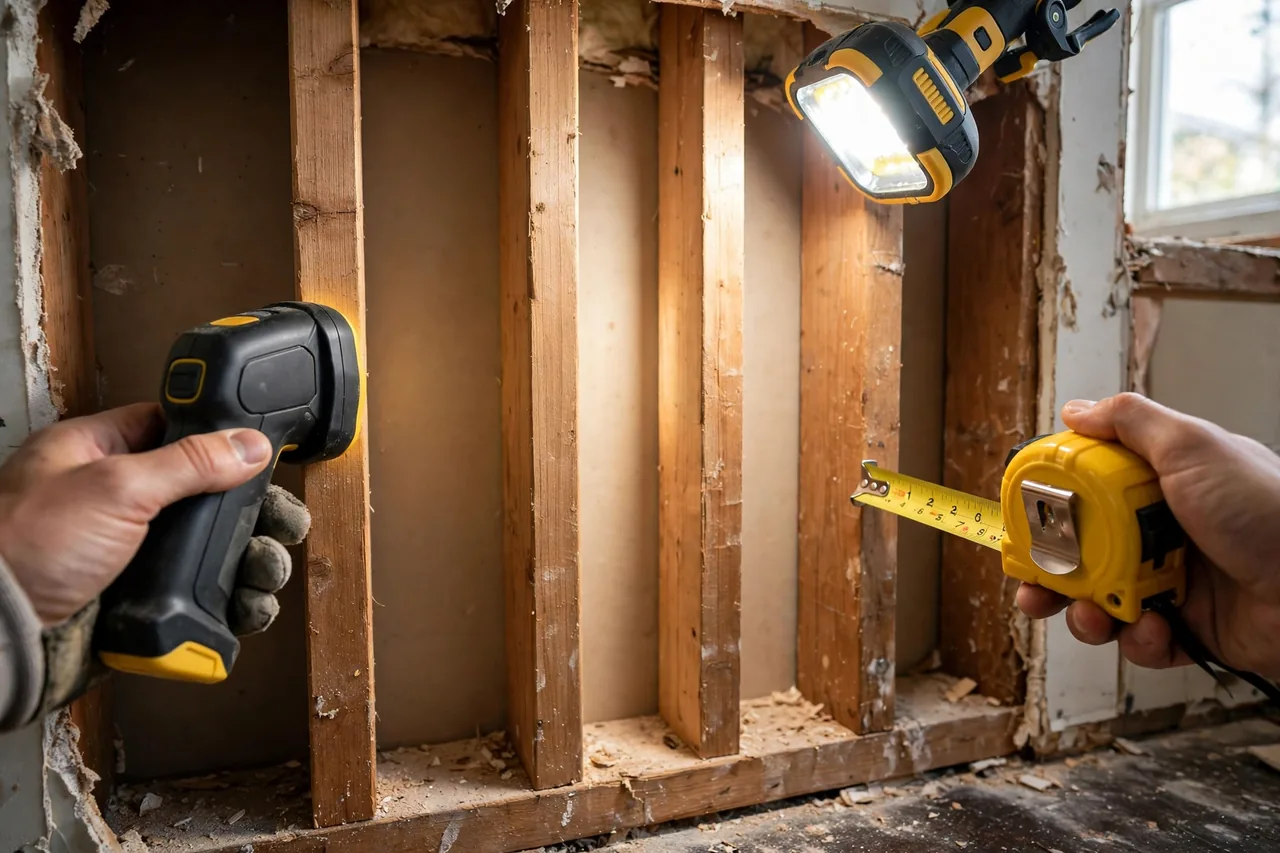
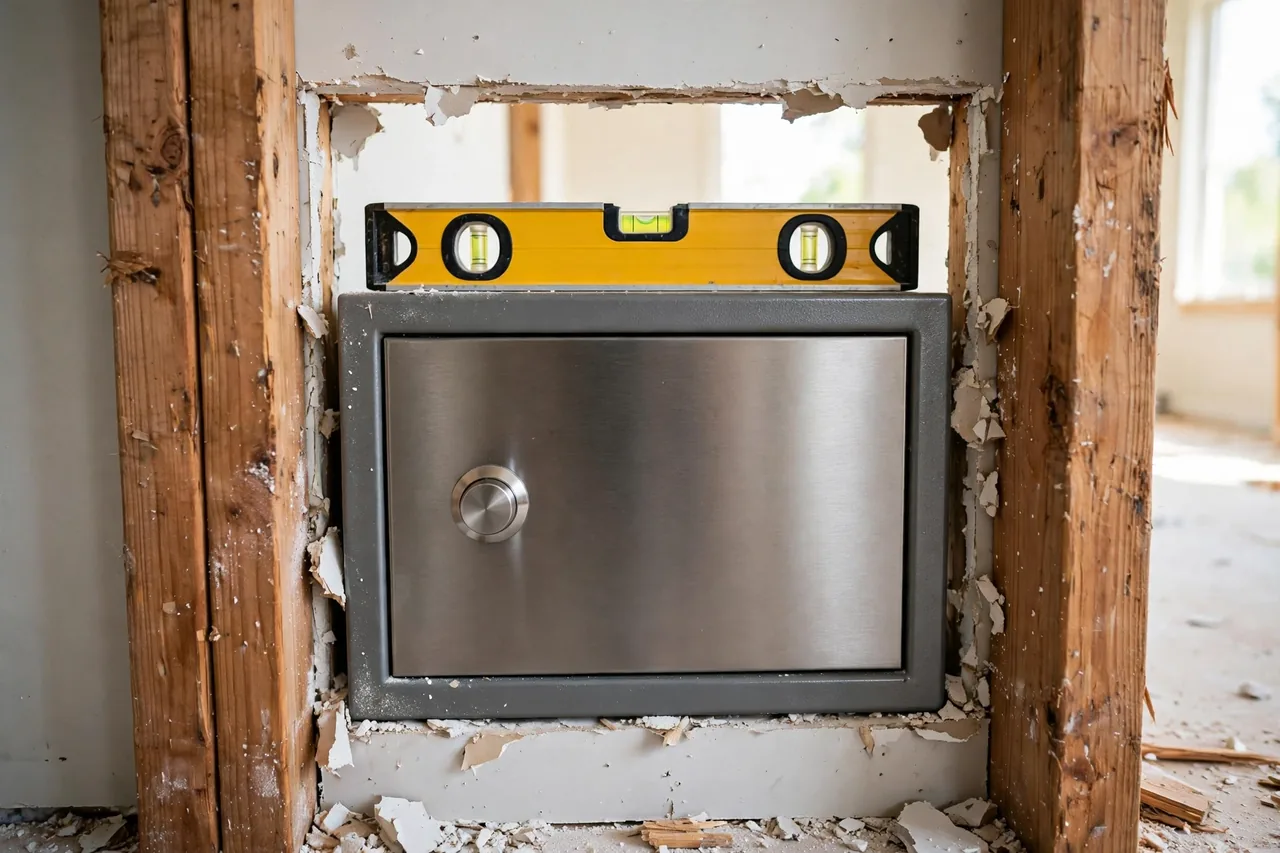
Install in this order, and do not skip the checks. First, pick the bay and check it for wires, pipes, and ducts. Second, mark the opening to the exact size the maker gives, and cut the drywall with a keyhole saw or oscillating tool. Third, set the safe in the opening and check it with a level. Fourth, pre-drill each stud and drive lag screws through the safe’s side holes into the studs, and do not over-tighten. Fifth, test the lock three times before you cover the safe, then hang the picture or mirror.
Cut power to that circuit before you cut, wear safety glasses, and keep a vacuum handy, because drywall dust gets everywhere. If the safe is heavy, get a second pair of hands: a 40-pound steel box at chest height in a wall opening is awkward alone. If the wall is concrete or block, use masonry anchors into solid concrete, and expect a much harder job.
Wall safe vs. floor safe: which hides better?
A wall safe and a floor safe hide in opposite ways. A wall safe hides in plain sight, behind a picture on a wall anyone can see, and its defense is that nobody thinks to look behind the picture. A floor safe hides under the floor itself, under a rug or a piece of furniture, and its defense is that nobody knows the floor opens. The floor safe is harder to carry away, because it sits in concrete, but it is also harder to reach, harder to install, and useless in a flood-prone room.
Choose the wall safe when you reach the contents often, when the items are flat, and when you rent or cannot cut a floor slab. Choose the floor safe when the items are small, rarely needed, and very valuable, and when you own the home and can cut concrete. Many owners use both: a wall safe for passports and daily jewelry, and a floor safe for cash reserves and heirlooms. The two together cost less than one large premium safe, and a burglar who finds one rarely finds the other.
One more difference matters: a floor safe in concrete resists fire better than any wall safe, because the concrete itself insulates it. A wall safe has only thin steel between your papers and the flames. If fire protection is the job, the floor safe wins; if quick access is the job, the wall safe wins.
How well does a wall safe hide?
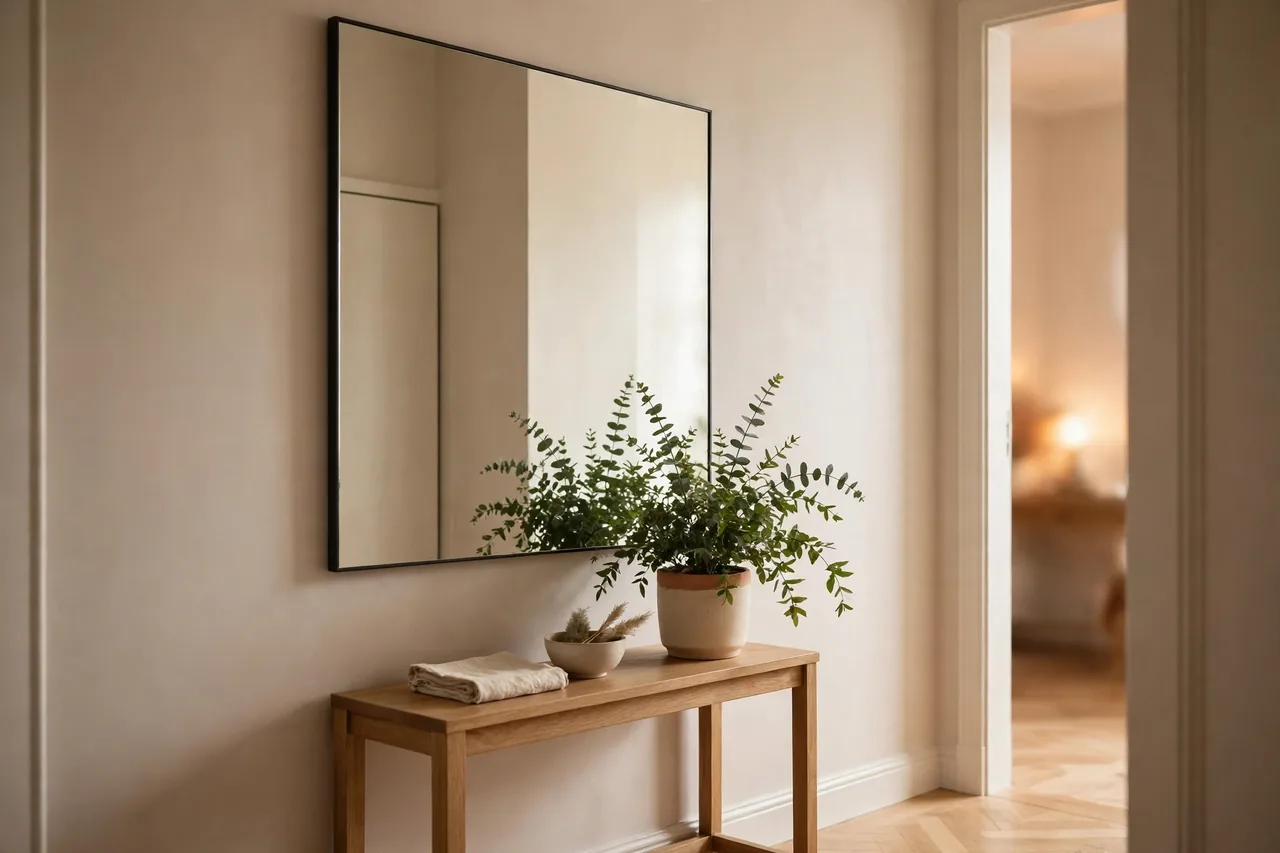
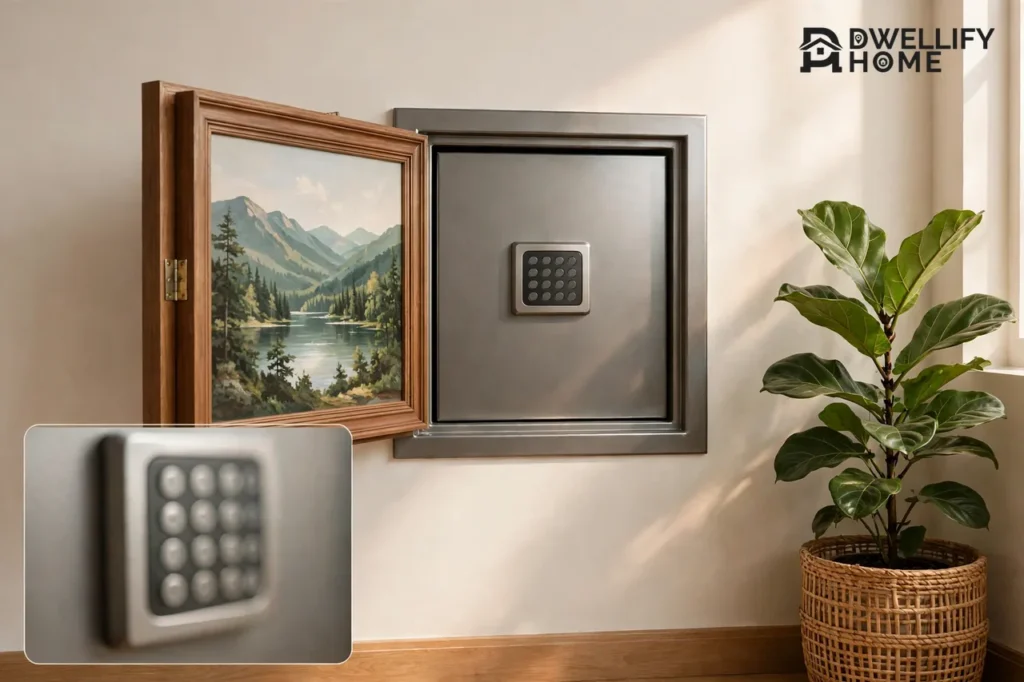
A wall safe’s best defense is a burglar never finding it. The smaller the front, the easier a picture, mirror, or row of clothes covers it. A white or black front blends with the wall or the frame you hang over it, and a flush fit hides best of all.
Choose the spot with care. Burglars check behind pictures first and go through the bedroom, closets, and dressers fast. A pantry, a garage wall, or the back of a kitchen cabinet behind a false panel gets searched less. Do not put the safe behind the one big painting in the master bedroom, because that is the first place anyone looks.
Add an alarm or a camera as well. No safe is unbreakable, so the goal is delay, and most burglars are in and out fast. A home security camera system that watches the hallway approach gives you a face on record, which a hidden safe alone never will.
Is a wall safe strong? The honest answer
A wall safe is a steel box held by a few screws in wooden studs. It is not a vault. A thief who finds it can pry it out and open it later, often through its thin back. Its real protection is concealment, not strength. Real burglary protection is a lab rating, UL’s RSC or the tougher TL-15, and none of the budget picks here has one. The word “burglary resistant” in a listing is the seller’s word, not a test.
That does not make wall safes useless. Most burglaries are fast, under ten minutes, and a thief scanning a room grabs what is visible rather than hunting for a hidden safe. Concealment alone cuts your risk a lot. But if you store irreplaceable items, pair the wall safe with a heavy floor-bolted safe or a bank box, and never store the only copy of anything in a wall safe.
Fire protection: what wall safes cannot do
Almost no wall safe is fireproof, and the reason is physics. A 4-inch-deep box has no room for the thick insulation layers that a floor safe uses, so heat passes through thin steel fast. Several wall safes are sold as “fireproof” but name no lab, no time, and no temperature, which means the claim is untested.
The AMSEC WFS149 is one of the few wall safes with a real 1-hour fire rating, but it needs a deep wall. For a standard wall, the practical fix is a small fire-rated pouch inside the safe for papers and photos. It is a workaround, but it works, and it costs far less than rebuilding a wall.
Related Guides
Wall safes work best as one layer of a home security plan: the best home security camera system for watching entries, glass break alarms for the windows near the safe, and cellular home security systems that keep working when the power or internet fails.
Frequently asked questions
How deep is a wall safe?
Most between-stud safes are 3 to 4 inches deep, to fit inside a standard 2×4 wall. Deeper models like the Mesa MAWS2113E adjust to 6 inches, but they need a 2×6 wall or a bump-out.
Are wall safes safe from burglars?
They protect by hiding, not by strength. A wall safe is a steel box screwed to wooden studs, so its best defense is a burglar never finding it. Bolt it in well all the same, because an unanchored safe is just a box a thief carries off to open later.
Can I install a wall safe myself?
Yes, if the bay is clear of wires and pipes and you can use a stud finder, a drywall saw, a level, and a drill. Cut power to the circuit first, check the bay with a probe, and get help lifting a safe over 30 pounds.
Do wall safes need a fire rating?
Most do not have one, and for documents that matters. If fire protection is your main goal, choose a fire-rated floor safe instead, or keep papers in a fire-rated pouch inside the wall safe.
What should I store in a wall safe?
Store flat valuables: cash, passports, jewelry, documents, USB drives, and small firearms. Do not store bulky items, because the 4-inch depth will disappoint you, and do not store the only copy of anything irreplaceable.
💡 Practical Home Tip: Before you cut, tape a paper template the exact size of the safe to the wall and live with it for a day. Check the picture that will cover it, the light at night, and whether the door swings clear — moving a paper template is free, moving a cut hole is not.
Start with the Paragon 7725 if you want the best value, or the Viking VS-52BLX if you want fingerprint access. Either way, measure the stud bay first, check for wires, and bolt the safe to both studs — a wall safe that fits right and hides well is the one a burglar walks past.