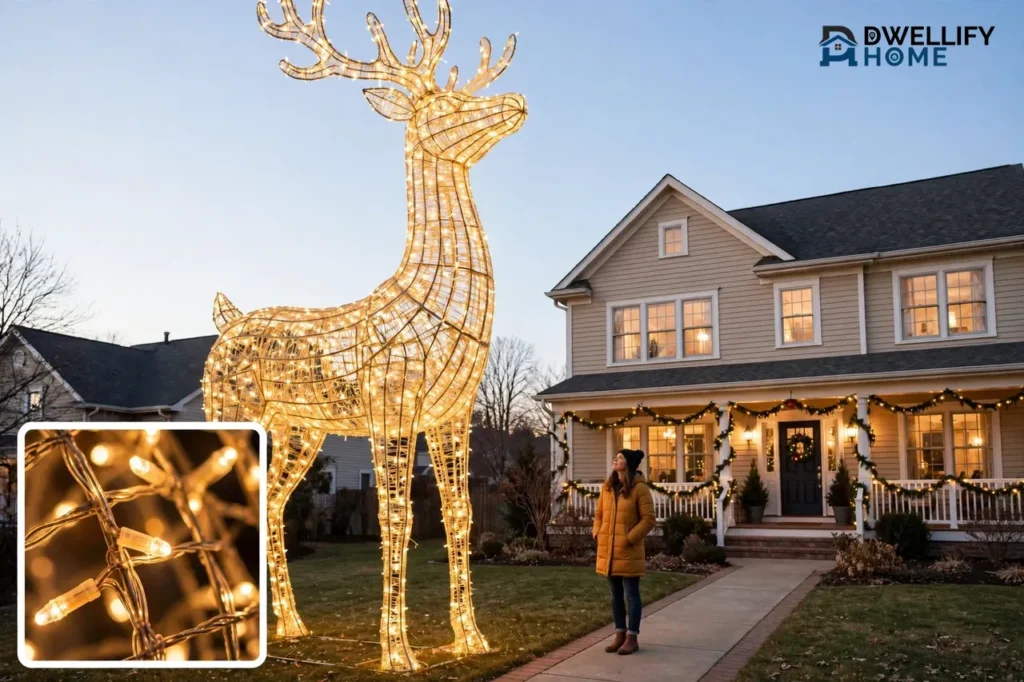
Large Christmas decorations work best when you pick one bold focal point, size it to your house and yard, and anchor it well. A single big piece that people can see clearly from the street beats a yard full of small figures that vanish into the lawn. In this guide, you will learn how to judge scale from the street, match a piece to your home, anchor it for wind, light it for night, and store it with ease in January.
That is the whole plan, and it starts before you shop. Big Christmas decorations, also called big Xmas decorations by many shoppers, earn their place by doing one job well: they give the eye a clear place to land. When you get the size right, your whole display looks planned, even if you own only a few pieces. When you get it wrong, even costly pieces look lost or crowded. So slow down, measure once, and let scale lead every choice that follows.
💡 Practical Home Tip: Before you buy anything, stand across the street at dusk and take a photo of your house. The first thing your eye lands on is your real focal point, planned or not. Put your large piece there, or clear that spot first, and the rest of your display will fall into place.
What Counts as a Large Christmas Decoration?
A large Christmas decoration is any piece big enough to read clearly from the street, not just from your front walk. For ornaments, that usually means well over the size of a normal tree ornament. One well-known ornament guide notes that big ornaments typically measure over 4 inches across or longer than 6 inches, and some reach 22 inches or more, with the biggest sizes made for lawns and large displays. For yard pieces, think in feet, not inches: tall lighted figures, giant wreaths, oversized bows, and inflatables that stand as tall as a person or taller.
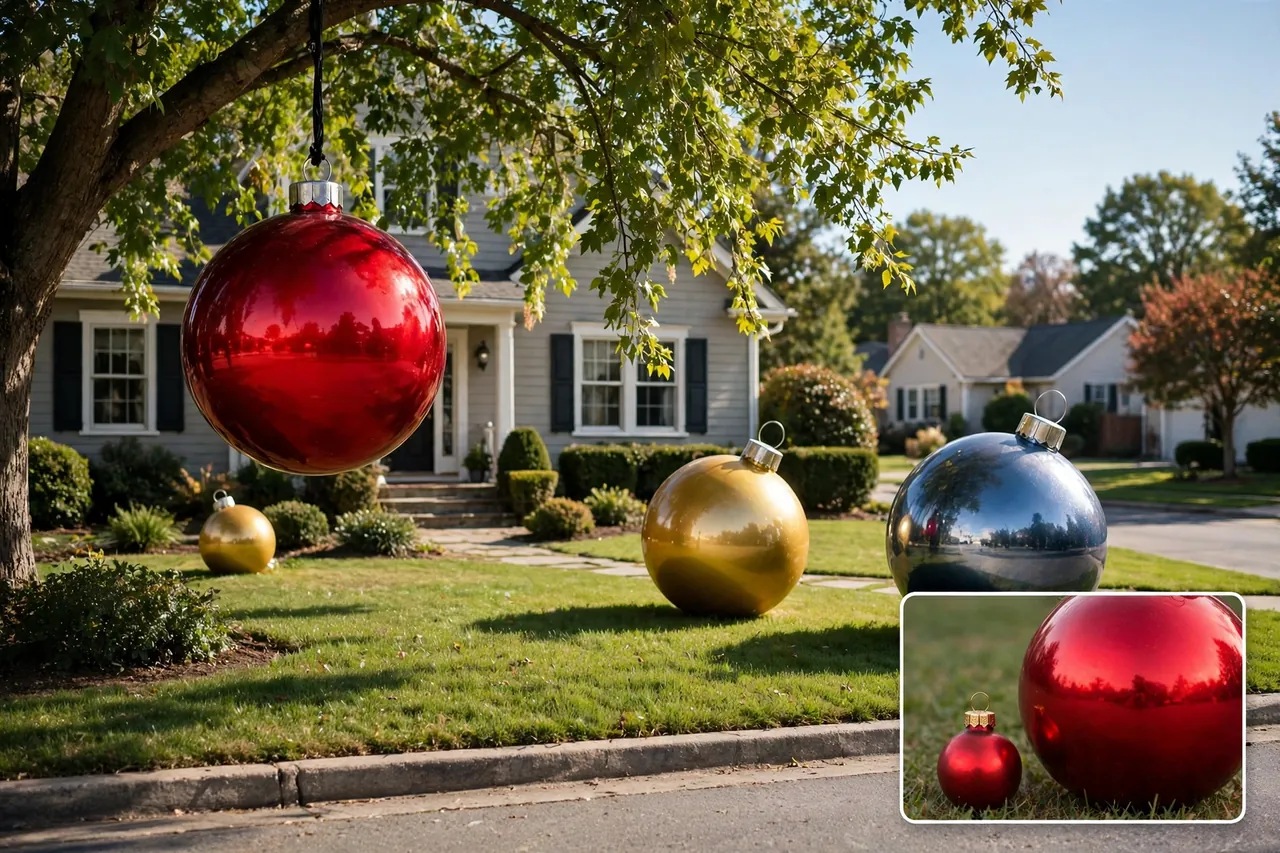
Size alone does not make a piece large in effect, though. A 24-inch ornament hung on a huge oak can still disappear, while the same ornament on a small porch tree can steal the show. What matters is the relationship between the piece, the house behind it, and the distance of the viewer. A piece counts as large when it holds its shape and color from the farthest place people will see it, which is usually the street or the sidewalk across the road.
The Street Test: Judge Scale Before You Spend a Dollar
Most scale mistakes happen in the store, where everything looks big under bright lights and close walls. Your yard is not a store. So test every idea at home, at the real viewing distance, before you pay for it. The street test takes ten minutes, and it saves more returns than any sale ever will.
First, walk to the street, or across the street if you can do so safely, and look at your house the way a neighbor sees it. Notice the brightest spot, the darkest spot, and the first thing your eye lands on. That first thing is your focal point. If it is a bare wall or a dark corner, you now know where your large piece belongs. If it is already a big tree or a wide lawn, you have a natural stage, and your job is to frame it, not fight it.
Next, mark the spot with something you already own. Set a chair, a ladder laid flat, or a cardboard box cut to the height of the piece you want, right where the decoration would stand. Step back to the street and look again. Does the marker read clearly, or does it vanish against the house? Does it block the front door, the walkway, or a window you love? A marker test answers all three questions for free, and it works for a tall inflatable, a wide wreath, or a group of giant ornaments alike.
Finally, check the view twice: once in daylight and once at dusk with your porch light on. Large Christmas decor must work in both lights. A dark figure that glows beautifully at night can look like a shapeless lump by day, while a bright, glossy piece can glare at night if its lights fight the house. If a piece passes both checks, it earns its place. If it passes only one, keep shopping.
Match the Piece to Your House and Yard
Your house sets the scale, so start there. A tall two-story home with a wide front can carry a tall figure or a wide wreath without breaking a sweat. A small cottage or a narrow townhouse needs a smaller hero piece, placed close to the door where guests meet it up close. The goal is balance, not size for its own sake. A massive home with tiny decorations feels empty, and a small yard stuffed with a giant figure feels crowded.
Your yard depth matters just as much as your house height. A home set far back from the street needs larger pieces, because distance shrinks everything. A home close to the sidewalk can use a medium piece, because viewers stand near it. Think of it this way: the farther back your house sits, the bigger your focal point must be, and the simpler the rest of the display should stay.
Use the planning table below as a starting guide, not a strict rule. Every home differs, so run the street test on your own house before you treat any row as final. The table gives you a sensible place to start, and your own eyes give you the final answer.
Table: A simple scale starting guide for large Christmas decorations
| Your setting | Good focal point size | What to avoid |
|---|---|---|
| Small yard, house near the street | One medium piece near the walkway, or one oversized wreath or bow on the wall | A tall inflatable that blocks the door or the path |
| Average yard, one-story home | One tall figure or one large ornament group, placed off-center near the entry | Many small figures scattered across the lawn |
| Large yard, two-story home | One tall hero piece, plus medium pieces that lead the eye toward the door | One small piece alone in a wide, empty lawn |
| Home set far back from the street | Larger, taller, and brighter pieces, grouped at different heights | Small, dark pieces that vanish by the road |
Placement shapes scale, too. A piece set off to one side of the entry usually reads better than one dead center, because it frames the door instead of blocking it. A piece tucked against the house hides, while the same piece set a few feet out into the lawn breathes and shows its full shape. Leave empty lawn around your hero piece. Empty space is not a flaw. It is the quiet frame that lets your best piece shine.
Color plays a part in scale, too. A bold red, gold, or warm white piece reads farther than a dark green or navy piece of the same size, especially at dusk. Keep your palette tight: two or three colors plus green, so a large display looks designed instead of loud.
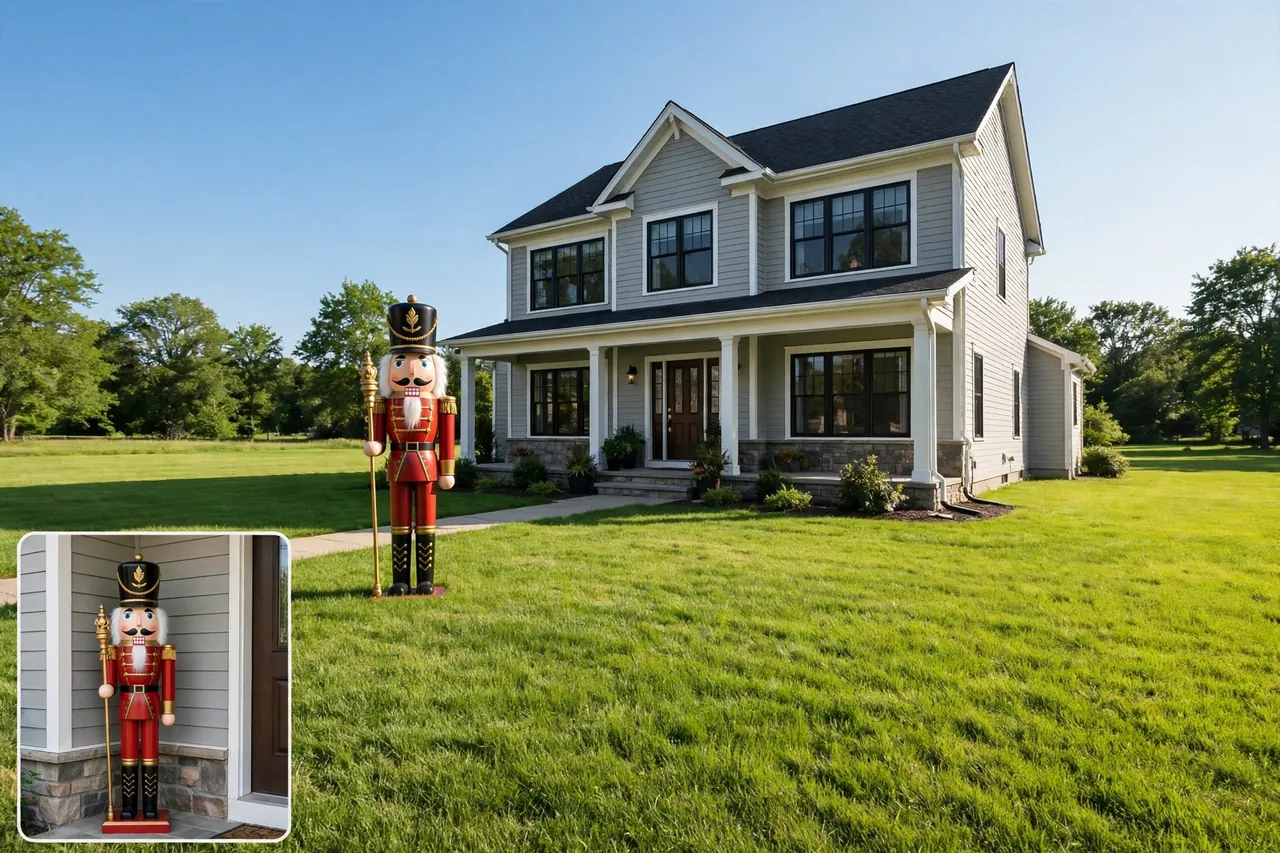
Pick One Hero, Then Let Smaller Pieces Support It
Every great large-scale display has one hero. The hero is the piece people remember and describe to friends: the tall lighted tree in the planter, the giant wreath on the garage wall, the big ornament cluster in the front tree. Everything else in the yard should help people find the hero, not compete with it. That single rule keeps a big display calm instead of chaotic.
Choose your hero by your best spot, not by the store display. Walk your yard at dusk, find the spot your eye lands on first, and ask what belongs there. A wide wall wants a wide wreath or a big bow. A wide lawn wants a tall figure or a lit tree. A big front tree wants oversized ornaments hung high enough to read from the road. When the spot and the piece agree, the display feels easy, almost obvious.
Then add support in layers. Medium pieces can line the walkway or flank the door, and small details belong near the entry, where guests see them up close. This layering builds depth: large shapes far away, medium shapes in the middle, small touches near the door. A display with depth feels rich, while a flat row of same-size pieces feels like a lineup. For the whole-yard version of this plan, with roofline, yard, and path layers working together, see our guide to Christmas decor exterior ideas.
Compare the Big-Piece Types Before You Choose
Large Christmas decorations come in a few main families, and each one behaves differently in wind, daylight, and storage. Pick the family that fits your yard, your weather, and your patience, not just the one that looks best in a photo. The comparison below keeps the choice honest.
Table: Large-piece types at a glance
| Piece type | Best for | Watch out for |
|---|---|---|
| Inflatables | Playful scenes, fast setup, big impact on a budget | Wind catch, needs power all night, needs deflating in storms |
| Lighted frames and figures | Crisp shapes at night, slim storage, windy yards | Thin frames can tip unless you stake them well |
| Giant ornaments and baubles | Trees, porches, and walls; strong color by day and night | Needs strong hanging hardware and outdoor-safe build |
| Oversized wreaths and bows | Walls, garage doors, and entries with no ground space | Heavy pieces need wall-safe anchors, not a single nail |
| Large lit trees and planters | Entries and small yards that need one tall anchor | Needs a weighted base so wind cannot tip it |
Inflatables win on fun and speed, but they act like sails in wind, so they need the strongest anchoring here. Lighted frames win on nighttime shape and fold flat for storage. Giant ornaments win on daytime color, wreaths and bows win where ground space runs out, and a large lit tree in a weighted planter wins on small lots.
Before you buy, check three things: an outdoor-safe label, weather-resistant materials such as sturdy plastic, metal, or sealed fabric, and the weight of the piece. Weight tells you how much anchoring to plan, because a light, broad piece catches more wind than a heavy, slim one.
Anchor a Big Piece So Wind Cannot Move It
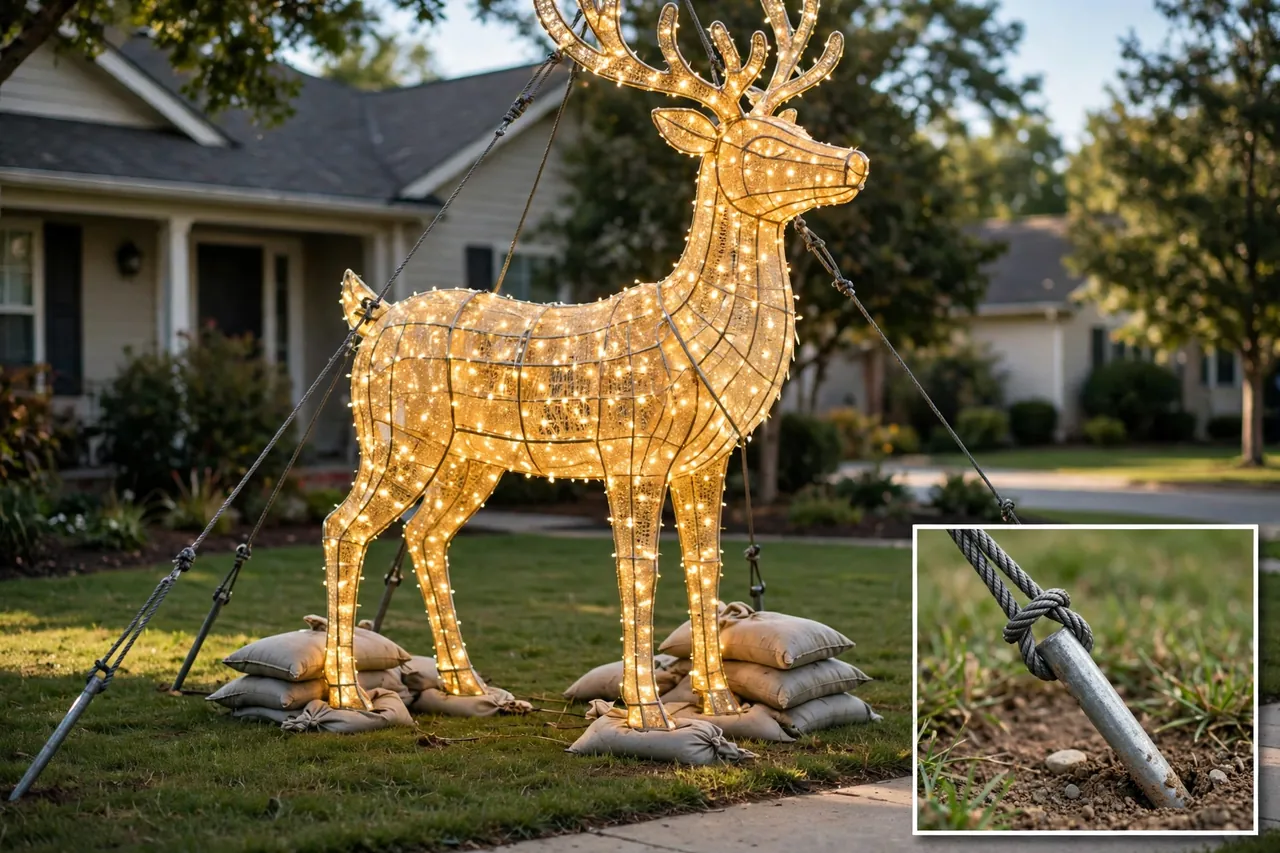
Wind is the quiet enemy of every large display. A big piece catches more wind than a small one, so it needs more holding power, not just a hope and a single stake. Anchor every large piece before the first storm, not after it. A decoration that blows into the street is not just lost. It can hurt a neighbor, hit a car, or tangle in power lines, so treat anchoring as safety work, not cleanup work.
Start with the maker’s own anchor points. Use every loop, grommet, and tie-down the piece provides, because the maker placed them where the stress falls. If your piece came with light plastic stakes, upgrade them. Heavy-duty metal tent stakes, driven at an angle away from the piece, hold far better in soil, and sandbags or weighted bases add holding power where stakes cannot grip, such as on a patio or a frozen lawn. For tall or broad pieces, add guy lines from more than one point, so gusts spread their force across several anchors instead of yanking one.
Place big pieces with wind in mind, too. A fence, a shrub row, or the side of your house shelters a tall piece, while an open corner takes the full gust. Leave airflow behind an inflatable or flat figure, so pressure cannot build up behind it. When a high-wind warning arrives, deflate inflatables or bring the most exposed pieces inside for the night.
Anchor a Large Outdoor Piece, Step by Step
- Pick a sheltered spot. Set the piece near a windbreak, clear of walkways, driveways, and overhead lines, and mark where each anchor will go.
- Use every anchor point. Connect each loop or grommet to its own stake, weight, or tie-down. Never rely on a single stake for a large piece.
- Drive stakes at an angle. Angle metal stakes away from the piece, deep into firm soil, and pull each line snug without bending the frame.
- Add weight where stakes cannot grip. Set sandbags or weighted bases at the base on patios, frozen ground, or hard surfaces, and hide them behind greenery if you like.
- Add guy lines for tall pieces. Run lines from upper points to stakes on more than one side, so wind from any direction meets resistance.
- Test it by hand. Push the piece firmly from several sides. If it rocks, leans, or slides, add another anchor before you call it done.
- Recheck after the first storm. Walk the display after the first windy night, tighten loose lines, and replace any bent stake at once.
For a deeper anchoring walkthrough from a display maker, including rebar, rope, and base-plate methods for heavy figures, see Christmas Night Inc.’s guide to anchoring outdoor Christmas decorations. Use its methods alongside your own piece’s instructions, and follow the stricter of the two wherever they differ.
Power and Light for a Display That Reads at Night
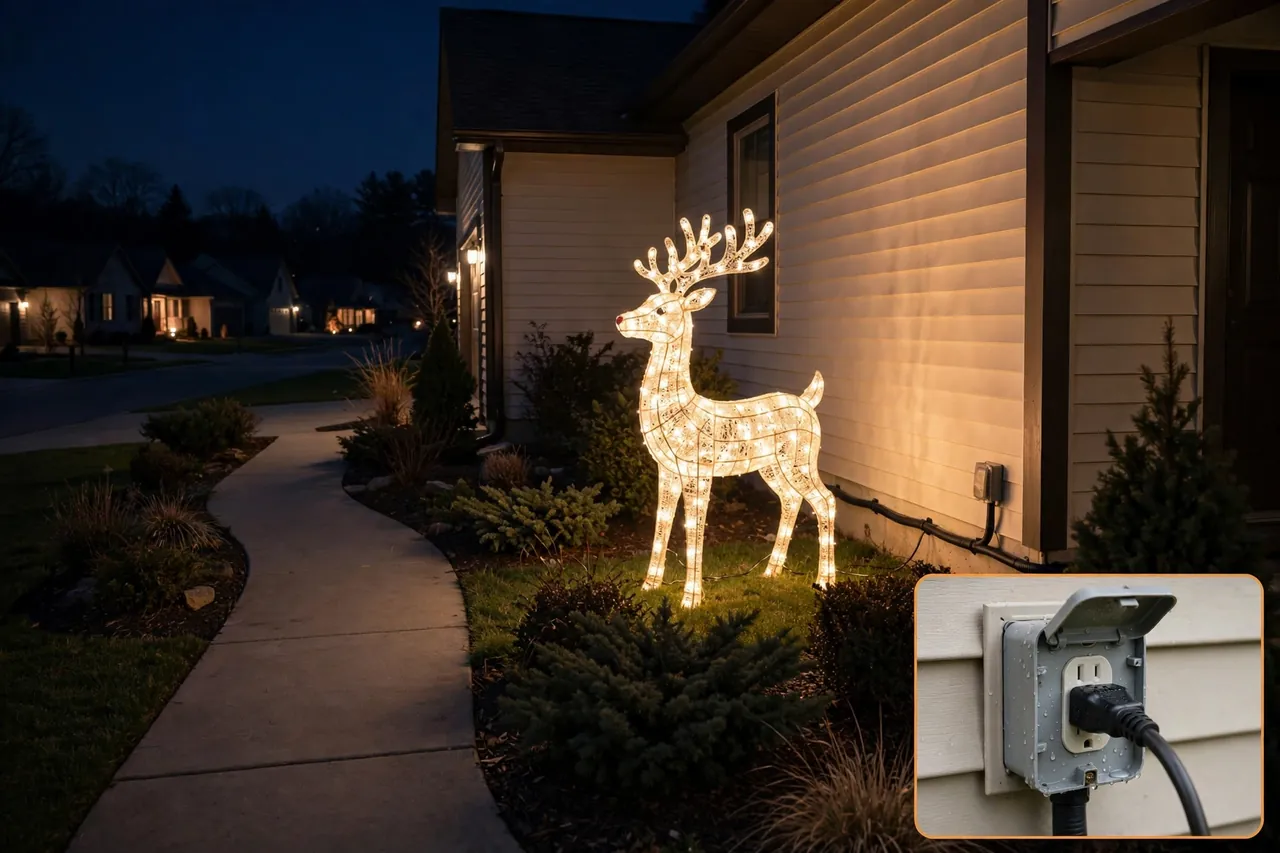
A large piece earns half its praise after dark, so plan its power before you place it. Map your outdoor outlets first, then place pieces where cords can reach without crossing a walkway, a driveway, or a path guests use at night. A cord across a path is a trip hazard in daylight and a real danger after dark, so reroute cords along walls, under cord covers, or through beds, never loose across the ground people walk on.
Use only lights, cords, and decorations rated for outdoor use, and plug them into a ground-fault circuit interrupter, or GFCI, protected outlet. The U.S. Consumer Product Safety Commission advises exactly this: use only lights tested by a recognized lab such as UL or ETL, check every set for cracked sockets, frayed wires, or loose connections, throw damaged sets away, and plug outdoor lights into a GFCI-protected receptacle. Keep connections off the ground, under weatherproof covers, and out of puddles, and turn lights off when you go to bed or leave the house. For the full checklist, see the CPSC holiday decorating safety guidance.
Read the maker’s label for how many light strings you may connect end to end, and split the load across outlets when a display grows large. A timer helps twice over: it switches the display on at dusk, when people actually see it, and off when the house goes quiet. If a GFCI trips again and again, do not bypass it. Unplug sections one at a time until you find the damaged strand or wet connection, and replace it.
Light the piece itself, not just the yard around it. A tall figure with no light on it becomes a dark silhouette, while a modest figure with warm light on it reads clearly from the road. Keep bulb color consistent across the display: one color, used everywhere, makes a large display look designed.
Ladder Safety for High, Large Pieces
Large pieces often hang high: a giant wreath on a wall, big ornaments in a tall tree, or a bow over a garage door. Treat every high hang as ladder work, and never rush it. Set the ladder on firm, level ground, keep your body centered between the rails, and never stand on the top two rungs. Work with a helper who holds the ladder and hands you pieces, hang lights and large pieces in daylight, and keep the ladder far from overhead power lines. If a piece needs a height or a reach that feels unsafe, hire help or pick a lower spot. No decoration is worth a fall.
Small Yard? Go Tall, Not Wide
A small yard can absolutely carry large Christmas decorations, as long as you go tall instead of wide. Walls, trees, porch posts, and the entry wall give you height without eating floor space. A big wreath on the wall, a tall slim tree in a weighted planter, or giant ornaments hung in a front tree all give you scale without crowding the ground.
On a small lot, pick one hero and stop, and keep the path clear all season. For porch-scale ideas that pair with a large hero piece, see our guide to Christmas decor on porch, which layers wreath, greenery, and light without crowding the entry.
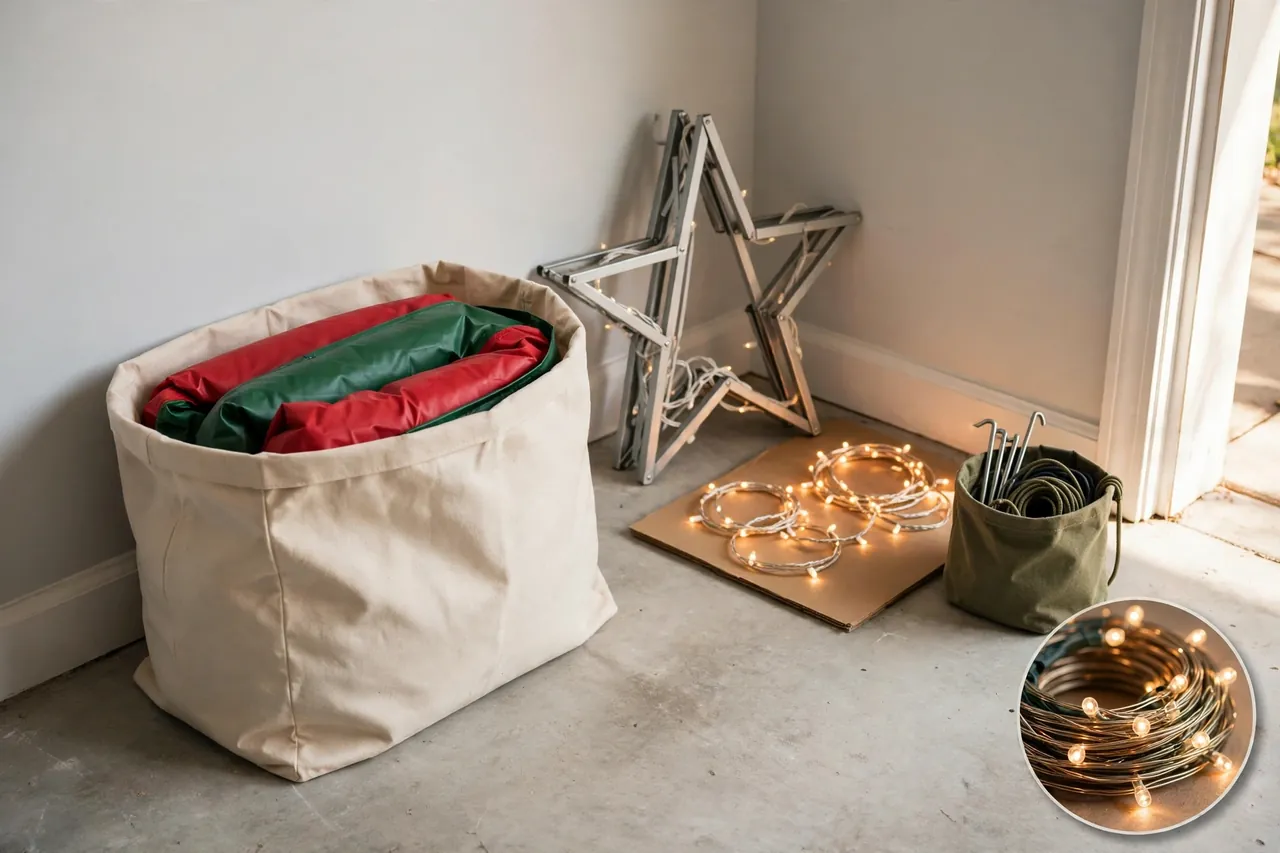
Store Big Pieces So Next December Starts Easy
Large pieces punish careless storage more than small ones do, because they bend, crush, and tangle at a bigger scale. So store them with the same care you used to place them. Deflate inflatables fully, dry them before you fold them, and fold along their seams instead of stuffing them into a bag. Coil light strings loosely around cardboard so they do not tangle, and keep stakes, guy lines, and remotes in one labeled pouch with the piece they belong to.
Measure your storage space before you buy a very large piece, not after. A tall figure that needs a full corner all year must have a home waiting for it in January. If space runs tight, favor pieces that deflate, fold flat, or break into sections. For tree-scale storage lessons that apply to any large piece, see our guide to Christmas tree storage bags.
Label everything. Write the piece name, its spot in the yard, and its anchor kit on the outside of its bag or box, and snap a photo of the display before you take it down. Next December, that photo and label turn a day of guessing into an hour of placing. Store pieces cool, dry, and off concrete floors, with nothing heavy stacked on top.
Troubleshooting: When a Large Display Goes Wrong
Every large display runs into one of these problems sooner or later. None of them needs a new purchase, just a small fix, so run through this table before you buy a replacement.
Table: Common large-display problems and quick fixes
| Problem | Likely cause | Quick fix |
|---|---|---|
| Piece vanishes from the street | Too small for the distance, or too dark against the house | Move it closer to the road, add warm light, or size up one step |
| Piece leans or rocks in wind | Too few anchors, or stakes too light for the piece | Add metal stakes at an angle, add guy lines, add weight at the base |
| Inflatable sags or flops | Blocked fan, loose tether, or low power | Clear the fan intake, tighten tethers, check the outlet and cord |
| Half the lights go out | Loose bulb, damaged strand, or overloaded circuit | Check bulbs first, replace damaged strands, split the load |
| GFCI keeps tripping | Wet connection or damaged cord | Dry and cover connections, replace the damaged set, never bypass the GFCI |
| Display looks cluttered | Too many heroes, or colors fighting each other | Remove one large piece, tighten the palette to two or three colors |
| Piece looks dull by day | Flat finish, weak shape, or faded fabric | Pick glossier, bolder pieces, and store them dry so color lasts |
Quick Reference: The Large-Scale Checklist
Run this checklist once, before you shop and once more before the first storm. It takes five minutes, and it catches nearly every scale mistake.
- Street test done? You viewed the house from the street, in daylight and at dusk, and marked the hero spot.
- One hero chosen? One piece leads, and every other piece supports it.
- Path and door clear? No piece, cord, or guy line blocks walking, driving, or the door swing.
- Anchors complete? Every anchor point connects to a stake, weight, or tie-down, and the piece passes the push test.
- Power safe? Outdoor-rated gear only, GFCI outlet, connections covered and off the ground, load split sensibly.
- Daytime shape clear? The piece reads as a clear shape from the street without its lights.
- Storage planned? The piece has a dry, labeled home waiting for it in January.
A Note on Safety Before You Hang Anything Big
Large decorations bring real weight, height, wind load, and electricity together, so treat safety as part of the design. Use outdoor-rated gear only, plug into GFCI-protected outlets, keep cords out of walkways, and never work on a ladder near overhead power lines or in high wind. Check every piece after the first storm, and bring light or exposed pieces inside when a severe wind warning arrives. If a hang needs a height, a weight, or a wiring change beyond your comfort, ask a capable helper or a professional. This guide gives general planning help, not a substitute for your piece’s own instructions or local rules, so follow the stricter guidance wherever they differ.
Related Guides
Christmas Decor Exterior Ideas for a Glowing Yard · Christmas Decor on Porch: 7 Layers for a Warm Welcome · Indoor Christmas Decorations: Room-by-Room Ideas · Christmas Tree Storage Bags: Pack & Protect Your Tree
Frequently Asked Questions
What Is Considered a Large Ornament?
Large ornaments run bigger than traditional tree decorations, measuring around 4 inches to over a foot across, though no single benchmark fits every style. For outdoor use, think bigger still: pieces of 18 inches or more read clearly from a distance, while smaller large ornaments suit trees, wreaths, and garlands up close.
Where Do You Put Large Ornaments?
Put large ornaments where their size earns attention: on a Christmas tree, wreath, or garland, in a bowl or vase as a centerpiece, or outside on a porch, patio, or in the yard. Outdoors, hang them high enough to read from the street, use strong hardware, and keep them clear of walkways.
Are oversized baubles suitable for outdoor use?
Many oversized baubles suit outdoor use when you pick outdoor-safe builds. Look for UV-resistant materials that resist fading, waterproof ratings, secure hanging hardware, and weighted bases for freestanding pieces. Skip indoor-only glass or thin plastic outside, because rain, wind, and cold will break or fade them fast.
How Do You Make Your Own Large Christmas Ornaments?
Start with large plastic or foam balls, paint them in your chosen colors with acrylic paint, and add sparkle with glitter or sequins once dry. Attach a ribbon or strong cord at the top for hanging, seal caps against water if they will hang outside, and test the weight on your branch or hook before you hang a full set.
What sizes are available?
Large outdoor pieces span a wide range, so shop by your yard, not by a single number. Guides and listings show oversized bows around 24 to 48 inches long, inflatable ornaments around 24 inches across, and lighted figures around 48 to 71 inches tall. Measure your spot, run the street test, and pick the size that reads clearly from the road.
Large Christmas decorations reward one good decision more than a dozen small ones: pick a hero your house can carry, anchor it like a storm is coming, and light it so the street can enjoy it. Do that, and your display will look planned by day, glow at night, and come back next year in fine shape. Start with the street test this weekend, and let your house tell you how big to go.