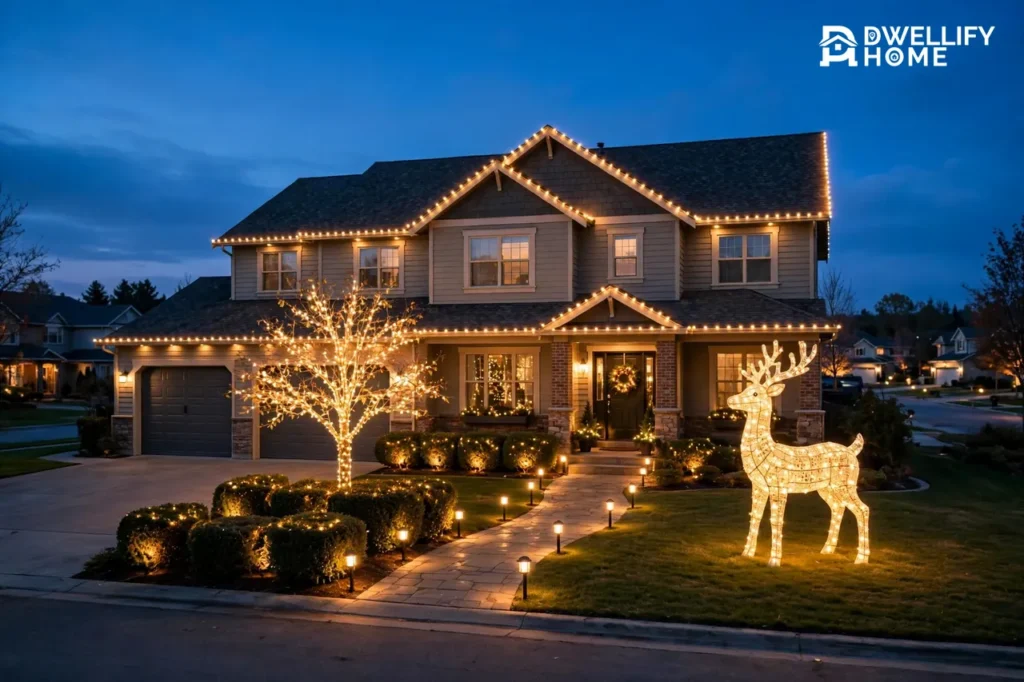
The best christmas decor exterior ideas are not a bigger pile of decorations. They are a simple plan: pick one theme, choose one big focal point, and light your home in three layers — the roofline, the yard at eye level, and the ground beneath it. When those three layers work together, your whole outside reads as one finished display from the street, even if you only own a few strands of lights and one good yard piece.
This guide walks you through that plan for the entire outside of your home: the yard, the facade, the roofline, the pathways, and the front door. You will learn where to spend your effort first, which looks hold up in wind and rain, and how to hang everything safely. Porch and door details get their own guides, so here we stay at the whole-outside level, where the big decisions live.
💡 Practical Home Tip: Before you buy one more box of lights, walk to the street at dusk and look at your house the way a neighbor sees it. The dark corner you notice first is your real starting point, not the store display. Fix that one dark spot, and the whole house suddenly looks planned.
Start With a Walk, Not a Shopping Cart
Most outdoor displays look scattered for one simple reason: they were bought before anyone decided what the yard should say. A theme fixes that. It does not have to be fancy. Classic red and green, all-white winter, vintage and retro, or even a funny, playful yard all work. What matters is that you choose one and let it rule every later choice, from bulb color to yard figures.
Take that dusk walk first. Stand at the street and notice three things: the brightest spot, the darkest spot, and the first thing your eye lands on. That first thing is your focal point, whether you planned it or not. If it is a bare porch or a dark corner, you now know exactly where your effort goes. If it is already a big tree or a wide lawn, you have a natural stage, and your job is to frame it, not fight it.
Then sketch a rough plan on paper, even a messy one. Mark your power outlets, because every light you hang must end at an outlet without an extension cord crossing a walkway. Mark your focal point, your roofline, and your paths. This ten-minute sketch saves you the classic mistake of buying beautiful lights and discovering, on a cold ladder, that they end six feet short of power.
Pick One Theme for the Whole Outside
A theme is a promise you keep across the yard. A vintage outdoor Christmas look, for example, leans on warm white bulbs, old-style big bulbs, wooden pieces, and simple greenery. A funny yard leans the other way, with playful figures and bright colors that make drivers slow down and smile. Both are wonderful. Mixing them at random is what makes a yard look like a clearance sale.
If you cannot decide, let your house decide. A brick home with white trim looks natural in warm white and greenery. A modern home with clean lines looks sharp in cool white and simple shapes. A cottage with a big front tree begs for that tree to become the star. When your theme matches your house, decorating outdoors for Christmas feels easy, because every choice answers itself.
For help choosing, a full theme guide walks through tree and yard themes side by side, so your inside and outside can share one look. See Christmas tree themes and pick the one your whole home can carry.
The Three-Layer Test
Here is the test professionals use, and you can steal it for free. Every good display has three layers of light: high, middle, and low. High means the roofline and tall trees. Middle means bushes, porch railings, and yard figures at eye level. Low means pathways, driveway edges, and ground-level spots that guide people in.
Walk your yard again and check each layer. Most beginners have only one, usually the roofline, and wonder why the yard looks half-finished. Add the missing layer, even with one small change like pathway lights, and the display suddenly looks deep instead of flat. Depth is what makes a home glow rather than glare.
Table: Outdoor zones at a glance
| Zone | First move | Light layer |
|---|---|---|
| Roofline | Hang one level strand line | High |
| Trees and bushes | Wrap trunks, net the shrubs | High and middle |
| Yard focal point | Place one big piece | Middle |
| Pathways | Repeat one marker style | Low |
| Front door | Frame with light and wreath | Middle |
Outdoor Christmas Lights That Do the Heavy Lifting
Lights do more work than any other decoration, so they deserve the first money and the first hour. Start with LED strands. According to the U.S. Department of Energy, LEDs use up to 90% less energy than incandescent bulbs and last up to 25 times longer, which matters a lot when your display runs for six weeks. That difference shows up on your power bill and in how many dead strands you replace next year. For the full comparison, see National Grid’s summary of the Department of Energy figures and Angi’s LED versus incandescent guide.
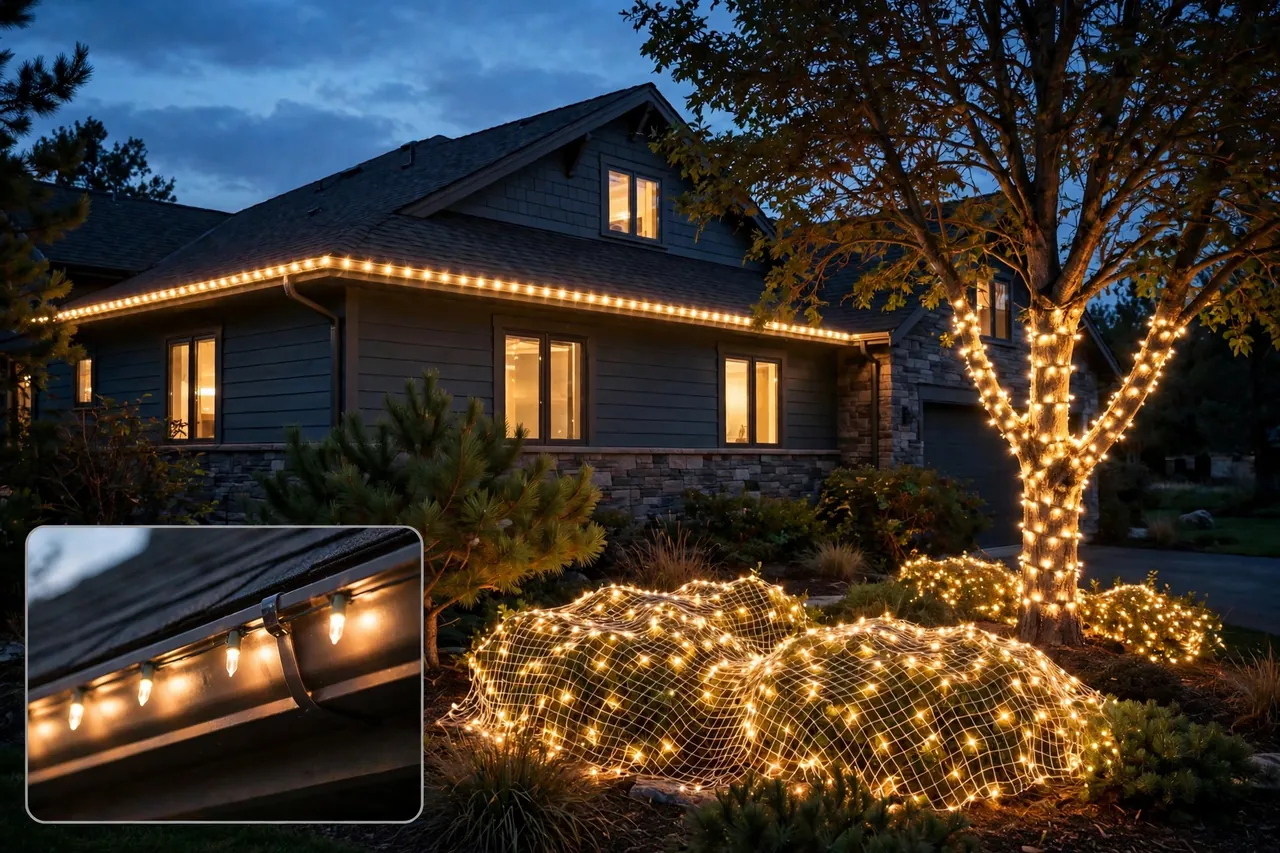
Hang the roofline first, because it frames the whole house. Warm white bulbs flatter nearly every home, while multicolor bulbs suit a playful theme. Icicle strands along gutters add a snowy edge, but keep them straight and evenly spaced. A sagging roofline reads as careless from the street, while a tight, level line reads as expensive, even with the cheapest bulbs.
Next, wrap your trees. Start at the trunk and work upward, wrapping the main limbs rather than every twig. You do not need to cover every branch. A tree wrapped on its trunk and lower limbs, with a few strands reaching up, glows beautifully and takes half the time. As one retailer guide suggests, plan roughly 100 to 150 lights per vertical foot of tree, or about one 50-light strand for every 2 to 3 feet of roofline, then adjust to your own trees.
Finally, light the bushes. Net lights drape over shrubs in minutes and give you an even glow without the tangle of wrapping each branch. If your bushes are bare in winter, wrap their frames loosely instead. The goal is a soft wash of light at eye level, which is the layer that makes your yard feel full rather than empty.
Yard Decorations With Real Presence
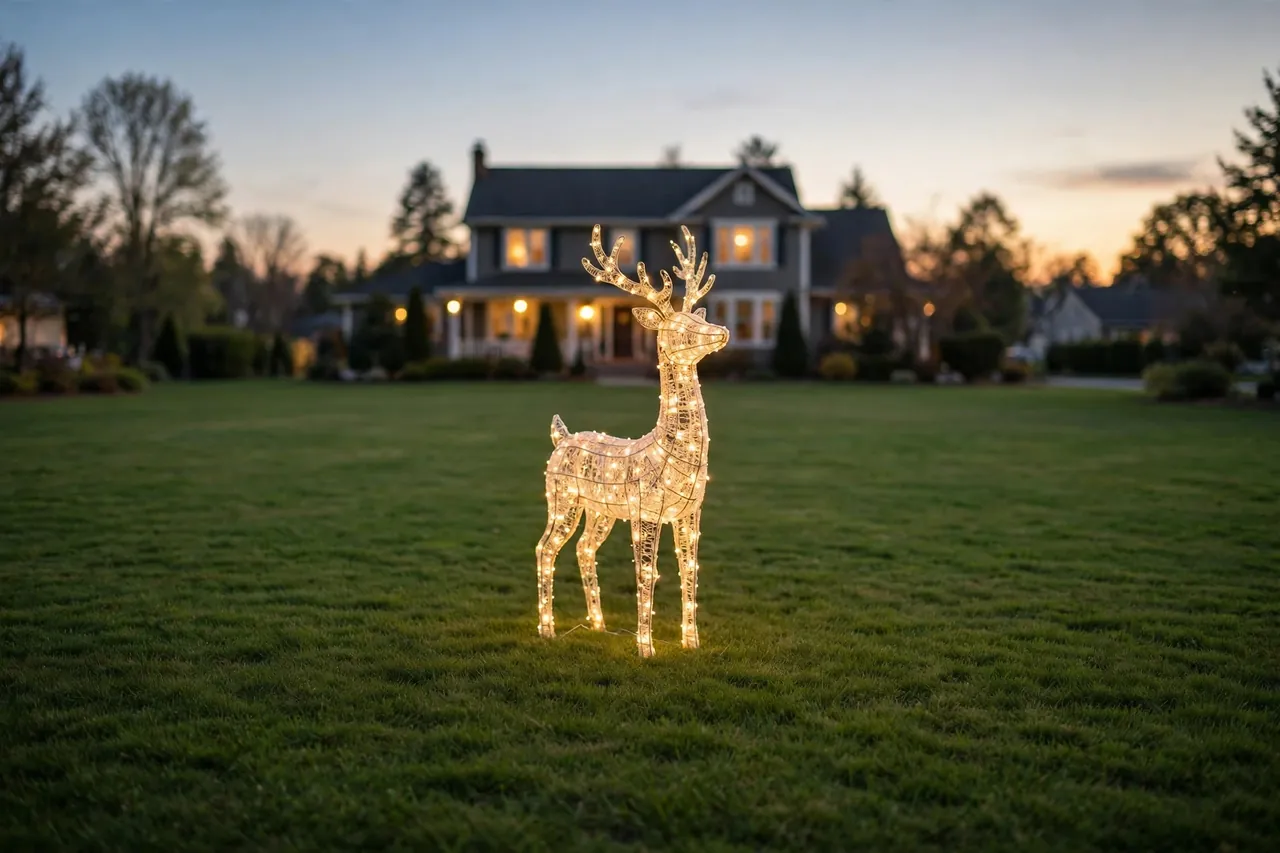
Once the lights are up, your yard needs something solid for the eye to rest on. This is where oversized outdoor Christmas decorations earn their keep. One big piece, like a tall lighted reindeer set, a large star, or an oversized ornament hanging from a tree, beats ten small figures scattered across the lawn. Big pieces read from the street. Small ones disappear.
Place your focal piece where the dusk walk told you to look. A wide lawn wants one tall piece near the center or slightly off to one side, never shoved against the house where it hides. A small yard wants one medium piece near the walkway, where guests meet it up close. Resist the urge to fill every bare patch. Empty lawn is not a problem. It is the quiet space that lets your best piece shine.
Wooden yard decorations bring a warmth that plastic cannot copy. Simple wooden trees, stars, or reindeer silhouettes, painted or left natural, look handmade in the best sense, and they survive wind far better than hollow figures. If you enjoy making things, a few DIY yard pieces, like wooden cutouts or a simple lighted frame, give your display a personal touch no store display can match. Keep DIY pieces to a few strong shapes rather than many fussy ones.
Vintage and retro touches work beautifully outdoors because they age well. Old-style bulb shapes, classic colors, and simple wooden or metal figures feel timeless, and they pair naturally with warm white lights. A funny touch, like a playful figure tipped at a cheerful angle, can be the detail neighbors remember all year. Just keep the joke to one piece. A yard with five jokes feels noisy, while a yard with one feels clever.
For a yard that tells a story, consider a small outdoor village scene or nativity grouping tucked near a tree or along a sheltered wall. A few lit figures at ground level, framed by greenery, turn an ordinary corner into a scene people stop to look at. See Christmas village display ideas for ways to build a scene that reads from the sidewalk, not just from two feet away.
The Facade: Roofline, Windows, and the Front Door
Your facade is the face your house shows the world, and it needs to look like one face, not three separate projects. The roofline gives the outline, the windows give warmth, and the front door gives the welcome. When all three share your theme and your bulb color, the house looks designed. When they fight, even expensive decorations look accidental.
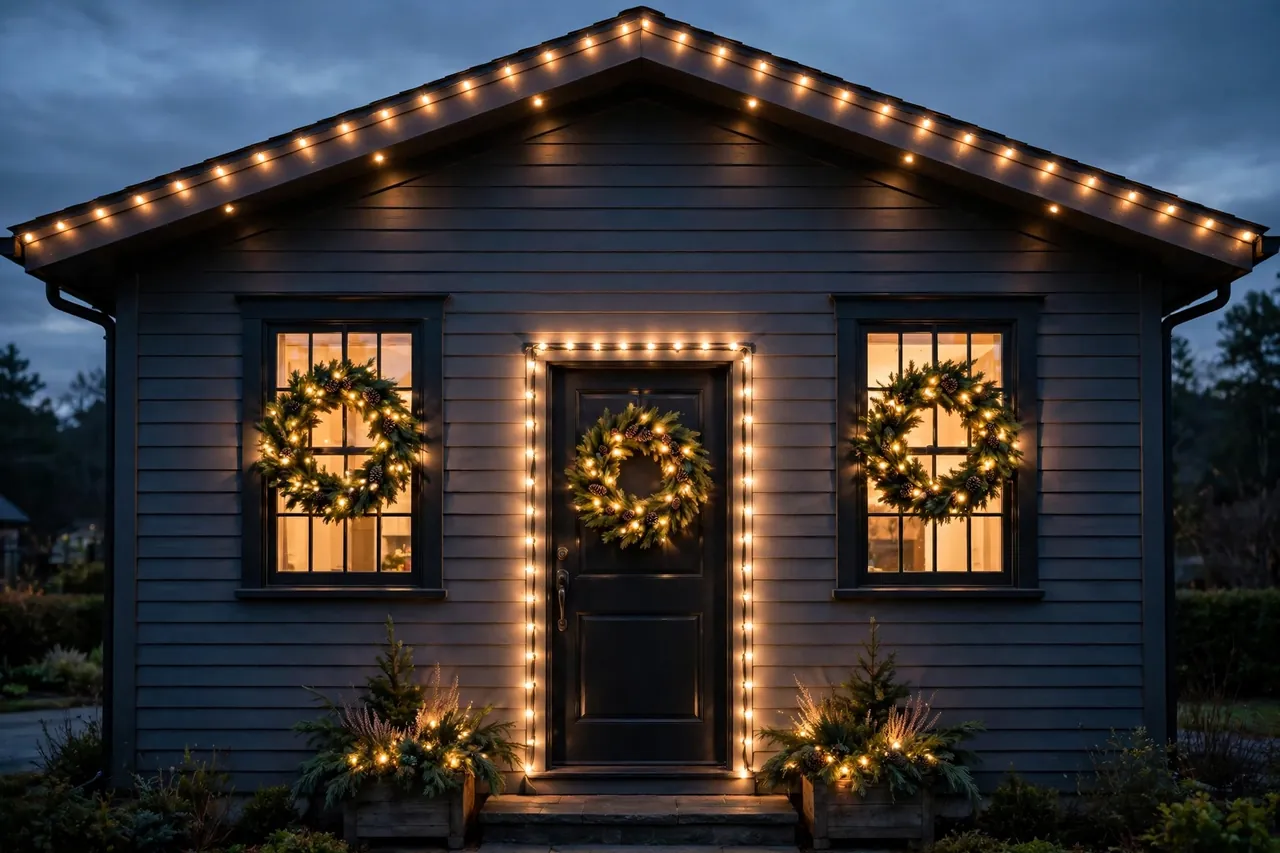
Windows deserve more love than they usually get. A simple wreath on each front window, or a strand of lights tracing the frame, doubles your display after dark because lit windows glow from inside and out. Keep window treatments simple and even. One wreath on every front window beats a crowded arrangement on one window and bare glass on the next.
The front door is the handshake of the whole display. Frame it with light, hang a wreath at eye level, and flank it with planters or lanterns if you have the space. But the door also deserves its own careful treatment, with wreath choices, garland, and porch styling that go beyond what a whole-yard guide can cover. For the full treatment, see Christmas decorations on front door and Christmas decor on porch, which walk through those two spots step by step.
Pathways, Driveway, and the First Thing Guests See
Guests judge your display twice: once from the street, and once on foot. The pathway is the second judgment, and it is the one people remember, because they walk through it. Line your walkway with light, and you turn a plain trip to the door into a small ceremony.
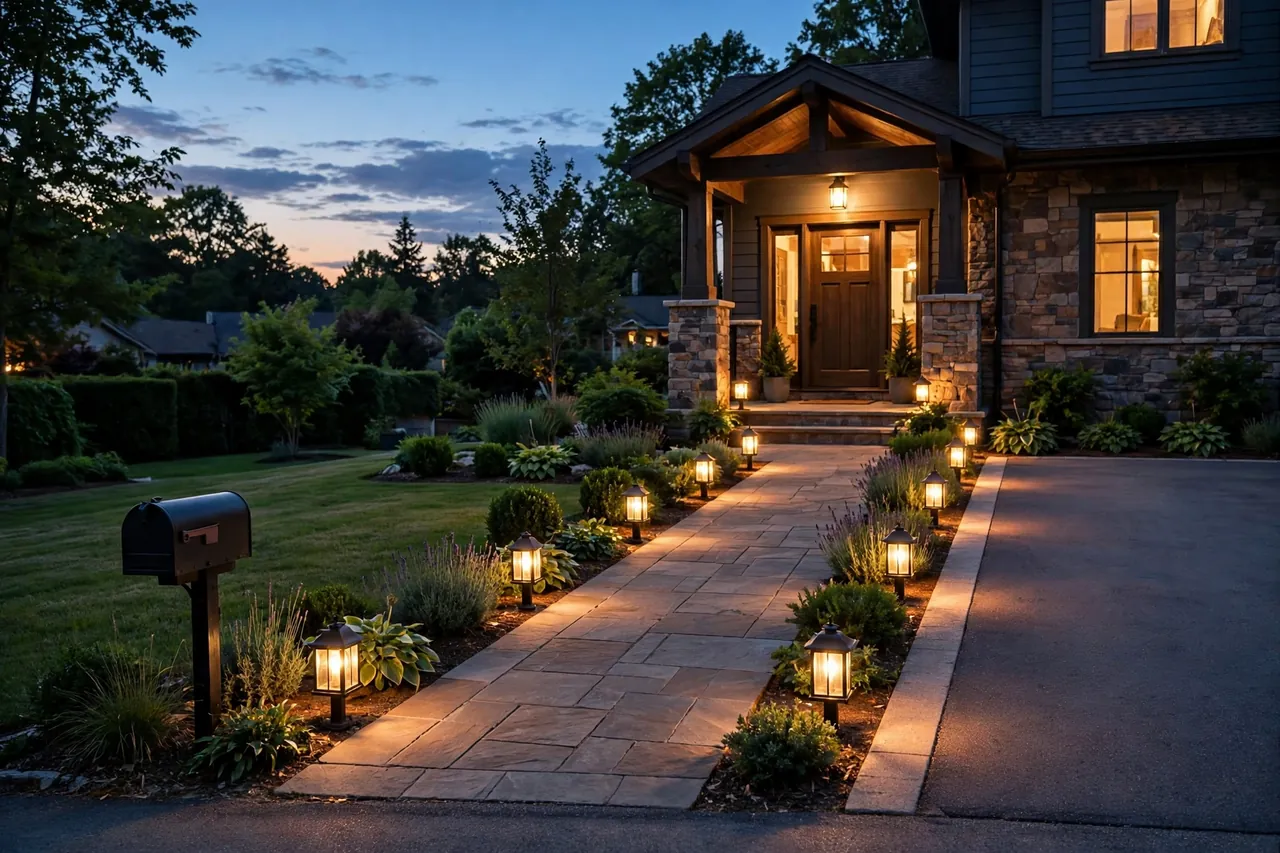
Pathway lights come in many forms: stakes with warm bulbs, lantern-style markers, candy-cane stakes, or simple luminaries. Choose one style and repeat it down the whole path. Repeating one style looks intentional. Mixing four styles looks like leftovers. Space them evenly, keep them low, and make sure they light the ground, not guests’ eyes.
Do not forget the driveway edges and the mailbox area. A few lights along the driveway frame the whole property, and a dressed mailbox tells visitors they have arrived before they even reach the walk. Keep these touches simple and in theme. They are the frame, not the painting.
Lighted lawn decorations along the path, like small lighted gift boxes or low glowing figures, add magic at ankle height, which is exactly where children look. Keep them clear of the walking surface itself. Nothing ruins a welcome faster than a guest tripping over a decoration in the dark.
Carry the Look Inside
Here is the secret of the best-decorated homes: the outside and the inside tell the same story. When a guest walks from your glowing yard into a living room that shares the same theme and colors, the whole home feels like one celebration instead of two separate projects. You do not need to match everything. One shared thread, like warm white lights or the same vintage feel, is enough.
Start with the mantel, because it is the fireplace’s version of a front door. The same greenery and bulb color you used outside can frame it beautifully. See Christmas ideas for decorating a fireplace mantel and decorating a fireplace at Christmas for mantel plans that pair with an outdoor display.
Then let the theme flow into the living room and the tree. If your yard glows warm white, an all-white tree inside feels like a natural echo. See white Christmas tree decorations and decorating ideas for a living room at Christmas. And if your home has a staircase, the same garland-and-light treatment that framed your porch railings works beautifully on the banister too. See how to decorate stairs for Christmas. For the full indoor plan, see indoor Christmas decorations.
Stay Safe While You Hang Everything
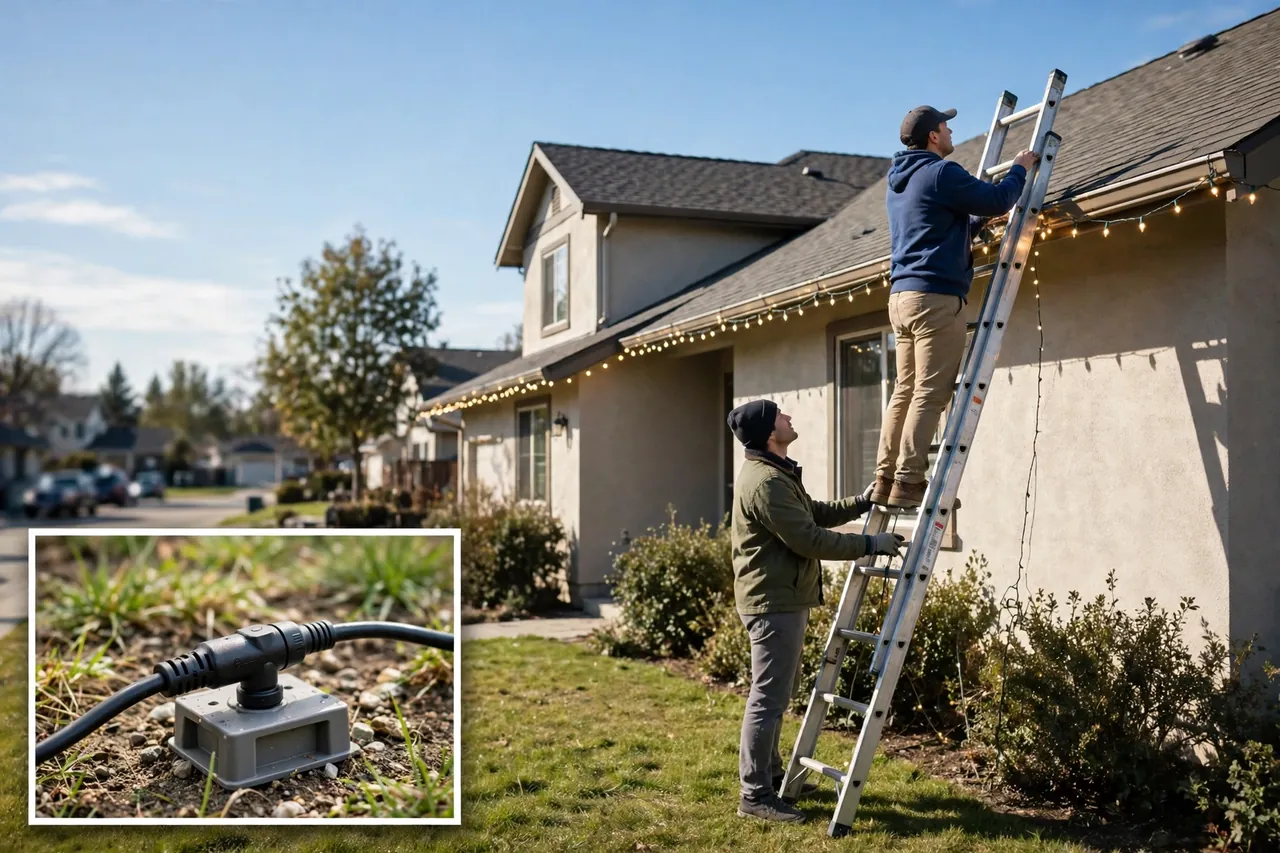
Beautiful lights mean nothing if they put your home at risk, so treat safety as part of the design, not an afterthought. Use only lights and extension cords rated for outdoor use. Indoor lights belong inside. Check every strand for cracked bulbs, frayed wires, or damaged plugs before it goes up, and throw away any strand that looks worn. A cheap replacement costs far less than a fire.
Plug outdoor displays into ground-fault protected outlets, known as GFCI outlets, which shut off power fast if water gets into the circuit. Keep all connections off the ground and out of puddles, and never run extension cords under rugs, through doorways that pinch them, or coiled tightly, because trapped heat can build up. Connect only as many strands end to end as the manufacturer’s label allows, and read that label before you plug anything in.
Ladders deserve the same respect as electricity. Never lean a ladder against a gutter full of lights, never stand on the top two rungs, and never raise a ladder near overhead power lines. Work with a helper holding the ladder when you hang the roofline, and hang lights in daylight. Night hanging on a ladder is how careful people get hurt.
Wind is the quiet enemy of yard displays. Stake down inflatables and light figures, weigh down planters, and bring in anything hollow before a storm. A decoration that blows into the street is not just lost. It is a hazard for drivers and neighbors.
These cautions matter more than most people realize. According to the National Fire Protection Association, U.S. fire departments responded to an average of 835 home fires per year started by holiday decorations between 2018 and 2022. Most of those fires were preventable with outdoor-rated gear, protected outlets, and a quick inspection before hanging. For a fuller safety checklist, see Eversource’s holiday decorating safety tips.
Take It Down Without the January Dread
Every display ends, and the way you take it down decides how you feel next December. Take lights down on a dry day, while you still remember how they were hung. Wrap each strand around a piece of cardboard or a cord reel instead of stuffing it into a bag. Label every box by zone: roofline, trees, pathways, yard figures. Next year, you will thank yourself within the first ten minutes.
Test each strand briefly before you store it, and throw away the ones that failed. Store lights somewhere dry and cool, off the concrete floor, where mice cannot chew them. Yard figures need the same care. Clean them, dry them, and store them where heavy boxes will not crush them.
Tree storage deserves the same system. A sturdy bag or box, labeled and kept dry, keeps an artificial tree fresh for years. See Christmas tree storage bags for bag styles that fit tall trees and upright storage. When January comes, a tidy takedown turns a chore into a calm closing ritual, and it leaves your yard ready for whatever you dream up next Christmas.
A short note on safety: outdoor electrical work and ladder work carry real risk. If your roofline is high, your wiring is old, or anything about your outlets worries you, hire a qualified electrician or installer for that part. A professional hour costs less than a hospital visit, and it lets you enjoy the display without worry.
Related Guides
If this whole-yard plan has you ready for the next step, these guides go deeper on the spots that matter most: Christmas decor on porch, Christmas decorations on front door, Christmas ideas for decorating a fireplace mantel, indoor Christmas decorations, and Christmas tree storage bags.
Frequently Asked Questions
How should I decorate my yard for Christmas?
Start with a focal point, like a lighted tree, a reindeer family, or one large yard figure. Then add pathway lights and roofline string lights around it. Layer heights, with ground lights, eye-level pieces, and overhead lights, so the display has depth when seen from the street.
What are popular Christmas lawn decorations?
Lighted reindeer sets, inflatable Santa and snowmen, pathway luminaries, and LED-wrapped trees remain favorites. Warm-white LEDs and oversized ornaments are especially popular right now, because they read beautifully from the street and suit nearly any theme.
How many lights do I need for outdoor Christmas decorations?
As a planning rule, allow 100 to 150 lights per vertical foot of tree, or roughly one 50-light strand for every 2 to 3 feet of roofline. Start with one zone, such as the roofline, and expand from there, rather than buying everything at once and guessing.
How do I hang outdoor Christmas lights safely?
Use only outdoor-rated lights and cords, plug them into GFCI-protected outlets, and keep every connection off the ground and out of water. Inspect strands for damage before hanging, connect only as many strands as the label allows, and never work on a ladder near power lines or in the dark.
When should I put up outdoor Christmas decorations?
Most homeowners start in late November, once the weather allows safe ladder work, and many put lights up a week or two earlier and switch them on after Thanksgiving. The best time is a dry, calm weekend when you can work in daylight, not a rushed evening before a storm.
Your outside is the first hello your home gives at Christmas, and it deserves a plan as warm as the welcome inside. Pick one theme, light it in three layers, give the yard one strong focal point, and hang everything safely. Then step out to the street at dusk, look at what you built, and enjoy it. That quiet moment, with your whole home glowing, is the whole point. If the porch or the front door calls for more detail next, the guides above are ready when you are.