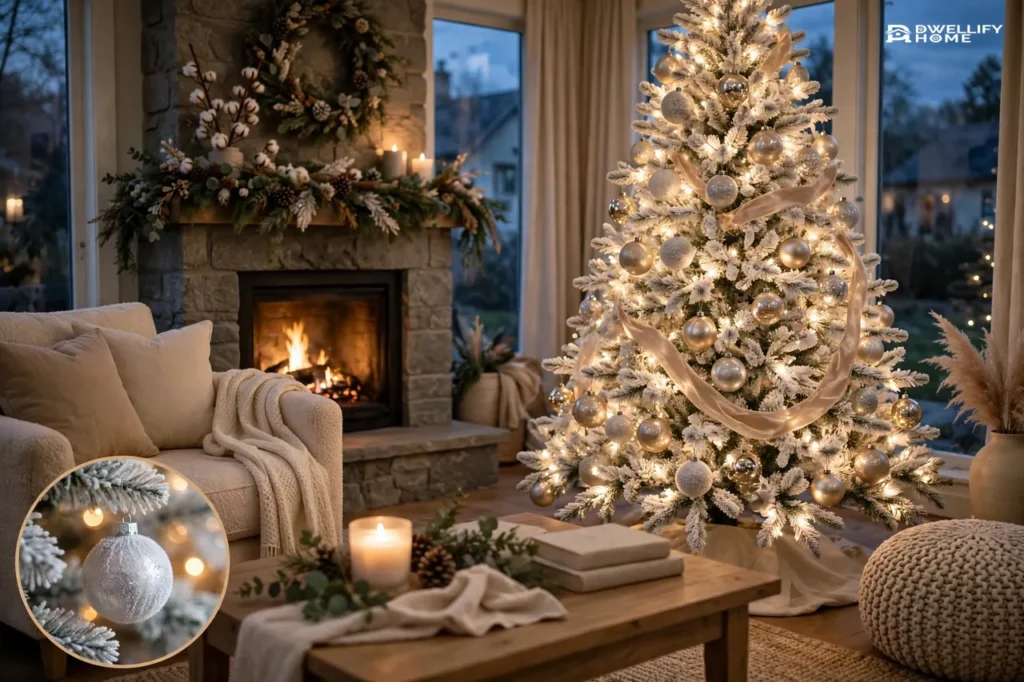
White Christmas tree decorations work best when you treat your white tree like a blank canvas, not like a green tree. Start with warm white lights, pick two or three colors at most, and mix textures — matte, shiny, frosted, and soft — so the tree gains depth instead of looking flat. Silver and white give you the classic snowy look, red and white feel warm and traditional, and gold adds a soft glow. This guide walks you through palettes, lights, steps, and the mistakes that make white trees look cheap, so your tree shines from the first evening you plug it in.
💡 Practical Home Tip: Before you buy a single ornament, pick your palette on paper first. Hold paint chips, ribbon scraps, or phone photos of your room next to each other. If the colors look calm together in daylight, they will look calm on the tree at night too.
Why a White Tree Plays by Different Rules
There is a moment every white-tree owner knows. You plug the lights in, step back, and the tree glows like fresh snow in moonlight. Then you start hanging ornaments, and something feels off. The tree looks thin in places, or the colors fight each other, or the whole thing feels colder than you imagined.
That happens because a white tree breaks the rules you learned on a green tree. On a green tree, almost any bright color pops, and plain white ornaments shine like stars. On a white tree, plain white ornaments vanish into the branches. Dark gaps near the trunk show up more. And cool, bluish light can turn the whole room icy instead of cozy.
The good news is that none of this is hard to fix. A white tree is generous — it makes every color you choose look richer and cleaner. You only need to change three habits: choose warm light, limit your colors, and build texture on purpose. Do those three things, and decorating a white Christmas tree turns from guesswork into the most enjoyable hour of your holiday season.
Pick Your Palette First
Every beautiful white tree you admire started with one decision: a palette, chosen before the first ornament left its box. When you skip this step, you end up with a tree that collects colors instead of wearing them. When you take ten minutes on it, every later choice gets easier, and the tree looks like someone planned it — because someone did.
White Christmas tree decorating ideas work around one simple limit: two or three colors, plus white itself. White counts as your background, not as one of your colors. So “silver and white” means silver is your color and white is your canvas. “Red and white” means red does the talking and white answers back.
The table below gives you six palettes that suit a white tree, with the feel each one creates and the room it fits best. Pick the row that sounds like your home, then shop and decorate inside it.
White tree palettes at a glance
| Palette | Colors | Feel | Best for |
|---|---|---|---|
| All white and silver | White, silver, clear glass | Snowy, calm, elegant | Modern rooms, small spaces |
| Silver and blue winter | Silver, icy blue, white | Frosty, serene, crisp | Cool-toned rooms, winter themes |
| Red and white classic | Red, white, a touch of gold | Warm, traditional, joyful | Family rooms, classic homes |
| Gold and champagne | Gold, champagne, cream | Soft, rich, glowing | Formal rooms, evening light |
| Black and white drama | Black, white, silver | Bold, graphic, modern | Minimal rooms, statement corners |
| Blush and rose gold | Blush pink, rose gold, white | Gentle, romantic, dreamy | Bedrooms, soft glam rooms |
If you cannot decide, start with silver and white. It is the most forgiving palette on a white tree, it suits almost any room, and you can warm it up later with gold ribbon or cool it down with blue ornaments next year. The Livingetc white tree ideas guide gives the same rule: white, silver, pale gold, or clear glass for an expensive look, with bolder colors for a traditional or contemporary feel. If you want a wider view of theme families before you commit, our guide to Christmas tree themes compares the big theme directions side by side.

Lights First: Warm White Wins on a White Tree
Lights are not the finishing touch on a white tree. They are the foundation, and they decide whether your tree feels like a snowdrift at dusk or a display case under office lights. Decorating guides agree on this point again and again: warm white lights make a white tree glow, while cool white lights can make it look blue, harsh, and cold.
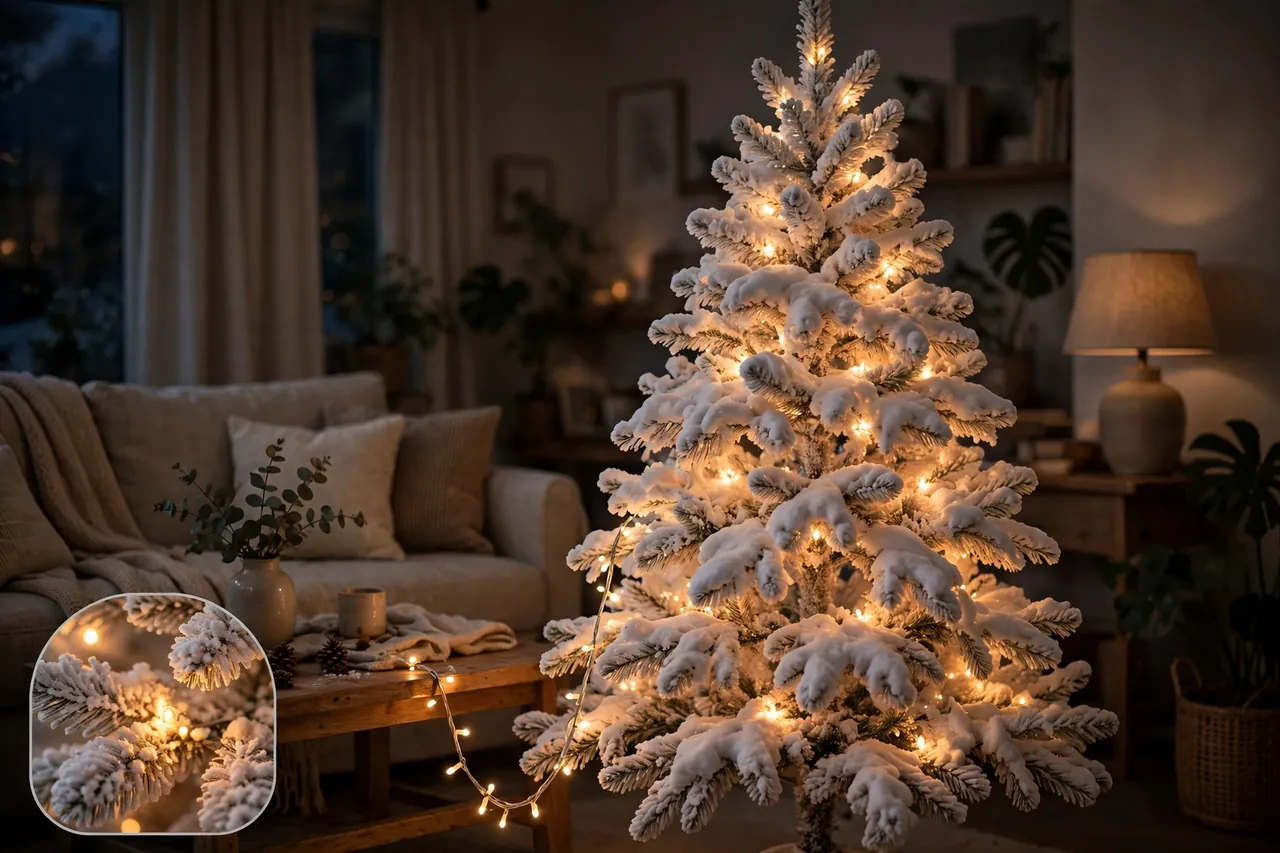
Choose warm white or soft white LEDs, around the warm end of the scale, and test one strand at night before you commit. Plug it in, turn the room lights down, and look at the tree from your sofa. If the branches look like candlelight on snow, you have the right lights. If they look like a hospital corridor, swap the strand before you hang a single ornament.
As a rule of thumb, decorating guides commonly suggest about 100 lights per foot of tree height, so a six-foot tree wants roughly 600 lights. Treat that as a starting point, not a law. A slim tree needs fewer, a very full tree hides more light and wants extra strands tucked deep inside. String the lights from the trunk outward, not just around the outside, so light comes from inside the tree as well. That inner glow is what stops a white tree from looking flat, and it makes your ornaments shine instead of sitting in shadow.
Check your lights before decorating day. Plug every strand in, look for dark sections, and replace dead strands now. Nothing spoils the mood faster than finding a dead section after the ornaments are already up.
How to Decorate a White Christmas Tree, Step by Step
Knowing how to decorate a white Christmas tree matters more than owning beautiful ornaments. The order you work in decides whether the tree looks layered or lopsided. Follow these steps in order, and step back for a look after each one. The Wayfair step-by-step guide follows the same lights-first, large-to-small order, and it works because each layer supports the next.
- Shape and fluff the tree. Pull every branch outward and downward, fill gaps by hand, and turn the tree slowly to check it from all sides. A white tree shows thin spots more than a green one, so spend real time here.
- String the lights. Work from the trunk outward and from top to bottom, weaving strands deep inside the branches. Step back and check for dark patches before you move on.
- Add ribbon or garland. Drape wide ribbon in loose waves, or wrap it from top to bottom in a gentle spiral. Ribbon gives the eye a path to follow and hides bare branch tips.
- Hang the largest ornaments first, deep inside. Push big baubles and statement pieces toward the trunk, not just on the tips. These inner ornaments fill the dark center and make the tree look thick.
- Add medium ornaments at eye level. This is where most people look, so give this band your best pieces and your main color.
- Fill with small ornaments and picks. Tuck frosted picks, berry sprigs, and small balls into gaps. These finishers turn a good tree into a full one.
- Top the tree, then skirt the base. Add your topper last so you can judge its size against the finished tree, then hide the stand with a skirt or collar.
- Step back in low light. Turn the room lights down, walk to the far side of the room, and look for bare spots, color clumps, or a leaning topper. Fix those now, not on Christmas Eve.
One habit separates tidy trees from stunning ones: hang ornaments at different depths. If every ornament sits on the branch tips, the tree looks like a poster. If some sit deep, some sit mid-branch, and some sit on the tips, light bounces between them and the tree gains a shape you can feel, not just see.
Texture Is What Stops a White Tree Looking Flat
Here is the secret most guides whisper and few explain: a white tree needs texture more than it needs color. White branches reflect light evenly, so a tree dressed only in shiny balls can look like a flat picture. Texture breaks that flatness. It gives the eye rough and smooth, soft and hard, matte and bright to travel across.
Mix at least four textures in your ornament box. Matte ceramic balls calm the shine down. Mercury glass and clear glass catch light and throw it back. Frosted ornaments and snowflake shapes echo the snowy branches. Then add something soft — a velvet ribbon, a faux-fur garland, a felt ornament — so the tree invites touch as well as sight. Natural touches help too: pinecones, dried orange slices, or cinnamon sticks warm a white tree up and keep it from feeling like plastic.
Cluster, Don’t Scatter
Hang ornaments in small clusters of three or five, close together, instead of spacing every piece evenly apart. A cluster reads as one rich moment, while evenly spaced singles read as a row of dots. Mix sizes inside each cluster — one large, one medium, one small — and let a cluster sit at different depths in the tree. Your eye will travel from cluster to cluster, and the tree will feel full without feeling crowded.
Fill the Dark Center
Every white tree has a dark hollow near the trunk, because light cannot reach as deep as it does on a green tree. Fix it with filler, not with more tip ornaments. Push large, inexpensive shatterproof balls in your main color deep toward the trunk. Tuck white or silver tinsel garland into the inner branches. The filler reflects light back out, the hollow disappears, and the tree looks thick from every angle.

Silver and White: The Classic Snowy Look
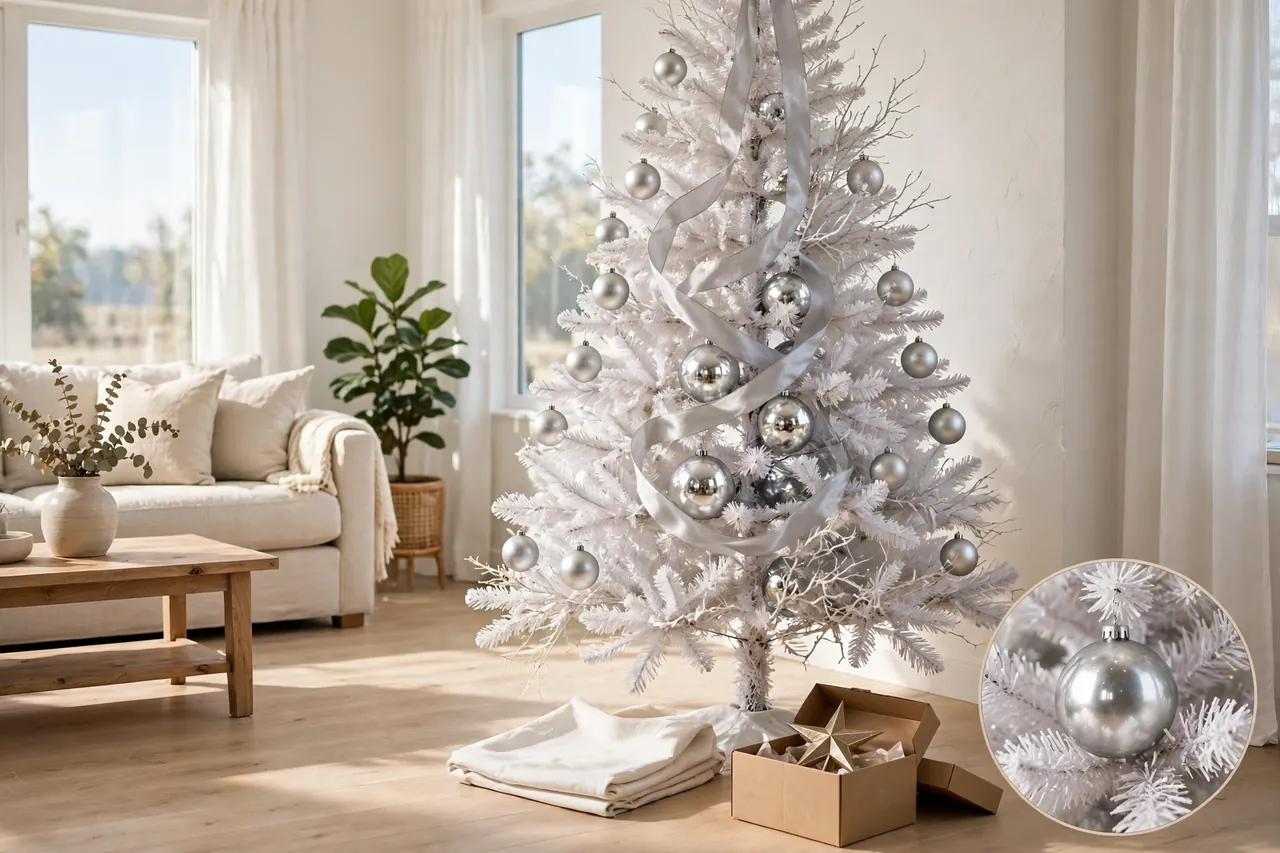
If one look defines white Christmas tree decorations, it is silver and white. Silver Christmas tree decorations on white branches create the winter scene people picture when they close their eyes: snowfall, moonlight, and quiet. Silver and white Christmas tree decorations work because silver behaves like light itself — it brightens without adding a new color, so the tree stays calm and the room stays peaceful.
Build this look in layers of silver, not in one flat shade. Mix shiny silver balls with matte silver ornaments, frosted silver snowflakes, and clear glass icicles. Add white ornaments in different finishes — glossy, matte, and frosted — so the white itself gains texture instead of disappearing. A silver ribbon, wide and soft, ties the layers together, and a silver or crystal topper finishes the story.
Christmas tree decorations in white silver tones suit small rooms especially well. The pale palette bounces light around, so a small living room feels brighter and a little larger. If your room already has cool tones — gray walls, chrome fixtures, pale floors — this palette will feel like it always belonged there. For more ways to dress the rest of the room to match, see our decorating ideas for a living room for Christmas.
Color That Pops: Red, Black, and Soft Pastels
Silver and white is the classic, but a white tree earns its keep by making color look richer than a green tree ever could. Because the background is neutral, your accent color appears deeper, cleaner, and more deliberate. Here are the three accent directions that work best.
Red and White: The Warm Classic
Red on white is the most joyful combination in Christmas decorating. The white branches make red ornaments look deeper and warmer, like holly berries against snow. Keep red as your star and let white answer back: roughly two parts white to one part red keeps the tree bright instead of heavy. Add a thin gold ribbon if the tree needs warmth, but skip green garland here — green fights the clean red-and-white story. A white Christmas tree with black decorations is a different mood entirely, and it deserves its own moment below.
Black Decorations: Bold and Modern
A white Christmas tree with black decorations sounds daring, and it is — in the best way. Matte black baubles, black velvet ribbon, and a few silver accents turn the tree into a graphic statement, the kind guests photograph before they even say hello. Seasonal buyers quoted in the Ideal Home white tree ideas guide call black and gold fantastic accents for a white tree, and on a white tree they are right. The trick is restraint: black should be your accent, not your flood. Use black ornaments in clusters, keep silver as your bridge color, and let plenty of white show through. In a minimal room with dark furniture or black-framed art, this look feels intentional rather than shocking.
Blush, Blue, and Soft Pastels
Pastels love a white tree. Blush pink and rose gold feel gentle and romantic, icy blue and silver feel like a frosty morning, and soft lavender or sage add a quiet surprise. Pastels work best when you commit to one pastel family instead of mixing them all — blush with rose gold, or blue with silver, but not blush, blue, and lavender at once. Keep the finishes soft too: frosted glass, satin ribbon, and matte balls suit pastels better than hard glitter.
Finish the Look: Topper, Skirt, and Base
The topper and the base frame your tree the way a frame finishes a picture. Get them wrong and the eye notices, even if it cannot say why. Get them right and the whole tree looks finished.
Choose a topper that matches your palette, not just your habits. A silver star or crystal finial suits silver and white. A classic star or angel suits red and white. A black tree can carry a black or silver topper, and a pastel tree loves a soft gold or blush topper. Check the size before you buy: a topper should crown the tree, not outweigh it. If it leans, it is too heavy for the top branch — swap it for a lighter one rather than wiring it into place.
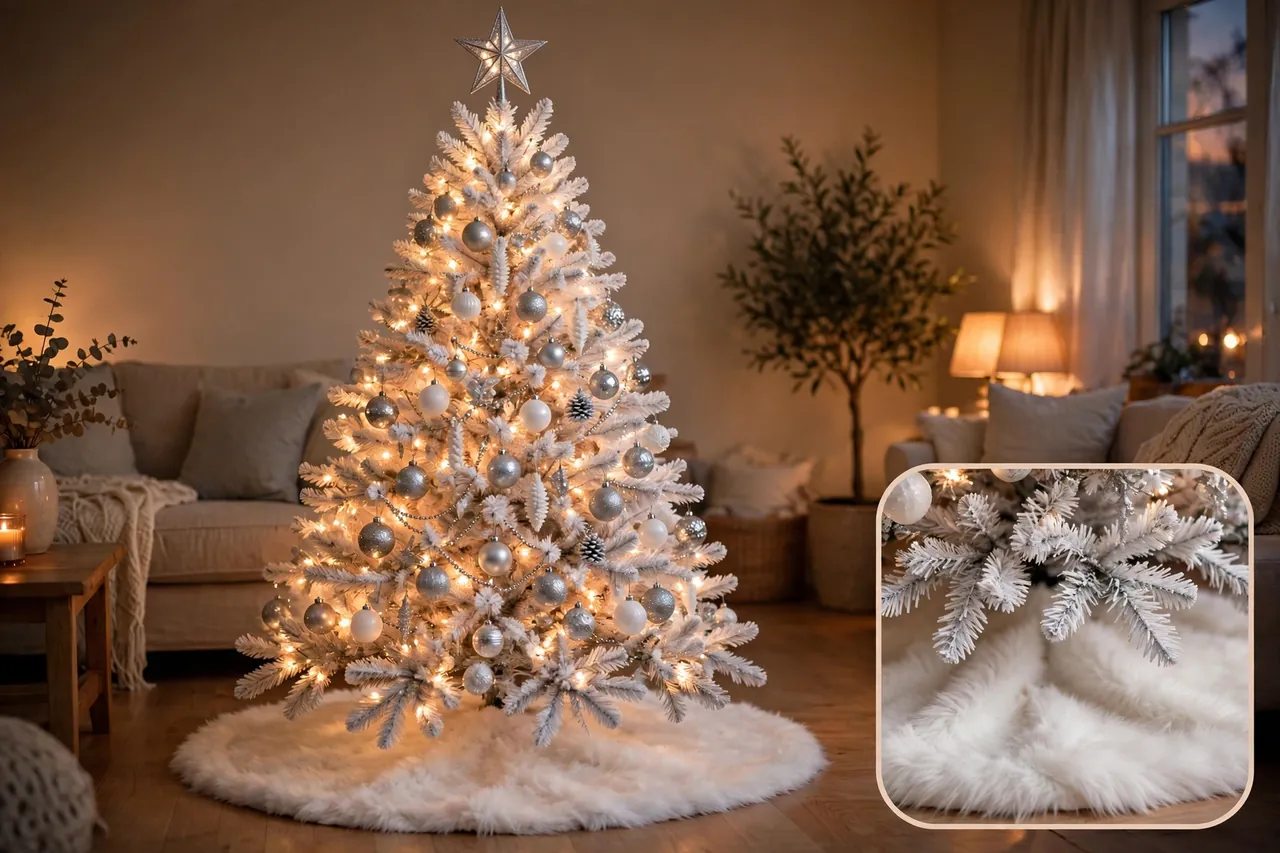
At the base, hide the stand completely. A faux-fur skirt in white or cream looks soft under a silver tree. A woven or velvet skirt in your accent color grounds a red or black tree. A metal collar gives a clean, modern finish and suits small spaces where a skirt would bunch up. Whatever you choose, pull it out past the lowest branches so no stand legs peek out, and keep it clear of heaters and open flames.
Mistakes That Make a White Tree Look Cheap
Most white-tree disappointments come from a handful of avoidable mistakes. Check your tree against this list before you call it done.
- Cool white lights. Blue-toned light turns white branches icy and the room cold. Warm white is the fix, every time.
- Too many colors. Five or six colors on a white tree look like a toy box, not a design. Two or three colors, plus white, is the limit.
- White ornaments with nothing behind them. Plain white balls on white branches vanish. Pair white ornaments with silver, glass, or texture so they register.
- Every ornament on the tips. Tip-only decorating leaves a dark hollow in the center and a flat outline. Push large pieces deep inside.
- Overcrowding. A white tree needs breathing room. If you cannot see branch between ornaments, take a few pieces off and let the tree show.
- Mixing warm and cool metallics without a plan. Gold and silver can share a tree, but only when one leads and the other accents. Equal amounts of both look undecided.
- Forgetting the base. A bare stand under a beautiful tree breaks the spell. Skirt it, collar it, or basket it — just cover it.
Keep It White: Care and Storage
A white tree only stays beautiful if it stays white. Sunlight is the main enemy: even indirect light fades white branches over months, so store your tree in a cool, dark place, never in a sunny attic corner or a clear container by a window. Dust it before you pack it away, because dust settles into white branches and dulls them over time.
When the season ends, take the ornaments off, wipe the branches gently with a dry cloth, and pack the tree in an opaque storage bag. Keep the bag somewhere dry and cool, and keep heavy boxes off it so branches do not bend out of shape. Good Christmas tree storage bags protect both the tree and your ornaments, and they make next December’s decorating start clean instead of dusty.
If your tree yellows a little with age, do not panic. Care guides advise keeping it out of sunlight and cleaning it before storage, which slows the change. A tree with gentle cream tones still decorates beautifully — shift your palette slightly warmer, with champagne and gold, and the tree will look intentional rather than aged.
Carry the Look Through the Room
A white tree looks best when the room quietly agrees with it. You do not need to redecorate the house — a few echoes are enough. A silver and white tree pairs beautifully with a mantel dressed the same way, so browse our Christmas ideas for decorating a fireplace mantel and repeat one or two of your tree’s materials there, like silver ribbon or frosted picks. If you love the fireplace glow as a whole, our guide to decorating a fireplace at Christmas shows how to dress the hearth without stealing the tree’s spotlight.
Carry the palette one step further and the whole home feels designed. A white-and-silver garland on the stairs ties the tree to the upper floor — see how to decorate stairs for Christmas without overloading the banister. A small Christmas village display under or beside the tree adds a storybook corner that children love. And if your tree sits near the entry, echo the palette outside too: Christmas decor on porch, Christmas decorations on front door, and Christmas decor exterior ideas help the outside of your home promise what the tree delivers inside. For the rest of the house, our indoor Christmas decorations guide keeps every room in the same calm language.
Related Guides
- Christmas Ideas for Decorating a Fireplace Mantel
- Decorating a Fireplace at Christmas
- Decorate Stairs for Christmas
- Christmas Tree Themes
- Christmas Village Display
- Christmas Decor Exterior Ideas
- Christmas Decor on Porch
- Christmas Decorations on Front Door
- Christmas Tree Storage Bags
- Decorating Ideas for a Living Room for Christmas
- Indoor Christmas Decorations
Frequently Asked Questions
What colors look best on a white Christmas tree?
Christmas Tree Themes: How to Pick a Look You Will Love All Season · Decorating Ideas for a Living Room at Christmas · Indoor Christmas Decorations: A Room-by-Room Guide to a Warm, Festive Home
What are the best Christmas decorations for a white tree?
The best decorations mix metallic ornaments, clear glass baubles, and textured pieces, with warm lights and a few natural touches like pinecones or berries. That mix gives the tree shine, depth, and warmth at the same time. Avoid filling the tree with only one finish, which is what makes it look flat.
How do I prevent my white Christmas tree from yellowing?
Store your tree in a cool, dark place in an opaque bag, since sunlight is the main cause of yellowing, even indirect light over months. Dust the branches before packing, keep the bag dry, and keep heavy boxes off it. Cleaning before storage also stops dust from dulling the white over time.
Is a white Christmas tree suitable for traditional holiday decor?
Yes, with small adjustments. Choose a warm white tree rather than a stark pure white one, then use classic red ribbons, gold ornaments, and vintage pieces, which stand out vividly against white. Skip green garlands, which compete with the clean backdrop instead of complementing it.
What’s the difference between frosted and pure white trees?
Frosted trees carry a snow-dusted coating that looks rustic and textured, and the flocking hides small flaws well. Pure white trees have a smooth, even surface that suits modern, minimal rooms and gives cleaner lines. Frosted trees need gentler storage to protect the coating, while pure white trees show dust more easily.
Your white tree is ready to become the quiet star of your home this Christmas. Pick your palette tonight, hang your lights warm, and let the tree do what it does best — make every color you love look a little more magical. When the last ornament is up, turn the room lights down, step back, and enjoy the glow you built.