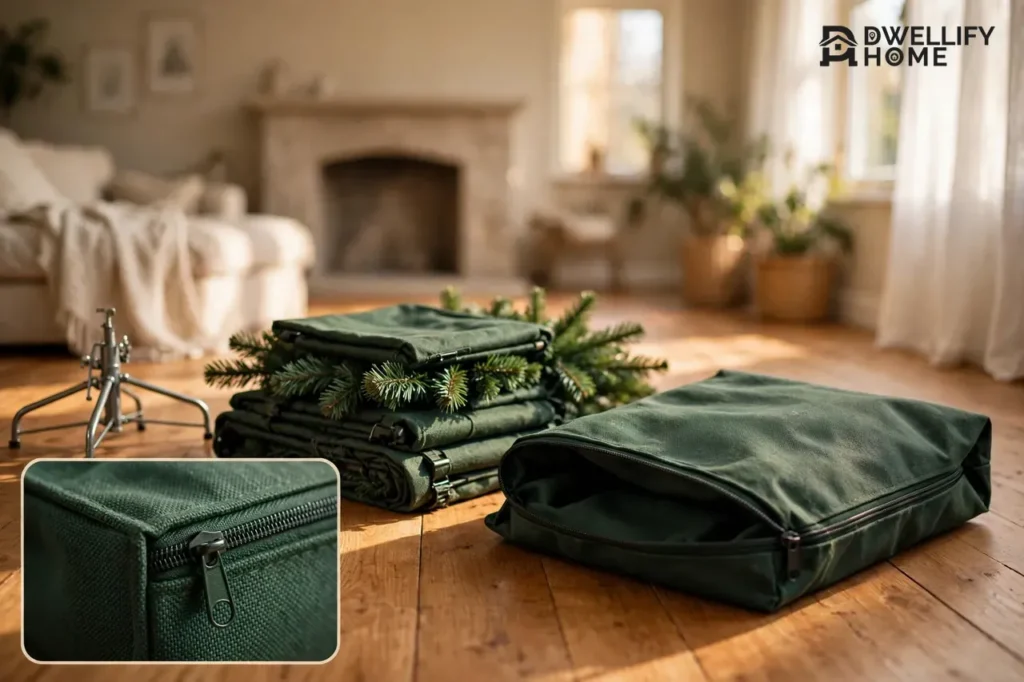
The best way to store an artificial Christmas tree is a Christmas tree storage bag sized to your tree, measured with its stand. A good bag guards the branches against dust, moisture, and crushing, and it makes next year’s setup faster because everything stays together. The original cardboard box cannot do that job well, and this guide shows you exactly how to pick the right bag and pack your tree so it looks full again next December.
Here is the honest truth most of us learn the hard way: your tree spends about eleven months in storage and only one month on display. Those eleven months decide whether it comes out lush or flat, tangled or tidy. So let us get this part right, once, and then you can forget about it until the lights go up again.
Why a Storage Bag Beats the Original Box
That cardboard box feels like the obvious choice because the tree arrived in it. Resist it. Professional organizer Lauren Saltman warns that cardboard holds moisture from the air, and critters can chew straight through it. One more season in a damp garage, and the box tears right when you lift it.
There is a second problem, and it is sneaky. At the factory, workers packed your tree while its branches were still flat. Once you fluffed those branches out at home, they will never fold back down the same way. Sandi Ricke, who buys lifelike trees for a living, puts it plainly: never try to force a fluffed tree back into its original box, because squeezing it damages the branches and the lights.
A purpose-made tree bag for storage solves both problems. It seals out dust and damp, it resists pests better than cardboard, and it gives the branches room to rest instead of crushing them. If your tree came with its own bag, follow the manufacturer’s directions for that bag first. If it did not, this guide picks one for you.
The 4 Types of Christmas Tree Storage Bags
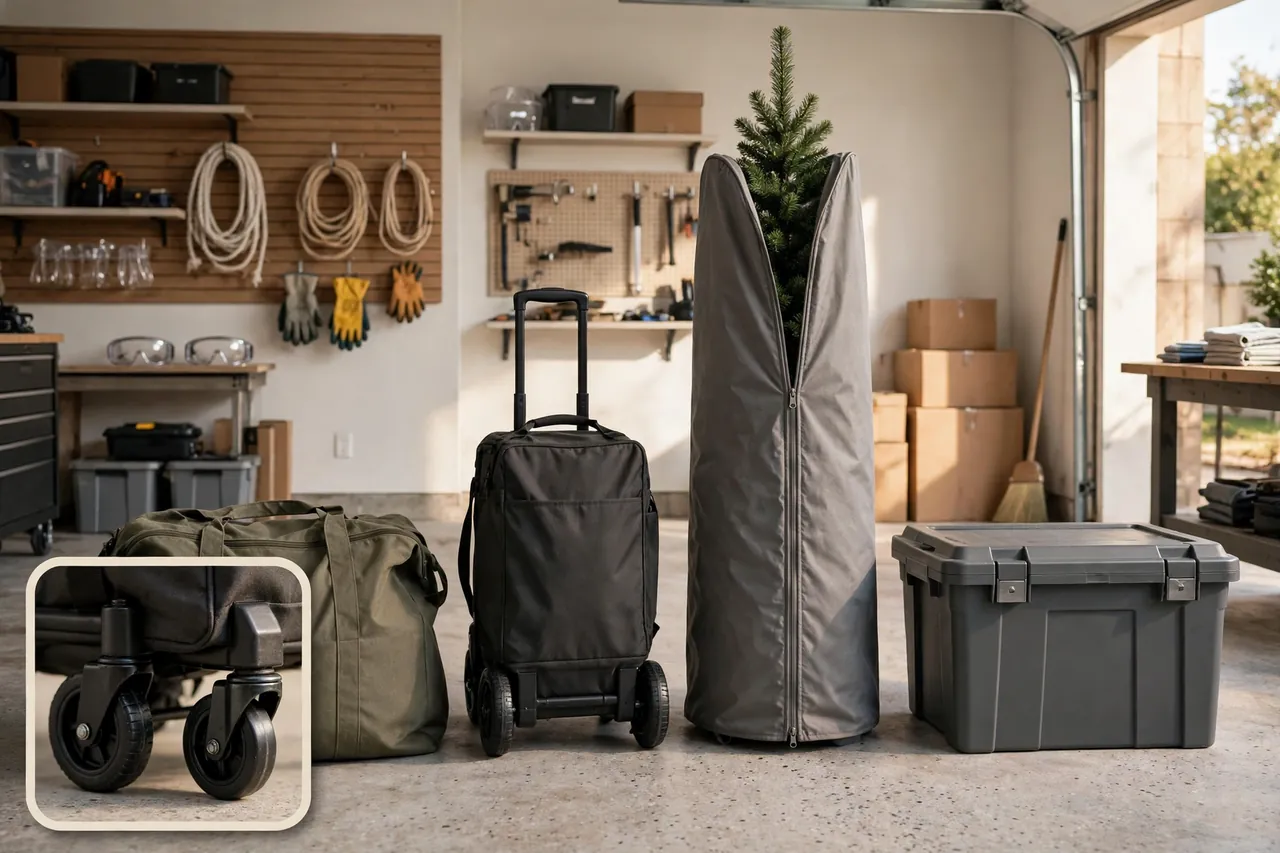
Walk into any store after the holidays and you will see four kinds of Christmas tree bags for storage. They are not interchangeable, so pick by how your tree comes apart and how much space you have.
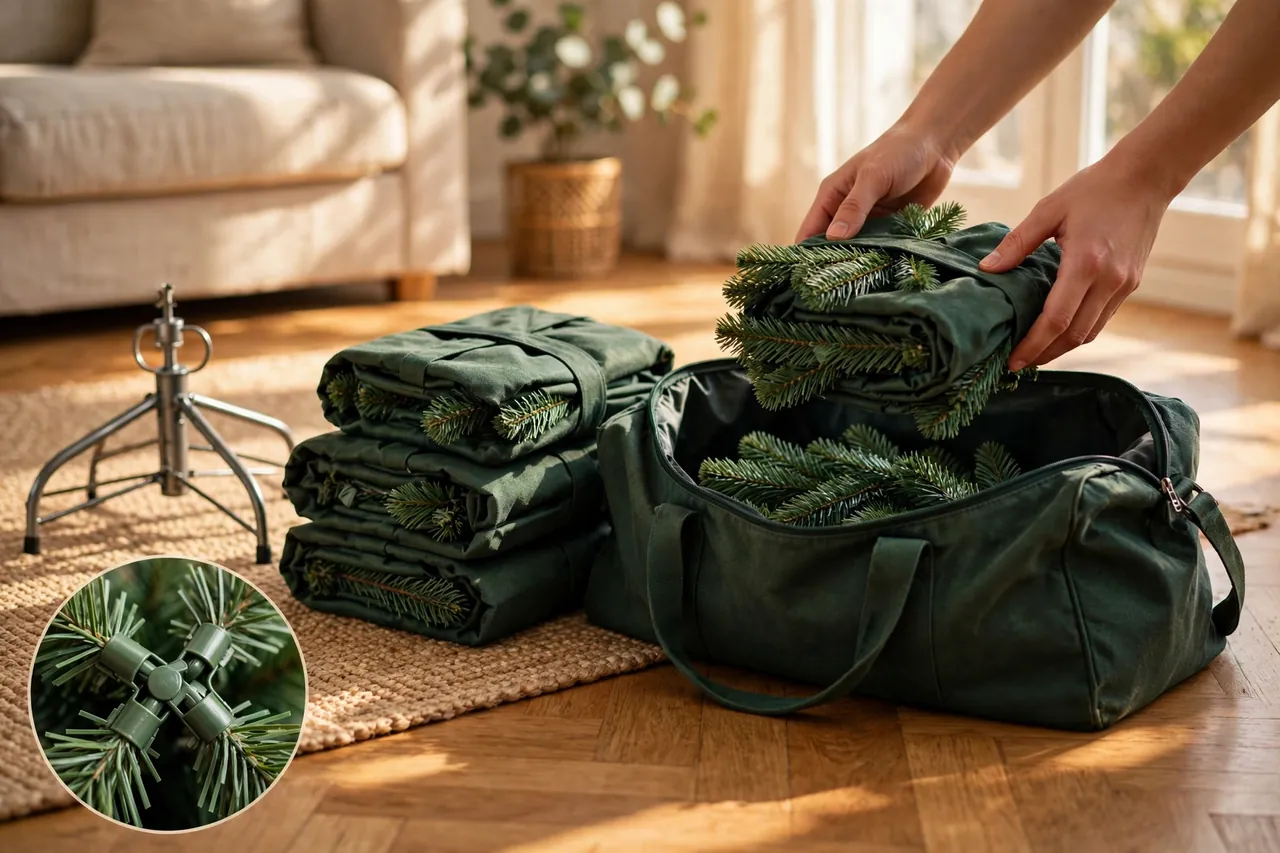
Duffel bags hold a tree you take apart into sections. You fold the branches, slide the sections in, and zip up. They cost the least, they fold flat when empty, and they suit most standard trees. Their weakness is weight: a full duffel gets heavy, so look for handles on more than one side.
Rolling bags are duffels with wheels, and they change the whole job. A Christmas tree storage bag with wheels lets one person move a big tree down a hallway and up a ramp without a second pair of hands. If your tree is tall or you store it far from the living room, wheels are worth every penny.
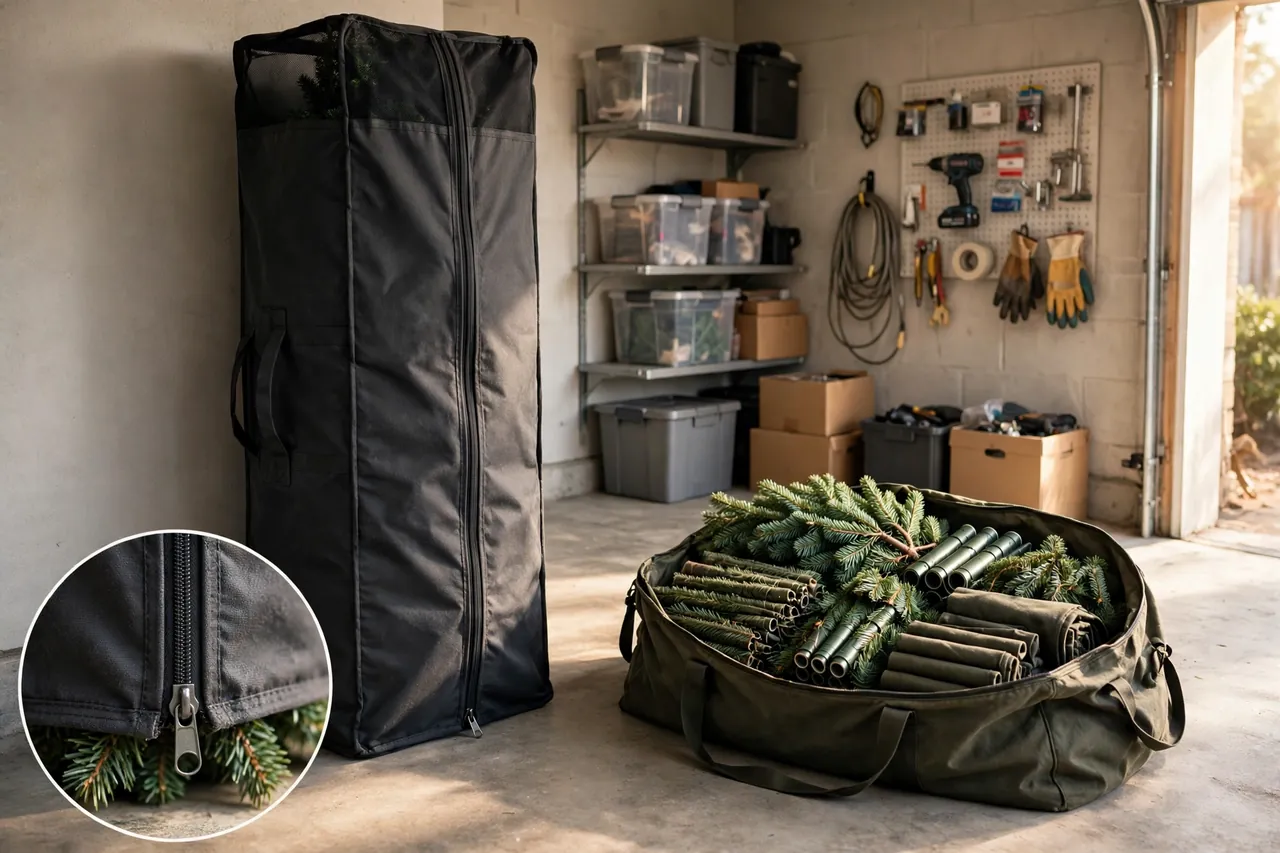
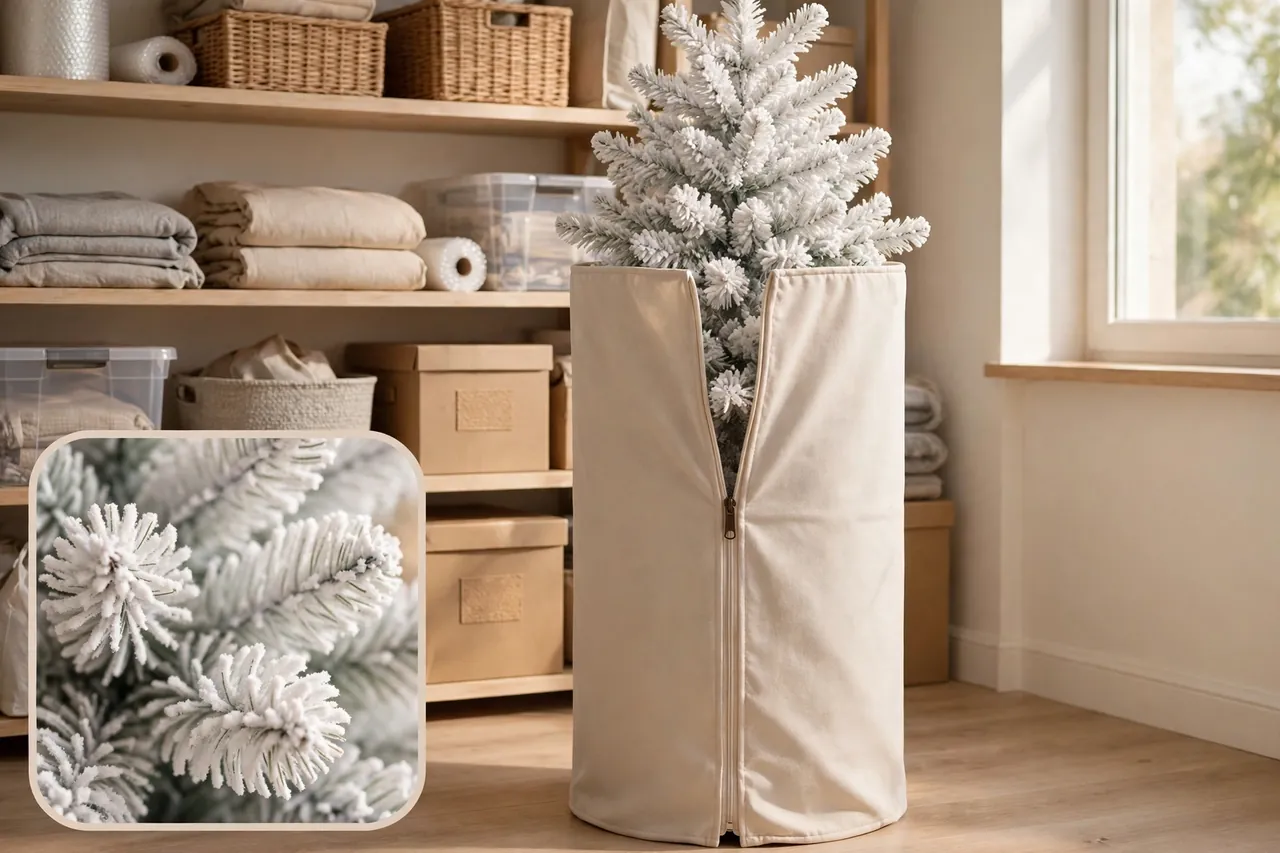
Upright bags slip over a tree that stays assembled and standing. You wrap the tree on its stand, zip the cover up, and store the whole thing upright. An upright Christmas tree storage bag saves you the entire rebuild next year, and it treats branches and lights most gently. It does demand real floor space, though, so measure your storage corner first.
Hard cases and plastic boxes give the strongest crush protection. A Christmas tree plastic storage box, or a rigid plastic box for Christmas tree storage, shields a delicate or expensive tree from anything stacked nearby. The trade-off is bulk: a rigid box takes up the same space empty as full, and it costs the most.
Bag type comparison
| Bag type | Best for | Watch out for |
|---|---|---|
| Duffel | Taken-apart trees, tight budgets | Heavy when full; needs good handles |
| Rolling | Large trees, long carries, solo packing | Needs clear floor to roll |
| Upright | Keeping the tree assembled | Needs standing floor space |
| Hard case or plastic box | Delicate or pricey trees | Bulky and priciest |
What Size Bag Does Your Tree Need?
Size causes more returns than any other mistake, so slow down here. Measure your tree’s height including the stand, then measure its width at the widest branches. Saltman gives that measuring tip for a reason: a bag that fits the tree but not the stand leaves you stuck at the last step.
If you sit between two sizes, choose the bigger one. Professional organizer Lisa Dooley gives the same advice: a slightly roomy bag protects branches, while a tight bag forces you to crush them. And here is a handy rule from Ricke: a 9-foot slim tree or smaller usually fits in one bag, but a taller or wider tree often needs two bags, one per half.
Manufacturers size their bags by tree height and width, not by box size. As one example, TreeKeeper’s upright bags come in Medium (under 7.5 feet tall and under 50 inches wide), Large (under 9 feet tall and under 60 inches wide), and Large-Girth (under 9 feet tall and under 70 inches wide), in a 600D polyester-blend fabric, listed at $99.99 on ChristmasWorld and checked on October 26, 2026. For very tall trees, TreeTime’s expandable XXL upright bag fits 9 to 12-foot trees, with a steel frame and ball-bearing wheels, listed at a $169.95 sale price (regular $189.99) on TreeTime and checked on October 26, 2026. A marketplace buying guide lists rough tiers for the rest of the market: basic drawstring bags around $10 to $15, heavy-duty zipper duffels around $25 to $40, and wheeled hard cases around $60 to $120 — treat those as guide ranges, not checked prices, because they vary by seller.
One last sizing truth: a heavy duty tree storage bag earns its name only if the fabric, zipper, and handles all hold up under a full load. Thin fabric with a weak zipper fails exactly when the bag is heaviest, so check the stitching and handles before you buy, not after you pack.
How to Pack Your Tree Step by Step
Packing goes smoothly when you work top-down and stay calm. Follow these steps in order, and your tree will thank you next year.
- Unplug everything and strip the tree. Remove every ornament, garland, and topper first. Pack fragile ornaments separately; they do not belong in the tree bag.
- Clean the branches. Dust or vacuum gently, or blow dust out with a hairdryer on a cool setting. Dust left on branches turns into grime over eleven months.
- Confirm the tree is completely dry. Any dampness invites mildew inside a sealed bag. If you cleaned it, let it air out before you zip anything.
- Take the tree apart top-down. Unscrew or unclip each section starting at the top, and handle hinged branches gently so you never snap a limb.
- Flip each section upside down and fold the branches in. Gravity helps the branches fold neatly, and you avoid forcing them against their hinges.
- Label each section. A strip of tape marked top, middle, and bottom saves real confusion next December. Some people photograph the setup before they take it down, and that photo pays off too.
- Load the sections in order. Heaviest section first, lightest last, so nothing crushes anything else. Slide the tree skirt and the stand into the same bag, so the whole setup lives in one place.
- Zip without overstuffing. If you must force the zipper, the bag is too small or too full. Swap up a size rather than straining the seam.
- Tag the outside. Write the tree’s height and type on the bag or on a luggage tag. Next year you will know exactly what you grabbed without opening it.
- Store it right. Set the bag where it stays cool, dry, and undisturbed, as the next section explains.
That is the best way to store a Christmas tree, start to finish. It works for a first tree and a tenth tree, because the steps protect the same weak points every time: wires, hinges, and branch tips.
Should You Store Your Tree Upright or Take It Apart?
This is the one decision that shapes everything else, so answer it before you shop. Upright storage keeps the tree assembled on its stand, inside a Christmas tree bag for upright storage. Branches keep their shape, lights stay undisturbed, and setup next year takes minutes instead of an hour. The cost is space: you need a corner, a closet, or a garage wall where a full tree can stand all year.
Taking the tree apart suits smaller homes. Most artificial trees split into three or more sections, so you can disconnect the parts, compress the boughs, and tuck the bag under a bed or onto a shelf. Dooley recommends a sturdy bag with heavy handles for this method, because a packed duffel gets seriously heavy. If you go this route, fold the branches gently and never yank a stuck section.
So which way wins? If you have the standing space, upright wins for branch health and speed. If you do not, disassembled storage in a good bag works beautifully, as long as you pack with care. Either way beats the original box, and either way beats leaving the tree out to gather dust.
Where to Store the Bag So the Tree Survives Summer
Place decides as much as packing does. Your best options are a cool, dry attic, basement, garage, or closet, with the bag properly sealed. Attics run hot, so if yours bakes in summer, pick a cooler spot instead.
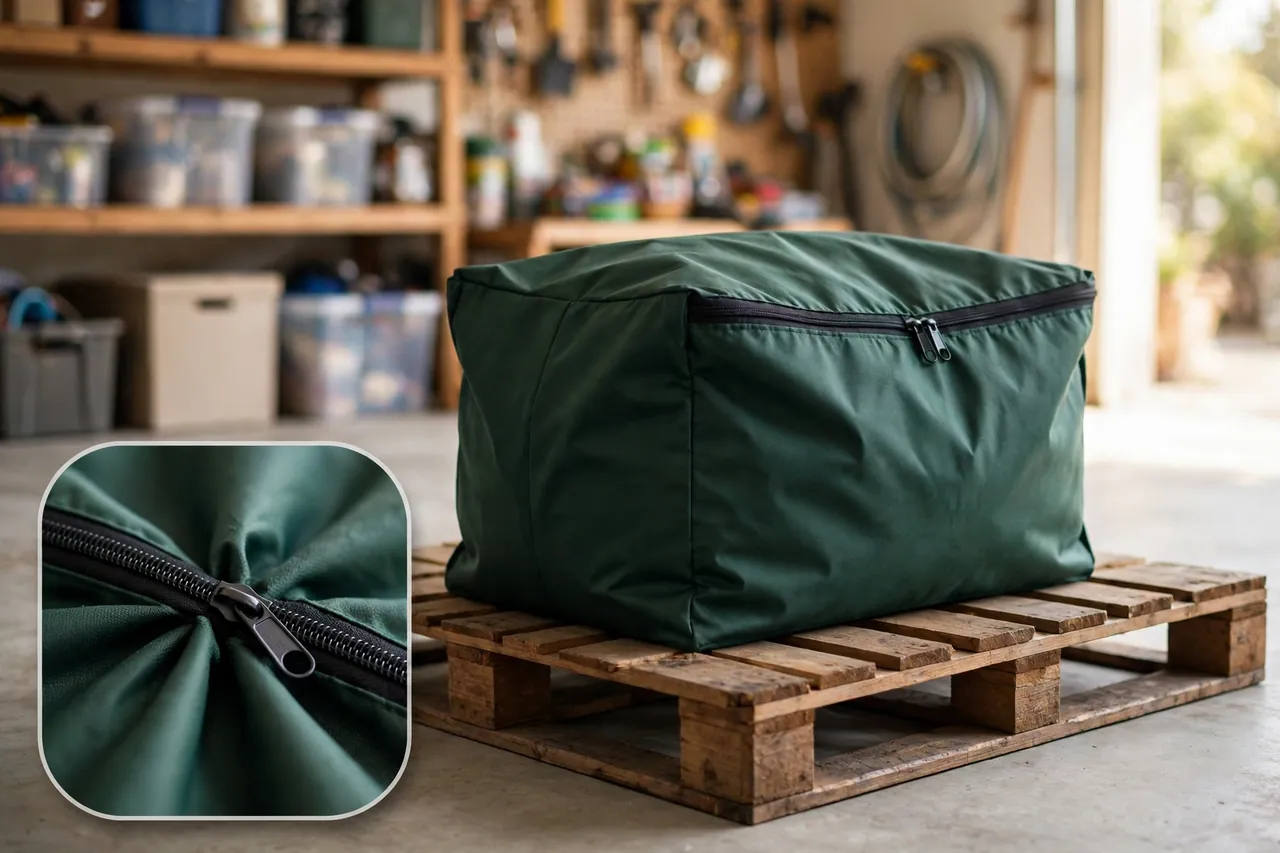
Here is why heat matters so much: artificial trees use meltable materials, and Dooley warns against spaces that get too hot. A bag in a scorching attic can warp branches and stress light wires over one summer. Cool and dry is the whole rule. If the garage is your only option, it still works for the tree, lights, and plastic decor, as long as the bag seals well and sits off the floor.
Set the bag on a shelf or a pallet, never straight on concrete, where damp creeps in. Stack nothing heavy on top of it, because pressure bends poles and flattens branches for months. And keep the bag where you can reach it without moving five other boxes, or next December starts with a wrestling match.
Special Cases: Pre-Lit, Flocked, and Slim Trees
Most trees follow the standard routine, but three types need extra care.
Pre-lit trees
Unplug the tree completely before you pack it, and never leave lights energized between seasons. Handle the wired sections gently, because a crushed wire hides until next year, when half the tree stays dark. Store spare bulbs in a small labeled pouch inside the bag, so you never hunt for them later.
Flocked and white trees
Flocking crushes easily and shows every mark, so treat these trees like guests, not cargo. An upright bag suits them best, because it skips the folding entirely. If you must take a flocked tree apart, fold loosely, never compress it tight, and keep it away from anything that rubs. Dust shows fast on white branches, so a sealed bag matters even more here. For more on caring for pale trees, see our guide to white Christmas tree decorations.
Slim and pencil trees
Slim trees are the easy win in tree storage. A 9-foot slim tree usually fits one bag, and its narrow shape slides into closets and corners that a full tree never could. Measure it anyway, because slim does not mean short, and a tall slim tree still needs a long bag.
Mistakes That Ruin a Tree in Storage
Most storage damage comes from small habits, not big accidents. Watch for these five.
- Packing a damp tree. Moisture sealed inside a bag grows mildew. Always confirm dryness before you zip.
- Sealing gaps with tape. Adhesive residue attracts dust and weakens fabric over time. Use the bag’s own zipper and fasteners instead.
- Stacking heavy boxes on top. Months of pressure deform branches and bend poles. Give the tree bag its own shelf space.
- Folding the same hinges tightly every year. Repeated stress on the same joint points wears them out. Vary your fold angles slightly each year.
- Overstuffing one bag. A strained zipper bursts at the worst moment. If it fights you, split the tree across two bags.
One more habit saves future you: when you take the tree down, note anything broken right then. A loose branch tip or a dead light string is easy to fix in January and miserable to discover next December.
What Does Not Belong in the Tree Bag
The tree bag holds the tree, its stand, and its skirt. Everything else earns its own home. Ornaments need divided boxes, because one loose ornament rattles against the rest all year. Fragile village pieces need even more care, with individual wrapping and compartments, which is why our guide to Christmas village displays treats their storage separately.
Loose light strings, spare fuses, and the remote for a pre-lit tree can ride in a small pouch inside the bag, but keep them off the branches themselves. And never toss the tree topper in loose on top of the sections. Toppers bend, and a bent topper crowns the whole tree wrong next year.
Related Guides
- Indoor Christmas Decorations
- Christmas Tree Themes
- Christmas Decor Exterior Ideas
- Christmas Decorations on Front Door
Frequently Asked Questions
Can I store my artificial tree in its original box?
Christmas Tree Themes: How to Pick a Look You Will Love All Season · White Christmas Tree Decorations: Ideas That Make Your Tree Glow · Indoor Christmas Decorations: A Room-by-Room Guide to a Warm, Festive Home
What size Christmas tree storage bag do I need?
Measure your tree’s height including the stand, plus its widest branch width, then buy a bag rated for those numbers or larger. When you sit between sizes, choose the bigger bag so branches rest instead of crushing. A 9-foot slim tree usually fits one bag, while taller or wider trees often need two.
Should I store my tree upright or take it apart?
Store it upright if you have standing space, because branches keep their shape and lights stay undisturbed, and setup takes minutes. Take it apart if space is tight: most trees split into three or more sections that fit a duffel under a bed or on a shelf. Either method beats the original box.
Can I store a pre-lit tree in a storage bag?
Yes. Unplug the tree completely, handle wired sections gently so wires never kink or crush, and keep spare bulbs in a small pouch inside the bag. Pack loosely around the light strings, and never stack heavy items on a bag holding a pre-lit tree.
Can I keep my tree bag in the garage?
Yes, if the garage stays reasonably cool and dry and the bag seals well. Set the bag off the floor on a shelf or pallet, and stack nothing on top. Skip the garage for candles, wax ornaments, and old photos, which suffer in summer heat, but the tree itself stores fine there.
How should I store an artificial Christmas tree in an apartment?
Use a tree storage bag with handles rather than the original box, and store it upright in a closet corner or flat under a bed. Keep the stand in the same bag so setup stays simple. A slim tree helps most in small spaces, since it fits narrow spots a full tree cannot.
When the last ornament comes off and the living room feels quiet again, remember that taking the tree down well is part of loving it. Pack it with care now, and next December will greet you with a tree that looks the way you remember it. If your tree stands in the living room, our guide to decorating ideas for the living room at Christmas will help you plan its return, and this bag will keep it safe until then.