The best smoke alarm and carbon monoxide detector for most homes is the Kidde 30CUA10-V at $74.97. It catches smoke and carbon monoxide in one unit, runs on house power with a 10-year backup battery, and talks to you with voice alerts. If your home has no alarm wiring, buy the battery-powered Kidde 30CUD10-V instead, also $74.97. Both prices were checked on 2026-11-05.
A combination alarm does two jobs at once. One sensor watches for smoke from a fire, and a second sensor watches for carbon monoxide, the colorless and odorless gas that faulty heaters and stoves can release. One device on the ceiling covers both dangers, so you need fewer alarms and fewer batteries to track.
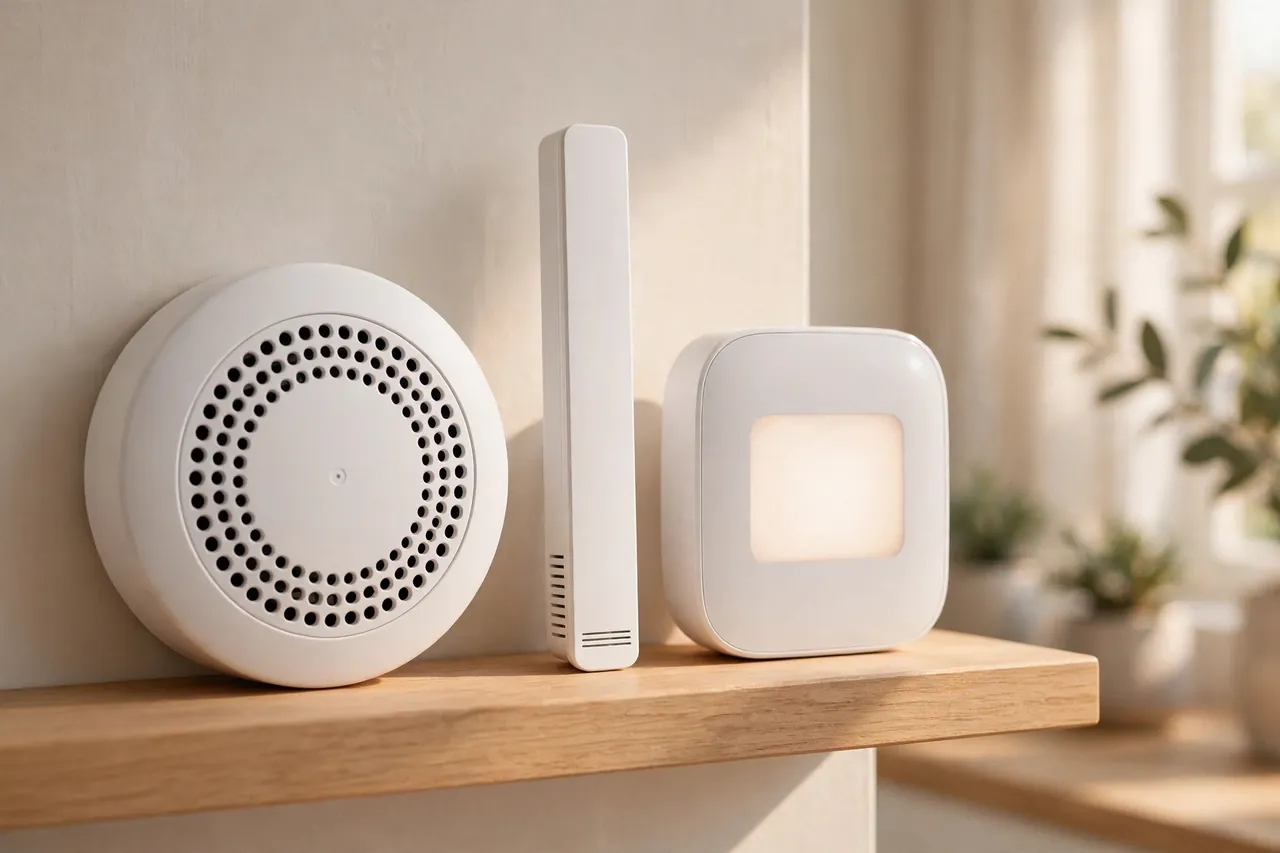
The Short Answer: Our Top Picks at a Glance
Pick by your wiring first, then by the features you want. A hardwired home should stay hardwired. A home with no alarm wiring should go with a sealed 10-year battery. Smart features matter only if you want phone alerts when you are away.
| Alarm | Best For | Power | Price Checked 2026-11-05 |
|---|---|---|---|
| Kidde 30CUA10-V | Best overall hardwired home | Hardwired, 10-year backup battery | $74.97 at Kidde |
| Kidde 30CUD10-V | Best 10-year battery, no wiring | Sealed 10-year battery | $74.97 at Kidde |
| X-Sense SC07 | Best budget pick | Sealed 10-year battery | $36.99 at Amazon |
| First Alert SC5 | Best smart pick, Nest Protect replacement | Battery, Wi-Fi | $129.99 at First Alert |
| Google Nest Protect | Best smart pick while stock lasts | Battery or hardwired | $119.00 list price |
| Kidde Ring RGCUAR-RW | Best for Ring homes | Hardwired, AA backup | $74.97 at Home Depot |
Prices change often, so check the price again before you buy. Every price in this guide names the seller and the exact model, and each one was checked on 2026-11-05.
What a Combination Smoke and CO Alarm Actually Does
A combination alarm holds two different sensors in one case. The smoke sensor watches for the tiny particles a fire sends into the air. The carbon monoxide sensor watches for CO gas, which you cannot see or smell.
Most combination alarms use a photoelectric smoke sensor. It shines a beam of light inside a small chamber. When smoke drifts in, it scatters the light, and the alarm sounds. Photoelectric sensors catch slow, smoldering fires early, the kind that start in bedding, sofa cushions, or wiring inside a wall.
Some alarms add an ionization sensor instead, or beside the photoelectric one. Ionization sensors react faster to fast, flaming fires, such as a pan fire on the stove. Dual-sensor alarms cover both fire types, but they cost more and can false-alarm near kitchens.
The CO sensor is electrochemical. It measures the CO level in the air and sounds the alarm when the level stays dangerous for a set time. Good models show the CO level on a small screen, so you can see a slow rise before the alarm trips.
One alarm cannot do everything. A combination alarm will not detect natural gas leaks, and it will not warn you about a fire behind a closed door or inside a wall until smoke reaches it. That is why placement matters as much as the model you buy.
Combination Alarm or Two Separate Detectors?
For most homes, a combination alarm is the simpler and cheaper choice. You mount one device, change one set of batteries, and test one button. You also cut the number of discs on your ceiling in half.
Separate detectors still make sense in a few spots. If your home already has good smoke coverage but no CO detection, add a plug-in CO alarm near the bedrooms instead of replacing every smoke alarm. If a room needs smoke detection but has no fuel-burning appliance nearby, a smoke-only alarm costs less.
Think about height too. Smoke rises, so a smoke alarm belongs high on a wall or on the ceiling. Carbon monoxide mixes evenly with air, so a CO alarm works at any height. A combination unit mounts high, which suits the smoke sensor and still catches CO fine.
The deciding question is simple. Do you need both protections in the same spot? In bedrooms, hallways, and near a furnace or attached garage, the answer is usually yes. Buy the combination alarm there, and use smoke-only alarms only where CO coverage already exists.
How to Choose: Hardwired, 10-Year Battery, or Smart
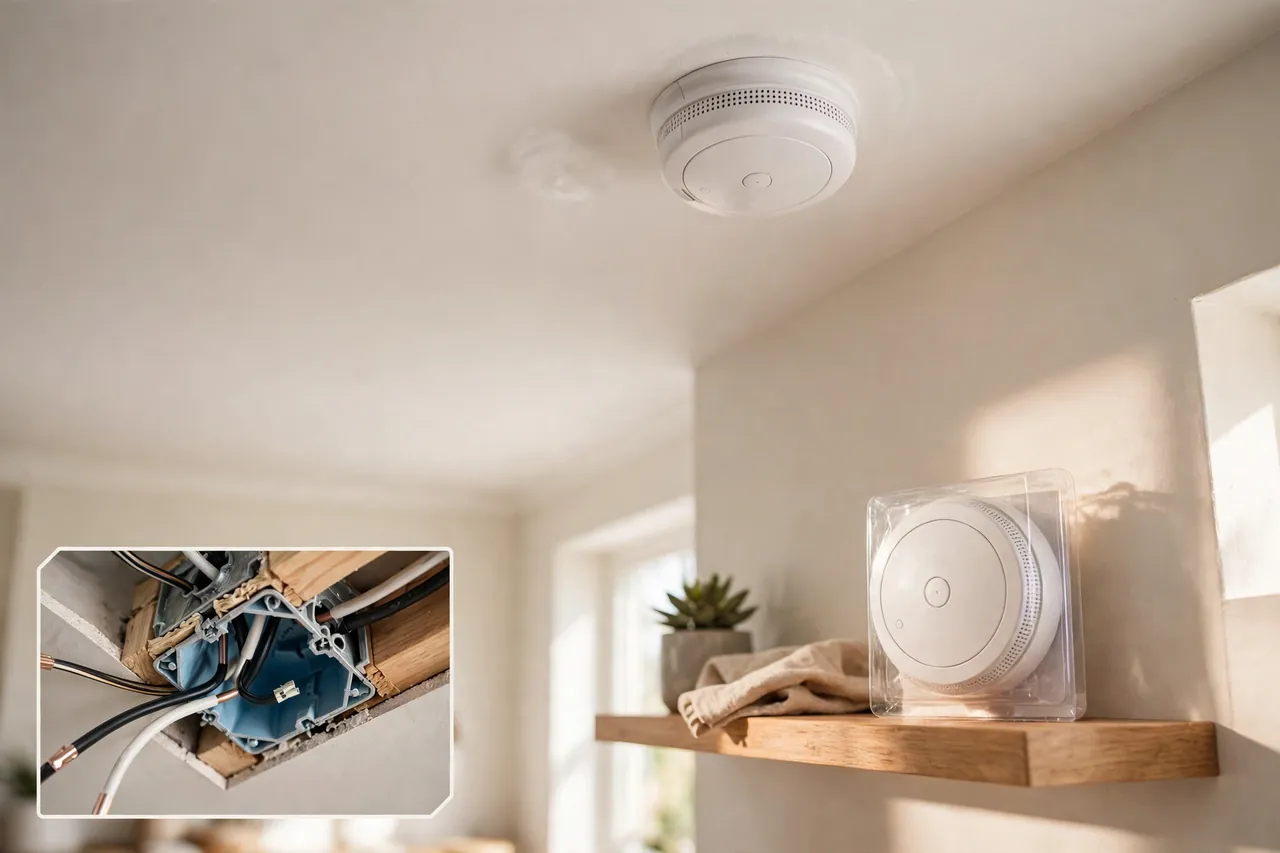
Start with what your ceiling already gives you. Take one old alarm down and read the label on the back. Note the brand, the model, the date it was made, and whether wires run into it. That label decides your whole purchase.
Hardwired alarms
Hardwired alarms draw power from your home wiring and keep a battery only as backup. When one sounds, the rest sound too through the interconnect wire. This is the safest setup for a multi-story home, because a fire in the basement wakes the bedrooms upstairs.
Hardwired alarms cost more per unit and need a wired ceiling box. If your home already has them, stay with the same brand family. Different brands often use different connectors, and mixing brands can break the interconnect link. Check the replacement model’s compatibility list before you buy a houseful.
10-year sealed battery alarms
A sealed-battery alarm runs for its whole 10-year life on one built-in battery. You never change a battery, and you never hear the 3 a.m. low-battery chirp. When the alarm reaches the end of its life, you replace the whole unit.
This is the right pick for older homes, rentals, and any room with no alarm wiring. Installation takes a drill, two screws, and ten minutes. The trade-off is interconnection. Basic sealed-battery models work alone, so each room alarms by itself unless you buy a wireless interconnected set.
Smart and Wi-Fi alarms
Smart alarms send a phone alert when they sound, name the room and the danger out loud, and let you silence a false alarm from your phone. They help most in a second home, a rental you manage from afar, or a house where nobody is home during the day.
Smart alarms cost two to three times as much as a basic combination alarm. They also need Wi-Fi and an app, and some need replaceable batteries instead of a sealed 10-year cell. Buy smart only if the phone alert solves a real problem for you. The alarm still has to do its local job first, and it does that with or without the internet.
What to check before you buy
- UL 217 listing for smoke and UL 2034 listing for CO, printed on the box or the alarm.
- A 10-year life from the manufacture date, not from the day you install it.
- Voice alerts that name the danger, so you know whether it is smoke or CO.
- An interconnect that matches the alarms you already own.
- A test and hush button you can reach without a ladder every time.
The 6 Best Combination Smoke and CO Alarms
These six cover every common home: wired or not, budget or smart, Ring or Google. Each one is a combination unit with both sensors, a UL listing, and a verified price checked on 2026-11-05.
1. Kidde 30CUA10-V: Best Overall for Hardwired Homes
The Kidde 30CUA10-V is the alarm to buy first if your home has alarm wiring. It runs on 120-volt house power, carries a built-in 10-year backup battery, and uses voice alerts to tell you whether the danger is fire or carbon monoxide. Kidde says its sensing technology detects smoke over 25 percent faster than its earlier models.
The hardwired interconnect links it to other compatible Kidde alarms, so one alarm sets off the whole house. The sealed backup battery means no yearly 9-volt change, and Kidde says it saves up to $40 in batteries over the life of the alarm. Price: $74.97 for one unit at Kidde, checked on 2026-11-05.
Buy this one if you are replacing old hardwired alarms in a Kidde system, or wiring a new home. Skip it if you have no ceiling wiring, because you would pay an electrician to add it.
2. Kidde 30CUD10-V: Best 10-Year Battery Alarm
The Kidde 30CUD10-V is the same idea without the wires. It is a battery-powered combination alarm with a sealed 10-year battery and voice alerts. You mount it, test it, and forget about batteries for a decade.
It suits older homes, apartments, and rentals where running new wiring makes no sense. It does not interconnect by wire, so buy one for each spot that needs coverage and test each one on its own. Price: $74.97 for one unit at Kidde, checked on 2026-11-05.
Buy this one if any room in your home has no alarm wiring. It is the simplest safe choice, and the voice alert removes the guesswork when it sounds at night.
3. X-Sense SC07: Best Budget Pick
The X-Sense SC07 gives you both sensors, a sealed 10-year battery, and a small screen that shows the live CO level, for about half the price of the Kidde models. It uses a photoelectric smoke sensor and an electrochemical CO sensor, and it carries UL 217 and UL 2034 listings.
The screen is the real win at this price. You can see a CO reading climb before the alarm trips, which helps you spot a slow problem early. The plain SC07 works alone, with no interconnection and no app. If you want linked alarms, step up to the SC07-W, which wirelessly links up to 24 units. Price: $36.99 for one SC07 at Amazon, list price $42.99, checked on 2026-11-05.
Buy this one if you need to cover several rooms on a tight budget. A three-bedroom home can get full combination coverage for roughly the cost of two premium alarms.

4. First Alert SC5: Best Smart Pick and Nest Protect Replacement
The First Alert SC5 is the smart alarm to buy now that Google has stopped making the Nest Protect. First Alert built it to work with and replace Nest Protect, and it connects through the Resideo Connect app and Google Home.
The battery model, SMCO600NV, pairs a photoelectric smoke sensor with an electrochemical CO sensor. It speaks voice alerts with a heads-up warning, names the type and location of the danger, and sends phone alerts when smoke or CO is detected. It also links wirelessly with compatible First Alert and Nest Protect alarms, so a mixed house still sounds together. Price: $129.99 for the battery model at First Alert, checked on 2026-11-05. A hardwired version, SMCO600NV-AC, costs the same $129.99.
Note the battery trade-off. The SC5 uses six replaceable CR123A lithium batteries, not a sealed 10-year cell. You gain phone alerts and Nest compatibility, and you give up the fit-and-forget battery. Buy this one if you are replacing Nest Protect alarms or building a smart system around Google Home.
5. Google Nest Protect: Best Smart Alarm While Stock Lasts
The Google Nest Protect is still the most polished smart smoke and CO alarm ever sold. Its split-spectrum sensor catches fast and slow fires, it speaks room-specific warnings, it tests itself daily, and it sends phone alerts with no monthly fee. Wirecutter named it its top smart smoke alarm pick for three years running.
The catch is supply. Google stopped making the Nest Protect in 2025, so new stock is finite and prices swing. The list price is $119.00, and sale prices near $99 have appeared on Amazon. If you already own Nest Protect alarms, buying one more to complete the set makes sense. If you are starting fresh, buy the First Alert SC5 instead, because it is the supported replacement. Price: $119.00 list price, checked on 2026-11-05.
Buy this one only if you find genuine new stock at a fair price and you already live in the Google Home world. Do not pay a scalper price for it.
6. Kidde Ring RGCUAR-RW: Best for Ring Homes
The Kidde Ring RGCUAR-RW is a hardwired combination alarm that talks to the Ring app. When smoke or CO is detected, your phone gets a fast notification, even if you are miles away. It uses two AA batteries for backup and links wirelessly with up to 24 compatible Kidde devices.
Ring offers optional 24/7 professional smoke and CO monitoring for $5 a month, but the alarm and its phone alerts work without a subscription. That makes it a strong pick for a vacation home, a rental, or any house that sits empty during the day. Price: $74.97 for one unit at Home Depot, checked on 2026-11-05. Ring lists the same model at $74.98.
Buy this one if Ring already runs your doorbell or cameras. If you do not use Ring, the plain Kidde 30CUA10-V gives you the same detection for the same money, with a 10-year backup battery instead of AA cells.
Where to Put Combination Alarms (and Where Not To)
The National Fire Protection Association recommends a smoke alarm inside every bedroom, outside each separate sleeping area, and on every level of the home, including the basement. Carbon monoxide alarms belong outside each sleeping area and on every level too, and near an attached garage.
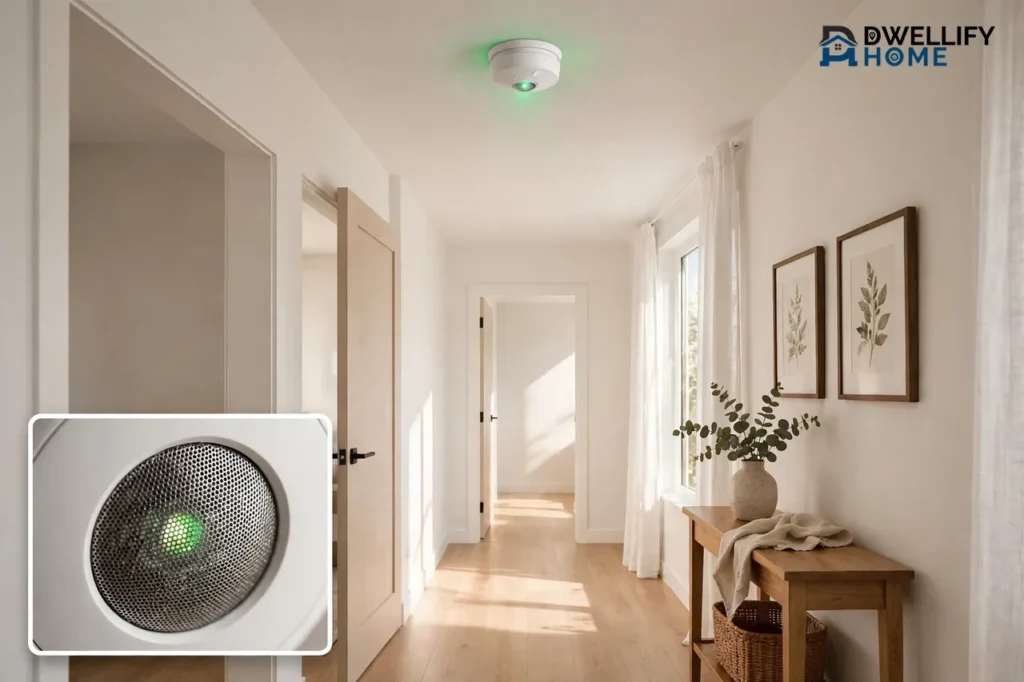
Mount combination alarms on the ceiling or high on a wall, within 12 inches of the ceiling. Smoke rises, so height is what lets the sensor catch it early. Keep alarms at least 10 feet from the stove to cut down on cooking false alarms.
| Spot in the Home | Put a Combination Alarm Here? | Why |
|---|---|---|
| Inside each bedroom | Yes | You need the warning while you sleep |
| Hallway outside bedrooms | Yes | Catches smoke and CO before they reach sleepers |
| Every level, including basement | Yes | Fire and CO start low as often as high |
| Near the furnace or water heater | Yes, outside the room | Fuel-burning appliances are the main CO source |
| Near an attached garage | Yes | A running car can push CO into the house |
| Kitchen, right over the stove | No | Cooking smoke causes false alarms |
| Bathroom or steamy room | No | Steam trips the smoke sensor |
| Inside the garage | No | Exhaust and dust cause false alarms |
Check your state and local code too. Some states require alarms in more spots, and rentals often have their own rules. The manufacturer’s instructions that come in the box always win over a general guide when they disagree.
Fuel-burning heat is the biggest CO risk in winter. A gas furnace, a boiler, or a propane heater all burn fuel, and a cracked heat exchanger or a blocked flue can spill CO into the living space. That is why the alarm near the heating equipment matters most in the cold months. Heating season is also the right time to run through the full checklist in our guide on how to winterize a house.
How Many Alarms Does Your Home Need?
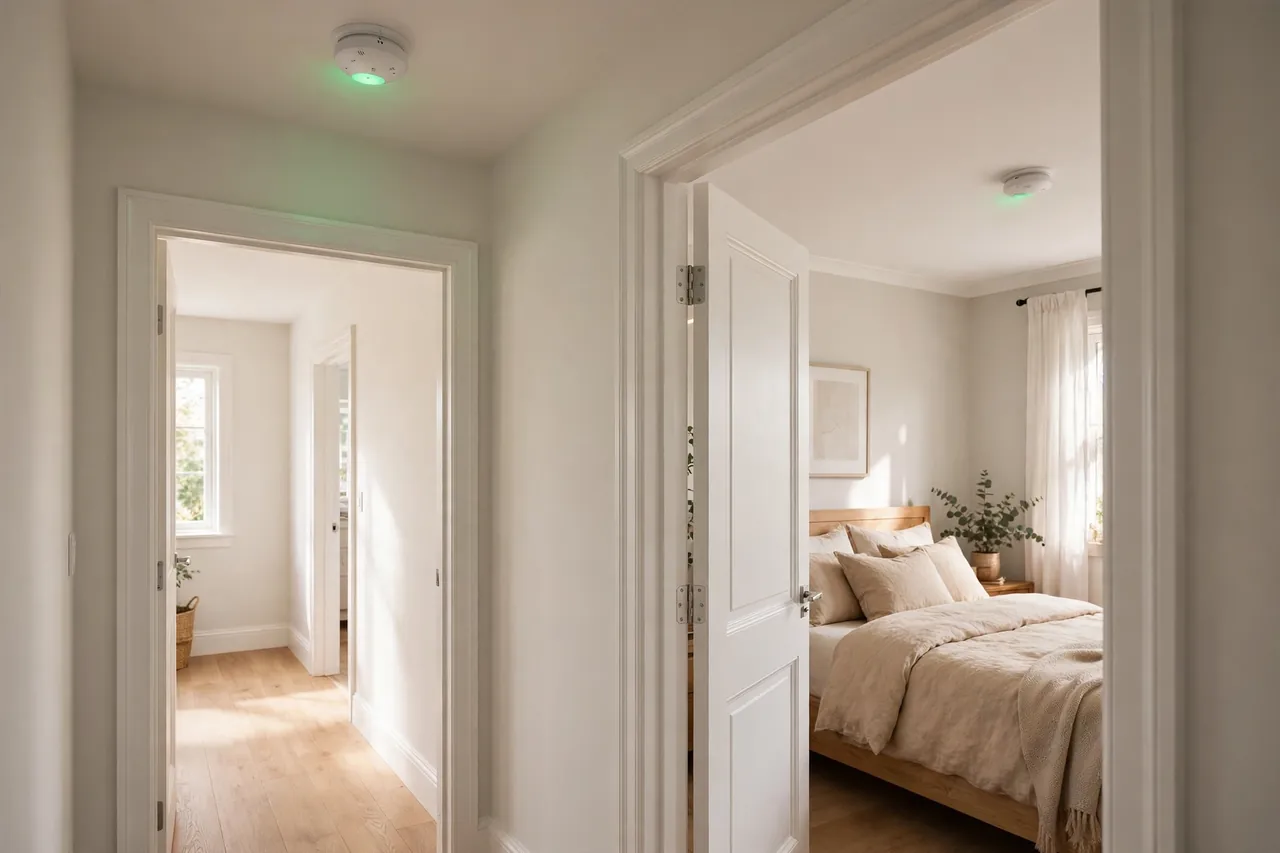
Count rooms, not devices. A typical two-story, three-bedroom home needs about six or seven alarms: one inside each bedroom, one in the hallway outside them, one on the ground floor living area, and one in the basement. A one-story apartment may need only two or three.
Use combination alarms in the spots that need CO protection, and smoke-only alarms where CO coverage already exists. Buying a combination alarm for every single spot is safe but wasteful. Buying too few is the real risk.
Walk your home with a notepad before you order. List every bedroom, every hallway, every level, and every fuel-burning appliance. Then match one alarm to each line. Order all of them at once, so you install them in one session instead of living with gaps for weeks.
Budget a rough total before you shop. At $36.99, six X-Sense SC07 alarms cost about $222. At $74.97, six Kidde alarms cost about $450. Smart alarms at $129.99 each push the same home past $750. Pick the tier that fits the house, not the tier that impresses the shelf.
How to Test and Maintain Your Alarms
Press the test button on every alarm at least once a month. A green light is not a test. The button proves the horn, the sensor, and the battery all still work together. If an alarm does not respond, replace it right away.
Dust each alarm monthly with a soft brush or a vacuum on low. Dust blocks the sensor chamber and causes false alarms or slow alarms. Never paint over an alarm, and never cover it with a plastic bag while you paint a room.
Replace every smoke alarm 10 years after the date printed on its back. The sensors wear out even if the test button still beeps. Combination alarms can have their own service life, so read the label and the manual. When one alarm in a set hits 10 years, check the dates on the rest, because alarms installed together usually expire together.
Write the install date on each alarm with a marker when you mount it. That one habit removes all guessing later, and it takes ten seconds per alarm.
What to Do When an Alarm Sounds
Learn the two sounds before you ever need them. Most combination alarms beep three times for smoke and four times for carbon monoxide, with a voice alert naming the danger on models that speak. Read your manual once, so the pattern is familiar.
If the smoke alarm sounds, get everyone out of the house first, then call 911 from outside. Do not stop to grab things, and do not go back inside. If the CO alarm sounds, get everyone into fresh air at once, call 911 or your local emergency number, and do not re-enter until firefighters or a qualified technician clear the home.
Never silence an alarm and go back to sleep. A silenced alarm is not a solved problem. If the alarm sounds again after you air the house out, treat it as real and get help.
Power outages deserve a special note. A storm can knock out power for hours, and that is exactly when people bring out generators and space heaters. Keep alarms working through the outage, run generators outside only, and never heat the house with a stove or grill. Our guide to staying warm without power covers safe heat options for an outage.
Mistakes to Avoid When Buying
- Buying a smoke-only alarm when the room also needs CO protection, then finding out later.
- Mixing brands in a hardwired interconnect system and losing the link between alarms.
- Choosing the cheapest alarm with no UL 217 and UL 2034 listings on the box.
- Mounting an alarm right over the stove or in a steamy bathroom, then disabling it after false alarms.
- Forgetting the manufacture date and keeping a 12-year-old alarm because it still beeps.
- Buying one smart alarm for a big house and leaving the other rooms unprotected.
- Paying a scalper price for a discontinued Nest Protect when the First Alert SC5 does the same job.
Related Guides
Best Indoor Propane Heater: 6 Safe Picks for Warm Rooms · How to Stay Warm Without Power: A Winter Outage Guide That Puts Safety First · How to Insulate an Attic: A Step-by-Step Guide That Starts With Air Sealing
Frequently Asked Questions
What is the best smoke and carbon monoxide detector?
For a conventional hardwired home, the Kidde 30CUA10-V is the best pick, at $74.97 checked on 2026-11-05. It combines smoke and CO detection with a 10-year backup battery, voice alerts, and hardwired interconnection. The best choice changes if your home already has a First Alert, BRK, or Kidde interconnected system, because staying in the same brand family keeps the alarms linked.
Should I buy separate smoke and CO detectors or a combination alarm?
Buy a combination alarm in most spots. It simplifies installation, cuts the number of devices on the ceiling, and covers both dangers at once. Separate alarms make sense where you need extra smoke coverage but already have enough CO detection, or where you only need to add CO protection to a room that already has a good smoke alarm.
Are 10-year smoke detector batteries really good for 10 years?
Yes, sealed long-life alarms are designed so the battery needs no routine replacement during the alarm’s service life. You should still test the alarm every month with the test button. Replace any unit that fails its test or reaches its printed end-of-life date, even if the battery has never been changed.
Can I replace a hardwired smoke detector with any brand?
No, do not assume so. Hardwired alarms can use different electrical connectors and interconnect rules. Check the replacement model’s compatibility information before you mix brands or change brands in an existing system. The wrong plug can leave the new alarm unpowered or break the link to the other alarms.
How often should I test smoke alarms?
Test every smoke alarm at least once a month with the test button. Press and hold the button until the alarm sounds, then let it reset. Replace any alarm that does not respond properly. Monthly testing is the recommendation from the National Fire Protection Association and the Consumer Product Safety Commission.
What is the best smart smoke detector after Nest Protect?
The First Alert SC5 is the best smart pick after Nest Protect. First Alert designed it to work with and replace Nest Protect, and it supports Google Home, phone alerts, and voice warnings. The Kidde Ring Smart Smoke and CO Alarm is the strong alternative for homes built around Ring.
A Short Safety Note Before You Buy
This guide helps you choose and place alarms, but it does not replace your local fire code, your alarm manual, or a qualified electrician for hardwired work. Homes, wiring, and local rules vary, and a licensed pro should handle any wiring you are not sure about. Alarms warn you about danger, but they do not fix a faulty furnace or a blocked flue, so get fuel-burning appliances checked by a qualified technician every year.
Start today with the label check. Take one old alarm down, read its date, and count what your home still needs. Then order the alarms that match your wiring, mount them high, test them monthly, and replace them at 10 years. That is the whole job, and it is one of the cheapest safety upgrades a home can get.