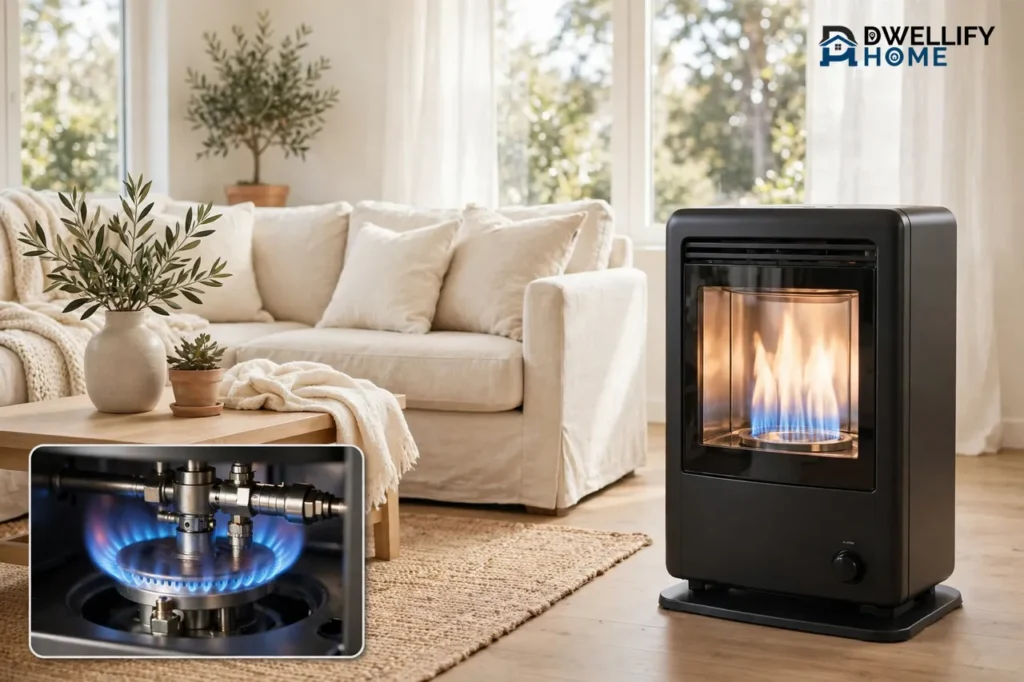
The best indoor propane heater for most homes is the Mr. Heater Portable Buddy MH9BX. It costs $97.23, puts out 4,000 to 9,000 BTU, and heats rooms up to 225 square feet. It carries an oxygen depletion sensor and a tip-over shut-off, and the maker rates it safe for indoor use. But no propane heater is safe to run without care. You still need fresh air, a working carbon monoxide alarm, and the manual open in front of you before the first light.
This guide covers only heaters rated for indoor use. It shows you how to tell an indoor-safe heater from an outdoor-only one, compares six heaters with verified prices checked on 2026-11-05, and walks through running costs, sizing, and the safety steps that matter most.
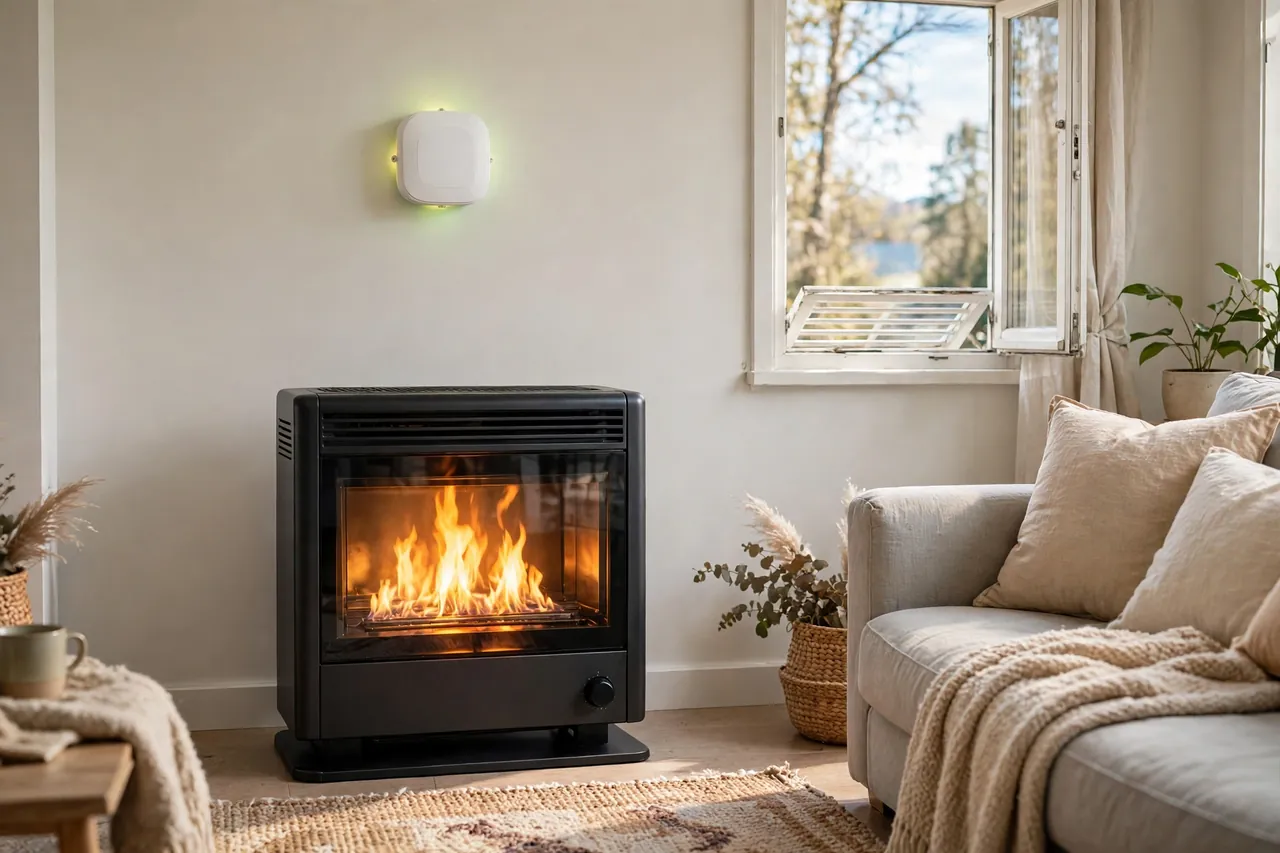
Read This First: Indoor Propane Heaters and Carbon Monoxide
Burning propane uses oxygen from your room and makes carbon monoxide, a gas you cannot see or smell. In a closed room, carbon monoxide can rise to a deadly level fast. That is the whole risk in one sentence, and it shapes every choice in this guide.
The U.S. Consumer Product Safety Commission (CPSC) warns that portable heaters play a role in an average of 1,600 fires a year, with an average of 70 deaths and 150 injuries a year from 2020 to 2022. The CPSC also says to turn off heaters when you sleep, keep them at least three feet from drapes, furniture, and bedding, and never refuel a fuel-burning heater while it runs. You can read the full warning on the CPSC winter heating safety page.
Follow three rules every time you run a propane heater indoors. First, use only a heater the maker clearly rates for indoor use. Second, crack a window or door for fresh air, exactly as the manual says. Third, run a battery-powered carbon monoxide alarm in the same room, and test it before you light the heater. If the alarm sounds, turn the heater off, open doors and windows, leave the house, and call for help from outside.
Never run a propane heater while you sleep, and never leave one running in a room with no one in it. If you want backup heat for a power outage, pair your heater plan with the steps in our guide on how to stay warm without power.
What Makes a Propane Heater Safe to Use Indoors?
An indoor-safe propane heater is built to a different standard than a patio heater. Four features separate the safe picks from the rest.
An oxygen depletion sensor, called an ODS, watches the oxygen level in the room. If oxygen drops too low, the sensor shuts the heater off. Look for the words “oxygen depletion sensor” or “low oxygen shut-off” on the box and in the manual. An ODS is not a carbon monoxide detector, though. It guards oxygen, not carbon monoxide, so you still need a separate alarm.
A tip-over shut-off kills the flame if the heater falls over. This matters most in homes with kids, pets, or uneven floors. Every heater in this guide has one.
A clear indoor rating from the maker is the third feature. The manual must say the model is approved for indoor use. A listing that says “indoor/outdoor” counts only if the manual agrees. If the manual says outdoor only, believe the manual.
The fourth feature is the safety standard behind the label. Indoor-rated portable propane heaters are commonly certified under ANSI Z21.11, the standard for unvented room heaters, and camp-style heaters under ANSI Z21.103. You do not need to memorize the numbers. Just check that the heater carries a recognized certification mark and an ODS before you buy. The University of Alaska Fairbanks Extension guide on space heater safety gives the same advice: use only heaters that carry a UL label, and check the manual to confirm the heater can be used in normal living space.
Indoor-Safe vs Outdoor-Only: How to Tell the Difference
Many heaters look alike on a store shelf. The label and the manual tell the real story. Use this table before you buy.
Table: How to spot an indoor-safe propane heater
| Check | Indoor-safe heater | Outdoor-only heater |
|---|---|---|
| Maker rating | Manual says approved for indoor use | Manual says outdoor use only |
| Oxygen sensor | Has an ODS or low-oxygen shut-off | No ODS listed |
| Tip-over shut-off | Yes, listed in the specs | Often missing |
| Common types | Radiant Buddy-style heaters, vent-free wall heaters, catalytic heaters | Forced-air torpedo heaters, most tank-top heaters, patio heaters |
| Where it runs | Ventilated room with a CO alarm | Outside only, never in a home, garage, tent, or shed |
Forced-air torpedo heaters and most tank-top heaters sit firmly in the outdoor-only group. They push out huge heat with no ODS, and they can flood a closed space with carbon monoxide. A patio heater belongs outside too. “Portable” does not mean indoor-safe.
Vent-free wall heaters need one more check. They burn room air, so local rules restrict them in some states and cities. They are not sold in California, and some models are not sold in Massachusetts or Canada. Check your local code before you order, and never install a 20,000 or 30,000 BTU vent-free heater in a bedroom or bathroom.
The 6 Best Indoor Propane Heaters
Every heater below is rated for indoor use by its maker, carries an ODS and a tip-over shut-off, and has a price verified on 2026-11-05. Prices change with sales and stock, so treat each one as a checked price on that date, not a promise. The table gives the quick view. The sections below it give the detail.
Table: The 6 best indoor propane heaters compared
| Heater | Price | Heat | Room size | Safety |
|---|---|---|---|---|
| Mr. Heater Portable Buddy MH9BX | $97.23 | 4,000-9,000 BTU | Up to 225 sq ft | ODS, tip-over shut-off |
| Mr. Heater Big Buddy MH18B | $144.99 | 4,000-18,000 BTU | Up to 450 sq ft | ODS, tip-over shut-off |
| Mr. Heater Little Buddy MH4B | $72.92 | 3,800 BTU | Up to 95 sq ft | ODS, tip-over shut-off |
| Mr. Heater Buddy FLEX MH11BFLEX | $129.00 | 8,000-11,000 BTU | Up to 275 sq ft | ODS, tip-over shut-off |
| Mr. Heater Vent-Free Blue Flame 20,000 BTU | $199.99 | 20,000 BTU | Up to 700 sq ft | Dual ODS, thermostat |
| DEWALT DXH12B | $229.00 | 6,000-12,000 BTU | Up to 300 sq ft | ODS, tip-over shut-off |
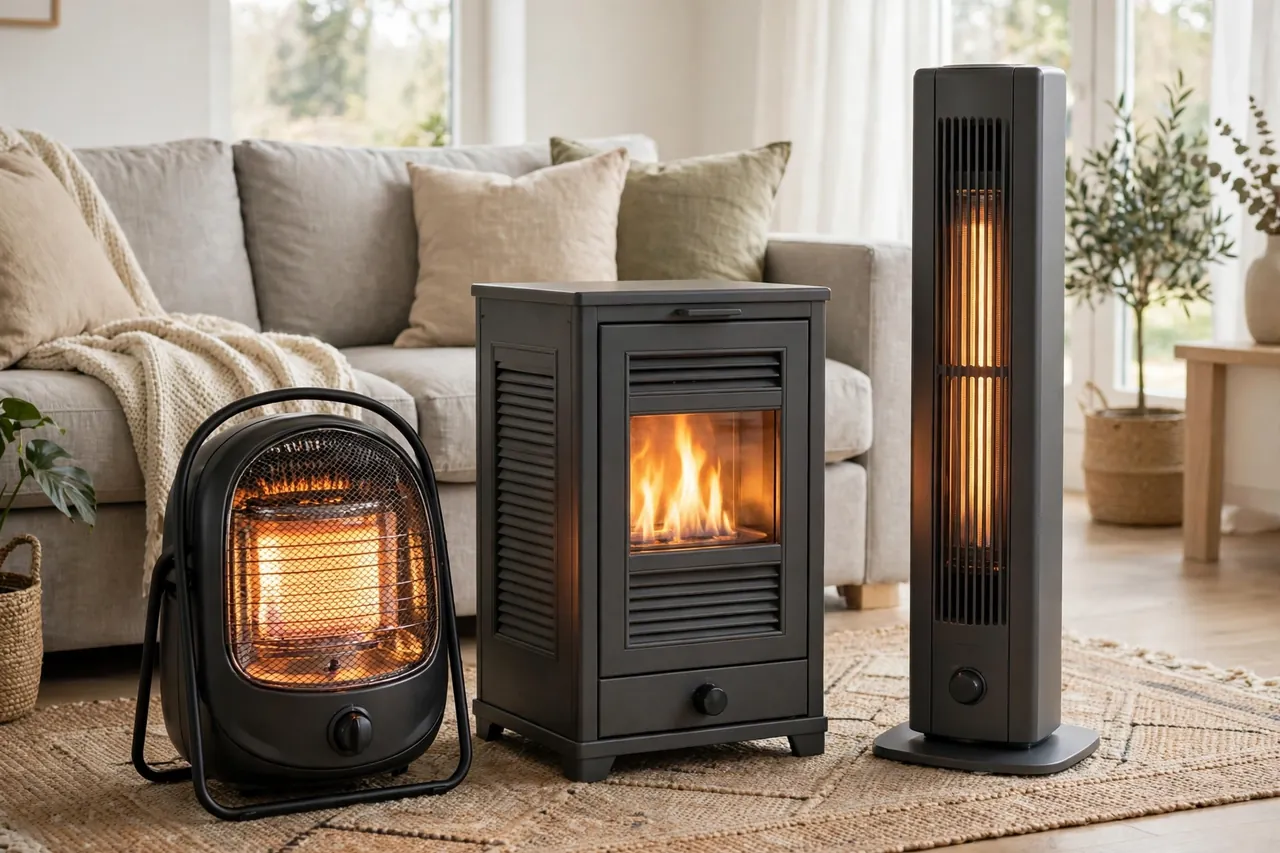
1. Mr. Heater Portable Buddy MH9BX: Best Overall
The Portable Buddy is the best indoor propane heater for most people because it hits the sweet spot on heat, size, and price. Its two settings give 4,000 BTU on low and 9,000 BTU on high, which covers a bedroom, office, or living room up to 225 square feet. It weighs about 10.6 pounds, so you can carry it from room to room with one hand.
It runs on a single 1 lb propane cylinder, or on a 20 lb tank with a hose and filter. A 1 lb cylinder lasts about 3 to 6 hours, depending on the setting. That short runtime is the main weakness. For a multi-day outage, connect a 20 lb tank and keep spare cylinders ready.
Price: $97.23 at KYGUNCO for the standard MH9BX, checked on 2026-11-05. Watch out for the Massachusetts and Canada version, which looks almost the same but is not indoor-approved. Check the model code on the box before you pay.
2. Mr. Heater Big Buddy MH18B: Best for Large Rooms
The Big Buddy is the pick when one room is not enough. It offers three settings, 4,000, 9,000, and 18,000 BTU, and heats open spaces up to 450 square feet. It takes one or two 1 lb cylinders, or a 20 lb tank with a hose, which makes it the best choice for a multi-day outage in a big living room or finished basement.
It costs more and weighs more than the Portable Buddy, and it is overkill for a single small bedroom. Some recent units ship without the circulation fan that older versions had, so check the box if a fan matters to you.
Price: $144.99 at Northern Tool for the standard MH18B, checked on 2026-11-05. Tractor Supply lists the Big Buddy Pro version at $159.99.
3. Mr. Heater Little Buddy MH4B: Best Budget Pick
The Little Buddy is the cheapest safe way to heat one small space. It puts out a fixed 3,800 BTU and covers rooms up to 95 square feet, which fits a small bedroom, a tent, or a cabin nook. A single 1 lb cylinder runs it for about 5 to 6 hours, the longest runtime per cylinder in this guide.
It takes 1 lb cylinders only, with no hose option for a big tank. That limits it to short outages and single rooms. If you need to heat a living room, step up to the Portable Buddy.
Price: $72.92 at KYGUNCO for the MH4B, checked on 2026-11-05.
4. Mr. Heater Buddy FLEX MH11BFLEX: Best Flexible Design
The Buddy FLEX sits between the Portable Buddy and the Big Buddy. It puts out 8,000 to 11,000 BTU from an omni-directional burner that spreads heat in a full 180-degree arc, and it covers up to 275 square feet. It lights with an electric starter and runs about 3.5 hours on a single 1 lb cylinder.
Pick the FLEX when you want more heat than the Portable Buddy and a wider heat spread for a group sitting around it, without jumping to the bulk of the Big Buddy. Walmart has sold it as low as $99 on sale, against a list price near $149.
Price: $129.00 at Home Depot for the MH11BFLEX, checked on 2026-11-05.
5. Mr. Heater Vent-Free Blue Flame 20,000 BTU: Best Wall-Mounted Pick
This is the only fixed heater in the guide. It mounts on a wall or stands on feet, needs no vent and no electricity, and heats spaces up to 700 square feet with a steady blue-flame burner. A built-in thermostat holds the room temperature, and dual oxygen depletion sensors guard both fuel settings.
It runs on a plumbed propane supply, not on 1 lb cylinders, so plan for a gas line and a qualified installer. It is a supplemental heater, not a furnace replacement. Check local rules first, since vent-free heaters face limits in some states, and never put a 20,000 BTU unit in a bedroom or bathroom.
Price: $199.99 at Tractor Supply for the 20,000 BTU dual-fuel blue-flame model, checked on 2026-11-05. A 30,000 BTU version that covers up to 1,000 square feet lists at $219.99 at the same store.
6. DEWALT DXH12B: Best for Job Sites and Power Outages
The DEWALT DXH12B is a 6,000 or 12,000 BTU radiant heater built for rough use. It lights with a push button, runs a fan and an LED light bar off DEWALT 20V batteries, and adds three USB ports to charge phones during an outage. It heats rooms up to 300 square feet and runs up to 7 hours on low with two 1 lb cylinders.
It costs the most in this guide, and batteries and charger sell separately. Owners also note the fan runs loud at one speed. Buy it if you already own DEWALT 20V batteries or want a heater that doubles as a work light and phone charger.
Price: $229.00 at Lowe’s for the DXH12B, checked on 2026-11-05.
How Much Does It Cost to Run a Propane Heater?
The heater price is only half the cost. Fuel is the other half, and the gap between small cylinders and big tanks is wide.
A single 1 lb Coleman cylinder costs $5.49 at Target, and a 2-pack costs $9.99, checked on 2026-11-05. A 20 lb tank refill typically costs $15 to $25, based on 2026 retail prices. That works out to roughly $5 per pound of propane in small cylinders against about $1 to $1.25 per pound from a big tank refill. Small cylinders cost about four times more per pound.
A 1 lb cylinder holds about 21,000 to 22,000 BTU of energy. Run the math for the Portable Buddy. On high at 9,000 BTU, one cylinder lasts about 2.5 hours. On low at 4,000 BTU, it lasts about 5.5 hours. At $5.49 a cylinder, that is roughly $1 to $2.30 an hour on small cylinders. A 20 lb tank holds about 430,000 BTU, so the same heater runs about 48 hours on high or over 100 hours on low. At a $20 refill, that drops the cost to roughly $0.20 to $0.45 an hour.
Table: What an hour of heat costs
| Heater and setting | On 1 lb cylinders | On a 20 lb tank |
|---|---|---|
| Portable Buddy on low, 4,000 BTU | About $1.00 an hour | About $0.20 an hour |
| Portable Buddy on high, 9,000 BTU | About $2.30 an hour | About $0.45 an hour |
| Big Buddy on high, 18,000 BTU | About $4.60 an hour | About $0.85 an hour |
The lesson is simple. Buy small cylinders for short use and easy storage. For a real outage, connect a 20 lb tank with the right hose and filter, and keep the tank itself outside with the hose running in, exactly as the manual allows.
How to Pick the Right Size
Size your heater to the room, not to the store shelf. Plan for about 30 to 40 BTU per square foot. A 100 square foot bedroom needs about 3,000 to 4,000 BTU, so the Little Buddy fits. A 225 square foot living room needs about 6,750 to 9,000 BTU, which is the Portable Buddy on high. A 450 square foot open space needs about 13,500 to 18,000 BTU, which is the Big Buddy on high.
A heater that is too small never catches up in a cold room, and you will run it flat out all day. A heater that is too big burns fuel fast and cycles on and off. Measure the room first, then match the BTU range. For drafty rooms, old windows, or high ceilings, pick the next size up rather than the bare minimum.
Remember the elevation limit too. Most Buddy-style heaters may shut off above 7,000 feet, and vent-free heaters can struggle above 4,500 feet. If you live high up, check the manual for your altitude before you buy.
How to Use an Indoor Propane Heater Safely
Safe use is a routine, not a single step. Walk through this list every time you light the heater.
- Read the manual for your exact model before the first use, and keep it near the heater.
- Test the carbon monoxide alarm in the room and put fresh batteries in it if it is battery powered. If you do not have an alarm yet, read our guide on the best smoke alarm and carbon monoxide detector before you buy a heater.
- Open a window a crack or leave a door open to the rest of the house, as the manual directs. Fresh air is not optional.
- Set the heater on a flat, stable, non-flammable surface, at least three feet from drapes, furniture, bedding, and anything else that can burn.
- Check the cylinder and hose connections for leaks with soapy water. Bubbles mean a leak. Turn the gas off and fix it before you light anything.
- Light the heater as the manual says, usually with the piezo igniter, and stay in the room while it runs.
- Turn the heater off before you sleep, before you leave the house, and before you refuel. Let it cool fully before you swap a cylinder.
If you feel a headache, dizziness, nausea, or confusion while a heater runs, treat it as an emergency. Turn the heater off, get outside into fresh air, and call for help. Do not go back inside to grab things.
Mistakes to Avoid With Indoor Propane Heaters
Most accidents come from a small shortcut, not a broken heater. Skip these mistakes and you skip most of the risk.
- Never bring an outdoor-only heater indoors. Torpedo heaters, patio heaters, and most tank-top heaters are not indoor-safe, no matter how cold the room feels.
- Never run any propane heater while you sleep. The CPSC says to turn heaters off at bedtime, and every maker manual says the same.
- Never trust an ODS in place of a carbon monoxide alarm. The sensor guards oxygen. Only an alarm warns you about carbon monoxide.
- Never store a 20 lb tank indoors. Keep big tanks outside and run a hose in only if the heater and manual allow it.
- Never seal the room tight to keep the heat in. A sealed room starves the flame of oxygen and lets carbon monoxide build up.
- Never use a heater with a damaged hose, a cracked cylinder, or a pilot light that will not stay lit. Replace the part or the heater.
- Never buy the Massachusetts or Canada version of a Buddy heater and expect indoor approval. That version is not indoor-rated, even though the box looks the same.
When your furnace quits in cold weather, a portable heater can bridge the gap, but it is not a repair. Read why your furnace quits on the coldest night of the year to find the cause and know when to call a pro.
Related Guides
How to Stay Warm Without Power: A Winter Outage Guide That Puts Safety First · Best Smoke Alarm and Carbon Monoxide Detector: 6 Combination Alarms That Protect Your Home · How to Keep Pipes From Freezing Without Heat
Frequently Asked Questions
Are propane heaters safe to use indoors during a power outage?
Yes, but only heaters designed for indoor use. They include an oxygen-depletion sensor that shuts the heater off before carbon monoxide reaches a dangerous level. You still need ventilation and a working CO alarm in the room. Heaters without an ODS, including most forced-air torpedo heaters, are for outdoor or garage use only.
What size propane heater do I need to heat a room?
Plan for about 30 to 40 BTU per square foot. A 95 sq ft bedroom is covered by the 3,800 BTU Little Buddy, a 225 sq ft room suits the 9,000 BTU Portable Buddy, and an open 450 sq ft living area calls for the 18,000 BTU Big Buddy. Undersized heaters will not make enough of a difference in a cold room.
How long will a propane heater run during an outage?
A 1 lb cylinder runs a small heater roughly 3 to 6 hours. A 20 lb tank connected by hose runs a Portable Buddy for more than a day and a Big Buddy for days at lower settings. For a multi-day outage, plan on a 20 lb tank or a stack of cylinders, not a single bottle.
Do indoor propane heaters work without electricity?
Yes. Indoor propane heaters run entirely on propane and light by piezo igniter or battery, so they work with the grid down. Only the DEWALT DXH12B uses a battery for its electronic ignition and fan, and it still needs no wall power to produce heat.
Do ventless propane heaters still need ventilation?
Yes. Even ventless heaters burn oxygen and produce trace emissions, which creates a carbon monoxide risk in enclosed spaces. Cracking a window or roof vent is usually enough to maintain safe airflow. Follow your manual and local rules, and always run a carbon monoxide alarm in the room.
Disclaimer
Propane heaters involve fire and carbon monoxide risk. This guide is general information, not installation or safety advice for your home. Always follow your heater manual and local codes, and ask a qualified pro for gas line work or if anything about your heater seems wrong. Homes, heaters, and local rules vary, so what fits one house may not fit yours.
Start with the Portable Buddy if you want one safe heater for a normal room. Step up to the Big Buddy for a large open space, or pick the vent-free wall heater for steady heat in a cabin or addition. Whatever you buy, buy the carbon monoxide alarm first, read the manual, and never run a heater while you sleep.