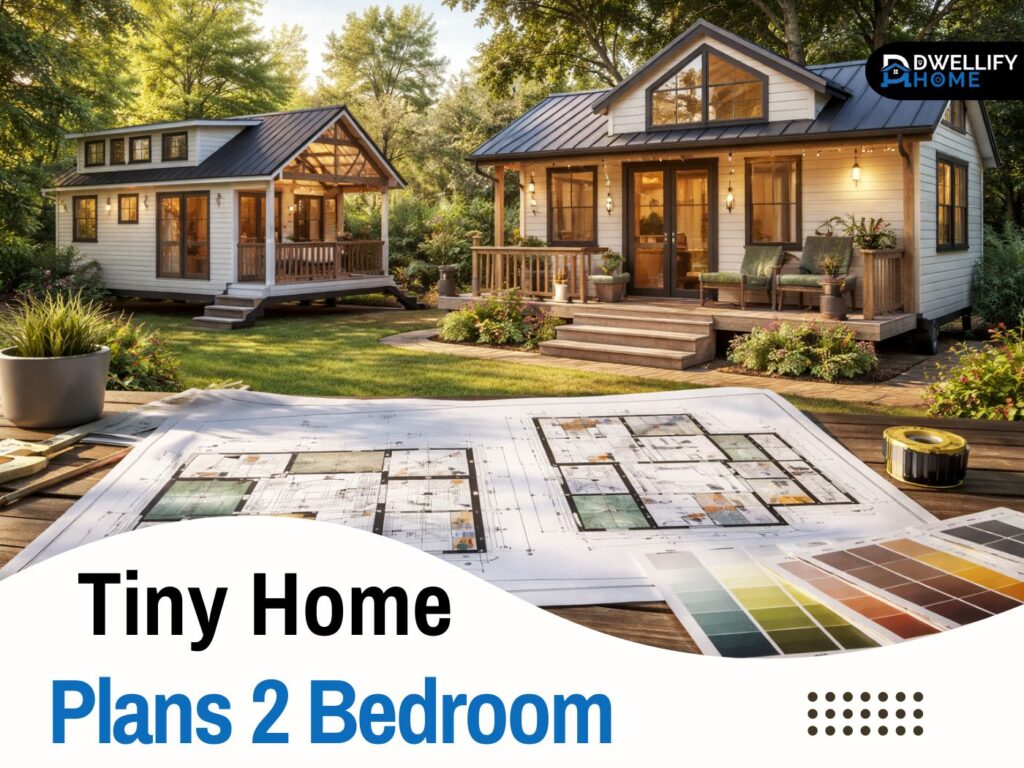
Fitting two bedrooms into a tiny footprint is absolutely doable, but it only feels good when the plan is honest about daily life. I’ve reviewed and adjusted a lot of compact layouts for couples, small families, and people who just want a guest room that doesn’t steal the whole house. The best plans don’t chase “cute.” They solve real problems like privacy, storage, and circulation.
A two-bedroom tiny home can work beautifully for a couple plus occasional guests, a parent with one child, or a small family that’s committed to simplified living. The trick is choosing the right layout style from the start. Once you do that, everything else, like kitchen size, bathroom placement, and storage, falls into place much more naturally.
You’ll also notice I won’t repeat the focus phrase a hundred times. Instead, we’ll talk in a natural way about simple tiny home plans 2 bedroom layouts, modern 2 bedroom tiny house plans, low cost options, and tiny home plans 2 bedroom with loft designs, because those are the decisions that actually matter.
Snippet-ready definition:
Tiny home plans 2 bedroom are compact floor plans that fit two sleeping spaces, often using a loft or flex room. The best designs balance privacy, storage, and smooth circulation so the home feels comfortable, not cramped.
Mission Statement:
At Dwellify Home, our mission is to help you make confident home decisions with practical design guidance, real-life layout tips, and clear, trustworthy advice you can actually use.
What “2 Bedroom Tiny Home” Really Means
In real projects, “two bedroom” can mean two fully enclosed rooms with doors, or it can mean one main bedroom plus a loft, bunk room, or flexible space that’s treated as a second bedroom. This matters because privacy, noise, and heat behave very differently in a loft than they do in a ground-floor room.
If you’re planning for everyday living, a true second bedroom usually needs three things: a door (even a sliding one), enough wall space for a bed, and storage that doesn’t invade the living area. Some plans try to “count” a curtained nook or an open loft edge as a bedroom. It might look fine in pictures, but it often feels exposed in real life.
A helpful way to think about it is this: you’re not just building two sleep zones. You’re building two routines. One person waking up early, kids going to bed first, a guest taking a call, someone working from home. A plan that supports those moments will feel bigger than its square footage.
Quick Guide Table (Comparison)
| Plan Type | Best For | Big Benefits | Watch Outs |
| Single-story 2 bedroom | Kids, aging-in-place, daily comfort | No climbing, true privacy, easier furniture planning | Needs more footprint or smaller living area |
| 2 bedroom with loft | Maximum space in a small footprint | Great separation, extra storage options, efficient layout | Heat rises, headroom limits, ladder or stair comfort matters |
| Hybrid (main bedroom + flex 2nd room) | Couples + guests, WFH setups | Office and guest room in one, adaptable long-term | Must plan storage and a real door for privacy |
5-step “pick the right plan” checklist
- Decide the second bedroom’s job: kids daily, guests, office, or mixed.
- Choose loft vs no-loft based on daily comfort and safety, not looks.
- Confirm storage zones in both bedrooms before falling in love with finishes.
- Check circulation: door swings, hallway pinch points, space around the bed.
- Match the plan to placement: wheels vs foundation, utilities, and local rules.
Pick Your Layout Type First (This One Choice Decides Everything)
Simple Tiny Home Plans 2 Bedroom (Single-Story / No Loft)
If you want the most comfortable day-to-day living, a one-level plan is usually the easiest path. No ladders, no steep stairs, fewer safety concerns, and the second bedroom can feel like a real room instead of an afterthought. These layouts are often a better match for aging-in-place, for families with very young kids, or for anyone who just doesn’t want to climb to sleep.
The trade-off is that you’ll need a slightly larger footprint or a tighter living area to make two ground-floor bedrooms work. In many one-story layouts, the living room is compact, and the kitchen is streamlined. That’s not a bad thing. It just means you design the living zone to be multi-use, with seating that has storage and a dining setup that doesn’t eat up the floor.
A practical tip from plan reviews: if the second bedroom is small, don’t force a full-size bed. A twin, daybed, or built-in platform with drawers can turn that room into a guest room and office without feeling cramped.
Tiny Home Plans 2 Bedroom With Loft
A loft-based layout is the most common way to squeeze in two sleeping areas without increasing the footprint. The best part is that lofts can create separation: one bedroom up, one down, or two loft zones split by a landing. On top of that, loft designs often unlock extra storage, because staircases can double as closets, drawers, or pantry space.
But lofts come with real compromises. Headroom is limited, heat rises, and getting up and down daily can feel like a workout. I’ve had clients love a loft in the first month and then start looking for a safer stair solution after they’ve bumped a shoulder or tried carrying laundry down in socks.
If you choose a loft, prioritize a stair design you can live with. Storage stairs are usually worth the space. Ladders can be fine for occasional use, but for a daily bedroom, they often become a pain point. And yes, tiny home plans 2 bedroom with loft layouts can still feel cozy and private if the plan adds proper guardrails, lighting, and a clear landing zone.
Most Popular 2 Bedroom Tiny House Plan Styles (Easy to Visualize)
Most two-bedroom tiny homes fall into a few style patterns. Modern 2 bedroom tiny house plans often focus on clean lines, large windows, and bright interiors. They feel open, but they can get too glassy if privacy is ignored. I like to place large windows in living areas and use higher windows in bedrooms to keep light without turning the room into a fishbowl.
Cabin or cottage styles usually lean on warmth: covered porches, simple rooflines, and natural finishes. They’re great when you want the tiny home to feel grounded and calm. A small porch can also act like an extra room for part of the year, which helps the interior feel less tight.
Then there are narrow and long layouts, which show up a lot when you’re working with a slim lot. These can be excellent, but they need careful door placement so you don’t create a hallway that wastes space. Finally, ADU-style plans are popular for backyard builds. In those, you’ll often see smart bedroom separation for privacy, which is perfect for guests, renters, or multi-generational living.
Tiny Home Plans 2 Bedroom With Pictures (How to Read Floor Plans Like a Pro)
Tiny home plans 2 bedroom with pictures can look amazing, but pictures don’t always show what it feels like to walk through the space. When I review plans with clients, I start with circulation. Can you move from the entry to the kitchen without squeezing past furniture? Can two people pass each other? Can you open the fridge and still walk by?
Next, look for “pinch points.” These are spots where doors collide, bathroom entries face the kitchen, or the bed blocks a closet. In small homes, even a two-inch mistake repeats everywhere. If a plan has a tight corner, it often becomes the place where life feels annoying.
Here are quick green flags that usually translate well in real life:
- An open central zone for living and kitchen
- Bedrooms placed away from the noisiest wall (often the kitchen wall)
- A clear storage wall or closet zone
- Bathroom placed so guests don’t walk through a bedroom to reach it
And here are red flags that often cause regret:
- No closet space shown in either bedroom
- A bathroom door that opens into the main seating area
- Loft access that requires climbing over furniture
- A “second bedroom” that’s really a passageway
Bedroom Setup That Actually Works (So It Doesn’t Feel Cramped)
The main bedroom usually does best when it gets a solid wall for the bed and at least one real closet zone. In tiny plans, closets are often shallow or split, and that’s okay. What you don’t want is clothing storage spread across the house. That’s how clutter takes over.
For the second bedroom, decide its job. Is it for kids every night, or is it a guest room that’s used a few times a month? If it’s a daily kids’ room, plan for storage that’s reachable and simple. If it’s a guest room, a daybed with drawers can be perfect. For a work-from-home setup, a wall desk and a fold-down bed can create a true dual-purpose space.
Privacy is the hidden factor. Pocket doors or barn-style sliders can work well if they close fully. Curtains are fine for a nap, but they don’t handle noise. A small detail I push often is separating bedroom walls from the loudest appliances. Avoid putting a bed wall directly behind the fridge, washer, or water heater if you can.
Kitchen + Living Area (Where Tiny Homes Win or Lose)
The kitchen and living zone is where the home either feels “easy” or feels like you’re always bumping into things. In compact layouts, a galley kitchen can be incredibly efficient. It keeps everything within reach and leaves a clear path through the center. An L-shape works well too, especially if you add a small peninsula for prep space and seating.
Storage is the real game. I like a tall cabinet wall when possible. It can hold pantry items, cleaning supplies, and even a slim broom closet. Toe-kick drawers, those shallow drawers at the bottom of cabinets, are also surprisingly useful for trays and flat items.
For dining, don’t force a big table. A fold-down wall table, a narrow island with stools, or a banquette with storage can handle meals without eating up the floor. The goal is simple: the room should convert between “everyday mode” and “hosting mode” without a full furniture shuffle.
Bathroom Planning for 2 Bedroom Tiny Homes
Bathrooms in tiny homes need to be designed like a good backpack: every inch has a purpose. One full bath is common, but a small half bath can be life-changing if you’re regularly hosting guests or living with kids. That said, adding a half bath is a big space decision, so it’s usually best in slightly larger layouts.
Wet baths, where the shower shares space with the toilet and sink, are space-efficient. They can also be annoying if you hate wiping down surfaces after every shower. If you’re building for long-term comfort, a standard shower stall often feels more “normal” and keeps moisture under control.
Laundry is another key choice. A combo washer-dryer or a compact stacked set can work well. I often suggest placing laundry close to bedrooms or the bathroom, because carrying baskets across a tiny home feels silly fast. Also, don’t skip ventilation. Good fans and smart moisture control protect your walls, your finishes, and your comfort.
Low Cost 2 Bedroom Tiny House Plans (How to Keep It Affordable)
Low cost 2 bedroom tiny house plans are less about cutting corners and more about choosing a plan that’s simple to build. Complex rooflines, lots of corners, and custom window shapes push costs up quickly. A simple rectangle footprint with a straightforward roof is usually the most budget-friendly approach.
Inside, standard dimensions save money. Standard door sizes, standard cabinet widths, and standard windows reduce both material waste and labor time. It’s not glamorous, but it’s smart. If you want the home to look modern without overspending, put budget into good lighting, durable flooring, and clean trim work. Those upgrades show, and they last.
Where you shouldn’t try to save: insulation, air sealing, and ventilation. Tiny homes heat up fast and cool down fast. A poorly insulated tiny home can feel uncomfortable year-round, and fixing it later is expensive and messy.
2 Bedroom Tiny House Plans Free (Smart Use of Free Plans)
2 bedroom tiny house plans free resources can be useful for inspiration and learning. Just be careful with the idea that “free” means build-ready. Many free plans don’t include engineering details, code notes, or climate-specific guidance. That doesn’t make them bad, it just means you need to verify them before spending real money.
If you’re using a free plan as a starting point, check the basics:
- Dimensions that actually fit your furniture
- Safe and practical loft access if there’s a loft
- Bedroom egress and window placement
- A logical plumbing route so the bathroom and kitchen aren’t fighting each other
In many real builds, people start with a free plan and then pay later for revisions. That’s normal. The goal is to avoid costly mistakes, like realizing the second bedroom can’t fit a bed once you account for trim, doors, and a closet.
Tiny Home Plans 2 Bedroom Free vs Paid vs Custom (Which Is Best for You?)
Tiny home plans 2 bedroom free options are great for exploring ideas, but paid plans usually bring clarity. They often include more complete drawings and fewer guesswork moments during construction. If you’re building on a tight timeline or working with a contractor, that clarity can save headaches.
Custom plans are best when you have specific needs. Maybe your lot is narrow, your climate is extreme, or your family routine needs a true second bedroom with sound separation. Custom design also helps when you’re building an ADU and must meet local rules, setbacks, and utility requirements.
A simple way to choose: if your situation is standard, a good paid plan can be perfect. If your situation is unique, custom can prevent expensive changes later.
Build vs Buy: 2 Bedroom Tiny House for Sale (Buyer Checklist)
A 2 bedroom tiny house for sale can be a great option, especially if you want to skip the long build process. But you have to evaluate it like a designer, not like a tourist. Pretty finishes are nice, but layout quality is what determines whether you’ll love living there.
When you walk through, focus on:
- Bedroom usability, door clearance, and storage
- Loft access safety and comfort
- Insulation and moisture control details
- Heating and cooling setup, especially in hot or cold regions
Also ask about the hidden costs: delivery, site prep, foundation or supports, hookups for water and power, and permits. I’ve seen buyers get surprised by those line items. It’s better to know up front than to scramble later.
Zoning, Codes, and Placement (Foundation, Wheels, ADU)
This part isn’t glamorous, but it can decide whether your tiny home dream is simple or stressful. Tiny homes on wheels and tiny homes on foundations are often treated differently by local rules. An ADU build can have its own set of requirements too, including setbacks, parking, and utility connections.
Before you commit to a layout, make sure the plan matches how you’ll place the home. A loft-heavy design on wheels might be limited by transport height. A foundation build might allow more freedom, but it could trigger different code requirements.
Utilities matter as much as layout. Septic versus sewer, water pressure, electrical load, and heating and cooling all affect where rooms should sit. A smart plan groups “wet” zones like kitchen and bathroom to reduce plumbing complexity and cost.
“Best-Fit” Quick Recommendations (Choose a Plan Like a Designer)
If you want a fast way to narrow options, match the plan to your lifestyle first.
- For couples plus guests: one main bedroom and a flexible second room works best. A daybed or Murphy-style setup keeps the room useful every day.
- For small families: prioritize a real second bedroom on the main floor if possible. Kids and loft ladders don’t always mix well long-term.
- For work-from-home: a second bedroom that doubles as an office is ideal. Make sure it has daylight, door privacy, and enough wall space for storage.
- For aging-in-place: choose a single-story plan with wider circulation. A loft might look great, but comfort and safety win over time.
Common Mistakes People Make With 2 Bedroom Tiny Homes (And How to Avoid Them)
The biggest mistake is underestimating storage. If both bedrooms don’t have clear storage zones, the living area becomes the closet, and that gets old fast. Build storage into stairs, seating, and bed platforms if you can.
Another common issue is ignoring loft comfort. Heat rises, so loft bedrooms can get warm. Good ventilation, fans, and smart window placement help a lot. Also, don’t assume you’ll enjoy climbing a ladder every night. If a storage stair option fits, it’s usually a better long-term choice.
Finally, people forget the entry zone. A tiny home needs a place to drop shoes, coats, and bags. Without it, clutter spreads. A small bench with storage or a slim closet near the door can change how the whole home feels.
FAQs
What size feels comfortable for two bedrooms?
It depends on layout efficiency, but comfort usually comes from smart circulation and storage, not just square footage.
Is a loft safe for daily use?
It can be, especially with proper stairs, guardrails, lighting, and a clear landing. Ladders are often better for occasional use.
Is it cheaper to build or buy?
It varies. Buying can save time, building can offer better customization. The key is comparing total costs, including site work and hookups.
Can I place a tiny home on my land legally?
Rules are local. Your best move is confirming whether it’s allowed as a primary home, an ADU, or a temporary structure.
Are free plans safe to build from?
They can be a good starting point, but most need verification for structure, code basics, and practical living details.
Conclusion: Tiny Home Plans 2 Bedroom Can Feel Big if the Layout is Right
A well-designed two-bedroom tiny home isn’t about squeezing in rooms and hoping for the best. It’s about designing routines: sleep, work, privacy, storage, and comfort, all in a small footprint that supports real life.
If you remember three things, you’ll avoid most regrets. First, pick your layout type early, single-story or loft. Second, build in storage so it doesn’t spill into your living space. Third, make sure the plan matches how the home will be placed and permitted.
And guess what, once those pieces are in place, the rest becomes fun. You can focus on the style you love, whether that’s modern, cozy cottage, or a simple, clean build that keeps costs low and life easy.
Disclaimer:
This article is for general education and planning. Building codes, zoning rules, and safety requirements vary by location, so confirm details with your local authority and a qualified architect, engineer, or licensed builder before you build or buy.

I’m Bilal, the founder of Dwellify Home. With 6 years of practical experience in home remodeling, interior design, and décor consulting, I help people transform their spaces with simple, effective, and affordable ideas. I specialize in offering real-world tips, step-by-step guides, and product recommendations that make home improvement easier and more enjoyable. My mission is to empower homeowners and renters to create functional, beautiful spaces—one thoughtful update at a time.