
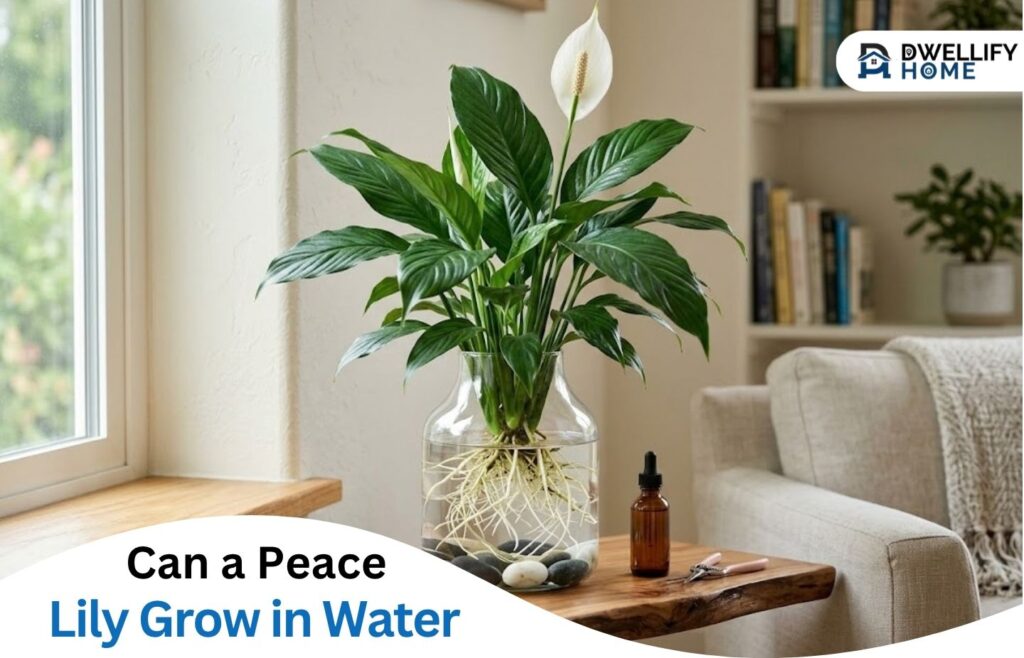
A peace lily in a glass vase makes an attractive desk plant, but removing the potting mix changes how you care for it. The roots still need oxygen and nutrients, and the vase needs more attention than an occasional top-up.
Can a peace lily grow in water without soil? Yes. The useful question is how to keep it healthy after the initial move—and whether that routine suits your home.
Short Definition
A peace lily can grow without soil through water culture, with its crown above water and roots supplied with oxygen and nutrients. This method creates a decorative display but requires regular cleaning and feeding.
DwellifyHome Mission Statement
DwellifyHome helps homeowners, renters, and home lovers make informed, practical choices for living spaces that feel comfortable, stylish, and welcoming.
Water-Growing Checklist
- Start with a healthy rooted plant or division.
- Support the crown above water, with lower roots reaching the water.
- Choose bright, indirect light and a stable, easy-to-clean vase.
- Check roots and water levels regularly; replace water and clean the container.
- Use a complete hydroponic fertilizer according to applicable product directions.
Can a Peace Lily Live in Water Long Term?
A peace lily (Spathiphyllum) can live in water long term when its roots receive oxygen, suitable nutrients, and regular care. Keep the crown—the base where leaf stalks and roots meet—above the water. Survival in plain water for a while doesn’t mean the plant has everything it needs for sustained growth. Lively Root’s water-growing guidance supports this approach.
There’s no dependable lifespan to promise for an individual plant. Its starting health, growing conditions, and response to the change all matter. Treat water growing as an ongoing care method, rather than a temporary display you can leave untouched.
Why Is Growing in Water Different From Overwatering?
Overwatering causes trouble when saturated potting mix leaves roots without enough oxygen. In water culture, roots grow in a managed water supply with access to oxygen. Simply placing a plant in stagnant water doesn’t provide that balance, and removing soil doesn’t eliminate the possibility of root disease.
Hydroponic systems may use an air pump and air stone to supply oxygen, as Oklahoma State University Extension explains. A simple vase without a pump needs appropriate root positioning and regular water renewal; it shouldn’t be filled to the leaf bases.
The trade-off is practical: you gain visible roots and a display without loose potting mix, but take on container cleaning and measured feeding. You’ll also want a spot where a tipped vase won’t damage a laptop, bookshelf, or wood surface.
Set Up Your Peace Lily and Move It Into Water
Gather a healthy plant, a clean vase, a removable support, clean scissors, and water. Decide where the finished display will sit before starting.
Keep it away from pets that chew plants. Peace lilies contain insoluble calcium oxalates and are toxic to cats and dogs; contact a veterinarian after suspected ingestion. ASPCA
Start With a Rooted Plant or Division
Choose a healthy nursery plant, a rooted division from a larger peace lily, or a plant already sold for water growing. A purchased hydroponic peace lily avoids the initial soil-removal step.
A division needs roots and growing shoots. A detached leaf with its stalk isn’t equivalent starting material: don’t treat it like a pothos cutting. Division is the established propagation method listed by NC State Extension.
For a sentimental plant, consider trying a suitable division instead of converting the entire clump. That keeps your experiment manageable without putting every growing point through the change.
Choose a Stable Vase and Support the Crown
Choose a vase with a broad base and an opening large enough to lift the roots out gently. A narrow-neck bottle may look tidy, but cleaning it or removing an expanding root mass can become awkward.
Use a removable plant holder or suitably sized net pot to support the crown at the opening. The support should hold the plant upright without pinching its stalks.
Keep the crown above water, with lower roots reaching the water and upper roots exposed to air. This positioning also appears in Patch’s hydroponic peace lily care instructions.
Clean, inert decorative stones can provide support, but they aren’t fertilizer. Avoid tightly packing the roots between rocks; you still need access for inspection and cleaning.
Remove the Soil and Position the Plant
- Ease the plant out of its pot. Support the root ball rather than pulling on the leaves.
- Loosen the potting mix gently. Work over a tray, then rinse remaining particles away with lukewarm water. Catch soil before it enters the drain.
- Inspect the roots. Preserve firm roots. Use clean scissors to remove clearly dead or mushy sections, rather than cutting healthy roots short to fit the vase.
- Set the plant into its support. Let the roots hang freely and add water to the position shown above.
- Check stability and placement. Make sure the plant won’t slide deeper into the vase, then place it in bright, indirect light.
The careful washing and removable support are illustrated in JayDee Mahs’ soil-to-water transfer.
Some plants droop after handling. Check the roots and setup rather than assuming every change is harmless adjustment, or expecting recovery by a fixed date.
Care for Your Peace Lily After the Move
Build a routine around water condition, root health, feeding, and light. A clear vase makes observation easier, but clear water alone doesn’t prove the plant’s needs are met.
Choose Water and Keep the Vase Clean
Tap water may be suitable; it isn’t automatically harmful. Its mineral content and treatment vary by location. Distilled water is another option, but it still needs an appropriate nutrient supply for long-term growing.
Don’t assume leaving tap water out overnight removes every disinfectant. Chloramine behaves differently from chlorine and isn’t removed by letting water stand, according to the CDC’s water-treatment guidance. Check your utility’s information before choosing a treatment method.
For a simple vase without an air pump, start with a weekly full water change, checking sooner for cloudiness, odor, or debris. This is a starting routine for that setup, not a schedule for every hydroponic system. Planet Houseplant’s water-growing guide recommends at least weekly changes without aeration.
Lift the plant by its support, empty the vase, and clean away any film before refilling. Rinse cleaning residue thoroughly. Check the level between changes so the lower roots remain in water.
Topping up replaces missing water. It doesn’t remove sediment or clean the container, so it can’t replace full water changes.
Choose and Measure a Suitable Fertilizer
Choose a complete hydroponic fertilizer with directions suitable for ornamental plants and your growing system. A nutrient solution is simply water containing dissolved plant nutrients. It needs both major nutrients and smaller amounts of micronutrients; an N-P-K number alone doesn’t describe the whole formulation.
Make feeding repeatable:
- Measure the water the vase actually holds at its working level, not its capacity to the rim.
- Follow the product’s applicable dilution and mixing instructions, including any directions for newly transferred plants.
- Use a marked syringe or measuring spoon instead of guessing a few drops.
- Follow replenishment directions rather than repeatedly adding a full dose to water already containing fertilizer.
If the label only describes feeding plants in potting soil, ask the manufacturer whether it suits continuous water culture. Don’t improvise a universal “quarter-strength” rule or substitute banana water, sugar, or other unmeasured homemade feeds.
Find the Right Light and Indoor Conditions
Give your peace lily bright, indirect light, such as a position near a window where strong sun doesn’t strike the leaves. A sheer curtain can help soften direct exposure. Deep shade may keep a plant looking green without supporting much growth or flowering. The Royal Horticultural Society recommends indirect light for peace lilies.
Choose a room with stable, comfortable temperatures, away from radiators, cold window glass, and strong heating or cooling drafts.
Recheck the position as seasons change. A desk that receives gentle light in one season may get harsh afternoon sun in another. Keep the water container out of strong direct sun too, especially if algae keeps returning.
What Should You Check If Your Peace Lily Starts Declining?
Check the water level, crown position, root texture, recent feeding, and light before changing care. Drooping and yellowing can have several causes; neither symptom proves the plant needs more fertilizer. Roots that are soft or collapsing deserve closer attention than roots that are simply darker than they used to be.
| What you notice | What to check | Sensible next action |
| Drooping after the move | Handling damage, roots reaching water, crown position | Correct the setup and inspect the roots; avoid repeated unnecessary handling. |
| Yellow leaves | Which leaves are affected, root condition, light, feeding history | Look for a pattern before changing fertilizer or moving the plant again. |
| Mushy or collapsing roots | Whether root tissue is soft or slips away | Remove clearly rotted tissue with clean scissors, clean the container, and reassess growing conditions. |
| Cloudy or unpleasant-smelling water | Leftover soil, dead roots, debris, dirty supports | Replace the water and clean the vase and support; inspect roots at the same time. |
| Green algae on the glass | Light reaching the water | Clean the container and reduce light around the reservoir while keeping foliage adequately lit. |
| Brown leaf tips | Recent fertilizer measurements, water source, nearby drafts | Review what changed before adding another treatment or increasing feed. |
A plant that has lost most of its roots, or has a soft, deteriorating crown, isn’t a routine transfer project. Recovery is uncertain. For continuing decline you can’t explain, take clear root and leaf photos to a reputable nursery or local extension service.
Frequently Asked Questions
Can a Peace Lily Bloom While Growing in Water?
Yes, flowering is possible in water, but the setup doesn’t guarantee blooms. Light, nutrition, plant maturity, and recovery from transfer all influence the result. Patch’s hydroponic peace lily guidance notes the importance of a brighter position for flowering. Give the plant suitable conditions rather than repeatedly increasing fertilizer to force flowers.
Can a Peace Lily Grow in Aquarium Water?
Yes, it can grow with roots in freshwater aquarium water and its crown and leaves above the surface. However, using aquarium water in a separate vase is different from growing a plant over a stocked tank. Neither arrangement should be assumed to provide complete, balanced nutrition automatically.
Don’t add a betta to a decorative vase or assume a peace lily replaces aquarium maintenance. The Tye-Dyed Iguana’s aquarium guidance cautions against these setups. Before adding fertilizer to a stocked tank, confirm its suitability for the livestock with an aquatic specialist.
Can You Move a Water-Grown Peace Lily Back Into Soil?
Yes, but returning to soil creates another adjustment period and isn’t a guaranteed cure for decline. Choose a pot with drainage holes that comfortably fits the roots, use a suitable houseplant potting mix, and keep it slightly moist rather than saturated. Provide indirect light and monitor the roots and foliage. Lively Root discusses returning struggling water-grown plants to soil.
Is Water Growing Right for Your Peace Lily?
Water growing can suit you if you enjoy seeing the roots and don’t mind cleaning a vase and measuring nutrients. Soil may fit your routine better if those tasks feel inconvenient.
Start with a healthy, manageable plant or rooted division, choose a container you can clean easily, and keep the crown above water. A care routine you can maintain gives the display its best chance of staying healthy over time.
Disclaimer
This content is for general informational purposes only. Individual homes, needs, preferences, budgets, and situations vary. Seek advice from an appropriately qualified professional for safety concerns, installation or repairs, legal matters, structural, electrical, plumbing or HVAC work, and major property decisions.