Buying a soil amendment should make repotting simpler. Yet two bags promising better drainage can leave you wondering whether the cheaper one is enough or whether the heavier one will suit your plants better.
The useful pumice vs perlite comparison comes down to weight, particle size, moisture behavior, and cost. Start with what your potting mix needs, and the choice becomes much clearer.
Short Definition
Pumice and perlite are volcanic materials used in potting mixes to support aeration and drainage. Comparing their weight, particle size, moisture behavior, and cost helps gardeners choose a suitable amendment.
DwellifyHome Mission Statement
DwellifyHome helps homeowners, renters, and home lovers make informed, practical choices for comfortable, stylish spaces that fit everyday life.
Pumice or Perlite? The Quick Answer
Choose pumice when you want a durable mineral ingredient that adds some weight and is less prone to rising to the surface. Choose perlite when low weight and an economical, accessible option matter most. Both can improve aeration; the grade and the complete mix determine how they handle water.
There’s also a reasonable third choice: keep using what already works. Healthy plants in a manageable mix don’t need repotting simply because another ingredient gets stronger recommendations online.
How Pumice and Perlite Compare in Potting Mix
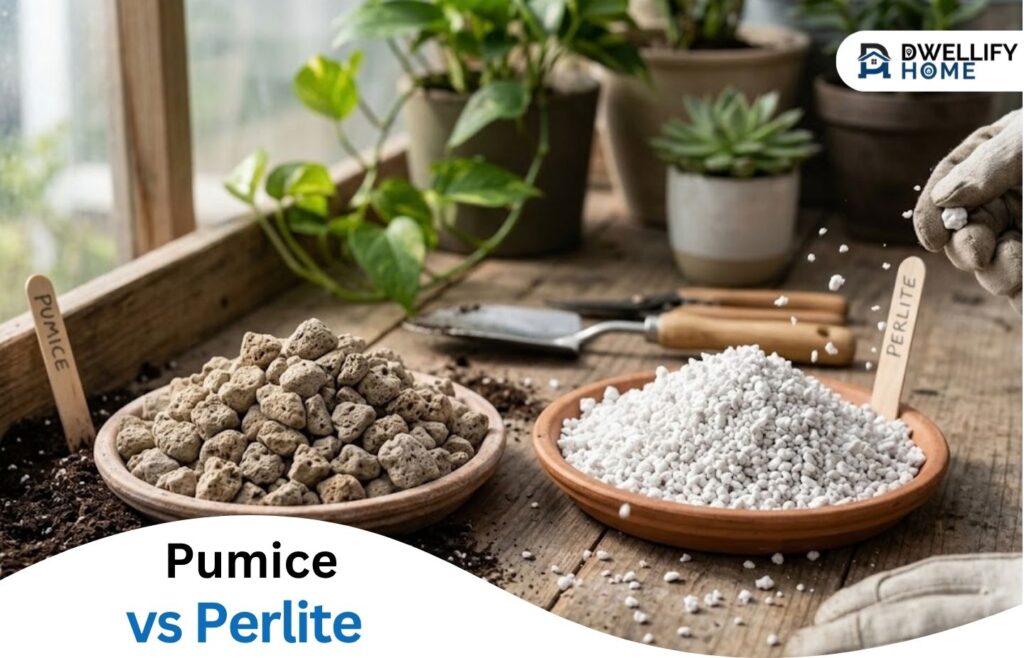
Pumice is naturally porous volcanic rock, sold in different particle sizes. Horticultural perlite is volcanic glass expanded by heating into the lightweight, usually white granules you see in many bagged mixes.
Both serve as mineral components within a blend. Perlite’s main role in horticultural growing mixes is to provide aeration alongside ingredients such as peat moss and coco coir.
| Factor | Pumice | Perlite |
| Container weight | Generally heavier; useful when added weight is welcome | Very light; useful for baskets and pots you move |
| Aeration | Can provide pore spaces within a suitable mix | Can provide pore spaces within a suitable mix |
| Water retention | Holds water in accessible pores; behavior varies with grade | Holds water on surfaces, in channels, and between particles; grade matters |
| Surface movement | Typically stays distributed better | More prone to floating upward during watering |
| Durability | Usually more resistant to crushing | Brittle particles can crush during handling |
| Cost and sourcing | Check local nursery and specialist supply options | Often an accessible budget choice; compare actual prices |
The practical differences in movement and crushing are also described in this succulent-growing demonstration.
Pumice can last for years in a potting mix, but that doesn’t make the whole mix permanent. Perlite also doesn’t decompose like an organic ingredient. Replace or refresh a blend according to its condition and the plant’s needs, rather than an assumed expiry date for either mineral.
Perlite collecting on the surface can be annoying, especially in a tidy indoor display. A few visible granules alone aren’t a reason to assume the root zone has failed.
Drainage and Water Retention: What’s the Difference?
Drainage is the movement of excess water out of a mix. Water retention is the moisture that remains afterward. Aeration concerns the air available in the pore spaces. A useful potting mix needs a balance of all three.
A porous ingredient can help create larger spaces between particles while holding some moisture itself. So “improves drainage” doesn’t mean “holds no water.”
Perlite, for example, retains water through several mechanisms, and its water-holding behavior changes with particle grade. That makes blanket claims that pumice always holds more water unreliable without comparable products and measurements.
Also distinguish drainage from drying time. Water running from a drainage hole doesn’t tell you how quickly the remaining moisture will be used or evaporate.
Why Particle Size Changes the Comparison
Fine and coarse versions of the same material can behave differently. Coarser perlite generally drains more readily than finer grades, which tend to retain more water. Pumice also comes in a wide range of grades.
Before buying, check the actual size range, not just the word “coarse.” Look for horticultural material suited to potting mixes and notice how much powder or fine material accompanies the granules.
Imagine replacing chunky perlite with much finer pumice. You’ve changed both the material and the particle distribution. Any difference afterward cannot fairly be attributed to pumice alone.
Which Fits Your Plants and Growing Conditions?
Either amendment can suit houseplants or succulents when the finished mix meets their needs. Use plant type to establish moisture requirements, then consider the pot, exposure, and watering routine. Weight and surface movement can help you choose between otherwise suitable ingredients.
These are practical starting points for making that choice:
| Growing situation | A sensible starting choice | What to check |
| Hanging basket or frequently moved pot | Perlite | Keep the overall container manageable when watered |
| Houseplant already thriving in a perlite blend | Keep the existing ingredient | Change only when there’s a clear problem to solve |
| Succulent or cactus container | Either, in an appropriate grade | The complete mix and growing conditions must support suitable drying |
| Bonsai or another long-term container planting | Consider pumice for durable granules | Follow the plant’s needs and the requirements of the whole substrate |
| Seed-starting mix or rooting cuttings | Perlite is a common option | Match grade and moisture management to the propagation method |
| Freestanding pot where extra weight is useful | Consider pumice | Added mix weight doesn’t replace a suitably stable pot |
Container material can change the result substantially. Unglazed terracotta loses moisture through its porous walls, while plastic and glazed ceramic generally retain it longer.
For example, a sunny patio pot and a houseplant in a cooler room may need different blends even when they contain the same plant type. Copying the ingredient list without considering the setting can lead to disappointing results.
Is Switching to Pumice Worth the Cost?
Switching can be worthwhile when pumice addresses a specific frustration, such as surface migration or a preference for sturdier granules. It’s harder to justify paying more when your existing perlite mix performs well. Compare the actual products available to you before assuming either option offers better value.
For US purchases, check:
- Equivalent volume: Compare the same units, such as quarts or cubic feet, rather than matching bag weights.
- Comparable grades: A screened coarse product and a fine, unscreened product aren’t equivalent purchases.
- Delivered price: Include shipping or the practical cost of collecting locally.
- Useful quantity: A large bag is only a saving when you’ll use it and have room to store it.
A small pumice purchase may make sense for a few pots where floating bothers you. Buying enough for a large collection deserves a closer comparison.
You don’t have to replace all your mixes at once. Trying one product during a routine repot gives you a chance to judge whether the difference matters to you.
How to Add or Substitute Either Material
You can often substitute pumice for perlite, or perlite for pumice, as the aeration component of a recipe. Start with a comparable horticultural grade and treat the substitution as a change to observe, rather than a guarantee of identical watering needs.
Prepare the ingredients before bringing the plant out of its pot. Use a tub or tray to contain spills and avoid creating clouds of dry material.
Follow the bag’s directions for dampening, rinsing, and protective equipment. Pumice can also produce dust: a manufacturer’s safety sheet specifically calls for minimizing dust during handling. Rinsing can remove loose fines, but it doesn’t sterilize used material.
Check What Your Potting Mix Already Contains
Read the ingredient list first. A commercial blend may already contain perlite, bark, or other components that create air spaces. Adding another generous portion automatically may move it away from the balance your plant needs.
Peat moss, coco coir, bark, and mineral ingredients contribute differently to a mix. Their processing and particle sizes matter too.
Ask what you’re trying to change: weight, texture, surface movement, or moisture behavior. A specific goal makes it easier to judge whether the adjustment helped.
Measure by Volume and Adjust for the Grade
Use the same scoop for each ingredient when following a recipe expressed in parts by volume. One scoop of pumice and one scoop of perlite occupy similar volumes but can weigh very different amounts.
For example, a recipe calling for three parts base mix and one part amendment means three equal scoops plus one equal scoop. That explains the measurement; it isn’t a universal recipe recommendation.
Mix the ingredients evenly before filling the pot. Keep a short record of the product, grade, and proportions so you can repeat a successful blend.
After repotting, check moisture in the root zone and notice the pot’s weight as it dries. Adjust watering to the plant and mix rather than automatically continuing the old calendar schedule.
Common Mistakes That Undermine Your Potting Mix
The right ingredient can still disappoint when the surrounding setup works against it.
- Putting all the amendment at the bottom. For improving the root-zone blend, mix it throughout. A coarse layer underneath does not make the finer mix above drain better; water can accumulate above that boundary.
- Assuming more is always better. Increasing the mineral fraction changes the blend’s water storage and handling. Judge the finished mix against your plant’s needs.
- Packing the mix firmly. Excessive pressing reduces air spaces. Fill around the roots gently instead of compressing the pot into a solid mass.
- Expecting pumice or perlite to replace fertilizer. Their role is primarily physical soil amendment. Keep nutrition decisions separate and account for any fertilizer already included in the bagged mix.
- Treating an amendment as a cure for root problems. Neither fixes standing water in a decorative outer pot or removes diseased roots. Investigate the cause before changing ingredients.
Long-lasting mineral granules also don’t prevent every change in an aging mix. Organic components can decompose and alter its structure, which is why reusing a container mix requires checking the blend as a whole.
Frequently Asked Questions
Can You Use Pumice and Perlite Together?
Yes. A blend can contain both, allowing you to balance weight and handling preferences. Count them together as part of the total mineral amendment rather than adding a full recipe’s allowance of each. Using two materials doesn’t automatically make a mix better than a well-chosen blend containing one.
Can You Reuse Pumice or Perlite After Repotting?
Both may be reusable when their particles remain suitable and they come from a healthy planting. Remove plant debris and assess the remaining mix. When disease or pests were present, replacing the affected medium is the more cautious choice; Oklahoma State Extension advises against reusing contaminated potting soil.
Can Vermiculite Replace Pumice or Perlite?
Vermiculite isn’t an equivalent substitute when your main aim is aeration. It’s particularly useful for holding moisture and some nutrients, so replacing an aeration ingredient with it can change the blend’s balance. Choose it when that moisture-holding role is wanted, rather than because it appears in another potting recipe.
Choose for Your Plants, Pots, and Watering Habits
Perlite is a practical choice when light weight and accessible supply matter. Pumice is worth considering when you prefer sturdier granules and less surface movement.
Before buying, check the grade, compare equivalent-volume costs, and identify the change your mix actually needs. A suitable blend that works with your watering habits is a better purchase than an ingredient chosen only because it’s described as superior.
Disclaimer
This content is for general informational purposes only. Individual homes, needs, preferences, budgets, and situations vary. Seek qualified professional advice for safety concerns, installation or repair work, structural, electrical, plumbing or HVAC issues, and legal or major property decisions.