
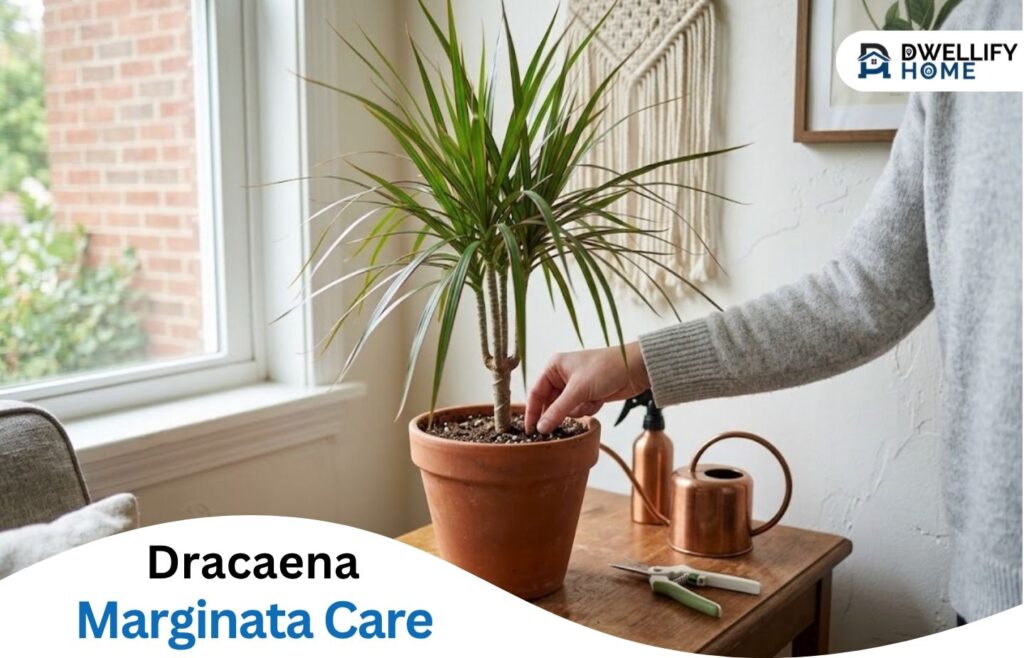
Brown tips can appear on a dragon tree even when you water it faithfully. Before adding another drink, check the pot: a dry plant and one with struggling, waterlogged roots can both look unhappy.
Good dracaena marginata care starts with understanding those differences. Light, soil moisture, and drainage give you better clues than a watering calendar—and help you decide when to act or leave a healthy plant alone.
Short Definition
Dracaena marginata care involves managing light, watering, drainage, and indoor conditions to keep a Madagascar dragon tree healthy and identify problems such as brown tips, yellow leaves, and root stress.
DwellifyHome Mission Statement
DwellifyHome helps homeowners, renters, and home lovers make informed choices for comfortable, practical spaces that feel like their own.
Quick Care Checklist
- Check soil moisture below the surface before watering.
- Choose bright indirect light and protect leaves from harsh sun.
- Confirm drainage holes are clear and empty collected runoff.
- Review watering, water quality, and feeding when tips turn brown.
- Check whether leaf loss is gradual or spreading, and inspect for pests.
- Keep leaves and cuttings out of pets’ reach.
Dracaena Marginata Care at a Glance
Dracaena marginata, also called the Madagascar dragon tree, has slender woody stems and narrow, often red-edged leaves. It does best with bright indirect light, a well-draining mix, and drying between waterings, without prolonged drought.
| Care need | Practical starting point |
| Light | Bright indirect light; protect from harsh sun |
| Water | Check below the surface before watering |
| Potting mix | Loose, well-draining houseplant mix |
| Temperature | A steady room around 65–80°F |
| Feeding | Light feeding during active growth |
| Maintenance | Inspect leaves, drainage, and changes in growth |
Pet safety: Dracaenas are toxic to cats and dogs. Keep leaves and fallen cuttings inaccessible. Contact your veterinarian or ASPCA Poison Control promptly after suspected ingestion.
Where Should You Put Your Dragon Tree?
Place your dragon tree near a window where it receives bright daylight without prolonged, harsh direct sun. An east-facing window may work well; stronger south- or west-facing exposure may need a sheer curtain. Check the light where the leaves sit, because a bright room can still contain dark corners.
A dragon tree can tolerate lower light, but growth slows and leaf coloring may fade. It also needs less water in lower light, so moving it away from a window can change its watering needs.
Watch for bleached or scorched patches after stronger sun exposure. Gradually adjust placement rather than moving a shaded plant straight into intense sunlight.
A grow light can help when usable daylight is limited. Follow the light’s placement instructions instead of assuming any nearby lamp provides enough light for growth.
Choosing the Right Pot and Potting Mix
Choose a container with drainage holes and a commercial houseplant mix that drains freely while retaining some moisture. Bark can help create air spaces; coir or peat holds moisture. Roots need both water and aeration, so neither dense garden soil nor a pot filled entirely with coarse bark is a good default.
A decorative planter without holes can hold an inner nursery pot. Make sure you can remove that inner pot and empty collected water.
When Your Dragon Tree Needs Repotting
Inspect the root ball—the roots and soil that slide out together—when roots become crowded or watering behavior changes noticeably. A single root escaping a drainage hole is a reason to inspect, not proof that a much larger pot is needed.
For a crowded, otherwise healthy plant, choose the next modest pot size and repot during active growth. Keep the cane at its previous planting depth. Avoid large jumps in pot size, because the extra mix can stay wet too long.
How Often Should You Water Dracaena Marginata?
Water when the upper portion of the mix has dried, before the whole root ball stays dry for long. For an established plant in ordinary potting mix, allowing roughly the upper half to dry is a practical starting point. The fraction is an estimate; actual moisture checks matter more.
In a deep pot, your finger may only reach the dry surface layer. Gently insert an untreated wooden skewer farther down, avoiding force through roots. Dampness and clinging moist mix suggest that deeper areas still hold water. Combine this with the pot’s weight when practical; no single check describes every part of the root ball.
Wait if the upper half is still moist. The aim is a drying cycle, without leaving the entire pot bone-dry for an extended period.
Two dragon trees in different rooms may need different intervals. Use reminders to check the soil, then water according to what you find.
Watering the Root Ball and Draining Excess Water
- Move a manageable pot to a sink, or use a saucer you can empty.
- Pour room-temperature water slowly over the soil surface.
- Let water drain through the holes, then discard the runoff.
Spraying the surface may leave much of the root ball dry. When water immediately runs down a gap around shrunken soil, pause and water slowly again so the mix can absorb it. Missouri Botanical Garden’s watering guide explains thorough watering and drainage.
Choosing Between Tap, Filtered, and Distilled Water
Dracaenas are sensitivge to fluoride, which can contribute to damaged tips and margins. Tap water’s suitability depends on its composition; browning alone doesn’t prove that water quality is the cause.
Distilled water is a practical option when fluoride is a concern. With filtered water, check the specific product’s removal claims. A pitcher filter and a reverse-osmosis system do not necessarily remove the same substances.
Leaving tap water overnight does not remove fluoride. Nor does switching water repair tips that are already dead.
Adjusting Care Through the Seasons
A steady room around 65–80°F suits indoor marginatas. Keep foliage away from cold window glass, frequently opened exterior doors, and direct blasts from heating or air-conditioning vents.
Shorter winter days may slow growth and soil drying, although indoor conditions vary. Keep checking moisture rather than automatically watering on the summer schedule.
Average household humidity is often workable. In persistently dry air, a humidifier offers more sustained help than occasional misting. Briefly spraying leaves does not maintain higher humidity.
Feed lightly with a houseplant fertilizer during active growth, following its directions. Reduce or pause feeding when growth slows, and account for fertilizer already included in fresh potting mix. Don’t use extra fertilizer to treat unexplained yellowing or root trouble.
Pruning and Propagating Your Dragon Tree
Pruning helps keep a tall plant comfortable in its space and can provide material for propagation.
Cutting Back a Plant That Has Grown Too Tall
Use sharp, clean pruners to shorten a healthy cane to your chosen height. New shoots can develop below the cut, changing the plant’s shape. Spring or early summer is a sensible time for planned pruning.
Keep healthy foliage on other canes when possible, and allow time for regrowth. A plant with soft stems or suspected root damage needs assessment before cosmetic pruning.
Starting a New Plant From a Stem Cutting
Choose a healthy leafy tip with a section of firm stem. Remove lower leaves that would sit beneath the mix, then insert the cut end into moist propagation mix in a small draining pot.
Keep it warm in bright indirect light, with the mix lightly moist while roots develop. This rooting stage needs different moisture management from an established plant. Avoid repeatedly pulling the cutting out to inspect it.
Wait until the cutting is well rooted before potting on; roots should hold the mix together. Then move it to a slightly larger container. Rooting time varies with the material and conditions.
Brown Tips, Yellow Leaves, or Drooping: What to Check
Leaf symptoms overlap. Start with the soil, drainage, recent changes, and the pattern of damage before choosing a remedy.
| What you notice | Check first | Next step |
| Brown tips | Moisture history, water quality, feeding, dry air | Address the likely contributor |
| A few older yellow leaves | Whether loss is gradual and growth remains healthy | Observe before intervening |
| Rapid or widespread leaf loss | Wet roots, drafts, pests, recent relocation | Investigate the whole plant |
| Drooping | Whether the root ball is dry or wet | Let that finding guide watering |
| A soft cane | Roots and extent of softened tissue | Assess promptly for decay |
Brown Tips and Dry Leaf Edges
Brown tips can reflect moisture stress, fluoride exposure, fertilizer salts, or dry air. Sun damage may appear as larger bleached or dry patches. These different causes of leaf damage need different responses.
Check drainage before increasing water, and review feeding before adding nutrients. Take a dated photograph after making a justified change. Watch for fresh damage or healthier new growth rather than expecting existing brown areas to disappear.
Yellow Leaves and Leaf Drop: Aging or a Care Problem?
A few oldest leaves gradually yellowing beneath healthy foliage can be normal aging. Rapid loss, yellowing across several parts of the plant, or deterioration alongside wet soil deserves closer attention.
A recent move can also change light and temperature. Look at what changed before repotting or feeding. A firm cane is reassuring, but it does not rule out an early root problem.
Drooping Leaves, Wet Soil, or a Soft Cane
Drooping with a dry root ball may call for thorough watering. Drooping while the mix remains wet calls for a drainage and root check instead.
Gently unpot a declining plant when persistent wetness suggests root trouble. Soft, deteriorating roots, sometimes with an unpleasant odor, are warning signs of root rot.
Empty trapped water and separate an affected plant from others. Extensive root or cane decay may make recovery impractical. Discard severely affected plants and take cuttings only from healthy tissue. A local extension service can help when the diagnosis is unclear.
Spotting and Managing Common Pests
Inspect leaf undersides, leaf bases, and canes while cleaning or watering.
- Spider mites: Fine webbing and pale stippling on leaves.
- Mealybugs: White, cottony clusters, often in sheltered crevices.
- Scale: Attached bumps on stems or leaves; some produce sticky residue.
Separate an infested plant and inspect neighboring plants. Wiping or rinsing can remove some pests, but follow-up checks matter.
For persistent problems, choose a treatment labeled for the identified pest and indoor ornamental plants. Follow dilution, application, and plant-sensitivity precautions. Avoid homemade dish-soap sprays, which can damage foliage.
Dracaena Marginata Care FAQs
How Long Can a Dracaena Marginata Live?
A dragon tree can remain a houseplant for many years, but there is no dependable fixed lifespan for an individual plant. Its growing conditions and root health matter more than a calendar estimate. A bare lower cane alone isn’t a reason to replace an otherwise healthy plant.
Should I Cut Off Brown Leaf Tips?
You can trim dried tips for appearance using clean, sharp scissors. Avoid cutting into healthy green tissue, and keep leaves that still have plenty of healthy surface. Trimming does not correct the original cause, and damaged tissue will not turn green again.
Can Dracaena Marginata Live Outdoors?
Yes, during suitable warm weather, or year-round where conditions remain reliably warm. Introduce an indoor plant gradually to a sheltered spot with filtered light. Monitor moisture after wind or rain, and bring it indoors before nights fall below about 55°F. Check for pests before its return.
Your Dragon Tree Care Routine
Give your dragon tree useful daylight, check moisture below the surface, and let excess water escape. When its appearance changes, investigate before adding more water or fertilizer. A steady routine built around those observations makes care easier to adjust as your plant—and your home—changes.
Disclaimer
This content is for general informational purposes only; individual homes, needs, preferences, budgets, and situations vary. Consult an appropriately qualified professional for safety, installation, repairs, legal matters, structural work, electrical or plumbing systems, HVAC, and major property decisions.