Christian outdoor Christmas decorations put the story of Christmas at the center of your yard. A nativity scene, a cross, a Star of Bethlehem, an angel, or a scripture sign can tell visitors, in one glance, what your family celebrates. The best displays keep the meaning clear, use weatherproof materials, and light the symbols gently so they read well after dark.
This guide covers faith symbols only. You will learn what each symbol means, how to choose a size and material for your yard, how to place and light a display with respect, and how to keep it safe through rain, snow, and wind. Outdoor electrical caution matters here too: use outdoor-rated cords and a GFCI-protected outlet for every lighted piece.
What Counts as a Christian Outdoor Christmas Decoration?
A Christian outdoor decoration shows a symbol from the Christmas story or the Christian faith. The most common symbols are the nativity scene, the manger, the cross, the Star of Bethlehem, angels, shepherds, wise men, and short scripture words such as “Joy to the World” or “Peace on Earth.”
That focus is what sets this kind of display apart. A yard full of lights can look festive, but it does not by itself tell the Christmas story. A faith-centered display makes one idea the star of the show, and everything else supports it. For example, soft white lights can frame a nativity scene without competing with it, and a simple star above the stable can draw the eye straight to the manger.
Many families also use the display as a teaching moment. Children can point to each figure and retell the story in their own words. Neighbors walking past can read a scripture sign and pause, even for a few seconds. That is why placement matters as much as shopping: a symbol hidden behind a bush or crowded by unrelated figures loses its message.
The Nativity Scene: The Heart of a Faith-Centered Yard
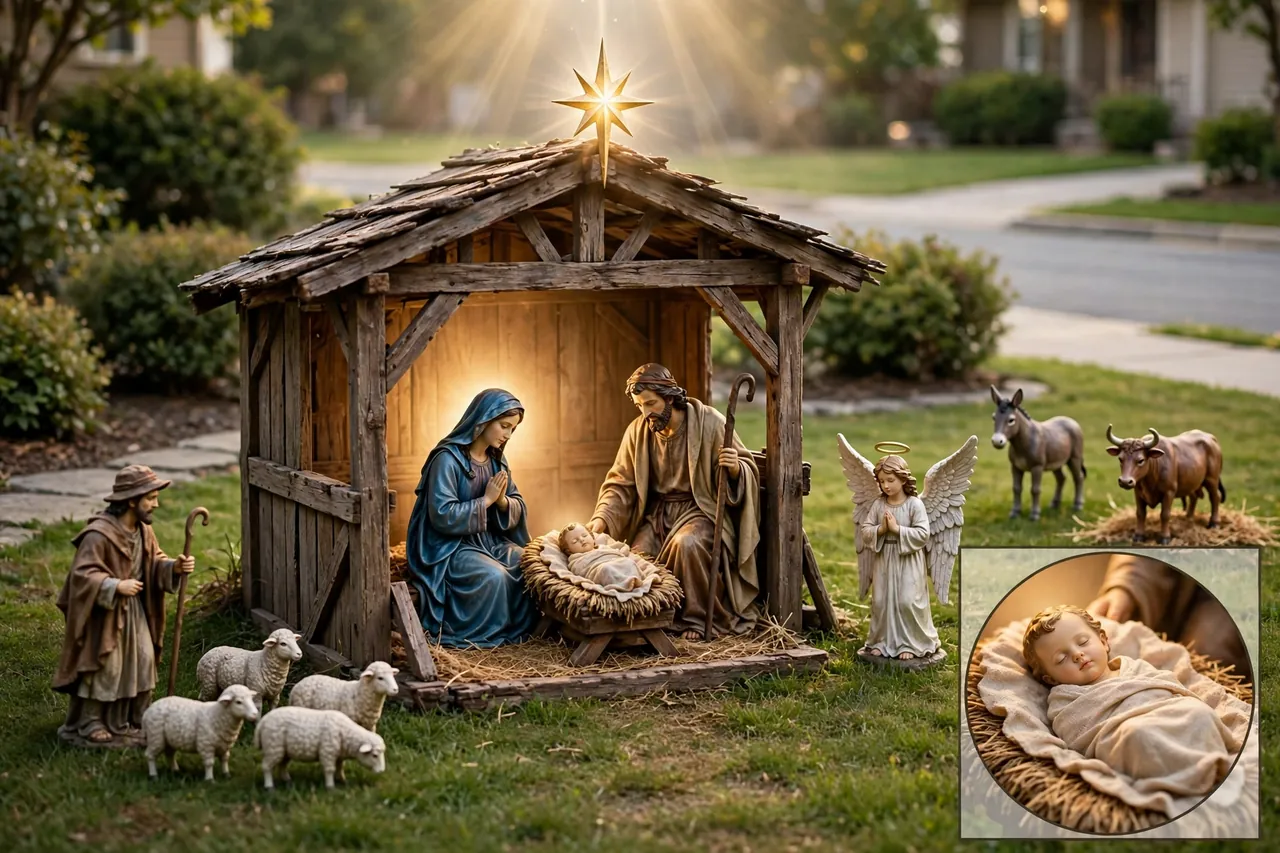
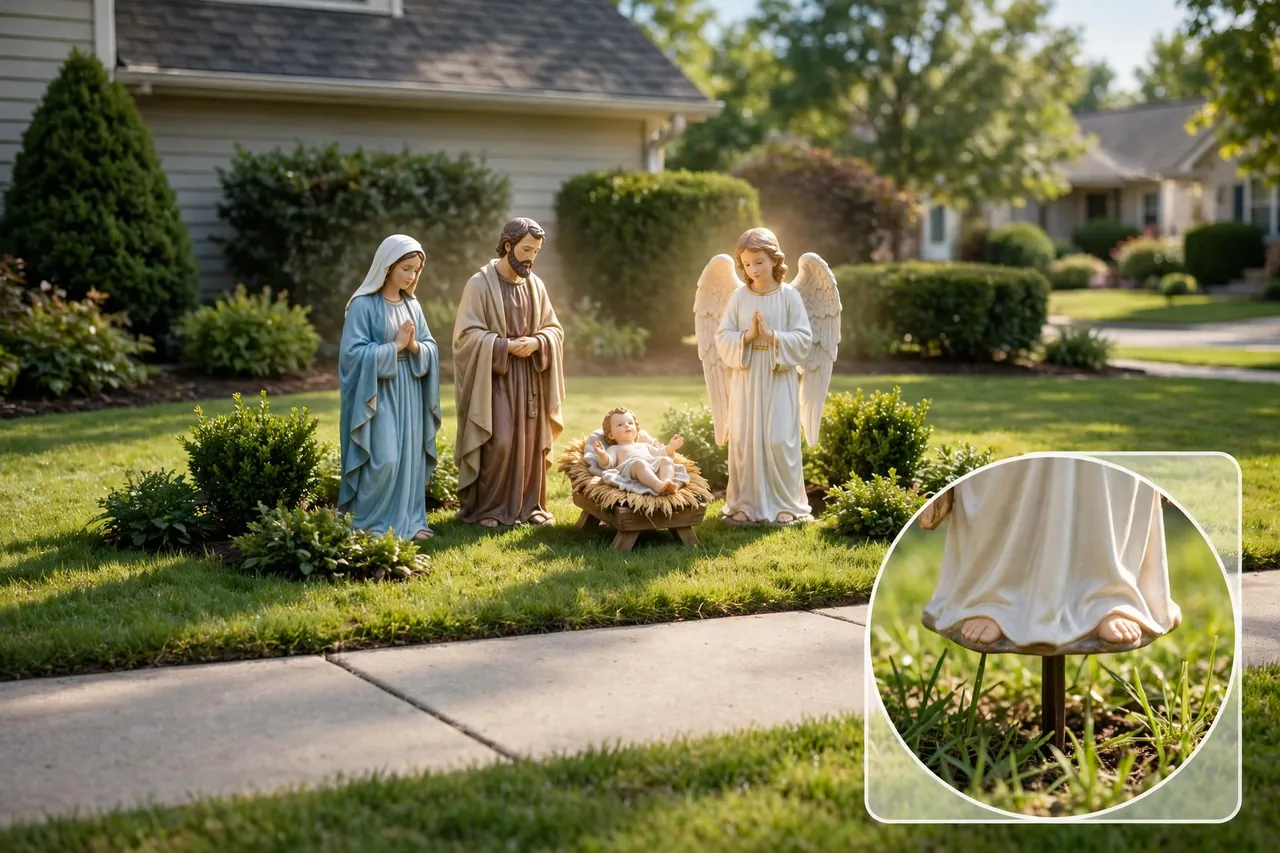
The nativity scene, also called a crèche, shows the birth of Jesus in Bethlehem. The central figures are Mary, Joseph, and baby Jesus in a manger. Shepherds, angels, animals, and wise men often join them, and a star usually shines above the stable.
Tradition traces the first living nativity scene to St. Francis of Assisi in 1223, when he staged the Christmas story with real people and animals so ordinary villagers could see it with their own eyes. Over the centuries, churches and families replaced living scenes with carved wood, painted figures, and later weatherproof outdoor sets. The Museum of the Bible notes that nativity scenes display the Christmas story as told in the Gospels of Luke and Matthew, and that the central figures remain Mary, Joseph, and baby Jesus in every version. You can read that history in full in the Museum of the Bible’s guide to the nativity.
Who Belongs in the Scene?
Start with the Holy Family: Mary, Joseph, and baby Jesus in the manger. These three figures carry the whole meaning, so give them the best spot and the clearest light. If your set is small, these three alone make a complete and honest display.
Next, add figures that deepen the story without crowding it. Angels announce the birth, shepherds come to see the child, and animals recall the stable setting. Wise men, who followed the star, are often added too, although some families wait until Epiphany on January 6 to place them, since tradition holds that their visit came later. There is no single correct order, and different churches and families follow different customs. Pick the arrangement your family understands and can explain.
Keep the scene readable from the street. A good rule is one focal group, not three competing groups. If you own a large set, spread the figures so each one has breathing room, and keep the manger at the visual center. A crowded scene looks busy in daylight and turns into a confusing silhouette at night.
Choosing the Right Size for Your Yard
Measure before you buy. A small front yard suits a compact set of about 3 to 4 feet tall, while a large lawn can carry a life-size or near-life-size set without looking lost. Walk to the sidewalk and look back at the spot you have in mind. If the figures would vanish against the house or the shrubs, go bigger or move the display closer to the street.
Height matters for wind as well as looks. Tall, flat figures catch more wind, so they need stronger stakes and a sheltered spot. Low, solid figures sit more safely in an open lawn. If you want ideas for judging scale in a big yard, see our guide to large Christmas decorations before you order.
Crosses, Stars, and Angels Outdoors
A nativity scene is the best-known faith symbol, but it is not the only one. Crosses, stars, and angels each carry their own meaning, and each works well on its own or beside a nativity scene.
Outdoor Crosses at Christmas
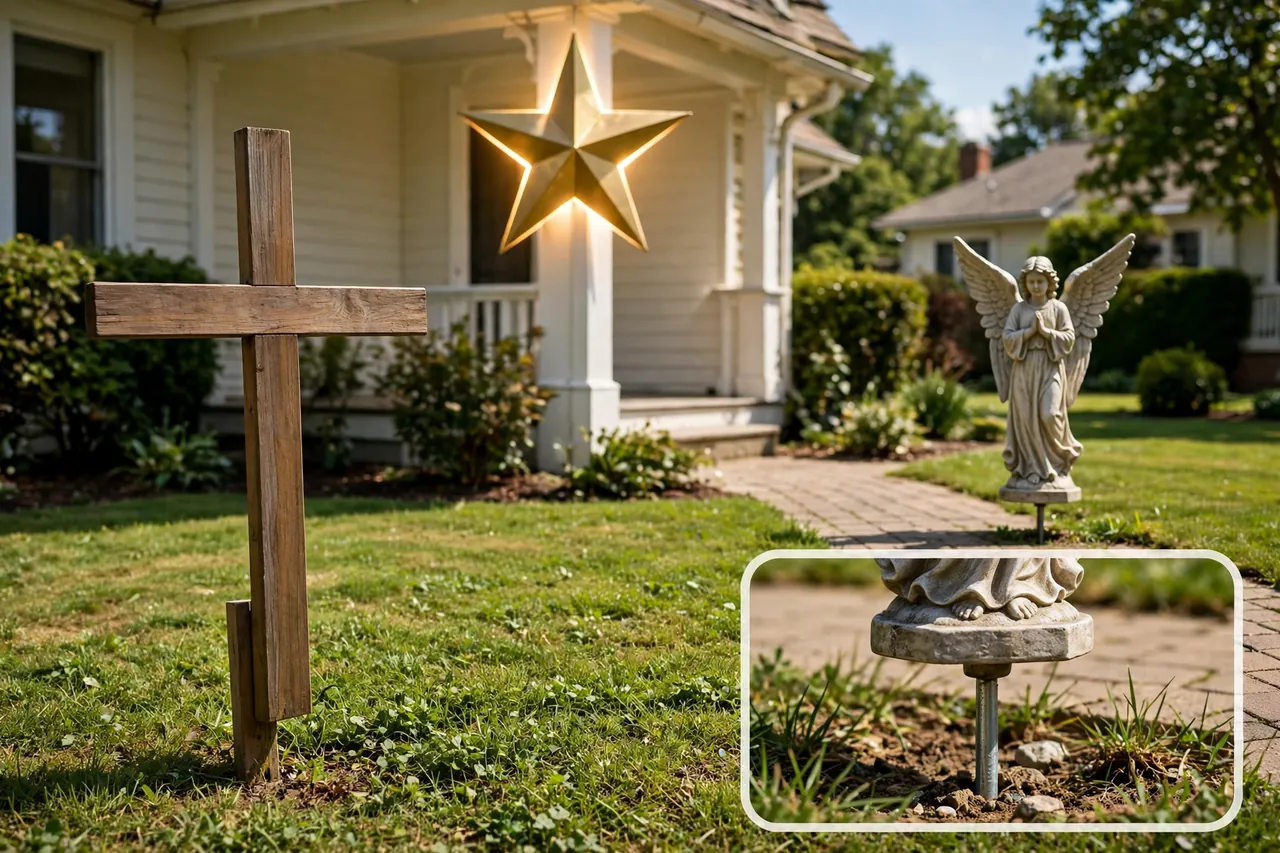
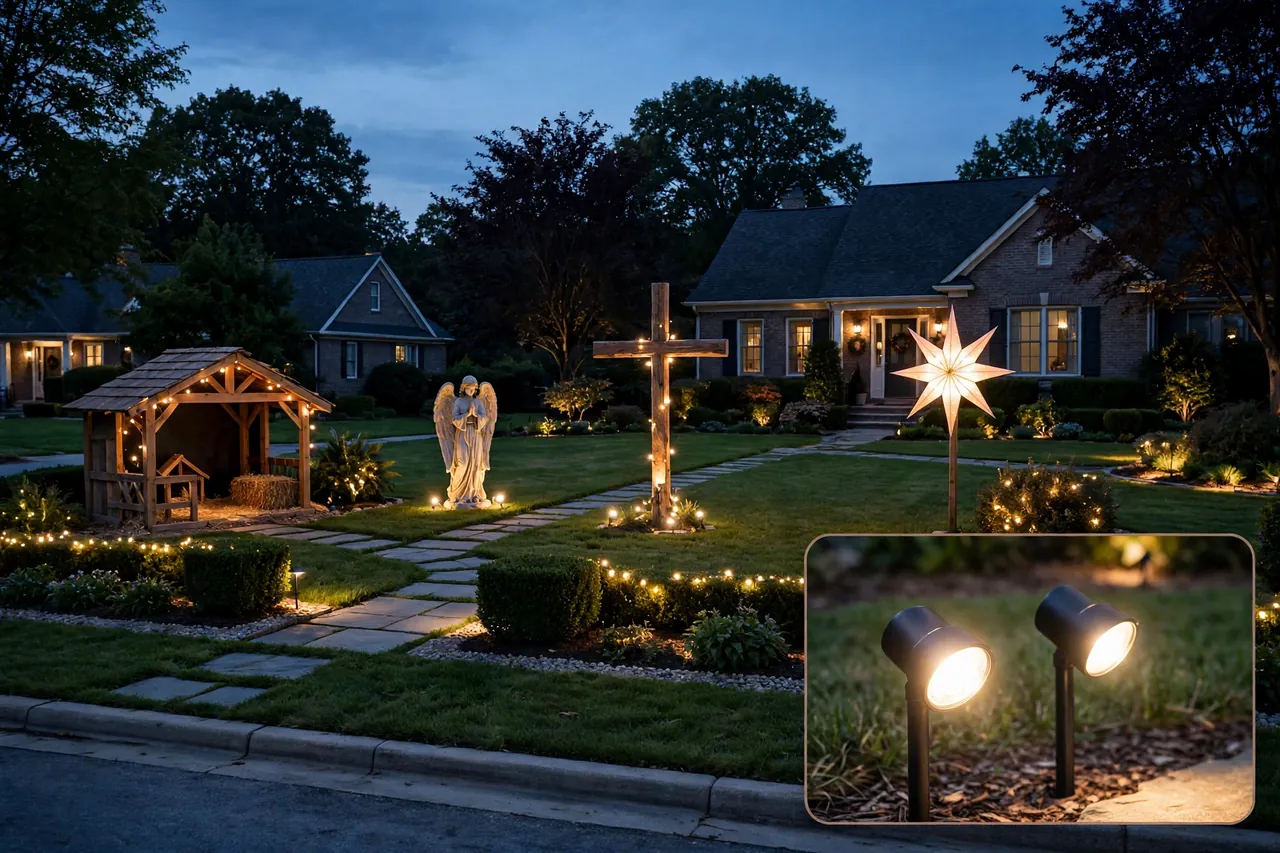
A cross at Christmas points beyond the manger to the whole Christian story. Some families place a simple wooden cross near the nativity scene, while others light a cross on the porch or in the yard as a quiet statement of faith. A plain, sturdy cross reads more clearly outdoors than a fussy design, because detail disappears at a distance and in low light.
Choose a cross made for outdoor use, with a sealed finish and a base or stake that holds it upright in wet soil. Place it where it will not block the nativity scene or the walkway. If you light it, use warm white lights and keep the glow soft, so the cross looks reverent rather than flashy.
The Star of Bethlehem
The Star of Bethlehem marks the sign that, in Matthew’s Gospel, guided the wise men to Bethlehem. Outdoors, a star works in three places: above a nativity stable, on top of a porch post, or mounted on the front of the house where it can be seen from the street.
A star with a simple, bold shape beats a delicate one outdoors. Five-pointed stars and four-pointed guiding stars both read well at night. Light the star from within or with a small spotlight, and keep it a little brighter than the figures below it, so the eye travels upward, just as the story describes.
Angels in the Yard
Angels announce the birth in Luke’s Gospel, telling the shepherds of good news and great joy. An outdoor angel can stand beside the stable, guard a walkway, or top a porch display. Trumpeting angels suit a joyful, welcoming entrance, while a kneeling or praying angel suits a quiet corner near the nativity scene.
Because angels often have wings and raised arms, check their balance before you leave them out overnight. Anchor the base well, and avoid placing a tall angel where a strong gust can topple it onto a path. A single well-placed angel usually speaks more clearly than a row of small ones.
Scripture Signs and Word Displays
Scripture signs let your yard speak in words. Short phrases work best outdoors, because drivers and walkers have only a few seconds to read them. “Joy to the World,” “Peace on Earth,” “Glory to God,” and “Jesus Is the Reason” are all easy to read from the street when the letters are large and bold.
Pick one message for the whole yard. Two or three different signs with different verses can split the reader’s attention and muddy the display. If you want a longer passage, save it for a porch sign where visitors stand close enough to read it, and keep the yard sign short.
For a faith-centered yard, a Christian Christmas decoration outdoors should still read as one display, not a collection of slogans. Place the sign where it supports the nativity scene, such as beside the walkway leading to it, rather than on the opposite side of the yard. Use high-contrast lettering, such as dark letters on a light board or lit letters on a dark board, so the words stay readable after dark.
Respect matters with words as much as with figures. Keep signs clean, upright, and in good repair all season. A faded, leaning, or broken sign sends the opposite message from the one you mean, so check it after storms and straighten it promptly.
Choosing Materials That Survive Winter Weather
Outdoor Christian Christmas decorations face rain, snow, wind, and freezing nights. The material you choose decides whether your display still looks dignified in January or starts to sag by mid-December. The table below compares the most common options.
Outdoor Nativity and Faith-Symbol Materials at a Glance
| Material | Best For | Watch Out For |
|---|---|---|
| Resin and fiberglass | Detailed figures, long seasons | Heavy pieces need solid anchoring |
| PVC board and silhouette sets | Clean modern look, easy storage | Flat panels catch wind |
| Metal frames with fabric | Lighted sets, quick setup | Check seams and lights yearly |
| Wood | Crosses, stables, rustic scenes | Needs sealed finish and dry storage |
| Inflatable fabric | Large scenes on a budget | Needs constant power and tie-downs |
Whatever material you choose, read the label before you buy. Look for “outdoor use” on the box, and check whether the lights, cords, and plugs carry the same rating. An outdoor-rated figure with an indoor-only cord is not an outdoor display. Store every piece dry after the season, because damp storage causes mold, rust, and peeling paint faster than a month of snow will.
Weight is a hidden factor. Lightweight sets are easy to carry, but they move in wind. Heavy resin figures stay put, but they are hard to lift and can crack if dropped on frozen ground. Choose the weight you can actually handle safely, then anchor it properly.
Lighting Your Display So the Meaning Shows After Dark
Most people see your yard at night, so lighting is not an afterthought. The goal is simple: the Holy Family, the star, or the cross should be the brightest, clearest thing in the yard. Everything else should glow more softly around it.
Warm white light suits faith symbols best. It feels calm and candle-like, and it flatters skin tones on figures and the wood of a stable. Cool white light can look crisp, but it can also make a nativity scene feel cold and commercial. Colored lights have their place in a general display, yet for a faith-centered scene, warm white keeps the mood reverent.
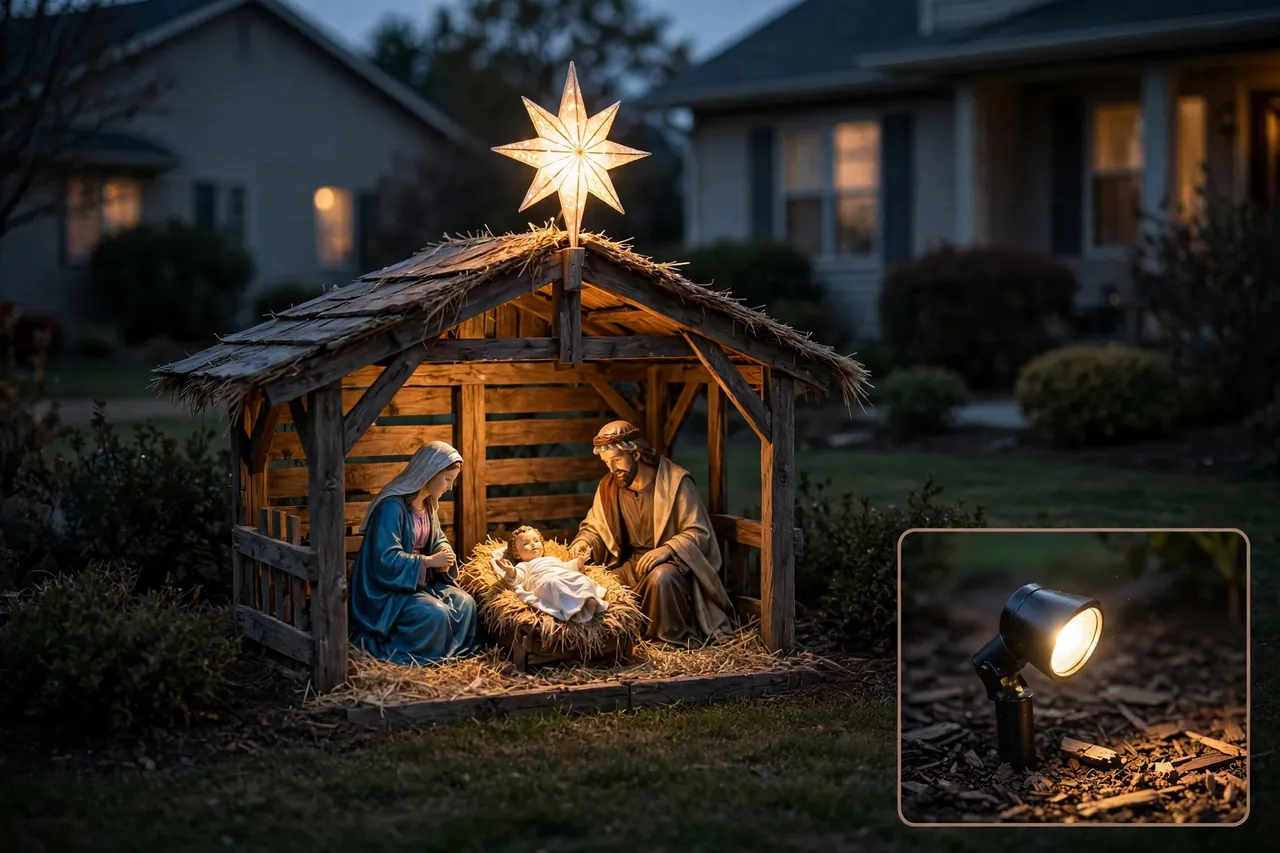
Use spotlights rather than wrapping every figure in strings. One or two low spotlights aimed at the manger create depth and shadow, while a string wrapped around each figure can blur the shapes into a tangle of light. If you do use string lights, run them along the stable roof or the edge of a sign, not across faces. For more ideas on making a lighted display read clearly, see our guide to light-up Christmas decorations.
Set lights on a timer so the display glows in the evening and rests overnight. A timer saves power, protects bulbs, and matches the safety advice to switch lights off when you go to bed or leave the house. Check the timer rating for outdoor use, just as you check the lights themselves.
How to Set Up a Faith-Centered Outdoor Display, Step by Step
A calm, orderly setup makes the finished display look intentional. Follow these steps in order, and resist the urge to add pieces before the main scene is placed.
- Pick one focal point. Choose the nativity scene, the cross, or the star as the center, and clear that spot of clutter, bins, and unrelated figures.
- Mark the viewing line. Stand where visitors will look from, usually the sidewalk or driveway, and confirm the focal point reads clearly from there.
- Set the stable or base first. Level the ground, place the stable or backdrop, and anchor it before you add any figures.
- Place Mary, Joseph, and baby Jesus. Put the Holy Family at the center, facing slightly toward the street so visitors can see their faces.
- Add supporting figures sparingly. Place angels, shepherds, and wise men around the center with space between them, and step back after each addition to check the balance.
- Raise the star last. Fix the star above the stable or at its own clear point, and confirm it sits higher than the figures below it.
- Light from the front and slightly above. Aim spotlights so faces and the manger catch light, and walk to the street to check for glare or dark patches.
- Run cords safely. Keep cords out of walkways, off wet ground where possible, and connected only to outdoor-rated, GFCI-protected outlets.
When you finish, take a photo from the street at night. The photo shows what visitors actually see, and it often reveals a leaning figure, a dark corner, or a cord crossing a path that you missed while standing in the yard.
Weatherproofing, Anchoring, and Electrical Safety
Winter weather tests every outdoor display, and safety must come before sparkle. The U.S. Consumer Product Safety Commission advises using only lights tested by a recognized testing laboratory, plugging outdoor lights into GFCI-protected circuits, and turning lights off when you go to bed or leave the house. You can read the full advice in the CPSC holiday decorating safety guide.
Anchor every tall or flat piece. Drive stakes into firm ground, use guy lines on large figures, and weigh down inflatable scenes exactly as the maker directs. Check anchors after the first strong wind, because soil softens in rain and stakes loosen. A figure that falls can break, block a path, or damage a light cord.
Protect plug connections from water. Keep connections off the ground, cover them with outdoor-rated cord covers, and never tape over a damaged cord as a fix. Inspect cords, sockets, and bulbs before setup, and throw out any set with frayed wires, cracked sockets, or loose connections. Use outdoor-rated extension cords only, and never run a cord through a doorway or window where it can pinch and wear.
Respect the limits of your circuit. Do not overload one outlet or one extension cord, and follow the maker’s limit on how many light sets you can link together. If a GFCI outlet keeps tripping, switch the display off and find the fault instead of bypassing the protection. A tripping GFCI is a warning, not a nuisance, and a qualified electrician should handle any outlet or wiring work you are unsure about.
Displaying Faith Symbols With Respect
A faith display in a front yard is public, so a little thought about neighbors goes a long way. Keep figures upright, clean, and well lit, and keep the yard tidy around them. A display that looks cared for reads as an invitation, while a neglected one can feel like clutter even to people who share your faith.
Present different traditions factually and without argument. Some families place baby Jesus in the manger on Christmas Eve, others display the full scene from the start of Advent, and some add the wise men at Epiphany. Some churches use a simple wooden cross, others a lighted star, and others a full nativity village. None of these choices needs defending in your yard. A short, clear display lets each visitor bring their own understanding to it.
Think about children and visitors on foot. Keep the display behind the sidewalk line, leave paths clear, and avoid sharp stakes or low guy lines where someone could trip. If children will walk up to see the figures, place smaller pieces where they can look without stepping onto a cord or a fragile base.
Finally, decide when the display comes down. Many families keep the nativity scene up through Epiphany on January 6, while others pack it away soon after Christmas Day. Either choice is fine. What matters is taking it down promptly once you decide, cleaning each piece, and storing it dry so next year’s display starts in good shape.
Troubleshooting Common Outdoor Display Problems
Most outdoor display problems have simple causes. Work through this list from the safest, cheapest check first, and switch the power off before you touch any cord or plug.
- One figure stays dark. Check its bulb or plug first, then test it on a known working outlet before you blame the whole string.
- The GFCI trips in rain. Dry the plug connections, lift them off wet ground, and cover them with an outdoor-rated cover. If tripping continues, unplug the display and inspect every cord for damage.
- Figures lean or fall in wind. Add longer stakes, move the display to a more sheltered spot, or reduce the height of the tallest piece.
- The scene looks washed out at night. Dim or move competing lights, and aim one warm spotlight at the manger instead of flooding the whole yard.
- Colors fade or paint peels. Move the piece out of constant direct sun where possible, and store it indoors and dry after the season.
- Cords cross a walkway. Reroute them along a bed edge or under a cord cover, and never leave a loose cord where visitors walk after dark.
If a cord is damaged, a plug is cracked, or an outlet feels warm, stop using that piece and replace it. Do not repair mains wiring yourself unless you are qualified to do so. A short delay beats a damaged display or an injury.
Disclaimer: homes, yards, circuits, and weather vary, so treat this guide as general advice, not a substitute for your product manuals. For electrical work beyond plugging in outdoor-rated lights, or for any damaged wiring or outlet, ask a qualified electrician for help.
Related Guides
If you are planning the wider yard around your faith display, these guides can help with scale and lighting. Our guide to large Christmas decorations covers judging size in a big yard, and our guide to light-up Christmas decorations covers making a lighted display read clearly after dark.
Frequently Asked Questions
What are Christian outdoor Christmas decorations?
They are outdoor displays built around Christian faith symbols, such as a nativity scene, a cross, the Star of Bethlehem, angels, and scripture signs. They tell the Christmas story in the yard, rather than filling it with general festive figures.
What should I include in an outdoor nativity scene?
Start with Mary, Joseph, and baby Jesus in a manger, since they are the central figures. Then add angels, shepherds, animals, and wise men only if space allows, and keep the manger at the center so the scene stays clear from the street.
How do I protect an outdoor nativity scene from rain and snow?
Choose outdoor-rated figures, anchor them firmly, and keep plug connections off wet ground under outdoor-rated covers. Inspect cords and bulbs before setup, store pieces dry after the season, and switch lights off in severe storms.
How should I light a nativity scene outdoors?
Use warm white spotlights aimed at the manger from the front and slightly above, so faces and the stable read clearly. Keep the star a little brighter, avoid wrapping strings across faces, and run everything on an outdoor-rated timer.
When should I put up and take down outdoor Christian Christmas decorations?
Many families set up during Advent, the four weeks before Christmas, and take the display down after Christmas Day or after Epiphany on January 6. Follow your family’s or church’s custom, and pack pieces away promptly and dry.
Start with one clear symbol this Christmas. Place a nativity scene, a cross, or a star where visitors can see it, light it gently, and anchor it well. Then step back to the street at night and look at it the way a neighbor would. If the meaning reads in one glance, your display is done, and you can enjoy it all season.