
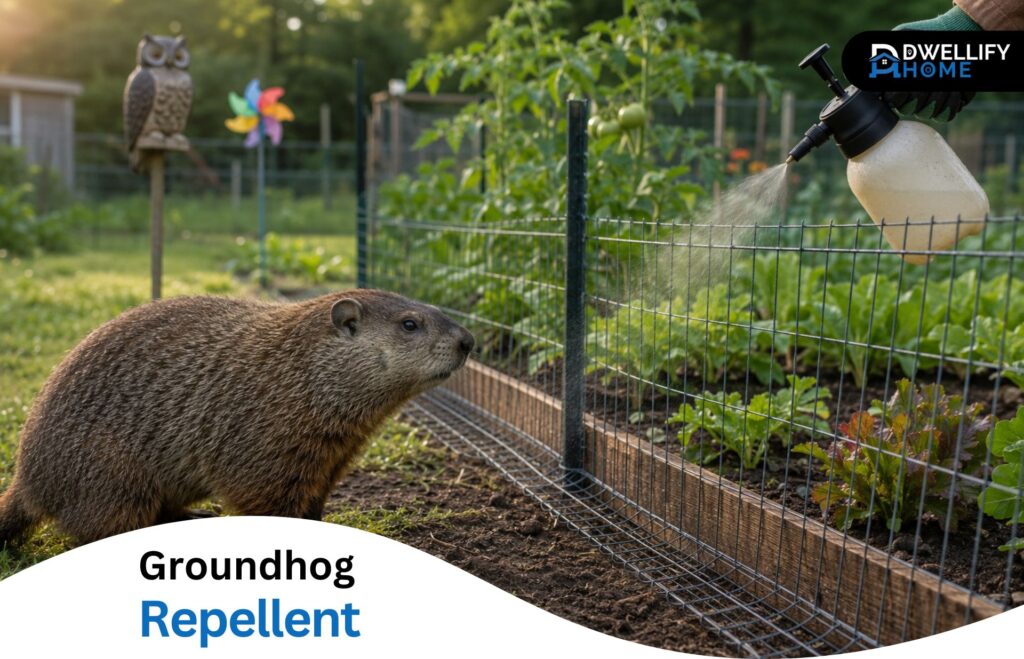
A groundhog can reduce a thriving vegetable bed to bare stems in a handful of visits. Repellent seems like the quickest answer, but the results depend on what you’re trying to accomplish.
Some products may discourage feeding or make a travel route less inviting. They’re less likely to remove an animal from an established burrow. The most reliable approach combines a suitable groundhog repellent with physical barriers, fewer food sources, and careful monitoring.
Short Definition
A groundhog repellent is a spray, granule, scent, or device intended to discourage woodchucks from feeding, digging, or entering gardens and other protected areas.
Mission Statement
DwellifyHome helps homeowners, renters, and home lovers make practical, informed choices that create more comfortable, functional, and stylish living spaces.
SERP Enhancement Elements
| Option | Best for | Main limitation |
| Commercial spray | Labeled plants and small areas | May require reapplication |
| Repellent granules | Garden perimeters and soil | Rain and coverage affect results |
| Motion sprinkler | Known routes and garden edges | Requires water and careful positioning |
| Buried fencing | Long-term garden protection | Requires materials and installation |
Do Groundhog Repellents Actually Work?
Groundhog repellents can provide temporary or situational relief, but they rarely solve an established problem by themselves. Sprays, granules, strong scents, and motion devices may discourage feeding or travel. Properly installed fencing is more dependable because it blocks access rather than relying on an animal’s reaction to an unpleasant smell or taste.
Virginia Cooperative Extension recommends viewing repellents as a source of short-term relief while more permanent protection is installed. It also cautions that product registration doesn’t guarantee that a repellent will be effective in every yard. Virginia Cooperative Extension
Repellents have the best chance of helping when:
- The groundhog has only recently started visiting.
- Damage is limited to a few plants or one travel route.
- The treatment covers the entire vulnerable area.
- Rain and irrigation haven’t removed the product.
- Food, shelter, and easy garden access are being addressed at the same time.
Why Groundhogs Choose Gardens and Keep Returning
A vegetable garden offers concentrated food with little effort. Beans, peas, leafy vegetables, flowers, fallen fruit, and other tender growth can make the same yard worth visiting repeatedly.
Nearby shelter matters too. Tall grass, brush, woodpiles, dense shrubs, decks, and sheds provide cover or places to establish a burrow. A repellent may become a minor inconvenience when the reward on the other side is an unprotected garden.
How to Confirm You Have a Groundhog
Look for several signs rather than relying on plant damage alone:
- A large burrow entrance with excavated soil nearby
- Damage concentrated close to the ground
- Broad sections of leaves or stems eaten
- Daytime sightings near the damaged area
- Burrows beneath sheds, decks, fences, or vegetation
- A repeated path between the burrow and garden
Groundhogs can both dig and climb. Damage that continues after a basic fence is installed doesn’t necessarily mean the animal has disappeared—it may have gone under, over, or through a weak point.
Food, Cover, and Burrows That Attract Groundhogs
Open compost, fallen produce, overgrown edges, accessible crops, and sheltered soil near structures can keep a groundhog interested. Removing these attractions won’t always evict one with an established den, but it makes other control measures more effective.
Groundhog Repellent Options and What to Expect From Them
The best option depends on whether you need to protect individual plants, discourage travel across a boundary, or interrupt repeated visits.
| Repellent type | Best suited to | Main limitation |
| Commercial liquid spray | Labeled plants and surfaces | May wash away and can have crop restrictions |
| Commercial granules | Soil, borders, paths, and labeled perimeter uses | Requires broad, even coverage and reapplication |
| Homemade scent or taste deterrent | Small-scale, low-cost experimentation | Evidence and strength are inconsistent |
| Motion-activated sprinkler | A defined approach or garden edge | Needs water, correct positioning, and complete coverage |
| Static sound or visual device | Short-term disturbance | Groundhogs may become accustomed to it |
Commercial Groundhog Repellent Sprays and Granules
Commercial products offer clearer application instructions than homemade mixtures. Some use odor, taste, or predator-associated ingredients to discourage animals from approaching or feeding.
Check that the product label covers:
- Groundhogs or woodchucks
- The intended application site
- Edible crops, when applicable
- Required reapplication
- Precautions for children, pets, water, and wildlife
A spray can be practical for several vulnerable plants. Granules can help establish a treated perimeter. Neither will close a fence gap or make an occupied den disappear.
Homemade Scent and Taste Deterrents
Garlic, cayenne pepper, castor oil, and predator-associated odors are commonly discussed as natural groundhog repellents. Their results are variable, and there isn’t a standardized homemade recipe that can be assumed effective or safe for every plant.
Strong pepper mixtures may irritate eyes and noses, including those of pets and people. Homemade sprays can also damage sensitive foliage. Test a small area first, avoid applying unknown mixtures to edible portions, and don’t assume that “natural” means harmless.
Motion-Activated Sprinklers and Scare Devices
A motion-activated sprinkler gives the animal an immediate and unpredictable consequence. It can work well along a known approach, but one unit may leave untreated paths into a large garden.
Stationary lights, pinwheels, radios, and ultrasonic devices are less dependable. Groundhogs can learn that a repeated sound or motion poses no real threat, a process known as habituation.
Groundhog Repellent Myths and Methods to Avoid
Household remedies are attractive because they’re inexpensive and already available. The problem is that personal success stories don’t establish reliable effectiveness.
Epsom Salt, Irish Spring Soap, Hair, and Other Home Remedies
Epsom salt, soap shavings, hair, and used litter may create an unfamiliar smell, but there’s limited dependable evidence that they provide lasting control. Rain can dissolve or disperse them, and a hungry groundhog may simply ignore the odor.
Treat these methods as experiments, not established solutions. Stop using them if they affect the soil, plants, pets, or enjoyment of the yard.
Why Static Noise and Ultrasonic Devices Often Disappoint
A device may startle a new visitor for a short period. Once the groundhog learns that nothing follows the sound, light, or vibration, it may resume feeding.
Changing device positions can delay habituation, but that still doesn’t create a physical barrier. Use scare devices as supporting measures, not the main defense for valuable crops.
Why Mothballs and Unapproved Chemicals Do Not Belong in the Garden
Mothballs are pesticides intended for specific labeled uses, commonly inside airtight storage containers. The National Pesticide Information Center advises that they should not be used as animal repellents unless the label expressly allows that use. Open-air placement can expose people, pets, and wildlife to pesticide vapors. National Pesticide Information Center
Don’t pour flammable, caustic, or unapproved chemicals into a burrow. Besides creating safety and environmental risks, an occupied animal may dig another exit instead of leaving the property.
How to Apply Groundhog Repellent Safely and Effectively
Start by defining the goal. Protecting bean plants requires a different placement strategy from discouraging travel along a fence.
Where to Apply Sprays and Granules
Follow the product label and treat the complete vulnerable area. Depending on the approved use, this may include:
- The garden perimeter
- Known approach paths
- Soil around vulnerable beds
- Damaged plants or nearby surfaces
- Approved areas near a burrow entrance
Avoid leaving untreated corners or gate openings. Never spray a product directly at the animal, and don’t apply it to plants or produce unless the label permits that use.
When to Reapply After Rain or Irrigation
Water can dilute a spray, disperse granules, or weaken an odor barrier. Follow the label’s reapplication schedule and inspect the area after heavy rain or irrigation.
Repeated washing may make a repellent impractical for the site. That’s a sign to strengthen exclusion rather than applying more product indefinitely.
How to Monitor Whether the Repellent Is Working
Track changes instead of relying on an occasional sighting. Look for:
- New feeding damage
- Fresh soil around burrow entrances
- Disturbed perimeter treatments
- New travel paths
- Activity recorded by a motion camera
A quiet day doesn’t prove that a burrow is empty. Monitor long enough to identify a pattern before sealing an entrance or changing methods.
Why Fencing Provides Better Long-Term Garden Protection
Fencing is more dependable because it prevents access. Extension recommendations vary slightly, but a practical groundhog-resistant fence is generally three to four feet high, uses durable wire with small openings, and extends about a foot below the soil. An additional section bent outward underground creates an L-shaped apron that frustrates digging.
University of Maryland Extension, Kansas State University Extension, and Virginia Cooperative Extension all emphasize buried fencing and climbing protection.
Fence Height, Mesh, and Climbing Protection
Welded wire or sturdy hardware cloth generally holds its shape better than lightweight netting. Use openings small enough that young animals can’t squeeze through.
A loose or outward-angled upper section can make climbing more difficult. An electric wire may provide additional protection where local rules permit it, but it introduces safety and maintenance concerns around children, pets, and vegetation.
How to Install a Buried L-Shaped Apron
Run the lower section into the soil, then bend the bottom outward, away from the garden. A groundhog digging at the fence meets wire beneath its feet rather than finding an open route below the barrier.
Secure overlaps and corners so they can’t separate. A shallow vertical fence without an apron may simply encourage the animal to dig deeper.
Protecting Raised Beds, Gates, Corners, and Other Weak Points
Check the entire boundary, especially:
- Space beneath gates
- Inside corners
- Overlapping wire panels
- Changes in ground level
- Drainage openings
- Gaps around posts
- Connections between a fence and wall
One accessible opening can defeat an otherwise well-built barrier.
What to Do When Groundhog Repellent Is Not Enough
Failure doesn’t always mean the product has no effect. Rain, incomplete coverage, easy food, multiple entrances, or an established den may be overwhelming it.
First, correct obvious gaps. If activity continues, shift effort toward fencing, habitat modification, or professional wildlife control rather than cycling through more household remedies.
Dealing With an Active Burrow Under a Shed or Deck
A structural burrow needs more caution than occasional garden feeding. Don’t seal the opening after seeing the groundhog outside once. Another animal or dependent young may remain inside, and a trapped animal may dig toward the structure.
Monitor the entrance for activity. Seek professional guidance when the den is near a foundation, crawlspace, utilities, retaining wall, patio, deck support, or other area where excavation or closure could affect the property.
When to Contact a Wildlife-Control Professional
Professional help is appropriate when:
- You can’t confirm whether a den is occupied.
- Young may be present.
- The burrow is close to a structure or utility.
- Repeated exclusion attempts have failed.
- Trapping appears necessary.
- You’re uncomfortable handling a trapped wild animal.
- Local wildlife rules are unclear.
A qualified provider can also explain the legal options available in your state. Don’t rely on a generic relocation distance found online.
How to Keep Groundhogs From Coming Back
Removal without prevention leaves food and shelter ready for the next animal.
- Harvest ripe produce promptly.
- Pick up fallen fruit and discarded vegetables.
- Use a covered compost container.
- Cut back tall grass, weeds, and dense cover near the garden.
- Move unnecessary woodpiles and debris.
- Repair fence damage and inspect the buried apron.
- Close confirmed-empty access points appropriately.
- Watch for fresh digging before plant damage becomes extensive.
Maintain these steps even after activity stops. Prevention is easier when the animal hasn’t established a den.
Groundhog Repellent FAQs
How Do You Get Rid of a Groundhog Permanently?
No repellent guarantees permanent removal. The most dependable plan combines a properly built fence, removal of food and protective cover, monitoring, and professional help for occupied burrows. Repellents can support that plan, but another groundhog may move in when access and attractive conditions remain unchanged.
What Smell Keeps Groundhogs Away?
There isn’t one proven smell that reliably keeps every groundhog away. Garlic, hot pepper, castor oil, and predator-associated odors are commonly used, but results vary and usually require reapplication. Odor deterrents work best as temporary support for fencing and habitat changes.
Does Epsom Salt Repel Groundhogs?
Evidence for Epsom salt is largely anecdotal. It may create an unfamiliar taste or surface condition, but rain dissolves it and hungry animals may ignore it. Because Epsom salt is magnesium sulfate, repeated garden application shouldn’t be treated as harmless or necessary without considering the soil.
Does Irish Spring Soap Repel Groundhogs?
There’s no dependable evidence that Irish Spring soap provides lasting groundhog control. Its fragrance might cause brief avoidance, but weather weakens the smell and animals can become accustomed to it. Soap shavings shouldn’t replace a buried fence, secure gate, or removal of accessible food.
Can You Legally Trap and Relocate a Groundhog?
That depends on state and local wildlife regulations. Some jurisdictions restrict trapping, transport, or release because of animal-welfare and disease concerns. Contact the state wildlife agency or a licensed wildlife-control professional before setting a trap. Don’t assume that releasing the animal several miles away is legal.
A Practical Groundhog-Control Plan
Begin by confirming the animal and locating its travel route or burrow. Use a properly labeled repellent or motion sprinkler for temporary pressure, then protect valuable beds with a buried, climb-resistant fence. Remove accessible food and cover, monitor activity, and maintain the barrier after the damage stops.
Bring in a wildlife-control professional when a burrow threatens a structure, occupancy is uncertain, or trapping and local regulations complicate the next step.
Disclaimer
DwellifyHome content is for general informational purposes only. Homes, needs, preferences, budgets, and circumstances vary. Consult a qualified professional for safety, installation, repair, legal, structural, electrical, plumbing, HVAC, or major property decisions.