Figuring out how to fix a heater starts with ruling out danger, then checking the thermostat, power, filter, vents, and access panel. These simple checks may restore heat without a service call. Stop, however, if you smell gas, hear a carbon monoxide alarm, notice smoke, or encounter a recurring electrical problem.
This guide focuses mainly on central forced-air furnaces—the equipment most U.S. homeowners mean when they say their house heater isn’t working. It will help you identify safe homeowner fixes, understand what the symptoms may mean, and recognize when an HVAC technician should take over.
Short Definition
Fixing a heater means identifying whether the problem involves its thermostat, power, airflow, or internal components, then completing only safe homeowner checks before arranging professional repair when needed.Mission Statement
DwellifyHome helps homeowners, renters, and home lovers create practical, stylish, comfortable spaces through clear and trustworthy guidance
Quick Checklist
- Check for gas odors, a CO alarm, smoke, or scorching.
- Set the thermostat to Heat and the fan to Auto.
- Verify the furnace switch and circuit breaker.
- Make sure the front panel is seated correctly.
- Inspect the filter and clear blocked vents.
- Record visible diagnostic codes.
- Stop if the breaker trips again or the heater repeatedly shuts down.
- Call an HVAC professional for internal gas, ignition, or electrical faults.
First, Make Sure the Heater Is Safe to Check
Don’t touch the thermostat, furnace, electrical panel, or gas controls until you’ve checked for immediate hazards.
Leave the Home if You Smell Gas or a Carbon Monoxide Alarm Sounds
A sulfur or rotten-egg odor may indicate a natural-gas leak. Leave the building immediately, keeping doors and windows as they are. Don’t operate lights, thermostats, appliances, plugs, or phones inside. Call 911 or your gas utility from a safe location.
Carbon monoxide is different: it has no smell or color. When a CO alarm sounds, don’t search for the source. Move everyone outside, call emergency services, and stay out until responders say it’s safe. The U.S. Consumer Product Safety Commission recommends never ignoring a CO alarm or re-entering without permission.
Shut the Heater Off for Smoke, Scorching, or Electrical Odors
Active smoke, sparks, fire, or a strong electrical burning smell requires immediate attention. Leave the area and contact emergency services when necessary.
Other serious warning signs include soot near the furnace, a loud bang during ignition, melted wiring, a hot electrical panel, and repeated breaker trips. Don’t continue troubleshooting equipment showing these symptoms.
Identify What Kind of Heater You Have
The correct checks depend on the heating system:
- A forced-air furnace heats air and distributes it through ducts and registers.
- A heat pump moves heat indoors and may produce air that feels less hot than furnace air.
- A boiler circulates hot water or steam through radiators or baseboards.
- A wall or portable heater has appliance-specific controls and safety switches.
- A water heater heats household water, not the living space.
The steps below primarily apply to forced-air gas and electric furnaces. Heat pumps share some thermostat, power, filter, and airflow checks, but refrigerant, outdoor-unit, and auxiliary-heat problems require system-specific guidance. Use the owner’s manual when the equipment type or controls are unclear.
Try These Safe Heater Checks First
Work through these checks in order. Ask what changed immediately before the failure: a filter replacement, thermostat installation, power outage, maintenance visit, or moved furniture can point toward the simplest explanation.
Check the Thermostat Mode, Temperature, Fan Setting, and Batteries
Confirm that the thermostat is:
- Set to “Heat,” not “Cool” or “Off.”
- Set above the current room temperature.
- Using “Auto” for the fan rather than “On.”
- Showing a normal display without battery or error warnings.
A fan set to “On” can circulate room-temperature air between heating cycles, making it seem as though the heater is blowing cold air. Raising the temperature dramatically won’t make most systems heat faster.
Replace accessible thermostat batteries if needed. After a recent smart-thermostat installation, check its configuration, connection, and compatibility guidance. A display that says “Heat On” only means the thermostat is requesting heat—it doesn’t prove the furnace has responded.
Verify the Furnace Switch, Circuit Breaker, and Front Panel
Gas furnaces still require electricity to run their controls, ignition system, and blower.
Look for the furnace service switch, which often resembles a light switch near the equipment. Confirm that it wasn’t turned off accidentally. Check the labeled furnace or HVAC breaker without removing the electrical-panel cover.
A tripped breaker can be reset once if the panel is dry, undamaged, and clearly labeled. Stop and call a professional if it trips again.
The furnace may also stay off when its front panel isn’t seated properly. If a user-access panel was removed during a normal filter change, reinstall it according to the manual so it engages the blower-door safety switch. Don’t remove a service panel solely to test this possibility.
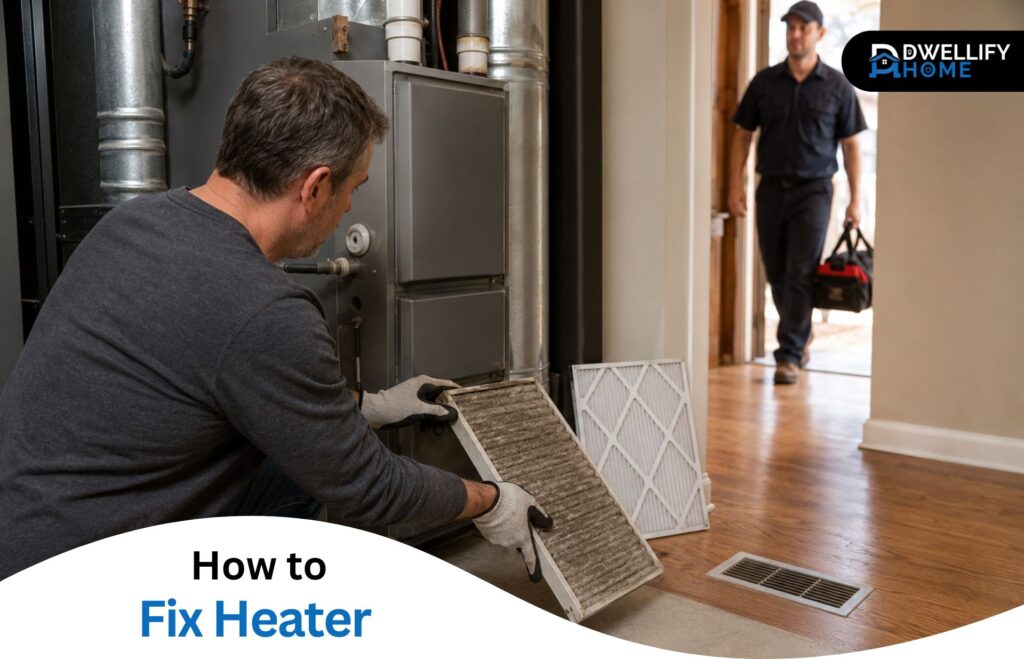
Inspect the Air Filter and Open Every Supply and Return Vent
Turn the system off as directed by its manual before removing a user-serviceable filter. Replace a dirty filter with the correct size and type, following the airflow arrow printed on its frame. Never run the furnace without a filter.
Open supply registers and make sure return-air grilles aren’t covered by furniture, rugs, boxes, or curtains. Closing several vents can increase airflow resistance rather than redirect heat safely.
Check for a Utility or Fuel-Supply Interruption Without Handling Gas Components
Check your utility’s outage notices. For gas heat, another gas appliance failing at the same time may suggest a broader service interruption.
Don’t open, close, loosen, or repair gas lines, valves, burners, or regulators. Contact the utility or an HVAC professional when fuel service is uncertain. Leave immediately if gas is suspected.
Diagnose the Problem by What the Heater Is Doing
A heater’s behavior is often more useful than a generic list of possible failures.
The Heater Does Not Turn On at All
A silent furnace may have an incorrect thermostat setting, lost power, an unseated access panel, or no heat request from the thermostat. After those checks, possible causes include a failed igniter, internal fuse, control board, safety switch, or blower component.
Those internal parts require proper diagnostic equipment. Don’t jump thermostat wires, bypass switches, or probe electrical terminals.
The Heater Runs but Blows Cold or Lukewarm Air
A brief burst of cool air at startup can be normal while the furnace warms. Persistent cold air is different.
Start with the fan setting, filter, open vents, and fuel availability. A furnace that blows continuously without producing heat may have an ignition failure, flame-sensing problem, or high-limit safety shutdown. These require professional diagnosis.
Heat-pump air may feel cooler than gas-furnace air while still warming the room. Judge it by whether the indoor temperature rises, not by touch alone.
The Heater Starts and Then Shuts Off
Frequent starts and stops are known as short cycling. Restricted airflow from a dirty filter or blocked vents may cause the furnace to overheat and trigger a protective shutdown.
Other possibilities include thermostat placement, a flame sensor, high-limit switch, condensate safety control, or ignition fault. Replace a dirty filter and clear the vents, but arrange service if the cycling continues. Repeated resets can mask the symptom without correcting the cause.
Airflow Is Weak or Some Rooms Stay Cold
Weak airflow throughout the house may come from a dirty filter, blocked return, blower problem, or duct restriction. One cold room is more likely to involve a closed register, obstructed return path, leaking duct, poor insulation, or system-balancing problem.
Clear visible obstructions first. Duct repairs, blower testing, and airflow balancing belong with a qualified technician.
The Heater Makes Noises, Produces Odors, or Shows an Error Light
Light rattling may come from a loose exterior panel, while whistling can indicate restricted airflow. Squealing, scraping, repeated clicking, or a bang during ignition deserves professional attention.
A mild dusty odor at the first seasonal startup may fade. Strong, persistent, electrical, smoky, or gas-like odors should never be dismissed.
Some furnaces display diagnostic codes through a visible LED. Record the flash pattern and model number, then consult the manual. Don’t remove an energized service panel to reach the control board.
Safe DIY Fixes Worth Trying
Reasonable homeowner fixes are limited to accessible controls and routine maintenance:
- Correct the thermostat’s mode, setpoint, schedule, and fan setting.
- Replace thermostat batteries.
- Replace a user-serviceable filter with the correct size and orientation.
- Clear furniture and household items from supply and return vents.
- Reseat a panel previously removed for routine filter access.
- Record a visible diagnostic code.
- Perform one reset only when the owner’s manual provides a specific procedure.
These steps can correct common oversights, but they won’t repair a failed motor, igniter, sensor, circuit board, gas control, or heat exchanger.
Avoid These Heater Troubleshooting Mistakes
Don’t:
- Keep resetting a breaker or furnace that repeatedly shuts down.
- Run the system without a filter.
- Close numerous vents to force heat elsewhere.
- Assume a much higher thermostat setting will warm the house faster.
- Bypass a panel switch or other safety control.
- Rewire thermostat or furnace terminals as a test.
- Clean or adjust burners, ignition parts, gas components, or internal wiring without appropriate training.
- Continue operating equipment that produces soot, smoke, scorching, or loud ignition noises.
A safety device that stops the furnace is reporting a problem, not creating one.
When to Stop and Call an HVAC Professional
Warning Signs That Need Immediate Attention
Leave the home and call emergency services or the gas utility for suspected gas or carbon monoxide. Active smoke, fire, sparking, or dangerous overheating also requires immediate action.
Don’t restart the heater after an emergency condition until trained personnel have inspected and cleared it.
Problems That Require a Scheduled Professional Diagnosis
Arrange HVAC service when:
- The breaker trips again after one reset.
- The furnace repeatedly starts and stops.
- The blower runs but heat never begins.
- The pilot won’t stay lit.
- An electronic ignition system fails.
- Error codes return after an approved reset.
- You see soot or hear delayed-ignition bangs.
- Weak airflow continues after replacing the filter and clearing vents.
- The problem involves wiring, gas controls, a flame sensor, limit switch, blower motor, control board, or heat exchanger.
Renters should document the symptoms and contact the landlord or property manager instead of modifying the equipment.
How to Stay Warm Safely While Waiting for Repairs
Use a Portable Electric Heater Safely
A portable electric heater can warm one occupied room temporarily. Place it on a stable, level surface at least three feet from bedding, curtains, furniture, papers, and other combustible materials.
Plug it directly into a wall outlet—never an extension cord or power strip. Keep it away from water, and turn it off before leaving the room or going to sleep. These precautions follow CPSC portable-heater guidance.
Protect People, Pets, and the Home From Falling Temperatures
Use layers, blankets, closed curtains, and closed interior doors to retain warmth in an occupied room. Move children, older adults, or anyone especially vulnerable to cold to a safely heated location if necessary.
Never use an oven, grill, camping heater, or indoor generator as a substitute for central heat. Contact the property manager, plumber, or appropriate professional if falling indoor temperatures could threaten plumbing or the building.
How to Prevent Another Heater Breakdown
Inspect the filter regularly and clean or replace it according to the equipment and filter manufacturer’s instructions. Keep registers, returns, and the area around the furnace clear.
Schedule professional heating maintenance before the cold season. ENERGY STAR recommends pre-season service and regular filter inspection to help prevent unwanted failures and equipment damage. Its HVAC maintenance checklist also places internal electrical, combustion, and heat-exchanger checks with the contractor.
Frequently Asked Questions About a Heater That Is Not Working
How Do I Fix My Heater at Home?
Start by checking for gas, carbon monoxide, smoke, or electrical hazards. If none are present, verify the thermostat, furnace switch, breaker, access panel, filter, and vents. These are the main homeowner-safe checks. Call an HVAC technician when the heater still fails or the problem involves internal electrical, ignition, or gas components.
Why Is My Heater Not Kicking On?
A heater may not start because the thermostat isn’t requesting heat, the furnace has lost power, the breaker has tripped, or the access panel isn’t engaging its safety switch. A clogged filter may also contribute to a protective shutdown. Ignition, control-board, and internal safety faults require professional testing.
Why Does the Thermostat Say “Heat On” but No Heat Comes Out?
“Heat On” means the thermostat has requested a heating cycle; it doesn’t confirm that the furnace received or completed that request. Check the furnace power, access panel, filter, and visible diagnostic light. A communication, ignition, safety-control, or blower problem may require an HVAC technician.
Can I Reset My Furnace Myself?
A homeowner can perform one reset when the furnace manual provides a clear procedure and there are no gas, carbon monoxide, smoke, overheating, or electrical warnings. Don’t keep resetting a system that locks out again. A recurring lockout signals an unresolved problem that needs diagnosis.
Is It Safe to Relight a Furnace Pilot Light?
Relighting may be appropriate for an older furnace only when its manual provides instructions, there is no gas odor, and you can follow the procedure exactly. Stop if the pilot won’t light or stay lit. Modern electronic ignition systems and recurring pilot problems should be serviced professionally.
Why Did My Heater Suddenly Stop Working?
A sudden shutdown can follow a power interruption, thermostat problem, dirty filter, blocked airflow, open access-panel switch, fuel interruption, or protective lockout. Check recent changes first. A shutdown accompanied by repeated breaker trips, gas odor, smoke, soot, or loud ignition requires professional or emergency help.
Get the Heat Back Without Taking Unsafe Risks
Start with safety, then check the thermostat, power, panel, filter, and airflow. Match the next step to the heater’s symptoms and stop before internal electrical, gas, or combustion work begins. The goal isn’t to attempt every possible repair—it’s to restore simple issues safely and recognize when trained help is the right fix.
Disclaimer
This content is for general informational purposes. Homes, needs, preferences, budgets, and circumstances vary. Consult a qualified professional for safety concerns, installations, repairs, legal matters, structural work, electrical or plumbing issues, HVAC service, and major property decisions.