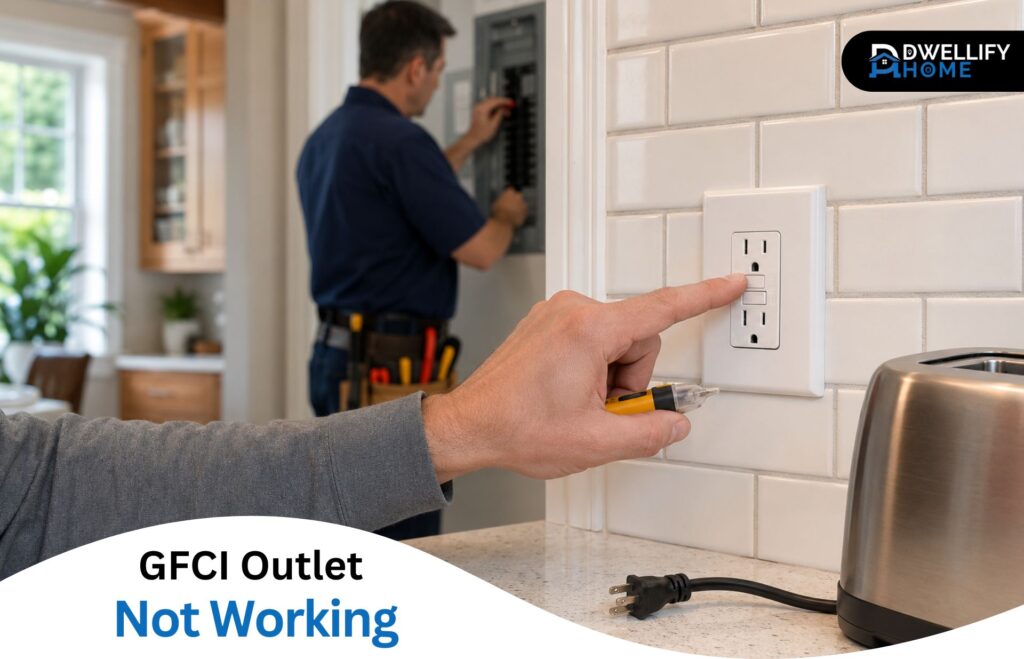
A GFCI outlet not working can leave a bathroom, kitchen, garage, or outdoor area without power even though the breaker appears normal. The cause may be a simple trip, a faulty appliance, another GFCI elsewhere, missing incoming power, moisture, or a problem that requires an electrician.
Start with the safe checks below. Don’t remove the outlet cover or touch any wiring to diagnose the problem.
Short Definition
A GFCI outlet not working means the receptacle has tripped, lost incoming power, detected an active fault, or failed. Safe checks help identify the cause and when professional repair is needed.
Mission Statement
DwellifyHome helps homeowners, renters, and home lovers create practical, comfortable, and stylish spaces through clear, trustworthy guidance.
Quick Checklist
- Unplug connected appliances and cords.
- Stop if the outlet is wet, hot, damaged, or buzzing.
- Press RESET once firmly.
- Reset the breaker fully OFF and back ON.
- Check other accessible GFCIs and the panel.
- Reconnect devices one at a time.
- Verify operation with TEST and RESET.
- Call an electrician if it remains dead or trips again.
GFCI Outlet Not Working? Here’s What to Do First
Unplug everything connected to the affected outlet, check it for visible damage or moisture, and press RESET firmly. If power doesn’t return, reset the circuit breaker and look for another tripped GFCI nearby. Stop troubleshooting if the outlet shows damage or repeatedly trips after being reset.
A ground-fault circuit interrupter is designed to cut power when it detects electricity traveling along an unintended path that could cause a shock. A trip is therefore a warning to investigate—not merely an inconvenience to override. ESFI explains the protective role of GFCIs.
Stop if the outlet is wet, hot, damaged, buzzing, or sparking
Do not attempt a routine reset when you notice:
- Water, condensation, or obvious moisture around the outlet
- Scorch marks or melted or discolored plastic
- A burning odor
- Buzzing, crackling, or sizzling
- Sparks
- A hot outlet or wall plate
- A shock or tingling sensation
- A breaker that trips again after being reset
Leave the outlet unused and contact a licensed electrician. Heat, discoloration, unusual sounds, burning odors, and repeated breaker trips are recognized electrical warning signs in guidance from the Consumer Product Safety Commission and Electrical Safety Foundation International.
Safe Checks That May Restore Power
These steps are limited to controls and components you can access without opening an outlet or electrical panel.
Unplug connected devices and press RESET
Unplug appliances and cords from the affected receptacle. If other nearby outlets also lost power, unplug their connected devices as well.
Press the GFCI’s RESET button firmly. A successful reset normally produces a click and allows the button to remain in place. Test the outlet with a small lamp or another device you know works.
A RESET button that immediately pops out is not something to hold in or press repeatedly. The GFCI may still detect a fault, or another problem may be preventing it from restoring power.
Reset the circuit breaker fully
A tripped breaker may sit between ON and OFF, where it can look almost normal. At the closed electrical panel:
- Locate the breaker serving the affected area.
- Move its handle completely to OFF.
- Move it back to ON.
- Return to the GFCI and try RESET once more.
Do not remove the panel cover. If the breaker trips again, leave it off and call an electrician rather than repeatedly resetting it.
Look for another tripped GFCI
One GFCI can protect other receptacles farther along the same circuit. The dead outlet may therefore be downstream from a controlling GFCI in a different location.
Check accessible GFCIs in places such as:
- Other bathrooms
- The kitchen or pantry
- The garage
- The laundry area
- The basement or utility room
- Exterior walls
- Near sinks or other damp locations
A garage GFCI, for example, may control standard-looking outlets elsewhere. Some homes also use a GFCI circuit breaker at the panel instead of a receptacle with buttons.
Reconnect devices one at a time
Once the GFCI resets and power returns, reconnect devices individually. This can reveal whether a particular appliance or cord triggers the trip.
Suppose a kitchen GFCI remains on until a coffee maker is plugged in. Unplug the coffee maker and stop using it until it has been inspected or replaced. Don’t keep resetting the GFCI to operate a device that repeatedly trips it.
What Your GFCI’s Symptoms May Mean
The outlet’s behavior can narrow the possibilities, although it cannot confirm a hidden wiring problem.
| Symptom | What it may indicate | Safe next step |
| RESET will not click or stay in | No incoming power, an active fault, failed self-test, damaged device, or installation problem | Check the breaker and upstream GFCIs; call an electrician if it still fails |
| RESET holds, but the outlet remains dead | Failed receptacle, model-specific lockout, installation issue, or another circuit problem | Check the manufacturer’s instructions and arrange professional diagnosis |
| GFCI immediately trips again | Moisture, a faulty appliance or cord, or another fault on the protected circuit | Unplug loads; stop if it trips again |
| Breaker looks on, but outlets are dead | Partially tripped breaker, upstream GFCI, failed device, or loose connection | Reset the breaker correctly and search for another GFCI |
| Green, red, flashing, or unlit indicator | Operating, tripped, failed-test, miswired, or no-power condition depending on the model | Consult the exact manufacturer’s indicator guide |
| Several outlets stop working together | A controlling GFCI or breaker may have interrupted their shared circuit | Check accessible upstream protection |
The RESET button will not click or stay in
Many modern GFCIs use a reset-lockout feature. Depending on the device, it may prevent resetting when incoming power is absent, the GFCI fails its internal test, or installation is incorrect. Eaton’s GFCI instructions describe these lockout conditions.
This symptom does not automatically mean the outlet needs replacement. Check the breaker and other GFCIs first. If those checks don’t help, professional testing is needed.
The outlet resets but immediately trips again
An immediate retrip suggests that the GFCI may still be detecting a problem. Unplug everything on the affected outlets and try RESET once.
If it now remains set, reconnect devices individually. If it trips with nothing connected, leave it unused and call an electrician. The cause could be moisture, damage, a downstream fault, or a problem the homeowner cannot safely see.
The breaker looks on, but one or more outlets are dead
First reset the breaker fully rather than relying on its appearance. Next, look for a tripped GFCI elsewhere.
If several outlets remain dead, the problem may involve a failed upstream device or an electrical connection inside the circuit. That diagnosis requires proper testing; don’t begin removing outlets to search for it.
The GFCI shows a green, red, flashing, or unlit indicator
Indicator colors are not universal. Green may indicate normal protected power on one model but communicate something different when the device is tripped or installed incorrectly on another. Red may indicate a trip, failed self-test, or end-of-life condition.
Use the label or instructions for the exact manufacturer and model. Leviton, for example, publishes model-specific indicator guidance. The built-in TEST/RESET result and manufacturer instructions are more reliable than a color assumption.
Why a GFCI Outlet Stops Working
A GFCI receptacle responds to ground faults that can create a shock risk. A standard circuit breaker primarily responds to overcurrent conditions. The two devices have different jobs, and a receptacle-type GFCI does not replace normal overload or short-circuit protection. Eaton makes this distinction in its installation guidance.
Moisture, a faulty appliance, or a damaged cord
Water exposure and damaged equipment can create electrical leakage that trips the GFCI. Think about what happened immediately before the failure:
- Did the outlet stop working after rain?
- Was a hair dryer, coffee maker, power tool, or other appliance just connected?
- Is a cord frayed, cracked, or overheated?
- Did the trip begin after cleaning near the receptacle?
This context may identify a suspect device or moisture event. It does not make a wet outlet safe to use.
No incoming power or an upstream interruption
A GFCI may be unable to reset when electricity is not reaching it. The interruption could be at the breaker, another GFCI, or a connection elsewhere on the circuit.
This is why replacing the visible outlet first can waste time: the receptacle may be reacting to a problem upstream rather than failing itself.
A failed receptacle or internal self-test
GFCIs contain mechanical and electronic components that can fail. A device may need replacement when it cannot pass the built-in test, shows a persistent fault indication, is physically damaged, or will not deliver protected power after other causes have been ruled out.
Replacement should be based on its condition and test performance—not an unsupported fixed lifespan.
A recently installed or incorrectly connected GFCI
A new GFCI that will not reset may have incorrect LINE and LOAD connections. LINE identifies the incoming supply; LOAD is used to extend protection to downstream outlets. This is not the same as swapping the black and white conductors.
Don’t experiment with these connections. Incorrect electrical work can leave an outlet energized without the expected protection. Have the installation checked by a licensed electrician.
Is the GFCI Bad or Protecting You From Another Fault?
A nonworking GFCI may be defective, but it may also be doing exactly what it was designed to do. The best clue is what happens after connected devices are unplugged and accessible upstream power has been checked.
Signs the GFCI itself may have failed
The receptacle may require replacement when:
- Its built-in TEST function fails
- RESET will not hold after incoming power is confirmed professionally
- It displays a persistent manufacturer-defined fault indication
- It is cracked, scorched, loose, or otherwise damaged
- It resets but cannot provide verified protected power
Signs the problem may be elsewhere on the circuit
Look beyond the receptacle when:
- Several outlets failed together
- A particular appliance causes the trip
- The failure followed rain or water exposure
- Another GFCI is tripped
- The breaker has lost power or trips repeatedly
- The GFCI is newly installed and has never worked correctly
Why age alone does not confirm failure
GFCI lifespan estimates vary, and operating conditions differ. An outdoor receptacle exposed to weather does not age under the same conditions as one in a dry interior space.
Use testing, visible condition, manufacturer fault indications, and qualified diagnosis to make the replacement decision. Age can provide context, but it does not establish the cause.
When to Call a Licensed Electrician
Call an electrician when the GFCI remains dead after the safe checks, will not reset with devices unplugged, trips repeatedly, or shows signs of heat, water, or physical damage.
Professional help is also appropriate when:
- Several outlets remain without power
- The breaker trips again
- The GFCI was recently installed or replaced
- You cannot identify the controlling GFCI
- The outlet’s indicators conflict with its behavior
- You suspect a loose connection or wiring fault
- The outlet must be removed to continue the diagnosis
An electrician can confirm incoming power, map the protected circuit, test the GFCI, inspect connections, check for moisture or damage, and determine whether the problem is at the receptacle, breaker, appliance, or another point on the branch circuit.
Test and Maintain the GFCI After Power Returns
Restored power is only part of the check. Verify that the GFCI can interrupt and restore power correctly:
- Plug in a small lamp and switch it on.
- Press TEST. The lamp should turn off.
- Press RESET. The lamp should turn on again.
If TEST does not cut power, or RESET does not restore it, stop using the receptacle and arrange replacement or professional inspection.
The CPSC, ESFI, and manufacturers recommend testing GFCIs monthly. During the check, also look for looseness, discoloration, damage, unusual warmth, or moisture.
Frequently Asked Questions
Where is the GFCI reset button?
On a receptacle-style GFCI, RESET is normally on the outlet face beside a TEST button. Labels, button shapes, and colors vary. If the dead outlet has no buttons, its protection may come from another GFCI receptacle or a GFCI breaker at the electrical panel.
Why does the dead outlet have no TEST or RESET buttons?
A standard receptacle can be connected downstream from a GFCI and receive its protection. When the controlling GFCI trips, the standard outlet also loses power. Search accessible GFCIs in nearby bathrooms, kitchens, garages, laundry areas, basements, and exterior locations.
Does a GFCI need power before it can reset?
Many modern GFCI receptacles are designed so they will not reset without incoming power. A tripped breaker, upstream interruption, loose connection, or installation problem may therefore leave the RESET button unresponsive. Leviton’s reset-lockout guide explains this behavior.
Can one GFCI protect several other outlets?
Yes. A receptacle GFCI can provide protection to outlets connected downstream through its LOAD terminals. Those outlets may look like ordinary receptacles and may be located elsewhere. Their power can disappear together when the controlling GFCI trips.
Can a faulty appliance trip a GFCI?
Yes. A damaged appliance, tool, plug, or cord can create electrical leakage that causes the GFCI to trip. Unplug all devices, reset once, and reconnect them individually. Stop using any device that consistently triggers the GFCI until it has been inspected.
Should you replace a GFCI just because it is old?
No. Age alone does not prove that a GFCI has failed. Consider its TEST/RESET performance, physical condition, manufacturer-defined fault indicators, and whether it can provide protected power. When the diagnosis requires access to wiring, let a licensed electrician evaluate it.
Restore Power Safely—and Know When to Stop
Begin with the simple checks: unplug devices, press RESET, reset the breaker correctly, and look for another controlling GFCI. Once power returns, verify the outlet with its TEST and RESET buttons.
A GFCI that repeatedly trips, remains dead, or shows heat, moisture, damage, or unusual sounds needs more than another reset. Leave it unused and have the underlying problem diagnosed safely.
Disclaimer
DwellifyHome content is for general informational purposes. Homes, needs, preferences, budgets, and situations vary. Seek qualified professional advice for safety-sensitive installation or repair and for legal, structural, electrical, plumbing, HVAC, or major property decisions.