
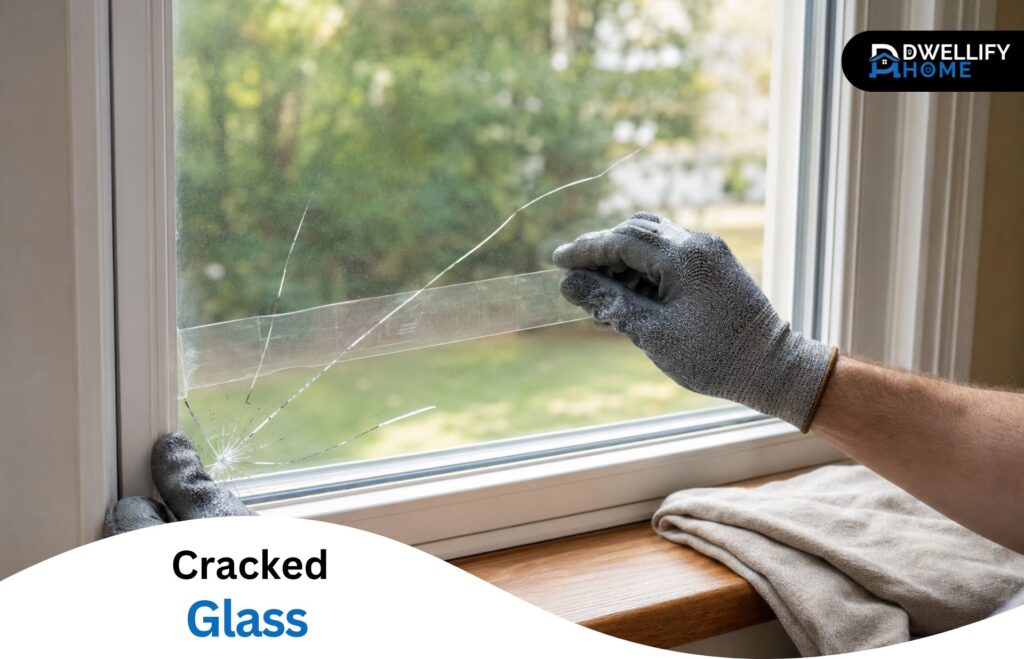
A thin line across a window can turn an ordinary room into a safety concern. Cracked glass should be treated as damaged glazing, not merely a cosmetic flaw. Keep clear of the pane, avoid testing it with your hand, and determine whether the glass, sealed unit, sash, or complete window needs attention.
The right solution depends on the window’s construction, the condition of its frame, and how the damage occurred.
Short Definition
Cracked glass is a damaged window pane with a visible fracture caused by impact, temperature stress, edge weakness, or frame pressure. It may require pane, IGU, sash, or window replacement.
Mission Statement
DwellifyHome helps homeowners, renters, and home lovers make practical, stylish, and informed choices that create safer, more comfortable living spaces.
What to Do Immediately When Window Glass Cracks
A cracked window isn’t necessarily about to collapse, but its remaining strength can’t be judged by appearance alone. Keep people and pets away, don’t press or tap the glass, and arrange a professional assessment. Loose fragments, a bowed pane, a growing crack, or an exposed opening require urgent help.
The National Glass Association advises securing the surrounding area because broken architectural glass no longer has the integrity needed to provide its intended performance.
Take these precautions first:
- Keep children and pets out of the immediate area.
- Don’t open, close, or slam an operable window containing the cracked pane.
- Avoid moving blinds or curtains if they touch the glass.
- Don’t pull loose pieces from the frame.
- Call an emergency glazier if the opening exposes the home to weather or intruders.
- Stay away from large, overhead, bowed, or visibly unstable panes.
Signs the Window Needs Emergency Attention
Seek urgent professional help when glass is falling from the frame, the pane has a hole, the crack is visibly extending, or wind is moving the damaged glass. A cracked door, shower enclosure, skylight, or window above a walkway also deserves greater caution because people may come into direct contact with falling fragments.
Document the Damage Before It Is Removed
Take photographs from a safe position. Capture the complete window, the crack pattern, the surrounding frame, and any visible impact point.
Documentation can help a glazier investigate the cause and may be useful for a warranty, insurance claim, or rental discussion. Don’t delay urgent safety work simply to collect more pictures.
Assess the Crack and Window Type Without Touching the Glass
Start by observing the window from a comfortable distance. Look for the number of panes, the crack’s location, missing pieces, fogging, and visible frame damage. Don’t run a finger over the line or tap the pane to see whether it moves.
Single-Pane, Double-Pane, and Triple-Pane Windows
A single-pane window contains one sheet of glass in the sash. Traditional wood windows with glazing putty are common examples.
Double- and triple-pane windows contain a sealed insulated glass unit, or IGU. The panes are separated by a spacer, and the cavity may contain insulating gas. A crack in one pane breaches the sealed assembly even when the other pane remains intact.
Fog or condensation trapped between panes is another sign that an IGU’s perimeter seal may have failed. According to the National Fenestration Rating Council, seal failure can allow insulating gas to escape and moisture to enter between the panes.
Check the Glass, Sash, Frame, and Surrounding Opening
These parts serve different purposes:
- Pane: An individual sheet of glass.
- IGU: A sealed assembly containing two or more panes.
- Sash: The framed section that holds the glass and may move.
- Window frame: The larger structure attached to the wall.
A sound frame and sash may allow glass or IGU replacement without replacing the entire window. Rot, warping, failed hardware, water damage, or repeated cracks can indicate a broader problem.
Why Did the Window Glass Crack?
Common causes include direct impact, damaged glass edges, uneven heating, pressure from a distorted frame, installation problems, and severe weather. The crack pattern may suggest what happened, but it rarely proves the cause by itself.
Impact Damage and Weakened Glass Edges
A rock thrown by a lawnmower, a ball, storm debris, or another object can create a visible point of impact. Cracks may radiate outward in a starburst pattern.
Glass can also fail after less obvious edge damage. The vulnerable edge may be hidden behind trim or a glazing bead, making the origin difficult to see without removing parts of the window. That examination is best left to a glazier.
Thermal Stress, Frame Pressure, and Installation Problems
A thermal stress crack can develop when one area of the pane becomes substantially warmer or cooler than another. It often begins near an edge, although the visible line may later change direction. Pella’s explanation of stress cracks notes that partial shade and uneven heating can create this type of stress.
A tight, warped, or poorly supported frame can also place pressure on the glass. Installation contact, building movement, or a sash that is repeatedly slammed may contribute.
Fully tempered glass can occasionally break without an obvious impact because of hidden damage or a rare internal inclusion. This possibility shouldn’t be assumed without professional examination.
Can Cracked Window Glass Be Repaired?
Cracked residential window glass usually can’t be restored to its original strength by filling the line. Adhesive or epoxy may make limited damage less visible or provide temporary containment in certain situations, but it doesn’t recreate intact architectural glazing. Permanent correction normally means replacing the pane or sealed IGU.
The word “repair” can be confusing. A glass shop may describe replacing a pane inside an existing sash as window repair, even though the damaged glass itself is being discarded.
What Adhesive or Epoxy Treatments Can—and Cannot—Do
An adhesive treatment may improve appearance or reduce contamination inside a very small crack when a product is approved for that exact application. It shouldn’t be assumed to restore the pane’s original strength, weather resistance, safety rating, or energy performance.
Avoid applying material to a pane that is loose, bowed, shattered, overhead, or otherwise unstable. Pressing on damaged glass can make the situation worse.
Why Insulated Glass Usually Requires a Different Solution
An IGU is manufactured as a sealed system. Filling a crack on one surface doesn’t restore the cavity, perimeter seal, coating protection, or insulating performance.
The usual permanent solution is a newly manufactured IGU fitted into the existing sash. That doesn’t automatically mean the complete window and wall-mounted frame must be replaced.
Should You Replace the Pane, IGU, Sash, or Whole Window?
Choose the smallest replacement that safely restores the window and corrects the cause of the damage.
| Replacement option | Usually considered when | What to check |
| Individual pane | A traditional single-pane window has a sound sash and frame | Required glass type, pane thickness, and glazing condition |
| Sealed IGU | A double- or triple-pane unit is cracked, but the sash and frame remain sound | Dimensions, spacer, coatings, tint, glass type, and manufacturer compatibility |
| Complete sash | The sash is damaged or a matching factory sash is easier to obtain | Part availability, hardware, fit, and warranty requirements |
| Complete window | The main frame is deteriorated, distorted, repeatedly causing damage, or no compatible parts are available | Installation condition, water damage, age, and long-term value |
When Glass or IGU Replacement May Be Enough
A cracked IGU in a straight, undamaged vinyl frame may only require a replacement sealed unit. Ask the provider to quote the IGU or glass assembly separately from a complete window.
This approach preserves working components and can reduce disruption. It won’t solve a warped sash, rotten frame, or installation condition that continues to press against the glass.
When the Sash or Complete Window Should Be Replaced
Sash replacement can make sense when the glazing is built tightly into a removable factory component. A complete window becomes more reasonable when the frame is damaged, the opening leaks, compatible parts are unavailable, or several parts are failing together.
The largest replacement isn’t automatically the best choice. The decision should follow the actual extent and cause of the damage.
How to Protect the Area While Waiting for Replacement
Temporary protection should keep people away and limit exposure while professional service is arranged. It shouldn’t be treated as a permanent fix or proof that the pane is safe.
- Keep the sash closed and avoid vibration.
- Restrict access around the window.
- Move nearby furniture only when it can be done without approaching the glass.
- Arrange professional board-up service for an open or insecure window.
- Follow a glazier’s instructions if temporary film or tape is recommended for a stable pane.
Applying tape or film requires contact with the glass. Don’t attempt it on a loose, bowed, extensively cracked, large, or overhead pane.
Temporary Protection Is Not a Permanent Repair
Tape, film, plywood, or another temporary barrier may contain fragments, block weather, or improve security. These measures don’t restore the glazing’s original load capacity, insulating seal, clarity, or safety performance.
Mistakes That Can Make the Damage More Dangerous
Don’t drill near the end of the crack, scrape it with a blade, deliberately break out the remaining pane, or use force to test it. Avoid operating the window and don’t assume a hairline crack will remain unchanged.
Document the Damage and Arrange the Right Service
A local glass shop or residential glazier is often the best first call when the frame appears sound. Manufacturer-authorized service may be useful for a factory sash, specialized IGU, or possible warranty claim. A full-window company is more relevant when the frame or installation also needs replacement.
What to Provide When Requesting a Quote
Share the following without measuring or handling the damaged glass directly:
- Photographs of the crack and complete window.
- Approximate frame dimensions.
- The number of panes and which one appears damaged.
- Any manufacturer name or label visible on the sash or spacer.
- Signs of fogging, water entry, rot, or warping.
- Whether the window opens and where it is located.
- Any recent impact, storm, sharp temperature change, or building work.
- Access details, such as window height and indoor or outdoor obstacles.
Ask whether the estimate covers the glass or IGU, the sash, or the entire window. Separate options make competing quotes easier to compare.
Check the Warranty, Insurance Policy, or Lease
Photograph the damage and check the manufacturer’s warranty before authorizing non-emergency removal. Coverage may depend on the cause, product age, installer, and use of an authorized service provider.
Renters should report the damage promptly and preserve clear records. Homeowners considering an insurance claim should check their policy and deductible rather than assuming that accidental or weather-related glass damage is covered.
How to Reduce the Chance of Another Window Crack
Not every crack is preventable, but several practical steps can reduce avoidable stress:
- Keep lawn equipment, sports activity, and unsecured outdoor objects away from vulnerable windows.
- Repair sashes that bind, slam, or sit unevenly.
- Address warped, rotten, or water-damaged frames.
- Avoid placing concentrated heat or cold directly against the glass.
- Check compatibility before installing aftermarket film or tint.
- Investigate repeated cracks instead of replacing the glass without examining the frame and installation.
Replacement glazing must also suit its location. Doors, shower enclosures, sliding patio doors, and other safety-sensitive areas may require specific safety glazing. The U.S. Consumer Product Safety Commission regulates glazing in several of these products, while local building requirements may add other conditions. A qualified glazier or local building department can confirm what applies.
Frequently Asked Questions About Cracked Window Glass
Will a Cracked Window Keep Spreading or Shatter?
A window crack can extend, remain unchanged for a time, or lead to further breakage. Its behavior can’t be predicted reliably from appearance alone. Temperature changes, wind, vibration, frame movement, and existing edge damage may affect it, so the pane should be protected from contact and assessed promptly.
Can Only One Pane of a Double-Pane Window Be Replaced?
Replacing one sheet on-site generally won’t restore a factory-sealed double-pane unit. The usual solution is to replace the complete IGU containing both panes, while retaining the existing sash and main frame when they remain suitable. A glazier or manufacturer can confirm whether a compatible IGU or replacement sash is available.
Can Windshield Resin Be Used on a House Window?
Windshield resin shouldn’t automatically be used on residential window glass. Automotive windshields are laminated systems, while house windows may contain annealed, tempered, laminated, or insulated glass. Unless the product manufacturer approves the exact architectural-glass application, don’t assume it will restore safety, strength, sealing, or energy performance.
Who Should You Call to Repair Cracked Window Glass?
Call a residential glazier or local glass shop first when the damage appears limited to the pane or IGU. Contact the window manufacturer for specialized parts or possible warranty service. Use a full-window installer when the sash, frame, opening, or installation is also damaged, and request emergency service for an exposed or unstable opening.
Make the Window Safe and Choose the Smallest Effective Replacement
Treat cracked window glass as a safety and performance problem rather than a cosmetic mark. Keep clear of the pane, document the damage, and determine whether the fault is limited to the glass or extends into the sash, frame, or installation.
A sound window may need only a replacement pane or IGU. A damaged frame may justify a larger repair. The right choice is the smallest option that safely restores the window and addresses the reason it cracked.
Disclaimer
DwellifyHome content is for general informational purposes only. Homes, needs, preferences, budgets, and circumstances vary. Consult a qualified professional for safety, installation, repair, legal, structural, electrical, plumbing, HVAC, or major property decisions.