
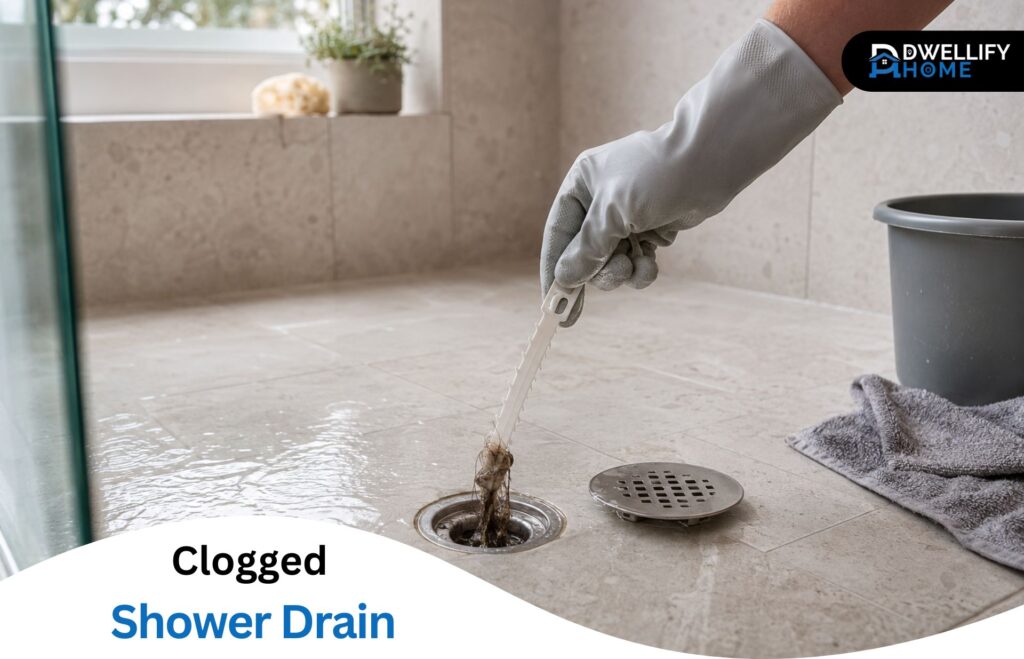
Water pooling around your feet usually means hair, soap, and bath-product residue have narrowed the drain opening. A clogged shower drain can often be cleared with simple physical removal, but the safest method depends on what is blocking the pipe and whether a chemical cleaner has already been used.
Start with the least aggressive option. Check the grate, remove anything you can reach safely, and test the flow before trying another method. Stop and call a plumber when several fixtures are affected, wastewater backs up, or the clog returns soon after clearing.
Short Definition
A clogged shower drain is a partial or complete blockage—commonly involving hair and bath-product residue—that slows water flow, causes pooling, and may require cleaning or plumbing help.
Mission Statement
DwellifyHome helps homeowners, renters, and home lovers create practical, comfortable, and stylish living spaces through clear, trustworthy guidance.
Quick Checklist
- Stop the water and check whether a cleaner was used.
- Wear gloves and remove visible hair or debris.
- Test the flow after each method.
- Read product labels before plunging or using tools.
- Never mix cleaners or force the drain cover.
- Call a plumber for backups, recurring clogs, or multiple slow fixtures.
What Should You Try First for a Clogged Shower Drain?
Stop running the shower, find out whether anyone has poured a cleaner into the drain, and inspect the grate for trapped hair. Put on gloves, remove reachable debris, and run a small amount of water to test the result. Don’t combine treatments or move to a stronger method until you know whether the first step worked.
Check What Has Already Been Poured Down the Drain
Ask everyone in the household whether they have used bleach, a commercial drain opener, or another cleaning product. This matters because a chemical may remain in the standing water or pipe even when it hasn’t cleared the clog.
Read the product label before plunging, snaking, or adding anything else. Some drain-opening products explicitly warn against using a plunger or tool afterward because the chemical could splash back. Never mix household cleaners; Poison Control warns that doing so can release poisonous fumes.
Wear the protective equipment required by the label and ventilate the bathroom. Tell a plumber or property maintenance worker exactly what was used if professional help becomes necessary.
Remove Visible Hair and Test the Flow
Hair wrapped around the drain grate can make a shower appear more seriously clogged than it is. Remove loose strands from the surface, then lift or unscrew the cover only if its removal method is clear.
Pull reachable hair and sludge upward with gloved fingers or needle-nose pliers. Put the debris in the trash instead of rinsing it back into the pipe.
Replace the cover and run the shower briefly. Normal drainage means no additional treatment is needed. Slight improvement suggests that part of the blockage remains farther down.
What Is Clogging Your Shower Drain?
Most shower blockages form gradually. Loose hair catches on the drain cover or inside the pipe, then collects soap, conditioner, skin oils, and other residue. The result is a dense, sticky obstruction that restricts water flow.
Other possibilities include mineral deposits, a small object lodged in the pipe, or a deeper problem affecting more than the shower.
Hair Mixed With Soap and Bath-Product Residue
Hair is easier to remove before it travels beyond the drain opening. Once it mixes with soap scum and conditioner residue, it can form a flexible mass that lets some water pass while continuing to collect debris.
Typical signs include:
- Water draining more slowly over several weeks
- Hair visible around or below the grate
- A musty or stale odor from trapped organic material
- Temporary improvement after surface cleaning
Physical retrieval is usually more useful for this type of clog than pouring a household mixture into the drain.
Mineral Buildup, Foreign Objects, and Deeper Drain Problems
Hard-water deposits can narrow a pipe gradually, but they aren’t handled the same way as a removable hair clog. A razor cap, jewelry item, or piece of packaging may also create a catch point that collects hair.
A deeper drainage problem becomes more likely when the shower is not the only affected fixture. A slow sink, gurgling toilet, or water backing up elsewhere can indicate a blockage in a shared branch drain or farther along the drainage system.
Match the Fix to the Likely Blockage
Choose a method based on the symptoms rather than trying every remedy in quick succession.
| What you notice | Likely issue | Reasonable first step | When to stop |
| Hair caught on the grate and slow drainage | Surface hair buildup | Remove the hair by hand or with pliers | Stop if the cover must be forced |
| Water drains slowly but no cleaner has been used | Nearby hair-and-residue clog | Try a cup plunger or plastic hair tool | Stop if the tool meets hard resistance |
| Drain improves briefly and clogs again | Partial removal or deeper buildup | Consider a manual drain snake | Call a plumber if recurrence continues |
| Fixed grate or narrow openings block access | Drain-design limitation | Use a tool that fits without force | Contact maintenance or a plumber if access is uncertain |
| Several fixtures are slow, gurgling, or backing up | Shared branch or main-line problem | Stop using affected fixtures | Arrange professional diagnosis |
How to Clear a Clogged Shower Drain, From Simple Fixes to More Involved Methods
Use one method at a time and retest afterward. This keeps the process controlled and prevents chemicals, homemade mixtures, and mechanical tools from being combined accidentally.
Clear Reachable Debris and Remove Excess Standing Water
Remove enough standing water to see and work around the drain safely. A cup, small container, and sponge are usually sufficient. Don’t use a wet/dry vacuum when a chemical cleaner may be present.
Clean the grate and pull out anything within easy reach. A barbed plastic drain stick can catch hair sitting just below the opening, although it has limited reach and may not help with a deeper obstruction.
Insert it slowly, turn it gently, and pull upward. Expect the removed material to be unpleasant. Wear gloves, keep a trash bag nearby, and wipe the tool or discard it according to its instructions.
Use a Plunger With a Proper Seal
A flat-bottom cup plunger can move a nearby blockage without adding chemicals. Remove the drain cover when it is designed to come off, then position the cup directly over the opening.
Add enough water to cover the plunger’s rim and use several controlled strokes without breaking the seal. A tub-and-shower combination may have an overflow opening that needs to be covered with a wet cloth so pressure stays directed toward the clog.
Test the drain afterward. Don’t plunge when chemical cleaner could remain in the pipe unless its label specifically permits it.
Try a Plastic Hair Tool or Manual Drain Snake
A plastic hair tool is a short, barbed strip intended to retrieve hair near the opening. A manual drain snake, or hand auger, uses a longer cable to reach a blockage farther into the pipe.
Feed a manual snake gently and rotate it according to the manufacturer’s directions. When it catches soft resistance, work slowly so the tip can grab or break through the obstruction. Withdraw the cable carefully, remove captured debris, and test the drain.
Stop if the cable won’t pass, becomes stuck, or meets solid resistance. Forcing it can damage the drain assembly or lodge the tool in the pipe.
What to Do if the Drain Cover Will Not Come Off
Drain covers may be screwed down, snapped into place, built around fixed crossbars, or incorporated into a linear drain. Don’t pry aggressively or assume every grate is removable from above.
Clean through the openings with a narrow plastic hair tool if it fits freely. Avoid cutting, drilling, or forcing a cable through fixed parts. Renters should contact property maintenance when the cover is unfamiliar or access would require dismantling the fixture.
Do Hot Water, Baking Soda, Vinegar, or Drain Cleaners Work?
Hot tap water may rinse away loosened soap residue, but household mixtures and chemical products aren’t substitutes for retrieving a compact hair clog. Their usefulness depends on the blockage, pipe material, and product instructions. None should be combined with another cleaner.
Hot Water and Pipe-Material Limitations
Running hot tap water after removing debris can carry away loose residue. Boiling water is different: it may be unsuitable for some plastic pipes, joints, seals, or shower components.
The Home Depot’s drain guidance specifically cautions against pouring boiling water into PVC pipes. Use hot tap water when the plumbing material is unknown rather than assuming every drain can tolerate kettle-temperature water.
Hot water also won’t retrieve hair or remove a solid object.
What Baking Soda and Vinegar Can—and Cannot—Do
Baking soda and vinegar create visible fizz, but that reaction doesn’t prove a dense blockage is dissolving. An open drain cannot hold much pressure, and the mixture is unlikely to break apart a tough clog effectively, according to Poison Control’s explanation of homemade drain cleaners.
The mixture may help freshen a drain or loosen light residue after physical debris has been removed. Don’t use it when another cleaner may already be present, and don’t let it delay mechanical removal of visible hair.
Chemical Drain Cleaners and the Safety Rules That Matter
A commercial drain opener may be labeled for certain hair or organic clogs, but suitability varies by product, pipe material, fixture, and septic system. Follow the current label exactly, including the amount, waiting time, ventilation, protective equipment, and flushing instructions.
Never mix cleaners or follow one product with another. Avoid splashing, keep children and pets away, and don’t assume that leaving a product longer will improve the result. Some manufacturer instructions also prohibit plunging or tool use after treatment because chemical liquid may splash from an uncleared drain.
For a chemical exposure in the United States, follow the product’s first-aid directions and contact Poison Control at 1-800-222-1222.
Why Does the Shower Drain Keep Clogging?
A recurring shower drain clog usually means the blockage was only partly removed, hair is entering the drain faster than it is being cleared, or buildup remains deeper in the pipe.
Look for these patterns:
- The drain slows again within days: Part of the original obstruction may remain.
- The hair catcher shifts or restricts flow: It may be the wrong shape or size.
- A snake retrieves little material: The blockage may be deeper, mineral-based, or caused by an object.
- Other fixtures are affected: The problem may extend beyond the shower drain.
- The same drain repeatedly needs chemicals: A temporary treatment may be masking a problem that needs diagnosis.
Repeatedly pouring products into the drain is not a maintenance plan. A persistent pattern deserves a closer inspection.
When Should You Stop and Call a Plumber?
Call a plumber when the clog remains after reasonable physical-removal attempts, returns quickly, or affects other fixtures. Wastewater backup, persistent gurgling, a sewer-like odor, suspected pipe damage, and an unreachable object are signs that the problem may be beyond a simple shower clog.
Warning Signs of a Deeper Plumbing Problem
Arrange professional drain cleaning or diagnosis when:
- The shower, sink, or toilet is slow at the same time
- Running one fixture causes water to rise in another
- Wastewater backs up onto the shower floor
- The drain gurgles repeatedly
- A strong sewer-like odor persists
- A manual snake becomes stuck or cannot pass
- The drain remains fully blocked
- The clog returns soon after being cleared
Stop using affected fixtures when water is backing up. Continued use can send more wastewater into an already restricted line.
What Renters Should Report to Property Maintenance
Renters can usually remove hair from the grate or use a basic plunger when permitted, but invasive work should be left to property maintenance. Report standing water, repeat clogs, fixed covers, multiple slow fixtures, leaks, and suspected pipe problems promptly.
Tell maintenance which tools or products have already been used. That information helps the worker choose a safer next step and avoids unexpected contact with residual chemicals.
How to Prevent Another Shower Drain Clog
Prevention works best at the drain opening. Catch hair before it enters the pipe, remove surface residue regularly, and pay attention when drainage begins slowing instead of waiting for complete blockage.
Choose a Hair Catcher That Fits the Drain
Select a catcher that sits securely over or inside the drain without leaving large gaps. It should trap hair without causing water to pool during an ordinary shower.
Drain geometry matters. A flat mesh cover may suit one grate, while a recessed catcher works better with another. Clean it frequently and replace it if it warps, shifts, or becomes difficult to empty.
Remove Surface Buildup Before It Enters the Pipe
Collect loose hair from the shower floor and drain cover after use. Periodically lift a removable grate and clean residue from both sides, following the fixture’s care instructions.
Avoid washing thick oils, waxy products, or clumps of hair down the drain. A gradual slowdown is the right time to inspect the opening—not a reason to begin combining drain treatments.
Frequently Asked Questions About Clogged Shower Drains
What Can You Pour Down a Clogged Shower Drain?
There is no universal liquid fix. Hot tap water may rinse away residue after hair has been removed, while a commercial product may be suitable only when its label matches the clog, fixture, and plumbing. Physical removal is generally more useful when visible or reachable hair is causing the blockage.
What Will Dissolve Hair in a Shower Drain?
Some drain-opening products are formulated for hair, but their effectiveness and compatibility vary. Baking soda and vinegar should not be treated as reliable hair dissolvers. Pulling the hair out with a plastic drain stick, pliers, or an appropriate snake removes the obstructing material instead of pushing it farther into the plumbing.
Is Water Sitting Below the Drain Opening Normal?
A small amount of water visible below the opening can be normal because the shower’s P-trap is designed to retain water and block sewer gases. Oatey explains that this water seal is part of normal trap operation. Water pooling on the shower floor or draining unusually slowly indicates a problem.
Can a Clogged Shower Drain Clear on Its Own?
A minor obstruction may shift temporarily, but a drain that is progressively slowing rarely fixes itself. Hair and sticky residue tend to collect more material over time. Early removal is simpler than waiting until the shower stops draining or wastewater begins affecting another fixture.
Clear the Clog Safely and Know When to Stop
Start with what you can see and remove safely. Test the drain after each method, avoid mixing treatments, and don’t force a cover or tool through unfamiliar plumbing.
A single hair clog near the opening is often manageable. A blockage that returns, affects several fixtures, produces backups, or remains beyond reach needs professional attention. Once the drain is clear, a well-fitted hair catcher and regular surface cleaning can prevent the same problem from rebuilding.
Disclaimer
DwellifyHome content is for general informational purposes only. Homes, needs, preferences, budgets, and circumstances vary. Consult a qualified professional for safety-sensitive, legal, structural, electrical, plumbing, HVAC, installation, repair, or major property decisions.