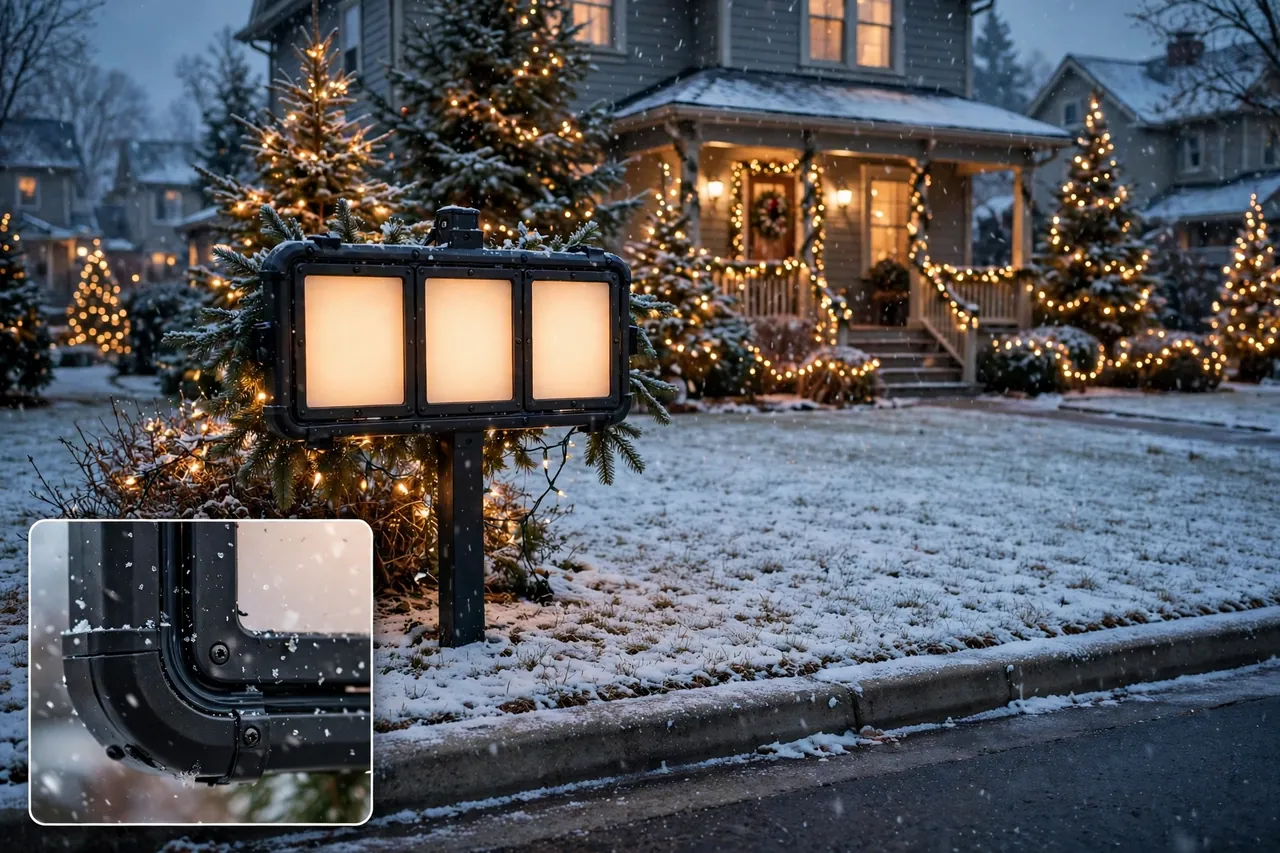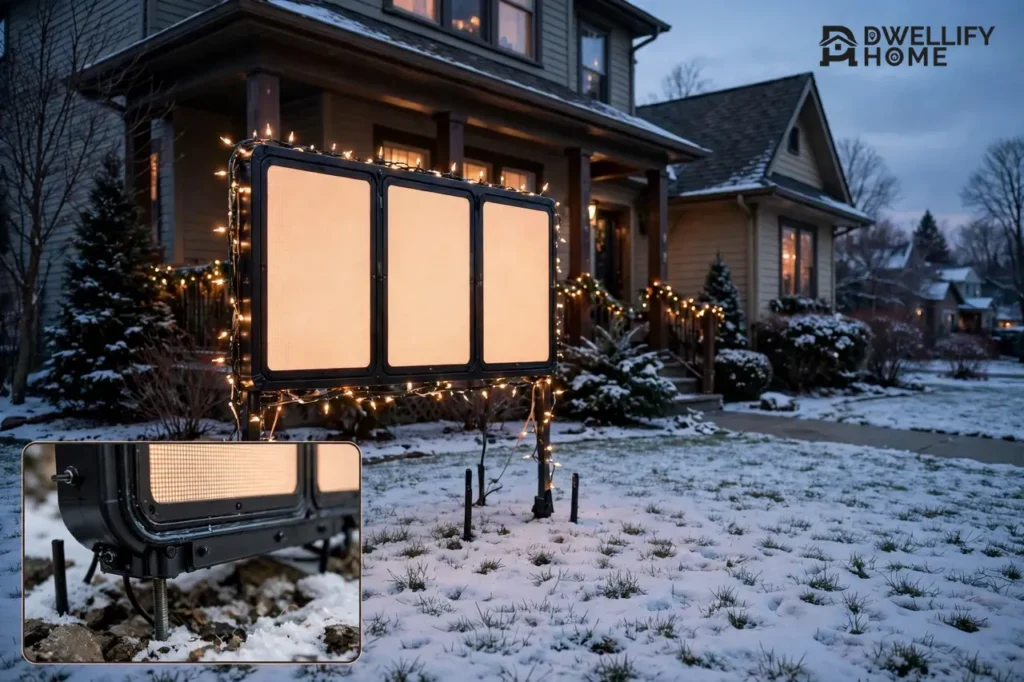
An outdoor Christmas countdown is a yard display that shows how many days, hours, or minutes remain until Christmas Day, December 25. You set it once, place it where people can see it, and it ticks down on its own until the big morning arrives. A light-up sign, a countdown clock, a projection, or a simple changeable number board can all do the job, as long as the display stays readable, weatherproof, and safely powered outside.
If you have ever answered “how many days until Christmas?” ten times before breakfast, you know exactly why this display earns its place in the yard. Kids love watching the number drop, neighbors slow down to read it, and the whole house starts to feel like the holiday is truly on its way. The trick is picking a countdown that fits your yard, your weather, and your patience for daily updates, because the best display is the one that still works on a cold, wet December night.
How an Outdoor Christmas Countdown Actually Works
Every outdoor Christmas countdown answers one question: how much time is left until Christmas Day? The difference between displays is how they get that answer and how they show it. Some count down automatically, and some wait for you to change the number by hand.
An automatic countdown clock works like a small computer with a calendar inside it. You set the current date and time once, and the clock counts the days, hours, minutes, and sometimes seconds left until December 25. Many models keep counting even when you unplug them, because a small battery holds the memory. When you plug the display back in, the lights come on and the count is still right.
A manual countdown board works the other way around. You write, slide, or hang a new number each day. A chalkboard sign, a set of changeable number tiles, or a felt board with pockets all fall in this group. Nothing about the board knows the date, so the daily update becomes a small family ritual instead of a machine doing the work for you.
A projection countdown works like a tiny movie show for your house. A projector throws a moving countdown onto a wall, a garage door, or a sheet, and the number changes on screen. This type suits a flat, light-colored surface and a yard with a clear line of sight, because the image needs darkness and distance to look sharp.
Whichever type you choose, the countdown target stays the same: midnight at the start of December 25, or Christmas morning, depending on how you set it. Decide that point before you set up the display, because a clock set to Christmas Eve night and a clock set to Christmas morning will disagree by a full day. Pick one, tell the family, and stick with it all season.
Types of Outdoor Countdown Displays
Four main types cover nearly every yard, budget, and skill level. Each one has a clear strength and a clear weakness, so the right pick depends more on your yard than on the prettiest photo online.
Light-Up Countdown Signs and Clocks
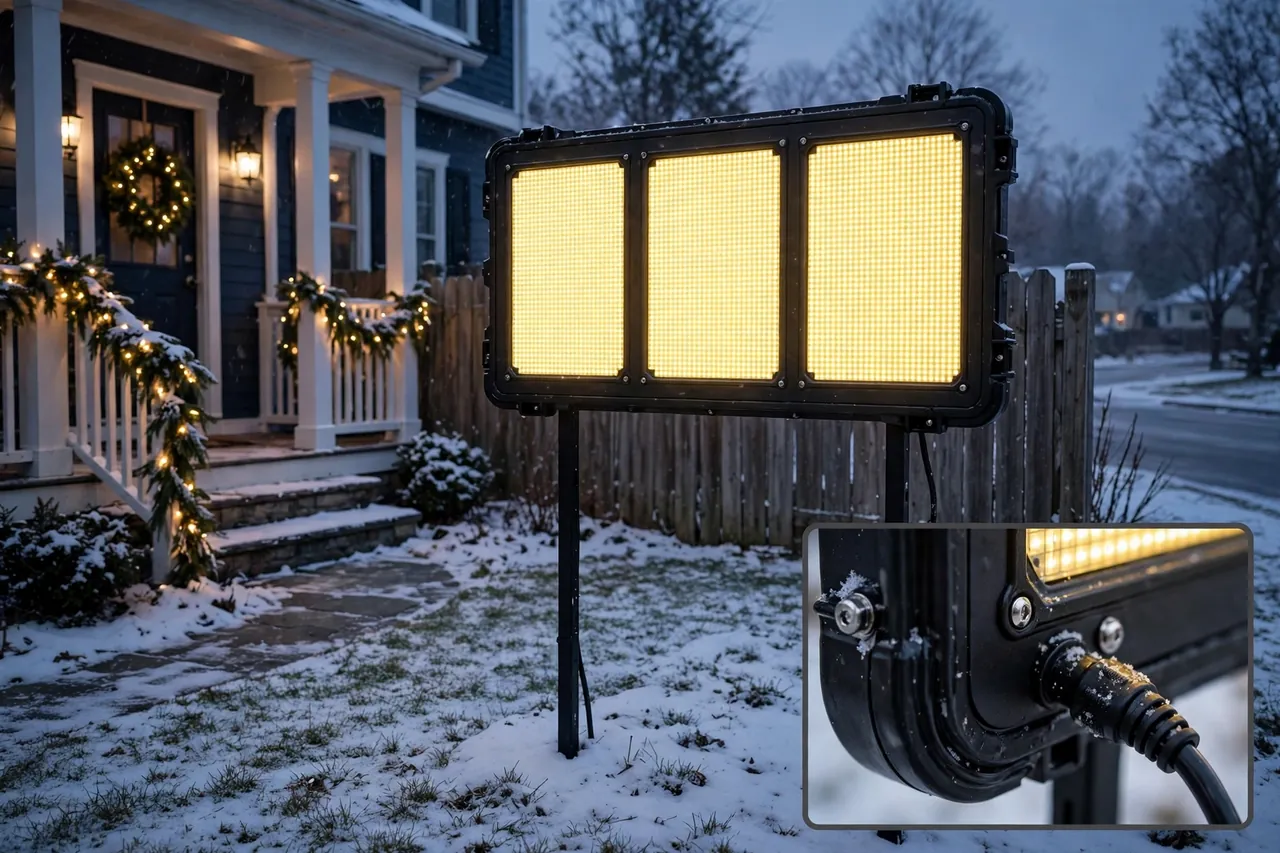
A light-up countdown sign uses bright LED digits to show the days left, and many models add hours and minutes too. These signs shine after dark, which is exactly when most people see your yard. They work well near a porch, a front window, or a fence line close to the street.
Look for a sign rated for outdoor use, with a sealed case and a cord you can protect from rain. Indoor signs look tempting because they cost less, but one wet week can fog the display or kill it outright. If the listing does not clearly say outdoor-rated, treat that as a warning, not a detail.
Manual Number Boards
A manual number board is the simplest countdown of all. You change the number yourself each morning, using chalk, tiles, magnetic digits, or hanging tags. These boards cost little, need no power, and never run out of battery at the worst moment.
The trade-off is honest: if nobody changes the number, the countdown lies. A manual board suits a porch or a sheltered spot near the front door, where changing it takes five seconds on the way out. Put it at the far end of a muddy yard, and the daily update will quietly stop happening by mid-December.
Projection Countdowns
A projection countdown turns a blank wall into a giant ticking clock. You point a weather-safe projector at the surface, and the countdown appears several feet tall. This type wins on drama, because drivers can read it from far away without squinting.
Projection needs darkness, a smooth light surface, and a steady mount. Textured brick softens the image, and a porch light shining on the same wall washes it out. Test the throw distance at night before you commit to a spot, because moving a mounted projector in December is no fun at all.
Smart and App-Controlled Countdowns
A smart countdown connects to your phone or home system and updates itself over Wi-Fi. Some smart displays show the count on a screen, while others run a light routine that changes as Christmas gets closer. For example, the display can grow brighter or more active in the final week.
Smart options suit you if you already use smart plugs or a home hub. They suit you less well if your front-yard Wi-Fi signal is weak, because a countdown that loses its connection may freeze on an old number. Check your signal at the exact spot where the display will sit, not from your couch.
Choose the Right Countdown for Your Yard
Start with three honest questions: how far away will people read it, how much weather will it face, and who will keep it running? Distance decides size: a sign 24 to 36 inches tall reads well from a typical suburban street, while a 12-inch sign suits a porch or walkway. Weather decides materials, because rain, snow, wind, and freezing nights punish thin plastic and unsealed electronics, and a light sign becomes a flying sign in a strong gust.
The table below compares the four types side by side, so you can match one to your yard in a minute.
Countdown Display Comparison: Pick by Distance, Power, and Upkeep
| Display type | Best for | Power needed | Upkeep |
|---|---|---|---|
| Light-up sign or clock | Night visibility | Outlet or battery | Low, automatic |
| Manual number board | Porches, low cost | None | Daily number change |
| Projection countdown | Big street impact | Outlet | Low, automatic |
| Smart or app countdown | Schedules, routines | Outlet, Wi-Fi | Low, automatic |
No single type wins for everyone. A manual board beats a smart display for a renter with no outdoor outlet, and a projection beats a small sign for a house set far back from the road. If you want the display to glow after dark alongside the rest of your yard, a light-up Christmas decorations guide can help you plan the surrounding lights so the countdown stays the star.
Set Up Your Outdoor Christmas Countdown Step by Step
Set-up day goes smoothly when you work in order: pick the spot, sort the power, set the clock, then anchor everything. Rushing straight to plugging in usually ends with a cord stretched across a walkway and a sign facing the wrong way.
- Walk to the street and look back at your house. Stand where drivers and walkers will actually see the display, and mark the spot that reads clearly without blocking a path or a mailbox.
- Check the nearest outdoor outlet and measure the cord run. Choose a route along a wall, fence, or garden edge, and keep cords off walkways where feet, shovels, and snow blowers can catch them.
- Test the display indoors first. Set the date and time, confirm the countdown target, and watch it tick for a few minutes before you carry it outside.
- Place the display, level it, and anchor it. Use stakes, weights, or a sturdy mount that matches the wind in your area, and tilt the face slightly toward the street if the ground slopes.
- Connect the power through a weatherproof in-use cover, then check the display at dusk. Adjust the angle, brightness, and position while you can still see the result clearly.
- Write down the settings and the countdown target on a card you keep indoors. Next year, that card turns a half-hour of guessing into a five-minute setup.
Weatherproof Your Countdown Display
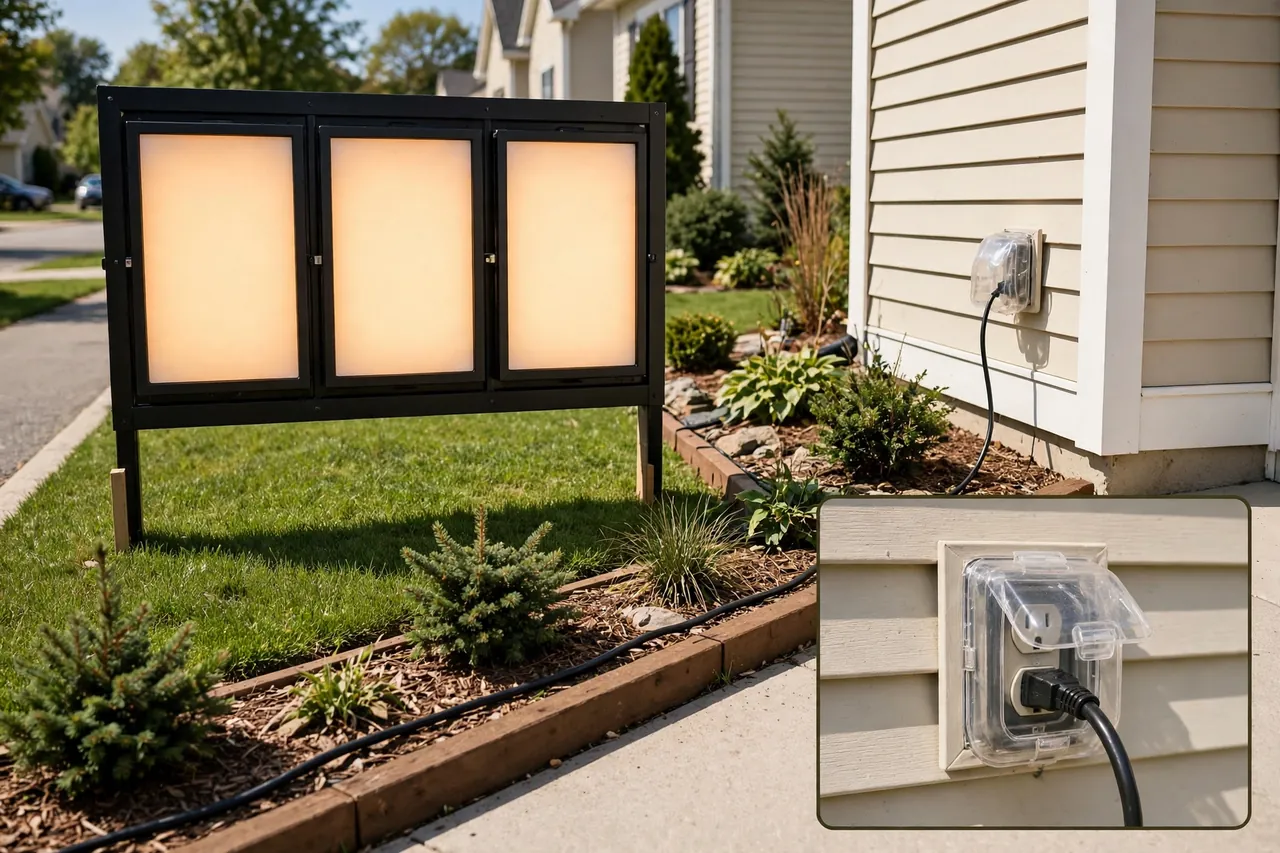
Weatherproofing is not one trick. It is a chain of small protections, and the chain breaks at its weakest link. A sealed sign with an open plug connection still trips, and a covered outlet with a cracked case still lets water in.
Start with the rating on the box. Outdoor-rated gear is built for rain and cold, while indoor gear is not, even if it sits under a porch roof. Wind drives rain sideways, and a porch roof will not save an unsealed case. If a product gives a temperature range, compare it with your coldest December nights, not your average ones.
Next, protect every connection. Plug joints belong inside a weatherproof cover or cord-connection box, never lying in a puddle or buried under leaves. Raise connections off the ground, and leave a small drip loop so rain runs down and off instead of straight into the plug. For manual boards, weatherproofing means the surface: exterior paint or a sealed board, damp-proof chalk markers, and a sheltered spot where driving rain cannot wash the number away overnight.
For projectors, shelter matters most. A covered mount or a spot under an eave keeps rain off the lens and vents. Never wrap a running projector in plastic, because trapped heat can damage it faster than rain would. Finally, plan for wind: stakes in soft soil, weights on hard surfaces, and a two-minute check after the first storm for leaning or water inside the case.
Power Your Countdown Safely Outdoors
Power is where a fun display turns serious, so give it the same care you give any outdoor electrical job. The rules are simple, and they protect both the display and the people walking past it.
Plug outdoor displays only into a ground-fault circuit interrupter (GFCI) protected outlet, or use a portable GFCI. The U.S. Consumer Product Safety Commission gives this exact advice for outdoor holiday lights: use only lights certified for outdoor use, and plug them only into a GFCI-protected receptacle or a portable GFCI. That guidance applies just as well to a countdown sign with a cord. If your outdoor outlet has no GFCI protection, call an electrician before the season starts rather than working around it.
Use cords rated for outdoor use, and match the cord to the load. Outdoor cords carry a marking for outdoor use, and they stand up to moisture, cold, and sunlight far better than indoor cords. Keep the total load well within the cord rating, and never daisy-chain cord after cord to reach a far corner of the yard.
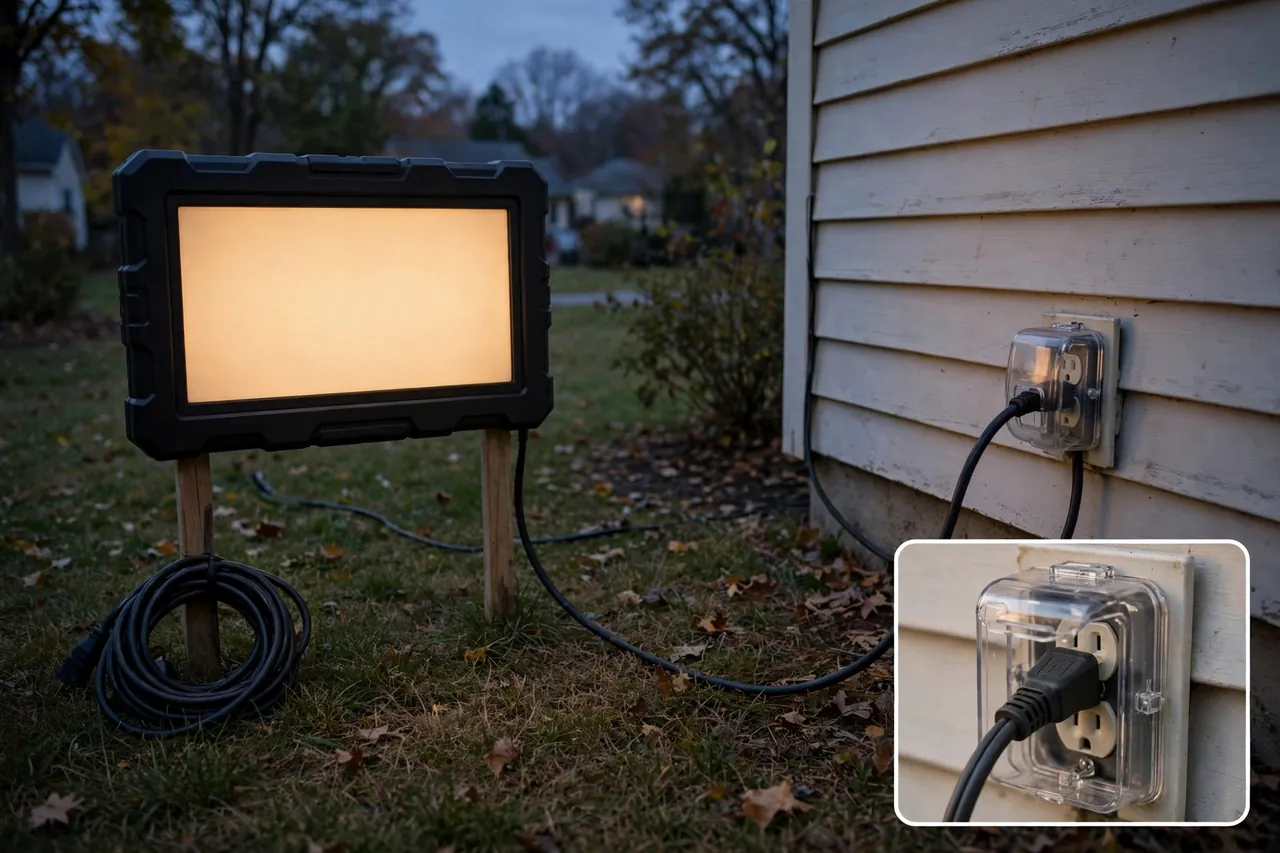
Protect the connection point with an in-use weatherproof cover, the kind that closes over the plugs while everything stays connected. The small flip-down cap that came with the house does not protect a live connection. Check the cover after rain, because a cover left ajar is barely better than no cover at all.
Battery and solar countdowns dodge the cord problem, but they bring their own limits. Cold weather drains batteries faster, and short winter days give solar panels less charging time. If you choose a solar countdown, place the panel where it catches the most winter sun, not the most summer sun, and keep it clear of snow. For more on winter solar limits, see our guide to solar Christmas outdoor decorations.
For a deeper walkthrough of timers, schedules, and weatherproof connections, the Christmas Light Emporium guide to automating Christmas light displays covers GFCI outlets, in-use covers, and connection protection in practical detail. Turn the display off when you leave the house for a long stretch or head to bed if your setup uses a manual timer, and inspect cords each season for cracks, fraying, or loose plugs. Throw out damaged cords instead of taping over the damage.
Make the Countdown Readable From the Street
A countdown nobody can read is just a glowing box. Street visibility comes down to size, contrast, background, and light, and each one is easy to fix once you stand where your audience stands.
Size comes first. Walk to the curb and read the digits out loud. If you squint, drivers will too, so move the sign closer to the street, choose a larger display, or switch to projection if the house sits far back. Contrast comes second: bright digits on a dark board read far better than pale digits on a busy background, so avoid placing a light-up sign directly in front of a bright window or a dense tangle of lights.
Background comes third. A lone sign floating in an empty lawn can look lost, even if the digits are large. Nestle it near a porch pillar or a planter, and the eye lands on the scene, then reads the number. Light comes last: check the display from the street at dusk, turn down competing lights that wash it out, and dim a display that glares.
Large displays face the same readability test at a bigger scale. If you plan a bold yard scene around the countdown, our guide to large Christmas decorations covers scale and safety for oversized pieces, which helps the countdown sit in proportion instead of looking tiny beside a giant display.
Sync the Count to Christmas Day
Syncing sounds technical, but it really means one thing: make sure the display counts toward the right moment. Most mistakes here are small and completely avoidable.
First, set the current date and time correctly before you set the countdown. A clock that thinks it is Tuesday when it is Thursday will count wrong all season, and nobody will notice until the numbers stop matching the calendar on the fridge. Set the time, then set the countdown, then double-check both.
Second, confirm the target. Some clocks count down to December 25 at midnight, while others count to Christmas morning. A one-day gap between your clock and your neighbor’s clock usually means different targets, not a broken display. Pick the target your family uses, and set every countdown in the yard to the same one.
Third, watch for resets. Power cuts, dead batteries, and accidental button presses can reset a clock to a factory default, sometimes 99 days. Fresh backup batteries prevent most surprise resets, so check batteries and settings before you assume the display broke.
For smart displays, syncing also means checking the connection and the time zone in the app. If the app time zone is wrong, the countdown will be wrong too, even though the hardware works perfectly. Finally, plan Day Zero before December 24: some signs flip to a “Merry Christmas” panel, some clocks show a festive message, and manual boards can swap the number for a star or wreath.
Countdown-Specific DIY Builds Worth Trying
You do not need to buy a countdown to have one. The builds below stay strictly on the countdown job: they show the number, they update it, and they survive outside. They are not general yard projects, and they work best when the countdown itself is the point.
A chalkboard number board is the easiest start. Paint a weather-sealed board with chalkboard paint, write “days until Christmas” across the top, and change the number each morning with a chalk marker. Hang it near the front door under a porch roof, where rain cannot wash it clean and the update takes seconds.
A changeable tile board suits families who like a hands-on ritual. Mount a board with rails or hooks, and hang number tiles that swap in and out each day. Kids love pulling yesterday’s tile off and hanging today’s, and the board needs no power at all. Store spare tiles in a small box by the door so a lost “7” does not end the countdown early.
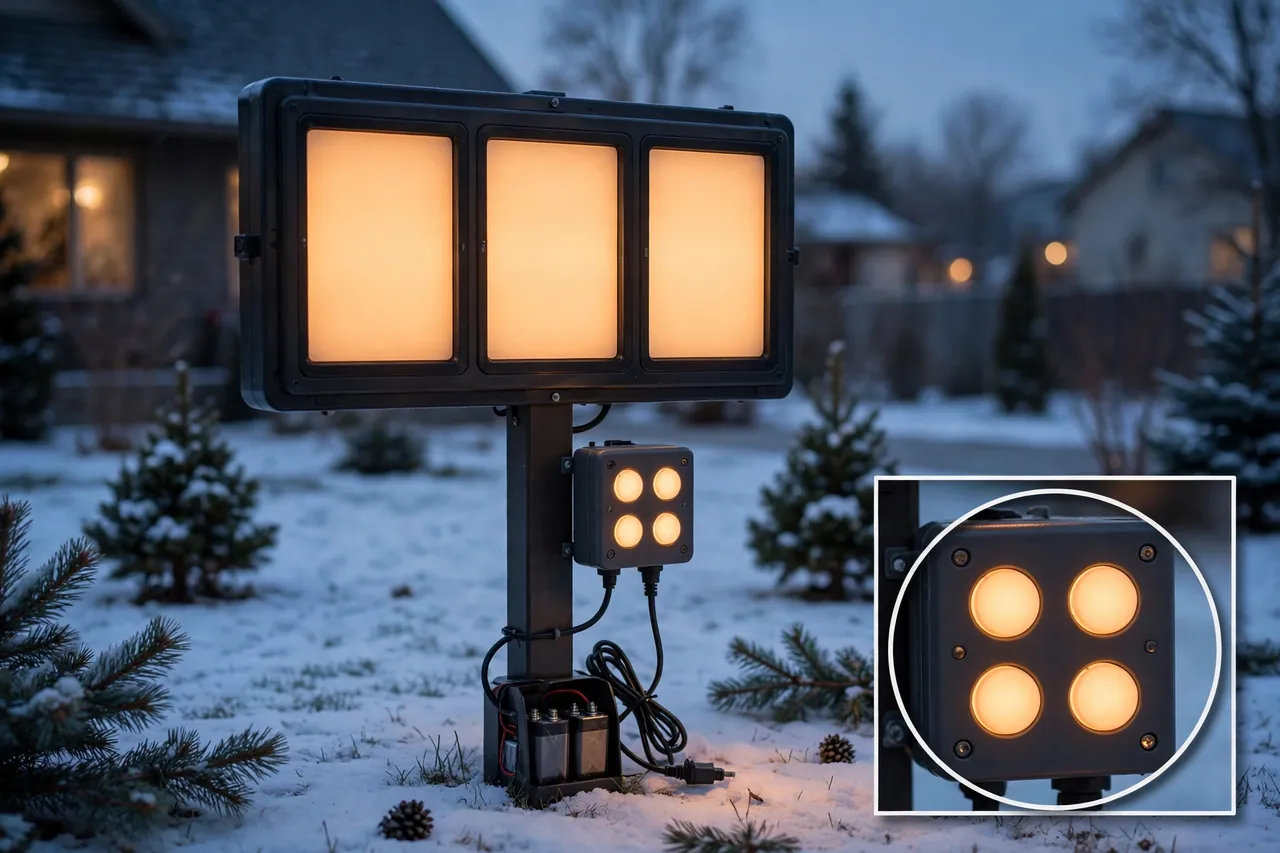
A light-up number board adds night visibility to a DIY build. Fix battery-powered fairy lights or a waterproof LED strip around the edge of a sealed board, and let the glow frame the number after dark. Keep the lights on the frame, not across the digits, so the number stays readable instead of turning into a blur of light. The Wonderlearning guide to DIY outdoor Christmas countdowns offers more build ideas in this same spirit, including lantern and pallet-board countdowns.
Whichever build you pick, test it for a week before December. A board that warps or a marker that fades will show up fast, and a week of testing leaves time to fix it.
Troubleshooting Your Outdoor Christmas Countdown
Most countdown problems have boring causes and quick fixes. Work through this list in order, starting with the cheapest and simplest checks.
- The number is wrong. Recheck the current date and time first, then the countdown target. A wrong target or a wrong time zone explains most wrong numbers.
- The display keeps resetting. Replace the backup batteries, then check for loose power connections. A clock that loses power and has a dead backup battery forgets its settings.
- The display is dark at night. Check the outlet, the GFCI, and the timer schedule before you blame the sign. A tripped GFCI or a timer set to the wrong hours is a common culprit.
- The digits look dim or garbled in cold weather. Move the display to a slightly sheltered spot, check the maker’s temperature range, and remember that some LCD screens struggle in deep cold while LED digits hold up better.
- The projection looks washed out. Dim nearby lights, darken the projection surface, and move the projector closer for a brighter, smaller image.
- The sign keeps tipping over. Add weight, drive stakes deeper, or move the sign to a sheltered spot out of the strongest wind path.
- The GFCI keeps tripping. Unplug the display, dry every connection, and check for cracked cords or water inside a cover. A GFCI that trips is doing its job, so find the moisture instead of bypassing the protection.
- The smart countdown froze on an old number. Check the Wi-Fi signal at the display, restart the app and the display, and confirm the time zone setting.
If a fix involves wiring, a damaged cord, or an outlet that looks or smells wrong, stop and call a licensed electrician. A countdown display is never worth a shock or a fire risk, and a professional can sort the outlet in one visit.
When to Buy, Build, or Skip a Countdown
Buy a countdown when you want automatic updates, night visibility, and a display that runs itself. A light-up clock or a smart display fits a busy household, a long driveway, or anyone who knows the daily update would slip by week two.
Build a countdown when you enjoy the ritual, want a custom look, or need to keep costs down. A manual board fits a porch, a small yard, and a family that treats the morning number change as part of the season. Building also lets you match the board to your house colors and style in a way a store sign never will.
Skip the countdown, or delay it a year, when your yard has no safe power, no readable spot, and no shelter from harsh weather. A sign nobody can read, or one that dies in the first storm, adds frustration instead of cheer. In that case, an indoor countdown on a mantel or a window facing the street gives the family the same ritual without fighting the weather.
Related Guides
If you are planning the whole yard around the countdown, these guides help with the pieces around it: light-up Christmas decorations for the surrounding glow, large Christmas decorations for scale, solar Christmas outdoor decorations for cord-free power, and inflatable outdoor decorations for blow-up yard pieces.
Frequently Asked Questions
How does an outdoor Christmas countdown clock work?
An outdoor Christmas countdown clock holds the current date and time, then counts the days, hours, and minutes left until December 25. You set the date and time once, and the clock updates itself. Many models use a small backup battery to keep the count safe during a power cut.
Can I leave a Christmas countdown sign outside all winter?
Yes, if the sign is rated for outdoor use and its connections stay dry and covered. Outdoor-rated cases, sealed electronics, and a weatherproof in-use outlet cover handle rain, snow, and cold far better than indoor signs. Bring indoor-rated signs inside during wet or freezing weather.
What size countdown sign can drivers read from the street?
A sign about 24 to 36 inches tall reads well from a typical suburban street, while a 12-inch sign suits a porch or walkway where people stand close. Always test from the curb at dusk, because distance, glare, and background clutter change readability more than the product photo suggests.
How do I power an outdoor Christmas countdown safely?
Plug corded countdowns only into a GFCI-protected outdoor outlet, use cords rated for outdoor use, and cover every connection with an in-use weatherproof cover. Keep cords off walkways, stay within the cord rating, and discard cracked or frayed cords instead of taping them.
What should my countdown show on Christmas Day?
Plan a Day Zero display before December 24. Many signs flip to a “Merry Christmas” panel, some clocks show a festive message, and manual boards can swap the number for a star or wreath. A planned ending keeps the yard looking intentional through the holiday week.
Why does my countdown show the wrong number of days?
A wrong number usually means a wrong current date, a wrong countdown target, or a wrong time zone on a smart display. Check those three settings first, then check for a reset caused by dead backup batteries or a power cut. Matching every yard display to the same target prevents one-day disagreements.
Disclaimer: Homes, yards, weather, and electrical setups vary, so treat this guide as general advice. For outdoor wiring, damaged outlets, or repeated GFCI trips, ask a licensed electrician. Outdoor electrical work is not a learn-as-you-go project.
Your countdown is ready when three things are true: the number is right, a stranger can read it from the street at dusk, and every cord and connection is dry, covered, and safe. Pick your type this week, test it one evening before December, and let the falling number do what it does best. Tomorrow morning, someone in your house will run outside just to change it or check it, and that small daily moment is the whole point.