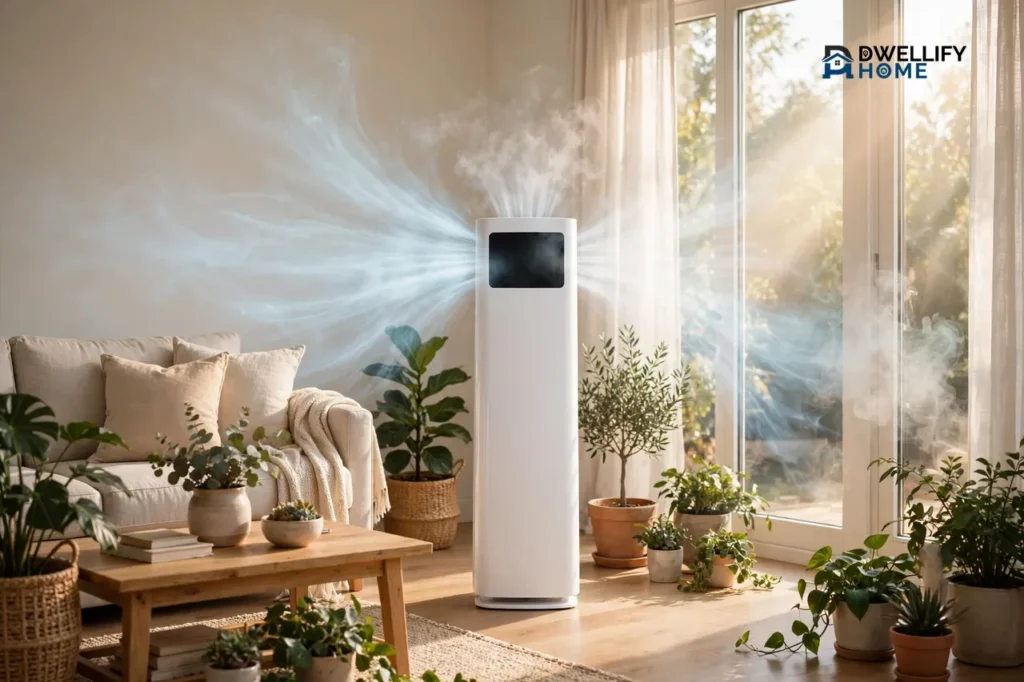
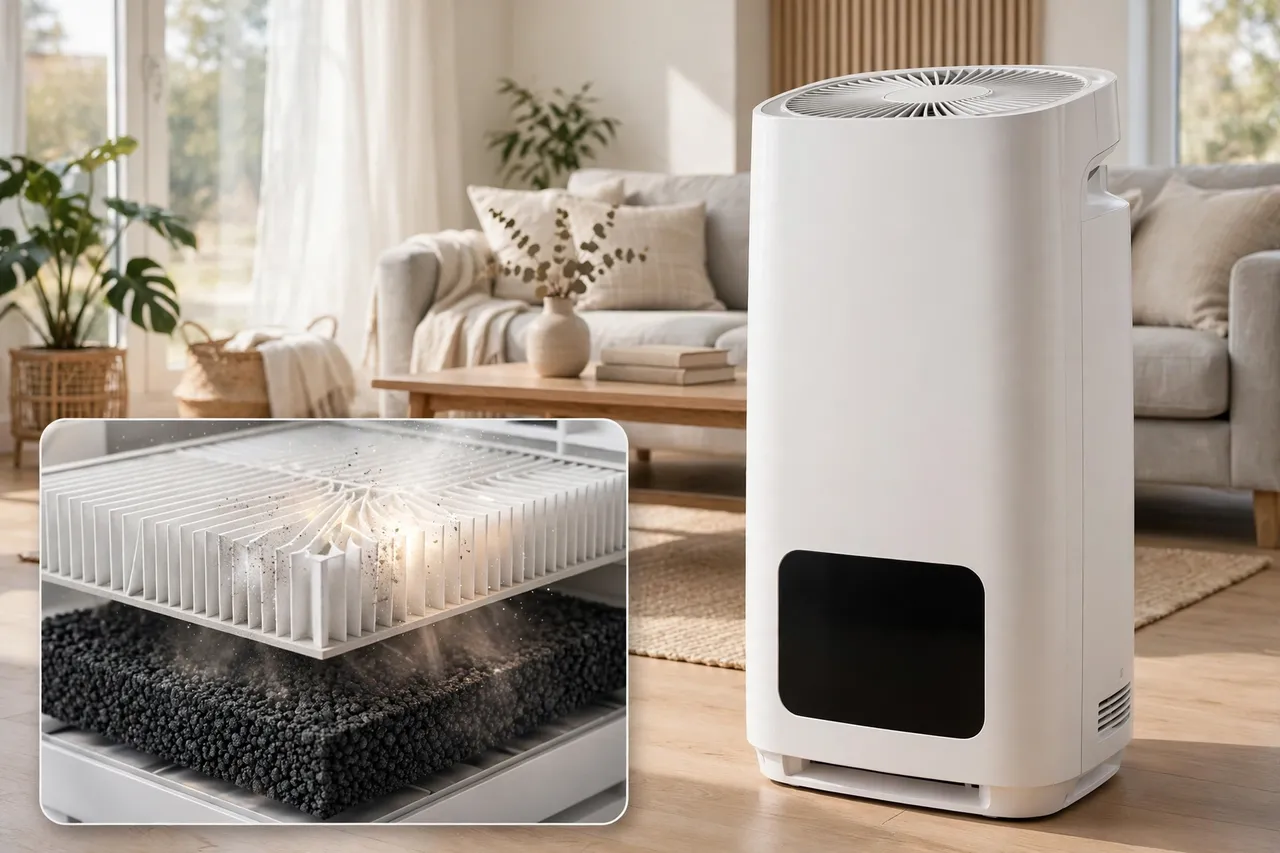
Yes, an air purifier can clear smoke odor from your home, but only if it has the right filter for the job. Smoke smell lives in gases, not in dust, so a HEPA filter alone will clear the haze and leave the smell behind. You need a purifier with a real activated carbon filter, sized to your room, and you need to run it on high while the smell is strong.
That one detail explains most of the disappointment people have with smoke purifiers. They buy a unit that promises “smoke removal,” watch the visible haze fade, and then wonder why the room still smells like an ashtray or last night’s frying pan. The haze and the smell are two different problems, and they need two different filters.
Why Smoke Smell Is Two Problems, Not One
Smoke is a mix of tiny solid particles and invisible gases. The particles are what you see as haze and what irritates your eyes and throat. The gases are what you smell. A single filter cannot catch both, because they behave in completely different ways.
HEPA Catches the Particles You Can See
A true HEPA filter traps at least 99.97% of airborne particles 0.3 microns in size, according to the U.S. Environmental Protection Agency’s guide to air cleaners in the home, and smoke particles fall squarely in that range. Consumer Reports notes that the best HEPA purifiers can cut particle levels by as much as 85%, also citing EPA findings. So HEPA handles the visible half of smoke very well: it clears the haze and pulls the fine PM2.5 particles out of the air you breathe.
What HEPA cannot do is catch a gas. Odor molecules are far smaller than any particle a mesh filter can trap, so they sail straight through. A purifier with HEPA and no carbon is a haze remover, not a smell remover.
Activated Carbon Catches the Smell You Can’t See
Activated carbon works by adsorption: odor molecules stick to the huge surface area inside tiny pores in the carbon. This is the only common home filter technology that actually removes smoke odor from the air instead of covering it up. But the amount of carbon matters far more than the fact that carbon is present at all.
Many budget purifiers carry only a thin carbon-coated sheet, holding roughly 20 to 50 grams of carbon. That amount can handle light cooking smells for a few weeks, but heavy smoke saturates it in days. For real smoke odor, look for a dedicated carbon filter measured in ounces or pounds, not a sheet. HouseFresh, which has tested more than 130 air purifiers since 2020, found in its weed smoke testing that the units that actually beat smoke odor carry pounds of pelleted carbon, such as the Austin Air HealthMate with about 15 pounds of activated carbon and zeolite, or the Alen BreatheSmart 75i with 3.6 pounds of pelleted carbon. The rule of thumb from independent testers is simple: for meaningful smoke odor removal, you want at least 1 pound (450 grams) of activated carbon. Less than that, and the filter fills up before the smell is gone.
How to Pick an Air Purifier for Smoke Odor
Shopping for a smoke purifier gets much easier once you ignore the marketing words on the box and check three things instead. Every one of them is printed in the spec sheet or the independent test data.
1. Check the Smoke CADR, Not the Square Footage
CADR, or Clean Air Delivery Rate, measures how much clean air the purifier actually delivers, in cubic feet per minute. The smoke CADR is the number that matters here, because the test uses smoke-sized particles. The U.S. EPA recommends a smoke CADR of at least two-thirds of your room’s floor area in square feet. A 300-square-foot living room needs a smoke CADR of at least 200.
Manufacturer square-footage claims are often measured at one air change per hour, which is far too slow for smoke. Trust the CADR, and look for AHAM Verifide certification, which means an independent lab checked the number.
2. Weigh the Carbon
Ask how much activated carbon the filter holds, in grams or pounds. Pellet or granule carbon beats a thin carbon sheet every time, because pellets pack far more surface area into the same space. If the maker will not state a carbon weight, treat that as your answer: the amount is too small to brag about.
Here is how a few well-tested models compare on the two numbers that matter most for smoke odor. Figures are checked against HouseFresh hands-on testing, AHAM Verifide listings, and Consumer Reports’ wildfire smoke testing, November 8, 2026.
Table: carbon weight and smoke CADR for six well-tested models
| Model | Activated carbon | Smoke CADR | Best for |
|---|---|---|---|
| Austin Air HealthMate | About 15 lb carbon + zeolite | Not published | Heavy, daily cigarette or cigar odor |
| Alen BreatheSmart 75i | 3.6 lb pelleted carbon | About 333 CFM | Strong odor in a large room |
| Levoit Core 600S with Smoke Remover filter | Pellet carbon, Smoke Remover option | 394 CFM (AHAM) | All-round smoke and odor value |
| Levoit Core 400S with Smoke Remover filter | 450 g pelleted carbon | 231 CFM (AHAM) | Smaller rooms and bedrooms |
| Blueair Blue Pure 211i Max | Carbon layer (light) | 435 CFM | Wildfire haze in big rooms |
| Winix 5510 | Pellet carbon (AOC filter) | 253 CFM (AHAM) | Budget pick with real carbon |
Notice the trade-off in the table. The Blueair moves the most air, so it clears wildfire haze fastest, but its carbon layer is light, so it is weaker on lingering odor. The Austin Air moves air more slowly but carries by far the most carbon, so it wins on smell. Match the machine to your problem: haze needs airflow, odor needs carbon.
3. Skip the Ozone and Ionizer Features
Some purifiers add an ionizer or an ozone generator and promise to “destroy” odors. Do not use them for smoke smell. The EPA warns against portable air cleaners that intentionally produce ozone, because ozone is a lung irritant, and the agency states that ozone generators sold as air cleaners are not approved by any federal agency for use in occupied spaces. At levels low enough to be safe, ozone does little to indoor air pollution; at levels high enough to attack odor, it harms the people breathing it. Choose a purifier that is CARB certified for low ozone, or one with no ionizer at all.
How Long Does It Take to Clear Smoke Odor?
It depends on what kind of smoke you are fighting. Fresh smoke from a single event, like a burnt dinner or a neighbor’s fire pit drifting through an open window, usually clears in a few hours with good ventilation and a correctly sized purifier running on high. The particles drop fast, often within an hour, and the smell follows over the next few hours as the carbon works through the gases.
Built-up cigarette odor is a different job. Smoke that has soaked into a home over months or years can take days to weeks of steady cleaning, filter changes, and continuous purification before the smell drops to a level you stop noticing. That is because the odor is no longer just in the air. It is stored in the room itself, and it keeps leaking back out.
Three habits make the purifier work faster:
- Run it on high first. Start on the highest fan speed for the first hour or two, with doors and windows closed, so the unit pushes several full room volumes of air through its filters. Then drop to medium or auto and leave it running.
- Keep it running after the smell fades. Odor keeps off-gassing from fabrics and walls for a day or two after the air seems clean. Keep the purifier on for at least a day after a smoke event so it catches what keeps leaking out.
- Put it where the smoke is. Place the purifier in the room where the smell is strongest, with clear space around its intake and outlet. A unit tucked behind a couch or in a hallway cleans the air around the couch, not the smoky room.
Smoke Odor by Source: Cigarettes, Cooking, Fireplace, and Wildfire
Not all smoke smells the same, and the fix shifts a little with the source. The filter rules stay the same, but the emphasis changes.
Cigarette and Cigar Smoke
This is the hardest smoke odor to beat, because it is continuous, heavy in gases and tar, and it soaks into everything. Carbon volume matters more here than airflow. A deep carbon bed, like the Austin Air HealthMate’s 15 pounds, is the right tool, and you should expect to replace the carbon filter more often than the manual says. Also be honest with yourself about the limit: the EPA notes that air cleaning can reduce exposure to secondhand smoke but cannot eliminate it. Only keeping smoking out of the home does that.
Cooking Smoke
Cooking odor is usually a short, sharp event: frying oil, a burnt pan, a smoky oven. A mid-size purifier with a real carbon filter handles it well, especially if you run the range hood at the same time so the purifier is not fighting a running source.
Fireplace Smoke
Fireplace smell usually means smoke is leaking into the room instead of going up the chimney, often because of a draft problem or a damper that is not fully open. A purifier helps with the smell in the room, but it cannot fix the leak. Check the damper, make sure the flue is clear, and only burn dry, seasoned wood.
Wildfire Smoke
Wildfire smoke is mostly a particle problem with a moderate gas load, and it arrives suddenly and lasts for days. Here airflow matters most: a high smoke CADR, like the Blueair Blue Pure 211i Max at 435 CFM or the Levoit Core 600S at 394 CFM, brings particle levels down fast across a whole room. Consumer Reports, which tests purifiers by pumping smoke into a sealed chamber, recommends in its wildfire smoke picks large units rated for rooms over 350 square feet, and advises running them on high with doors and windows closed.
What Does Not Work for Smoke Odor
Knowing what to skip saves as much money as knowing what to buy. These are the common dead ends:
- Air fresheners and scented candles. They add a scent on top of the smoke smell. The source never changes, so the smoke smell returns as soon as the fragrance fades.
- Ozone generators. They are marketed as odor destroyers, but the EPA is clear: ozone is a lung irritant, no federal agency has approved ozone generators for occupied spaces, and at safe levels ozone does little against indoor air pollution. Never run one in a room people are using.
- Ionizers and UV lights without a carbon filter. An ionizer charges particles so they settle out of the air, but it does nothing for the gases that carry odor, and some ionizers produce ozone as a byproduct. UV light can kill some germs, but it traps no particles and adsorbs no gases, so it does nothing for smoke smell by itself.
- A small purifier in a big room. A bedroom-size unit in an open living room will run all day and barely move the needle. Size the purifier to the room with the smoke CADR rule, or buy one unit per room.
- A HEPA-only purifier. It clears the haze beautifully and leaves the smell exactly where it was. If odor is your problem, HEPA without carbon is the wrong tool.
The Purifier Alone Won’t Finish the Job: Removing Odor From the Room
Here is the part most smoke guides skip: the air is only half the problem. Smoke residue settles into walls, fabrics, carpets, and ductwork, and those surfaces slowly release odor back into the air for days, weeks, or even months. Researchers call this thirdhand smoke, and studies have found its residue can persist for two months after a smoker moves out of a home. A purifier cleans the air, but it cannot clean your couch. If the smell keeps coming back after the purifier has run for days, work through the room itself, in this order:
- Ventilate first. Open windows on opposite sides of the room when outdoor air is clean, and put a box fan in a window facing outward. This flushes the airborne load before you start cleaning.
- Wash the fabrics. Curtains, cushion covers, bedding, and throw blankets hold the most odor. Wash what you can, steam-clean upholstery and rugs, and use hot water extraction on carpets with heavy buildup. Sprinkle baking soda on carpets and upholstery, leave it overnight, then vacuum it up. Baking soda reacts with acidic odor molecules instead of masking them.
- Wipe the hard surfaces. Nicotine and tar form a film on walls and ceilings that keeps off-gassing. Wash walls top to bottom with a trisodium phosphate (TSP) solution or a commercial smoke odor cleaner, wearing rubber gloves, and rinse each section with clean water. Test a small hidden patch first, especially on painted walls.
- Check the HVAC filter. Smoke particles collect in filters and ductwork, and a saturated filter starts redistributing them every time the system cycles. Replace the filter, vacuum inside the vents as far as you can reach, and consider professional duct cleaning if rooms still smell after a filter change.
- Seal it in if cleaning is not enough. For severe, long-term buildup, repainting walls with a stain-blocking primer seals the residue under a new surface and stops further off-gassing. In the worst cases, replacing carpet or drapes is more practical than cleaning them again.
- Keep the purifier running through all of it. Cleaning stirs odor back into the air. Run the purifier on high while you clean, and keep it running for a day or two after you finish so it catches what the surfaces keep releasing.
If the room still looks hazy after the smell is gone, the problem may be fine particles rather than smoke. Our guide to haze in a living room walks through the other causes, from cooking aerosols to humidifier mineral dust, and how to tell them apart.
How to Set Up and Run Your Purifier for Smoke Odor
Buying the right machine is only half the job. How you run it decides whether it actually clears the smell.
- Close the room up during a smoke event. Shut doors and windows so the purifier is cleaning the same air over and over instead of fighting a steady leak of smoky outdoor air. In winter, when the house stays shut for months, this matters even more, because particles and odor have nowhere to go. Our guide to why a closed-up house gets dry and dusty in winter explains how a sealed house traps what is inside it.
- Run it before the smoke arrives, when you can. During wildfire season, start the purifier before the haze reaches your street. A room that starts clean stays clean far more easily than one the purifier has to rescue.
- Watch for the smell coming back. If you can smell smoke while the purifier is running on high, the carbon is usually spent. That is your signal to replace the carbon filter, not to buy a bigger machine.
- Replace filters on the smoke schedule, not the normal schedule. During heavy smoke, filters load up roughly twice as fast. Check them monthly during fire season or in a home with daily smoking, and change them when they look dirty or the smell returns, even if the indicator light has not come on yet.
Related Guides
- Haze in Living Room: Causes, Health Signs, and How to Clear It Fast — if the air looks smoky even when you cannot smell anything, this guide sorts out particles, humidity, and cooking aerosols.
- Why a Closed-Up House Gets Dry and Dusty in Winter — how a sealed winter house traps dust and odor, and why filtration and cleaning solve different halves of that problem.
Frequently Asked Questions
Do air purifiers remove smoke smell effectively?
Yes, with the right setup. A purifier needs both a true HEPA filter for smoke particles and a real activated carbon filter for the gases that carry odor. HEPA alone clears the haze but leaves the smell. Match the smoke CADR to your room size and run the unit consistently for the best results.
How long does it take to get rid of smoke smell in a house?
Fresh smoke from a single event can often clear in a few hours with good ventilation and an air purifier on high. Cigarette smoke built up over years can take days to weeks of consistent cleaning, filter changes, and air purification. Thirdhand residue in walls and fabrics may require repainting or replacement.
Will cigarette smoke smell eventually go away on its own?
Airborne particles will fade over time, but the smell rarely disappears without active removal. Thirdhand residue, the chemical compounds deposited onto walls, fabrics, and floors, can persist indefinitely if not physically cleaned. Regular fabric washing, surface cleaning, and continuous air filtration are all needed to reduce it.
Can an air purifier remove cigarette smoke smell?
Not without activated carbon, and even then imperfectly. HEPA filters remove smoke particles, which clears visible haze and the fine particle health risk. The odor itself comes from gaseous compounds that no particle filter captures. Activated carbon provides real relief, but it saturates with repeated exposure and needs replacing.
Will an air purifier eliminate cigarette smell completely?
No single device eliminates smoke odor completely. Carbon filtration reduces many odor compounds, but smoke also soaks into walls, fabrics, and ductwork, where a purifier cannot reach it. Full removal takes the purifier plus cleaning the room itself, and only keeping smoking out of the home prevents the smell from returning.
Disclaimer: This guide is general home advice, not medical advice. Smoke contains harmful chemicals, and no home air purifier removes every health risk from smoke exposure. If anyone in the home has asthma, heart or lung disease, or breathing trouble during smoke events, talk to a doctor, and follow local air quality guidance. Never run an ozone generator in an occupied room. For fire damage or heavy smoke residue, consider a professional restoration service.
The short version is simple: HEPA clears the haze, carbon clears the smell, and the room itself needs cleaning too. Pick a purifier with a smoke CADR that fits your room and at least a pound of real activated carbon, run it on high while the smoke is strong, and clean the fabrics and walls that keep giving the smell back. Do those three things, and the room will smell like a home again instead of like smoke.