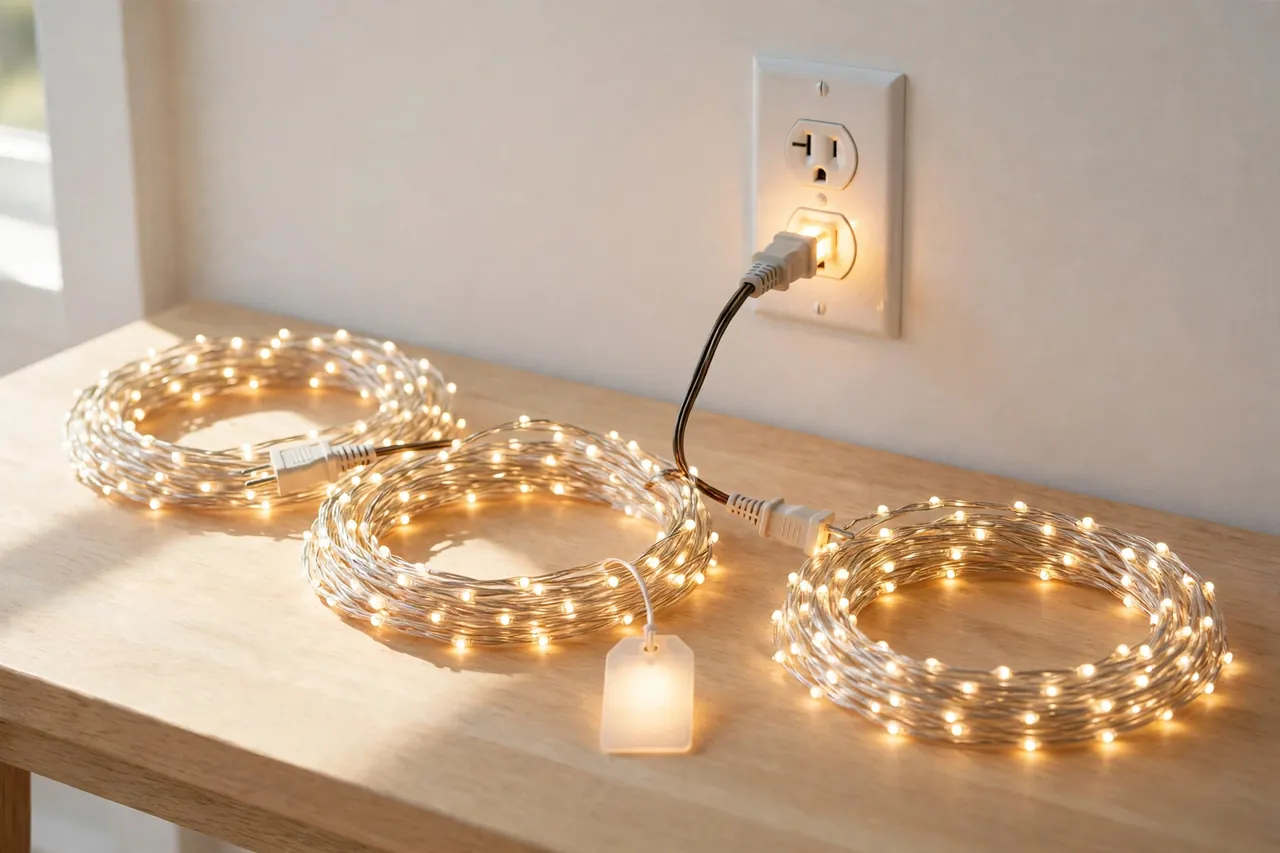
So, how many strands of Christmas lights can you connect end to end? The honest answer is: it depends on your lights, and your light set’s own label gives the final answer. Many incandescent mini-light sets allow only 3 to 5 strands in one chain, while many LED sets allow far more, but the exact number changes from one model to the next. Never guess the number. Read the tag on the cord, do the wattage math below, and stop at whichever limit comes first.
That label-first rule sounds dull, but it protects your home. A chain that draws too much power can overheat thin wires, blow a fuse, trip a breaker, or, in the worst case, start a fire. The good news is that the math is simple, and once you learn it, you can plan any display with confidence.
The Short Answer: Check the Label First
Every listed light set carries a rating near the plug. Look for words such as “maximum connectable,” “end-to-end,” or “do not exceed” followed by a watt or strand number. That rating beats every rule of thumb in this article, including the examples below.
Why does the label win? Because light sets differ in wire thickness, bulb type, fuse size, and plug design. Two boxes that look alike on the shelf can carry very different limits. The maker tested your exact model, so trust its number over a number you read online.
If the label is missing, faded, or unreadable, play it safe. Treat the set as unknown, do not chain it with other sets, and replace it if it also shows damage. A cheap new set costs far less than a damaged outlet or a fire.
Also, connect only identical sets end to end: the same model, from the same maker. Mixing brands, bulb types, or wire sizes in one chain breaks the rating, because the rating assumed one known set repeated.
Why One Number Cannot Fit Every Light Set
People want one magic number, and the internet offers plenty of them. You will see “3 strands,” “5 strands,” “25 strands,” and “50 strands” all stated with confidence. They disagree because they describe different lights, not because one writer lied and the rest told the truth.
An old-style incandescent set turns much of its power into heat. Its bulbs glow hot, its wires carry more current, and its thin cord warms up fast. An LED set sips power by comparison, stays much cooler, and leaves far more room in the same chain. That single difference explains most of the gap.
Wire thickness matters too. Under the UL 588 safety standard for seasonal and holiday lighting, guidance commonly cited for light strings caps a 22-gauge wire run at 210 watts total, while a thicker 20-gauge wire run can reach 420 watts. Some product markings show a slightly different cap, such as 216 watts (1.8 amps) for certain connector types, so the exact cap on your set still comes from its own tag. For the full standard background, see this explanation of UL standards for Christmas light strings.
Length adds a third limit: voltage drop. As power travels down a long chain of thin wire, the bulbs at the far end receive less voltage than the bulbs near the plug. Those far bulbs may glow dim, flicker, or shift color. Dim end bulbs often signal that you have pushed a chain too far, even before any fuse blows.
So forget the search for one universal number. Your answer always has three parts: the label limit, the wattage limit, and the circuit limit. The smallest of the three wins.
Watts vs Amps: The Two-Minute Load Math
Watts and amps both measure electricity, but they answer different questions. Watts tell you how much power a set uses. Amps tell you how much current flows through the wire and the circuit. You need both numbers to stay safe.
Here is the only formula most homeowners need: watts divided by volts equals amps. United States homes run at 120 volts, so you divide total watts by 120 to get amps. A 120-watt chain draws 1 amp. A 240-watt chain draws 2 amps.
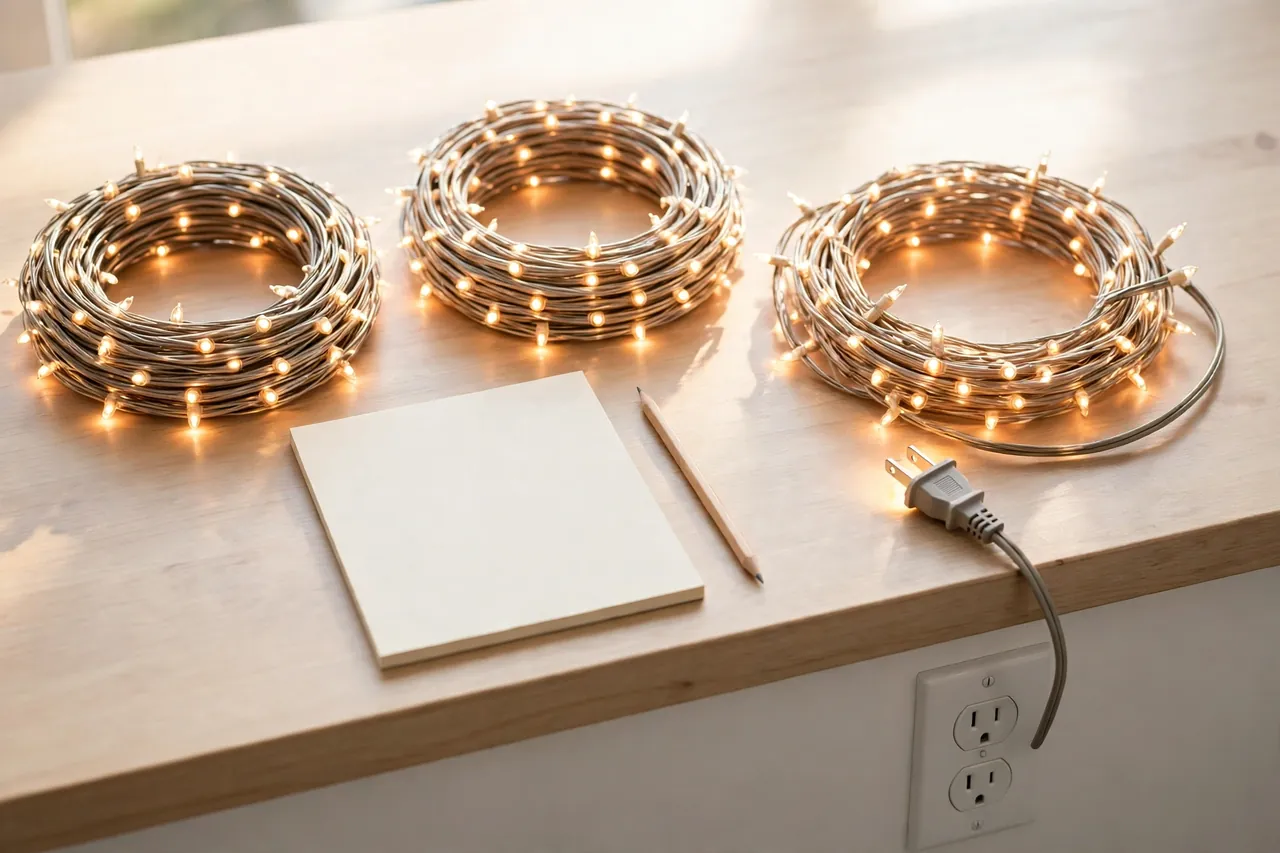
Run the math in this order. First, find the watts for one strand on its tag or box. Second, multiply that number by the number of strands you want to chain. Third, compare the total against the chain limit on the tag. Fourth, compare the same total against your circuit limit, which the next sections explain.
Do not round up when a limit is close. If the math gives you 5.25 strands, you can connect 5, not 6. The extra strand pushes you past the rated total, and ratings exist to leave a safety margin, not to invite you to spend it.
Incandescent vs LED: Why the Limits Look So Different
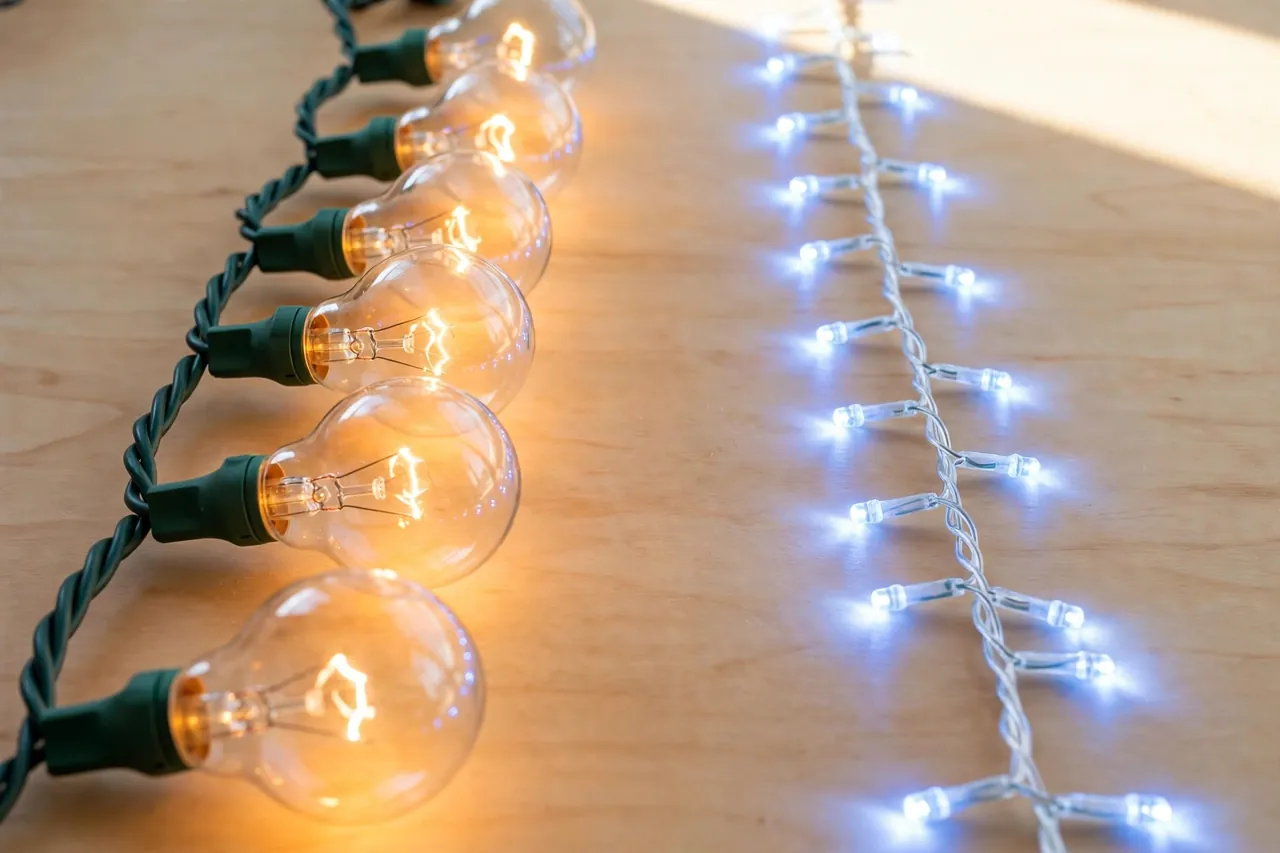
Incandescent bulbs make light by heating a tiny filament until it glows. That heat is wasted energy, and it is why these sets run hot and draw far more power. A typical 100-count incandescent mini-light strand draws roughly 40 watts, though the exact figure varies by model, so always read your own tag.
LED bulbs make light with a semiconductor instead of a hot filament. They waste far less energy as heat, so they draw only a small fraction of the power. A typical 100-count LED mini-light strand draws only a few watts, again with the exact figure set by the model.
Because the wattage gap is so large, the chain gap is large too. A 210-watt chain limit swallows only a handful of 40-watt incandescent strands, but it can hold dozens of low-wattage LED strands. That is the whole story behind the “3 to 5” rule for incandescent sets and the much larger numbers quoted for LED sets.
LED sets still have limits, though. Their drivers and controllers can only handle so much load, and some smart or dimmable LED sets cap their chains well below what pure wattage math would allow. A low wattage number never overrides a lower label number.
Table: Typical end-to-end chain limits by light type
| Light type | Typical watts per strand | Typical chain range | Main limit |
|---|---|---|---|
| Incandescent mini lights | About 40 watts | 3 to 5 strands | Heat and wire load |
| Incandescent C7 or C9 bulbs | Higher per strand | 2 to 3 strands | Heat and wire load |
| LED mini lights | A few watts | Often 20 or more | Label and driver limit |
| LED C7 or C9 bulbs | More than LED minis | Varies widely | Label and driver limit |
Treat every number in this table as a typical range reported across models, not as a rating for your set. Your tag may allow fewer strands, and fewer always wins. When sources disagree about a limit, follow the most conservative number that applies to your exact model.
Worked Examples: Do the Math Before You Plug In
The examples below are labeled worked examples, not measured facts about any product. Each one states its assumptions, so you can swap in your own set’s real watts and repeat the math.
Example: LED mini lights at 4.8 watts per strand
Suppose your tag says each 100-count LED mini strand uses 4.8 watts, and your chain limit is 210 watts. Divide 210 by 4.8 and you get 43.75, so wattage math alone would allow 43 strands. But if the same tag caps the chain at 25 strands, then 25 is your real limit, because the label wins over the math.
Example: Incandescent mini lights at 40 watts per strand
Suppose each 100-count incandescent strand uses 40 watts, with the same 210-watt chain limit. Divide 210 by 40 and you get 5.25, so wattage math alone would allow 5 strands. But many incandescent sets carry a label limit of 3 strands, and in that case 3 is your real limit. This is why the older “3 strands” advice still circulates: it matches many real labels, even though wattage math alone would suggest a slightly higher number.
Example: Checking the whole circuit, not just the chain
Suppose you run four separate LED chains, each drawing 100 watts, from different outlets on one 15-amp circuit. Your display total is 400 watts. Divide 400 by 120 and you get about 3.3 amps, well under the circuit’s safe continuous load of 1,440 watts explained below. Each chain must still respect its own label limit, because a safe circuit total never rescues an overloaded single chain.
Your Outlet and Circuit: The Second Limit
A chain limit protects the light string’s own thin wires. A circuit limit protects your home’s wiring and breaker. You must respect both, and they are easy to confuse, so keep them separate in your head.
A standard United States circuit runs at 120 volts. A 15-amp circuit can theoretically carry 1,800 watts (15 times 120), and a 20-amp circuit can theoretically carry 2,400 watts (20 times 120). Electricians commonly advise staying at or below 80 percent of capacity for continuous loads like holiday lights. That gives a practical ceiling of 1,440 watts on a 15-amp circuit and 1,920 watts on a 20-amp circuit. For a clear walk-through of this formula, see how to calculate how many Christmas lights you can string together.
Remember that your lights rarely own a circuit alone. The same circuit may also feed a room outlet, a television, or a space heater. Add up everything on that circuit, not just the lights, before you call the total safe. If you do not know what shares a circuit, switch off the breaker and see which outlets go dark, then add up only what stays on that circuit.
A tripped breaker is a warning, not an annoyance to reset and ignore. If a breaker trips when the lights come on, unplug part of the display, split it across circuits, and check for damage before you reset it. Repeatedly resetting a tripping breaker without reducing the load invites overheating.
Outdoor Rules: GFCI, Outdoor-Rated Gear, and Weather
Outdoor displays face rain, snow, damp ground, and curious pets, so the rules tighten outside. Use only lights, cords, and decorations labeled for outdoor use when they will sit outside. Indoor-rated sets lack the insulation and sealing that wet weather demands, and no bargain justifies that risk.
Plug every outdoor display into a ground-fault circuit interrupter (GFCI) protected outlet. A GFCI watches for current leaking where it should not go, such as through water or a person, and shuts power off in a fraction of a second. The National Fire Protection Association stresses GFCI protection for exterior receptacles and advises testing the device before use and at the maker’s recommended intervals. Read their electrical safety tips for exterior holiday lights before you hang your first outdoor strand.
Before you plug anything in, press the TEST button on the GFCI outlet, confirm that it trips, then press RESET and confirm that power returns. If the outlet fails either test, stop and call a qualified electrician. Never bypass a GFCI, and never replace it with a standard outlet to stop nuisance trips, because those trips may signal a real fault.
Keep plug connections off the ground and out of puddles. Use weatherproof connection covers or in-use outlet covers where plugs join, and route cords so water drips away from connections instead of pooling around them. Inspect every strand before hanging it, and retire any set with cracked insulation, loose sockets, frayed wire, or broken bulbs.
If you plan a big yard display, read our guide to light-up Christmas decorations for display ideas, then come back here and size each run with the math above before you buy or hang anything.

Extension Cords and Splitters: What Helps and What Does Not
A heavy-duty extension cord does not raise your chain limit. This surprises many people, so say it plainly: the cord feeds the first strand, but the first strand’s thin internal wires still carry the whole chain’s current. A thicker cord cannot cool down thin light-string wire or rewrite the maker’s rating.
What a good cord does do is deliver power safely over distance without adding its own overload. Choose an outdoor-rated cord for outdoor runs, match its wattage rating to your total load, and never daisy-chain extension cords end to end. One cord, one run, fully uncoiled: a coiled cord traps heat and can overheat even below its rating.
Never run a cord through a door or window that pinches it, under a rug, or through a wall. Pinched insulation fails quietly, and hidden damage is the most dangerous kind because nobody sees it until it smells or smokes. Route cords where you can see and inspect them, and keep them out of walkways where feet and furniture crush them.
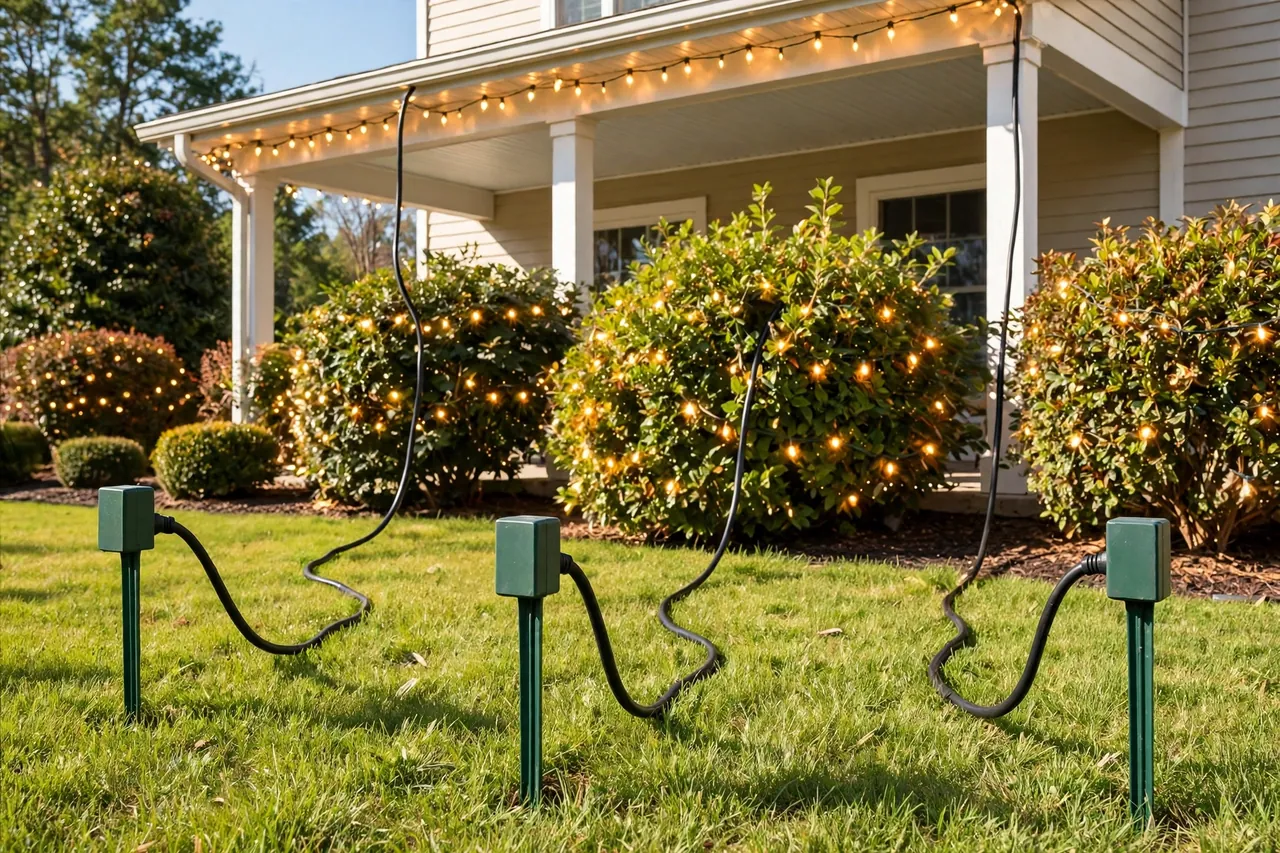
Splitters and multi-outlet stakes help only when you use them correctly. A splitter at the outlet starts separate runs; it does not extend one chain. Each branch off the splitter is its own chain with its own label limit, and the combined watts of all branches still count against the circuit. Plug a splitter into a GFCI-protected outdoor outlet, keep its connections dry, and never stack splitters into splitters.
Solar-powered sets deserve a special note. Many solar decorations run on their own panels and batteries rather than your house power, so you cannot chain them into a plug-in string the same way. If you love that look, our guide to solar Christmas outdoor decorations explains how to plan them as separate displays alongside your plug-in lights.
When You Need More Lights: Separate Runs Done Right
Most displays outgrow one chain, and that is normal. The fix is not a longer chain. The fix is more chains, each within its own limit, fed from the outlet or from separate outlets. Follow these steps in order.
- Count your total strands and group them into chains that each respect the label limit for that model.
- Add up the watts for every chain, plus anything else sharing the circuit, and confirm the total stays under the 80 percent circuit ceiling.
- Start each chain at the outlet, a splitter, or a separate outlet, never by extending a chain that already hit its limit.
- Use outdoor-rated, GFCI-protected power for every outdoor chain, and keep every connection dry and off the ground.
- Switch the whole display on and walk it: check for dim far-end bulbs, warm plugs, buzzing, or flicker before you leave it running.
- Put the display on a timer so it switches off overnight and while you are out, and unplug it before you change any bulb.
This approach also makes troubleshooting easier. When one run misbehaves, you can unplug that run alone while the rest of the display keeps shining.
For very large displays, plan the runs before you hang anything. Our guide to large Christmas decorations helps you think through scale, and the math in this article tells you how many separate runs that scale will need.
Warning Signs You Have Gone Too Far
Your lights will often warn you before they fail, if you know what to watch for. Check for these signs every time you switch the display on for the first few nights.
- Warm or hot plugs, cords, or connectors. Warmth at a plug means the connection is straining, so unplug that run and reduce it.
- Bulbs that dim toward the far end of a chain. Dimming signals voltage drop from a chain that is too long for its wire.
- Flicker, buzzing, or a burning smell. Switch the run off at once, unplug it, and do not reuse it until you find the fault.
- A fuse that blows more than once. A blown fuse signals overload or a short, so replace the fuse only after you reduce the load and inspect the strand.
- A breaker that trips when the display starts. Treat the trip as a stop sign, split the load across circuits, and check for damage.
- A GFCI that keeps tripping outdoors. Moisture or damaged insulation may cause the trip, so dry and inspect the run before you reset it again.
Never tape over a fuse, replace a fuse with a higher rating, or remove a fuse to keep a display running. The fuse is the cheapest safety device in the whole setup, and defeating it removes the protection that stands between an overload and a fire.
Common Mistakes to Avoid
Mixing incandescent and LED strands in one chain tops the mistake list. The two types draw power differently, and a mixed chain can stress LED drivers and confuse the rating entirely. Keep each chain to one type and one model.
Stapling or nailing through cords comes next. Metal fasteners slice insulation and create shorts, so use plastic light clips made for the job instead. The same rule applies to sharp hooks and tight wire ties.
Leaving damaged sets in service is another quiet risk. A strand with cracked insulation or a loose socket may still light up, but it has already lost part of its protection. Retire it. Likewise, never use indoor lights outside, never overload a power strip past its own rating, and never leave a display running while you sleep or leave the house without a timer.
Finally, do not trust memory over the tag. If you stored last year’s sets without their boxes, read the cord tag before you chain them. If the tag is gone, run the set alone or replace it.
Lanterns and other glowing accents can round out a display without adding to a light chain at all. See our ideas for Christmas lantern decorations if you want warm light in spots where another long chain would be a bad idea.
Related Guides
Light-Up Christmas Decorations — plan glowing displays before you size the runs.
Solar Christmas Outdoor Decorations — add solar displays that run apart from plug-in chains.
Christmas Lantern Decorations — warm accents that do not extend a light chain.
Large Christmas Decorations — scale up with separate runs, not longer chains.
Frequently Asked Questions
How many strands of Christmas lights can you connect together?
There is no single safe number for every set. Many incandescent mini-light sets allow 3 to 5 strands end to end, while many LED sets allow far more, but your set’s tag gives the final answer. Check the label, confirm the wattage math, and stop at whichever limit comes first.
Can you connect more than three strands if they are LED?
Often yes, because LED strands draw far less power and run cooler than incandescent strands. Many LED models carry label limits well above three strands. Still, read your exact model’s tag, because smart, dimmable, or high-wattage LED sets can cap their chains much lower.
Can you mix incandescent and LED strands in one chain?
No, do not mix them. Incandescent and LED strands draw power differently, and a mixed chain can stress LED drivers and void the rating for both sets. Keep each chain to one bulb type and one model, and start a separate chain for the other type.
What happens if you connect too many strands?
The chain can overheat its thin wires, blow its fuse, trip the breaker, or dim the far-end bulbs through voltage drop. In the worst case, overheated wiring can melt insulation and start a fire. If plugs feel warm or bulbs dim, unplug the run and shorten it at once.
Does a heavy-duty extension cord let you connect more strands?
No. A heavy-duty cord delivers power safely to the first strand, but it cannot change the light string’s own rating or cool its thin internal wires. The chain limit stays the same. Use the cord to start a separate run instead of extending a chain past its limit.
How many Christmas lights can you put on one circuit?
Stay at or below 80 percent of the circuit’s capacity for continuous loads: 1,440 watts on a standard 15-amp circuit and 1,920 watts on a 20-amp circuit at 120 volts. Add up every light chain plus anything else sharing that circuit, and split the display across circuits if the total runs high.
Disclaimer: This guide gives general safety information, not electrical advice for your specific home. Homes, wiring, and local codes vary, so call a qualified electrician if you feel unsure about a circuit, a GFCI outlet, or any sign of damage. Never work on live wiring, and never bypass a fuse, breaker, or GFCI device.
Now you know the real rule, and it is simpler than the arguments online suggest: read the tag, run the watts, respect the circuit, and split the display into separate runs when one chain is not enough. Check your labels tonight, sketch your runs on paper before you hang anything, and enjoy a display that shines bright all season without a single warm plug or tripped breaker.