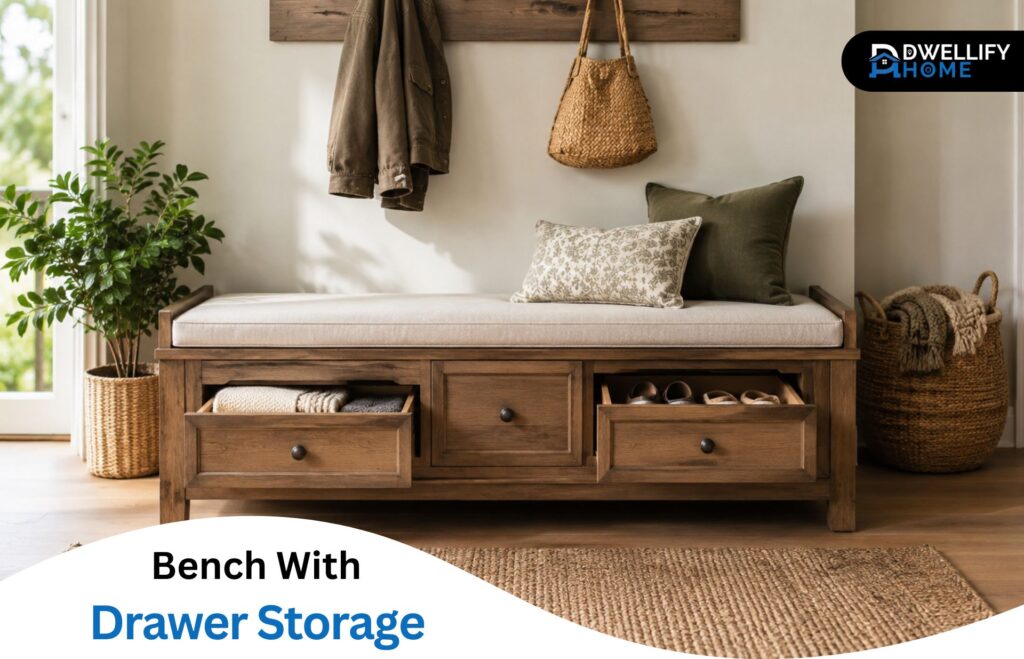
A bench can make a messy room feel more intentional in one move — but only when the storage actually matches the way the space is used. The mistake I see most often is choosing a bench with drawer storage because it looks tidy in a photo, then realizing the drawers are too shallow, too awkward to open, or wrong for the items that pile up every day.
A good storage bench should do three jobs at once: give you a comfortable place to sit, hide or organize clutter, and fit the room without making movement harder. That sounds simple, but the right choice changes depending on whether it’s going in an entryway, bedroom, mudroom, dining nook, or family room.
Short Definition
A bench with drawer storage is a seating bench with built-in pull-out drawers, chosen to hide clutter, organize small items, and add practical seating in entryways, bedrooms, mudrooms, and dining areas.Dwellify Home Mission:
Dwellify Home helps readers make practical, stylish, and informed decisions about their homes, gardens, and properties with clear guidance that fits real-life spaces.
Quick Answer: Who Should Choose a Bench With Drawer Storage?
A bench with drawer storage is best for someone who wants hidden, organized storage for smaller everyday items while keeping a usable seat on top. It works especially well in entryways, bedrooms, mudrooms, dining nooks, and small homes where loose items need a clear place to land.
Drawers are especially helpful when you want separation. Shoes in one drawer, dog leashes in another, hats and gloves in a third — that kind of order is much easier with drawers than with one big lift-top compartment.
What This Guide Will Help You Decide
This guide will help you choose the right storage bench by room, size, drawer layout, material, comfort, and daily use. By the end, you should know whether drawers are the right storage type for your space, what size to look for, and what details are worth checking before you buy.
Quick Comparison Guide
| Storage Type | Best For | Watch Out For |
| Drawer bench | Hidden, divided storage for shoes, linens, toys, and accessories | Needs front clearance to open drawers |
| Lift-top bench | Blankets, pillows, bulky seasonal items | Less convenient for daily access |
| Open cubby bench | Shoes, bags, and grab-and-go entryway storage | Looks less tidy if items are mismatched |
| Drawer-plus-shelf bench | Mixed storage needs in entryways and mudrooms | Can look busy in smaller spaces |
Key Benefits and Uses
- Adds seating and storage in one piece of furniture
- Keeps entryways, bedrooms, and mudrooms looking tidier
- Helps separate shoes, linens, toys, pet gear, and accessories
- Works well in small spaces when depth and drawer clearance are measured carefully
- Offers a cleaner look than open shelves or cubbies
What Is a Bench With Drawer Storage, and When Does It Make Sense?
A bench with drawer storage is a seating bench with one or more pull-out drawers built into the base. It makes sense when you need concealed storage that stays divided and easy to access, especially for shoes, accessories, linens, toys, pet items, or small household overflow.
The main advantage is control. Instead of lifting a seat and digging through one large box, you can assign each drawer a job.
Storage Bench vs. Shoe Bench vs. Drawer Bench
A storage bench is the broad category. It may have drawers, cubbies, baskets, shelves, cabinets, or a lift-top seat.
A shoe bench is usually designed for entryways and hallways, with storage sized around footwear. Some shoe benches use open shelves or cubbies, while others use drawers or tilt-out compartments.
A drawer bench is more specific: the storage pulls forward from the base. That makes it useful beyond shoes, especially in bedrooms, living rooms, playrooms, and dining areas.
When Drawers Work Better Than Lift-Top Storage or Open Cubbies
Drawers work better when you want items hidden but still easy to reach. They’re good for smaller things that benefit from separation: socks, gloves, scarves, keys, pet supplies, placemats, chargers, toys, or folded linens.
Lift-top benches are better for bulky items like blankets. Open cubbies are better for shoes that need air and fast access. Drawers sit between the two: neater than cubbies, more organized than one large storage chest.
When Drawers Are Not the Best Storage Choice
Drawers are not ideal when you need to store tall boots, large blankets, oversized sports gear, or anything damp that needs airflow. They also need room in front to open fully.
In a very narrow hallway, a drawer bench may technically fit but still be annoying to use. The bench has to fit both closed and open.
Start With the Problem You Need the Bench to Solve
The right bench starts with the mess, not the style. Before looking at finishes or cushions, decide what the bench needs to hold, who will use it, how often the drawers will open, and whether the stored items need to be hidden, aired out, or grabbed quickly.
That one decision prevents most buying mistakes.
For Shoes, Keys, Bags, and Everyday Entryway Clutter
Entryways collect small chaos: shoes, keys, mail, bags, umbrellas, reusable totes, leashes, and winter accessories. A drawer bench can calm that down, but only if the drawers match the items.
For shoes, check interior drawer height and depth carefully. Sneakers and flats are easier than boots. For keys and small accessories, shallow drawers are useful because things don’t disappear under a pile.
For Linens, Throws, and Bedroom Overflow
In a bedroom, a storage bench with drawers works well at the foot of the bed or under a window. It’s better for folded items than bulky bedding.
Use it for pillowcases, lightweight throws, sleepwear, slippers, books, or seasonal accessories. For large comforters, a lift-top storage bench usually makes more sense.
For Toys, Pet Gear, and Family Drop Zones
Family spaces need storage that people will actually use. Drawers can work well for toys, pet brushes, leashes, treats, craft supplies, or small games.
The key is ease. A drawer that sticks, feels heavy, or requires careful alignment will not survive a busy household routine. Smooth slides matter more here than fancy handles.
For Dining Linens, Placemats, and Kitchen-Nook Storage
A dining bench with drawer storage can be useful in a breakfast nook, banquette-style seating area, or compact kitchen corner. It’s a smart place for placemats, napkins, candles, serving pieces, or kids’ table supplies.
Just avoid using drawers for anything you need during every meal unless they’re easy to reach without asking someone to stand up.
How to Choose the Right Size Without Blocking the Room
Choose a bench size by measuring the wall, walkway, seat comfort, and drawer pull-out space — not just the empty floor area. A bench that fits on paper can still block a door swing, crowd a hallway, or become impossible to use once the drawers are open.
Measure the bench as a moving object, not a static one.
Width: How Many People Need to Sit?
A narrow bench may work for one person putting on shoes. A wider bench is better for two people, a bedroom footboard area, or a mudroom where bags land beside seated space.
In an entryway, width should also leave breathing room around doors, trim, outlets, coat hooks, and nearby furniture. Bigger is not always better if it turns the entry into a pinch point.
Depth and Height: What Feels Comfortable in Daily Use?
Bench depth affects comfort and traffic flow. A deeper bench feels better for sitting, but it can make a hallway feel tight.
Seat height matters too. A bench that is too low feels awkward for putting on shoes. A bench that is too high may look more like a console than a seat. For cushioned benches, remember that the cushion adds height.
Drawer Clearance: The Measurement Buyers Often Forget
Drawer clearance is the open space required in front of the bench so the drawers can pull out. This is one of the easiest details to miss.
Before buying, check the drawer depth and imagine the drawer fully open. Then ask: can someone still stand there, open the front door, pass through the hallway, or reach the closet?
Walkway Space: How to Keep Hallways and Entryways Usable
A bench should never make the room harder to move through. In tight entryways, a shallow bench with smaller drawers may be better than a deep bench with more storage.
Look at the path people naturally take. The bench should support that path, not interrupt it.
Which Drawer Layout Fits Your Routine Best?
The best drawer layout depends on what you store and how often you reach for it. One large drawer is better for bulkier items, while multiple smaller drawers are better for sorting daily accessories, shoes, pet supplies, linens, or children’s belongings.
Drawer layout is where function usually wins or fails.
One Large Drawer vs. Two or Three Smaller Drawers
One large drawer gives you flexibility. It can hold bigger items and odd shapes, but it can also become a junk drawer quickly.
Two or three smaller drawers create categories. This works well in shared spaces: one drawer for shoes, one for accessories, one for pet gear. Smaller drawers also make it easier to assign storage by person.
Drawer-Only Bench vs. Drawer-Plus-Shelf Design
A drawer-only bench looks cleaner and hides more visual clutter. It’s a good choice for bedrooms, living rooms, and polished entryways.
A drawer-plus-shelf design is more practical when some items need air or quick access. For example, shoes can sit on an open lower shelf while keys, socks, and leashes stay hidden in drawers.
Hidden Storage vs. Grab-and-Go Storage
Hidden storage makes a room look calmer. Grab-and-go storage makes busy routines easier.
The best choice depends on the room. In a formal entry, hidden drawers may be worth it. In a mudroom used by kids every morning, fully hidden storage may be too slow unless the drawers are smooth and clearly assigned.
Shallow Drawers vs. Deep Drawers: What Actually Fits?
Shallow drawers are useful for flat or small items: gloves, scarves, remotes, documents, napkins, or pet accessories. Deep drawers are better for shoes, toys, bulky linens, or bags.
The danger with deep drawers is clutter stacking. The danger with shallow drawers is disappointment when shoes or folded items don’t fit.
Best Rooms for a Bench With Drawer Storage
A bench with drawer storage works best in rooms where seating and concealed organization are both useful. The strongest placements are entryways, mudrooms, bedrooms, living rooms, playrooms, dining nooks, and kitchen corners where small items need a tidy, reachable home.
The room decides the storage job.
Entryway or Hallway: Best for Shoes, Bags, and Quick-Access Items
In an entryway, a drawer bench creates a landing zone. It gives you somewhere to sit, drop a bag, hide accessories, and keep the floor clearer.
Choose a narrow profile for tight halls and a durable finish if shoes, wet umbrellas, or daily bags will touch it often.
Mudroom: Best for Family Gear and High-Traffic Storage
Mudrooms are tougher on furniture than most rooms. Drawers here should feel sturdy, easy to clean around, and simple enough for everyone to use.
For family gear, drawer labels or assigned drawers can help. The goal is not just storage — it’s repeatable organization.
Bedroom: Best at the End of the Bed or Under a Window
At the end of the bed, a drawer bench can hold light linens, pajamas, slippers, books, or off-season accessories. Under a window, it can act like a softer window seat with practical storage below.
Match the bench width to the bed and wall so it feels intentional rather than squeezed in.
Living Room or Playroom: Best for Small Items You Want Hidden
In a living room, drawer storage works well for remotes, chargers, game controllers, toys, puzzles, and pet supplies. It keeps the room looking calmer without requiring everything to be stored far away.
For playrooms, choose drawers that children can open safely and easily.
Dining Nook or Kitchen: Best for Linens and Occasional-Use Items
In a dining nook, drawers are best for items you don’t need every few minutes. Think napkins, placemats, small table décor, art supplies, or occasional serving pieces.
For daily dining, make sure drawer access is not blocked by the table.
Materials, Cushioning, and Construction Details That Hold Up
A storage bench holds body weight, drawer movement, and daily bumps, so construction matters. Look beyond the finish and check the frame material, drawer slides, drawer bottoms, handles, seat support, cushion fabric, and overall stability before choosing one.
Pretty benches can fail quickly when the base and drawers are weak.
Solid Wood, Plywood, MDF, and Engineered Wood
Solid wood is often valued for strength, repairability, and long-term character, though it can cost more and may move slightly with humidity. Plywood can be strong when well-built. MDF and particleboard can work for light use, but they’re more vulnerable to moisture and rough handling.
For entryways and mudrooms, durability should carry more weight than looks alone.
Drawer Slides, Handles, Bottom Panels, and Joinery
Drawer slides should move smoothly without scraping or twisting. Full-extension slides are especially useful because they let you reach the back of the drawer.
Check handles for grip, not just style. Look at drawer bottoms too — thin, flexible panels are often the first place a budget bench shows weakness.
Cushions, Upholstery, Leather, and Performance Fabrics
A cushion makes the bench more comfortable, especially for putting on shoes. But fabric choice matters.
In a bedroom, softer upholstery can work beautifully. In an entryway or mudroom, choose something easier to clean, such as performance fabric, leather, faux leather, or a removable cushion cover. Light bouclé may look good, but it can be demanding in a dirty-shoe zone.
Weight Capacity and Stability: What to Check Before Buying
Weight capacity should come from the manufacturer, not guesswork. Check the product details before buying, especially for benches that will be used daily by adults.
Also look for a stable base, solid legs or side panels, and a seat that does not flex when you sit. A bench is still seating first.
How to Match the Bench to Your Home’s Style
Match the bench to your home by repeating the room’s existing lines, materials, and finishes. A drawer storage bench looks most natural when its wood tone, hardware, cushion fabric, and shape connect to nearby furniture, trim, flooring, hooks, mirrors, or cabinetry.
Style should support the room, not fight it.
Modern, Farmhouse, Mid-Century, Shaker, and Built-In Looks
Modern benches usually have clean lines and simple hardware. Farmhouse styles often use painted finishes, wood tops, or paneled fronts. Mid-century designs lean on tapered legs and warmer wood tones. Shaker-style benches feel simple, practical, and timeless.
A built-in look works well in alcoves, under stairs, mudrooms, and window seats.
Backless, Low-Back, or Full-Back Bench: Which Is Most Practical?
A backless bench is easiest to place and works well at the end of a bed, under a window, or against a wall with hooks above it.
A low-back bench feels more finished and comfortable. A full-back bench can be useful in an entryway or mudroom, but it takes more visual space and may limit styling flexibility.
How to Pair the Bench With Hooks, Mirrors, Baskets, or Wall Storage
A bench works harder when the wall above it has a job. Hooks hold coats and bags. A mirror opens the space and gives the entry a finished feel. Wall shelves can hold keys, mail, or décor.
Baskets are useful beside or under benches, but don’t duplicate the drawers unless you truly need extra open storage.
How to Make a Freestanding Bench Look Built-In
A freestanding bench can look built-in when it fits the wall closely, lines up with nearby trim, and connects visually to wall hooks, paneling, shelving, or a mirror.
The simplest trick is alignment. Center it under hooks, match the hardware finish to nearby pieces, and avoid leaving awkward gaps that make the bench look temporary.
A Hands-On Checklist Before You Buy
Before buying, test or inspect the bench the way it will be used at home: sit on it, open every drawer, check for wobble, look at drawer bottoms, inspect the finish, and confirm the dimensions with the drawers fully extended.
A bench should feel trustworthy before it looks charming.
The Sit Test
Sit on the bench the way you actually would. Lean slightly, shift weight, and notice whether the seat flexes, creaks, or feels too narrow.
For an entryway bench, mimic putting on shoes. That tells you more than simply sitting still.
The Slide Test
Open and close each drawer several times. It should move smoothly, not scrape, jam, or tilt.
A drawer that feels irritating in a store or during assembly will feel worse when you’re rushing out the door.
The Wobble Test
Gently rock the bench from side to side. A little movement on an uneven floor can happen, but the frame should not feel loose.
Wobble matters because benches take repeated side pressure as people sit, stand, and shift.
The Finish, Edge, and Drawer-Bottom Check
Run your hand along the edges. Sharp corners, rough seams, or thin finish can be warning signs in high-touch areas.
Look underneath the drawers too. A weak drawer bottom may sag when filled with shoes, toys, or linens.
Signs a Budget Bench May Wear Out Fast
Warning signs include flimsy drawer bottoms, rough slides, loose handles, hollow-feeling panels, thin cushions, exposed staples, uneven legs, and hardware that feels undersized for the drawer.
Budget benches can still be useful, but they should match light-duty expectations.
Common Mistakes That Make a Storage Bench Frustrating
The most common mistakes are choosing drawers that don’t fit the stored items, forgetting drawer clearance, ignoring moisture and odor, buying delicate upholstery for a messy area, and picking a bench for looks before checking comfort, stability, and daily access.
Most frustration comes from small practical details.
Choosing Drawers That Do Not Fit Boots or Bulky Items
Boots, high-top shoes, thick blankets, and large toys often need more height than people expect. Always check interior drawer dimensions, not just the outside bench size.
A large-looking bench can still have surprisingly shallow drawers.
Forgetting Moisture, Odor, and Dirty-Shoe Realities
Closed drawers can trap dampness and odor if shoes go in wet. For everyday footwear, open shelves, ventilated fronts, or a drawer-plus-shelf design may work better.
For closed shoe drawers, store only dry shoes and clean the drawer interiors regularly.
Buying a Bench That Looks Good but Blocks the Room
A bench that interrupts traffic will become annoying fast. This happens often in narrow halls, small apartments, and entryways with doors opening nearby.
Measure the pathway people use most. Then protect that space.
Choosing Pretty Upholstery That Is Hard to Clean
Soft, pale upholstery can work in a bedroom, but it may struggle in an entryway. Mud, denim dye, pet hair, and everyday dirt are not kind to delicate fabrics.
Use tougher fabric where life is tougher.
Ignoring Assembly Quality and Replacement Parts
Flat-pack benches can be practical, but assembly quality matters. Loose cam locks, misaligned drawers, or missing hardware can affect the whole piece.
Before committing, check reviews for repeated assembly complaints and confirm whether replacement parts are available.
FAQs About Bench With Drawer Storage
What Is a Bench With Storage Called?
A bench with storage is commonly called a storage bench. Depending on the design and room, it may also be called an entryway bench, shoe bench, mudroom bench, bedroom storage bench, drawer bench, ottoman bench, window seat, or banquette with storage.
The name usually changes by use. In an entryway, it’s often called a shoe storage bench. In a bedroom, it may be called an end-of-bed bench with storage.
What Are the Benefits of a Bench With Drawers?
A bench with drawers provides seating and hidden organization in one piece of furniture. The biggest benefits are cleaner floors, divided storage, easier access to small items, and a more finished-looking entryway, bedroom, mudroom, dining nook, or living space.
Drawers also make it easier to give each category its own place.
Are Drawers Better Than Lift-Top Storage?
Drawers are better for organized, frequently used items, while lift-top storage is better for larger, bulkier pieces. Choose drawers for shoes, accessories, linens, toys, and small household items. Choose lift-top storage for blankets, pillows, or seasonal items.
The right choice depends on access. Daily items usually do better in drawers.
Can a Bench With Drawer Storage Work in a Small Entryway?
A bench with drawer storage can work in a small entryway when the bench is shallow enough, the drawers have room to open, and the walkway stays clear. The best small-entry designs use compact drawers, slim profiles, and simple styling.
For tight spaces, avoid oversized cushions, bulky arms, and deep drawers that block the path.
Why Do People Put a Bench at the End of a Bed?
People put a bench at the end of a bed to add seating, soften the room, create a place for dressing, and provide extra storage. A bedroom storage bench can hold light linens, slippers, books, throws, or seasonal accessories while making the bed area feel more complete.
It’s one of the most practical decorative pieces in a bedroom.
Can You Store Shoes in Closed Drawers?
You can store shoes in closed drawers, but they should be dry and reasonably clean first. Closed shoe storage keeps the room looking tidy, but it can trap moisture and odor if wet shoes are stored without airflow.
For daily shoes, ventilated storage or open lower shelves may be easier to maintain.
Does IKEA Sell Benches With Drawer Storage?
IKEA often sells hallway benches, storage benches, shoe benches, and modular units that can function like drawer storage, but product availability changes by country and season. Check the current IKEA website or local store before planning around a specific model. [VERIFY]
IKEA-style solutions can work well for small entryways, but always confirm seat safety and weight limits.
Should I Choose a Cushioned or Wooden Seat?
Choose a cushioned seat if comfort matters, especially for putting on shoes or using the bench daily. Choose a wooden seat if you want easier cleaning, sharper lines, or better durability in a messy entryway or mudroom.
A removable cushion gives you the best middle ground.
Conclusion: Choose the Bench You Will Still Use a Year From Now
The right bench with drawer storage is not just the one that looks good on the product page. It’s the one that fits your room, opens easily, holds the items you actually own, and makes your daily routine smoother.
Start with the storage problem, then check the size, drawer layout, materials, comfort, and clearance. A bench that passes those tests will not just fill a space — it will quietly make the room work better every day.
Disclaimer:
This content is for general informational purposes only. Individual spaces, preferences, budgets, and product performance can vary. For built-ins, structural changes, or safety-sensitive installations, confirm details with a qualified professional or the product manufacturer.