Most people walk into a room, look up, and barely notice the ceiling fan. That’s the problem. For years, fans were treated like appliances you tolerate, not fixtures you show off. But the ones I’ve installed for clients over the past decade tell a different story — a well-chosen fan can do as much for a room as a good light fixture or a piece of art.
Unique ceiling fans sit in that sweet spot where design meets function. They move air properly, they last, and they give a room a bit of personality that generic five-blade builder-grade fans never will. A fan that looks like it belongs in your space changes how the whole room feels.
This guide walks through fifteen styles I keep coming back to, plus the practical details that actually matter when you’re picking one.
The Short Answer
Unique ceiling fans are statement-driven fixtures that combine distinctive design — sculptural blades, bold finishes, or hybrid chandelier styles — with modern airflow performance. Homeowners choose them to replace generic fans and turn a functional appliance into a true design focal point.
Mission Statement
At Dwellify Home, we help homeowners make confident, practical, and stylish decisions about the spaces they live in. From modern home upgrades to garden, outdoor, and property insights, our goal is simple — deliver honest, well-researched guidance that makes every corner of your home feel more like you.
What Actually Makes a Ceiling Fan “Unique”
A fan earns the word “unique” when something about it pulls your eye upward the moment you walk in. That might be a blade shape you don’t usually see — curved, sculptural, or cut from real wood. It might be a finish that doesn’t blend into the ceiling, like matte black, aged brass, or a soft indigo.
Sometimes it’s a hybrid design, like a fan built into a chandelier or a pendant. Other times it’s the silhouette — long-neck belt-driven fans, windmill shapes, oversized eight-blade profiles, or tiny compact fans meant for nooks.
Smart tech plays a role too. Integrated LED lighting with adjustable color temperature, app control, and whisper-quiet DC motors all push a fan out of “standard” territory. The best ones combine a few of these traits instead of relying on just one gimmick.
Quick Style Comparison Guide
| Style Category | Best For | Standout Feature |
| Modern & Minimalist | Contemporary homes | Matte black, integrated LED |
| Fandelier | Dining rooms, foyers | Chandelier-fan hybrid |
| Farmhouse & Rustic | Wood-toned interiors | Windmill or wood-blade design |
| Industrial Caged | Lofts, bars, kitchens | Exposed bulbs, metal cage |
| Coastal & Tropical | Patios, sunrooms | Palm-leaf or nautical blades |
| Luxury & Glam | Statement living rooms | Brass, crystal, polished finishes |
Key Benefits at a Glance
- Replace a generic builder-grade fan with something worth looking up at
- Quieter operation with modern DC motors
- Integrated tunable LED lighting reduces the need for extra fixtures
- Smart and voice-control options for daily convenience
- Designs that match specific interior styles instead of clashing with them
- Real airflow performance paired with visual impact
15 Unique Ceiling Fans That Blend Statement Design With Everyday Comfort
1. Sculptural Curved-Blade Modern Fan
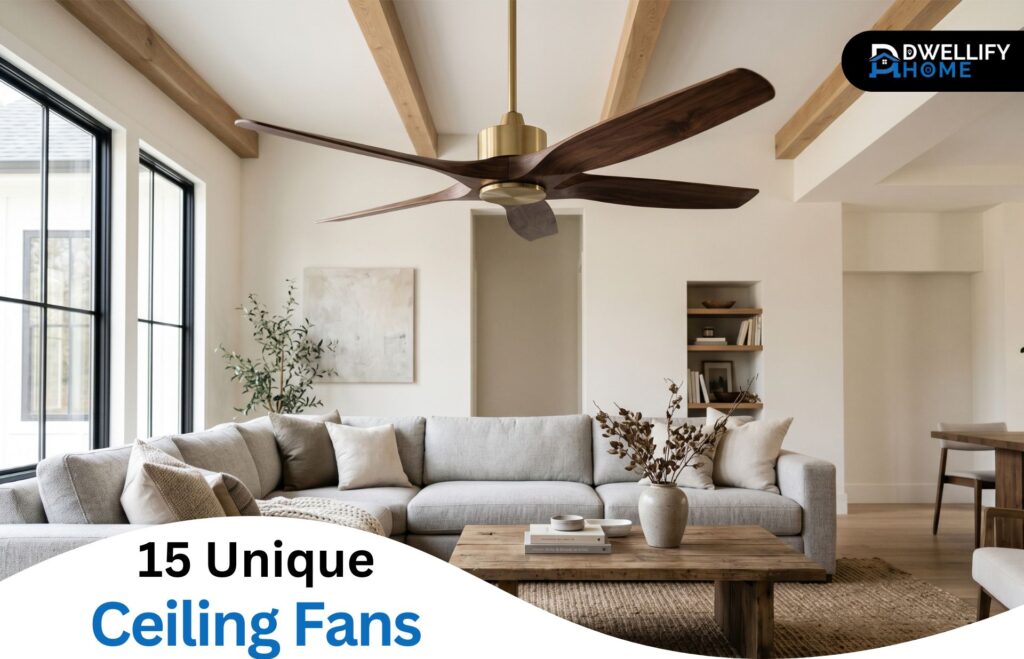
These have three long, twisted blades that look almost like an art piece at rest. The curves aren’t just for looks — they push air smoothly with less turbulence, which means less of that “buzzing” feel in the room.
2. Matte Black Minimalist Fan With Integrated LED
A flat black housing with a built-in light panel is my go-to recommendation for modern interiors. It disappears into dark ceilings and stands bold against white ones. Low drama, high impact.
3. Brass & White Designer-Favorite Statement Fan
The brass-and-white combo has quietly taken over design-focused homes. It reads lighter than bronze and warmer than chrome. Works beautifully in bedrooms, dining rooms, and softer modern spaces.
4. Fandelier — The Chandelier-Fan Hybrid
Fandeliers give you the drama of a chandelier and the airflow of a fan. The better ones hide the blades behind a fabric shade or glass so the fan “disappears” when it’s off. Ideal above dining tables or in two-story foyers.
5. Palm-Leaf Tropical Ceiling Fan
Real or faux palm-leaf blades bring a resort feel to sunrooms, covered patios, and coastal homes. These fans also tend to move a lot of air because of their wide blade surface.
6. Industrial Caged Fan With Edison-Style Bulb
A metal cage around the blades and an exposed filament bulb gives you that warehouse-meets-loft look. Great for lofts, home bars, garages converted into living space, and industrial kitchens.
7. Belt-Driven Long-Neck Vintage Fan
Brewmaster-style belt-driven fans have that old-world, turn-of-the-century charm. One motor powers two fans connected by a visible belt. I install these mostly in bar areas, libraries, and spaces with exposed beams.
8. Windmill-Style Farmhouse Fan
Multi-blade windmill fans lean heavy into rustic and modern-farmhouse interiors. Eight to twelve narrow blades, galvanized metal finishes, sometimes a small caged light in the center — very distinctive overhead.
9. Oversized 8-Blade Statement Fan
For rooms with tall ceilings, a large eight-blade fan does something a standard fan can’t — it fills the vertical space. These are less about raw airflow and more about presence.
10. Mid-Century Aviator-Style Fan
The aviator look — a wide central propeller with a simple spindle — suits mid-century and transitional rooms. Clean, sleek, and understated but clearly not your average fan.
11. Mini Compact Fan for Small Nooks
Under-30-inch fans exist for a reason. Laundry rooms, walk-in closets, small home offices, and reading nooks all benefit from a small fan that doesn’t dominate the ceiling.
12. Wood-Blade Rustic Fan With Natural Finish
Real wood blades — or convincing wood-grain composites — add warmth that painted or plastic blades just can’t match. Pairs well with exposed beams, wood floors, and earthy color palettes.
13. Smart Wi-Fi & Voice-Controlled Designer Fan
Unique ceiling fans with lights and remote access aren’t a novelty anymore. Voice control, app scheduling, and integration with smart home systems are standard in the better-designed fans now. Convenient, especially in bedrooms and great rooms.
14. Coastal & Nautical Outdoor Ceiling Fan
Wet-rated fans with rope detailing, weathered wood blades, or ship-wheel silhouettes bring coastal character to patios and porches. Pick one with stainless hardware if you’re anywhere near salt air.
15. Retro Color-Pop Fan in Bold Hues
Indigo blue, blush pink, sage green, mint — manufacturers have finally moved past black, white, and bronze. A color-pop fan works best when the rest of the room is neutral, so the fan becomes the focal point.
Choosing the Right Unique Ceiling Fan for Each Room
Unique Ceiling Fans for the Living Room
Living rooms give you the most freedom because you’ve got space, ceiling height, and plenty of design context. Sculptural, oversized, or mid-century pieces shine here. Aim for a blade span of 52 to 60 inches for most living rooms — bigger if the room opens into a dining area.
Unique Ceiling Fans for the Bedroom
Bedrooms need quiet first, style second. A DC motor is worth the extra cost because you’ll hear every click and hum at 2 a.m. otherwise. Fandeliers, brass-and-white fans, and mini compact options all work well depending on room size. If you’re leaning toward luxury ceiling fans for the bedroom, pick finishes that match your existing hardware rather than fighting it.
Unique Ceiling Fans for High Ceilings and Great Rooms
Tall ceilings need a longer downrod and a larger blade span. A small flush-mount fan twelve feet up looks lost and barely moves air where you need it. Oversized eight-blade fans, large aviator styles, and dramatic fandeliers all pay off in great rooms because you finally have the vertical space to let them breathe.
Unique Outdoor Ceiling Fans for Patios and Decks
Rating matters more than style outdoors. Damp-rated is fine for covered patios; wet-rated is required for anywhere rain can hit the fan. Coastal, tropical, and industrial styles translate well outdoors — just check that hardware is corrosion-resistant if you’re near humidity or salt water.
Unique Ceiling Fans With Lights vs. Without Lights
The decision comes down to how the room is already lit. Rooms with recessed lighting, pendants, or floor lamps usually look cleaner with a lightless fan — the ceiling stays visually calm. Rooms that depend on the fan as the main light source need integrated LED, ideally with tunable color temperature so you can shift from warm evening light to cooler daytime task light.
Unique ceiling fans with lighting also give you a two-in-one fixture in rooms where ceiling real estate is tight. Dining rooms, kitchens, and small bedrooms benefit most from this combo.
Matching a Unique Ceiling Fan to Your Interior Style
Modern and Contemporary Spaces
Clean geometry, minimal hardware, and integrated lighting define modern fans. Curved three-blade designs, matte black finishes, and hidden-blade fandeliers all fit here. Avoid ornate scrollwork or heavy shades — they’ll fight the room.
Farmhouse, Rustic, and Industrial Interiors
Windmill fans, wood-blade rustic fans, and caged industrial fans are made for these interiors. Look for galvanized metal, distressed wood, bronze, or matte black finishes. Edison-style bulbs pull the whole look together.
Coastal, Boho, and Tropical Interiors
Palm-leaf blades, rope-wrapped downrods, woven rattan accents, and weathered finishes all belong in this category. White housings with natural blades work especially well in sunrooms and coastal cottages.
Luxury and Glam Interiors
Crystal-accented fandeliers, polished nickel finishes, and gold-and-white combinations define this category. Luxury ceiling fans for the living room usually double as chandeliers, which is the right move when the fan is the room’s centerpiece.
Features That Separate a Designer Fan From an Ordinary One
DC vs. AC Motors and Why It Matters
DC motors are quieter, smaller, use roughly 70% less energy, and give you more speed settings. AC motors are cheaper upfront but louder and less efficient over time. For bedrooms, offices, and any room where you’ll run the fan for hours, DC is the better long-term choice.
Blade Pitch, CFM, and Real Airflow Quality
Blade pitch is the angle of the blade. A steeper pitch — around 12 to 15 degrees — moves more air. CFM (cubic feet per minute) tells you how much air the fan actually moves. A pretty fan with a low CFM rating is a decoration, not a fan. Aim for at least 4,000 CFM on high for most rooms.
Tunable LED Lighting and Smart Remote Controls
Tunable LEDs let you shift the color temperature from warm to cool without swapping bulbs. Smart remotes, wall controls, and app integration take the guesswork out of daily use. Once you’ve lived with voice-controlled fans, flipping a pull chain feels ancient.
How to Size and Mount a Unique Ceiling Fan Correctly
Room size determines blade span. Small rooms under 100 square feet do fine with 36 to 44-inch fans. Medium rooms up to 225 square feet need 44 to 52-inch blades. Large rooms up to 400 square feet call for 52 to 60-inch fans, and anything larger needs 60-plus inches.
For mounting, the bottom of the blades should sit at least 7 feet above the floor and ideally 8 to 9 feet for proper air movement. Low ceilings need flush-mount or hugger fans. Standard 8-to-9-foot ceilings work with a short downrod. High and vaulted ceilings need a longer downrod, sometimes 24 to 72 inches, to drop the fan to usable height.
Sloped ceilings need an angled mount adapter, which most quality fans include or sell separately. This one detail gets missed constantly and leads to wobbling fans and frustrated homeowners.
Finding Luxury and Unique Ceiling Fans Without Overspending
Clearance sections from major fan brands are the first place I check. Manufacturers rotate finishes and styles every year, and last season’s fan often drops 30 to 50%. Unique ceiling fans on clearance aren’t lower quality — they’re last year’s colorway.
Outlet pages from Hunter, Casablanca, Minka Aire, and Fanimation regularly carry statement pieces at a real discount. Direct-to-consumer fan retailers also run quieter sales than the big box stores. Sign up for email lists from two or three specialty fan stores and you’ll see the real prices before the general public does.
Mid-range DC-motor fans in the $250 to $450 range now rival what used to cost twice as much. You don’t need to spend $900 to get a statement fan unless you specifically want a luxury brand.
Common Mistakes to Avoid When Buying a Statement Ceiling Fan
The biggest mistake I see is buying a fan that’s too small for the room because the buyer picked based on looks alone. A 42-inch fan in a great room looks like a decoration and moves almost no air.
The second is ignoring ceiling height. A long downrod on a 9-foot ceiling drops the fan too low and makes the room feel cramped. A flush mount on a 14-foot ceiling puts the fan so far up that it’s pointless.
Other common errors:
- Choosing a pull-chain fan when the room would work better with a remote or smart controls
- Picking a finish that clashes with existing hardware, cabinet pulls, or door handles
- Overlooking noise — cheap AC motors hum, and you’ll notice in quiet rooms
- Installing an indoor-rated fan on a covered porch, which voids the warranty the first humid summer
- Forgetting about blade clearance from walls; blades should sit at least 18 to 24 inches from the nearest wall
Frequently Asked Questions About Unique Ceiling Fans
Are unique ceiling fans worth the higher price?
Usually yes, if you’re replacing a generic builder fan in a room you spend real time in. The better motors last longer, run quieter, and move more air. The design payoff is a bonus on top of the functional upgrade.
Do unique ceiling fans cool as well as regular ones?
A well-designed unique fan often cools better because manufacturers pair statement designs with modern DC motors and engineered blade pitch. Check the CFM rating — that number tells you the truth regardless of how the fan looks.
What ceiling fans do interior designers actually use?
Most designers I know lean toward matte black modern fans, brass-and-white statement pieces, and fandeliers. They avoid pull chains, overly ornate Tuscan-style fans, and anything with a boob-light glass shade.
Can a unique ceiling fan work on a low ceiling?
Yes — look for flush-mount or low-profile designs specifically. Many unique styles including fandeliers, minimalist disc fans, and compact three-blade fans come in low-profile versions for 8-foot ceilings.
Which unique ceiling fans are best for high ceilings?
Oversized eight-blade fans, large aviator-style fans, and dramatic fandeliers with extended downrods work best. The key is bringing the fan down to the 8-to-9-foot sweet spot where it actually moves air you can feel.
Turning a Functional Fixture Into a Design Moment
Changing out a plain fan for something with character is one of the quietest but most satisfying upgrades you can make to a room. You’ll feel the better airflow, you’ll hear less noise, and you’ll catch yourself looking up at the ceiling every so often — which used to never happen.
The goal isn’t to buy the flashiest fan you can find. It’s to pick one that fits the room, fits your style, and does its job without reminding you it exists. Done right, unique ceiling fans stop being appliances and start being part of the design — which is exactly where they belonged all along.
Disclaimer
This article is intended for general informational purposes only. Product recommendations, styling tips, and buying suggestions are based on common design principles and real-world observations. Individual preferences, room conditions, and requirements may vary, so readers are encouraged to evaluate their own space, needs, and budget before making a final decision.